New Renault Twingo 2026 review: a brilliant electric city car
The new Renault Twingo EV is clever, good-looking and a delight to drive


Verdict
Renault has built a fun, cleverly packaged and deeply desirable little car that appeals on so many levels. A touch more high-speed refinement might broaden its abilities, but compared with its direct competitors, there are few that outperform the Renault Twingo in terms of driving pleasure or value for money. Once again Renault has created a real-world electric car that pulls at the heartstrings, rather than purse strings.
Whether you like small French hatchbacks or not, the all-new Twingo is a very interesting proposition from Renault. Not only does it help democratise electric cars with a magical sub-£20,000 price tag, but it will also answer the question of whether a European brand can design, engineer and develop a fresh model to a Chinese-style time scale. This is the 100-week car… let’s see if it delivers.
Firstly, the Twingo’s package is quite remarkable in itself. Including the cost of European manufacturing and the expense of a battery pack, Renault is still aiming to bring this city-sized EV to the UK from less than £20,000. In fact, ‘Significantly under’ £20,000, we’re told.
This isn’t new ground, though. For comparison, the smaller and technically simpler Leapmotor T03 and Dacia Spring both sit at close to £16,000, while the BYD Dolphin Surf, with its larger body and more sophisticated interior, costs just over £18,000. But these are all based on existing and rather rudimentary city cars which have, let’s say, limited amounts of desirability.
Used - available now

2026 Toyota
Yaris Cross
38,941 milesAutomaticPetrol1.5L
Cash £17,050
2024 Volkswagen
Golf
38,341 milesManualPetrol1.5L
Cash £15,600
2019 BMW
5 Series
58,865 milesAutomaticDiesel2.0L
Cash £18,400
2023 Volvo
XC40 Recharge
69,742 milesAutomaticElectric
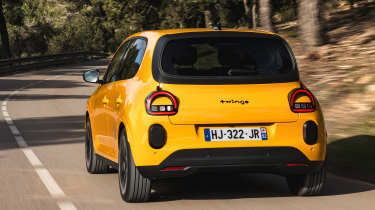
Cash £16,400The Twingo, on the other hand, is positively dripping with appeal from the moment you approach it. Unashamedly based on Patrick Le Quément’s nineties original, this new Twingo is a direct throwback to that car, but executed with ultra-modern touches that bring the design right into the 21st century.
It has a few elements that adapt it to modern tastes, though. All models are only available with five doors, and many variants will run comparatively large 18-inch alloy wheels. In many cases, however, the styling flourishes from the original now feel fully executed, such as the expressive daytime running lights or plastic shroud around the rear glass, which helps with aerodynamics. Much to Renault’s credit, all these changes sync wonderfully with the original model’s character.
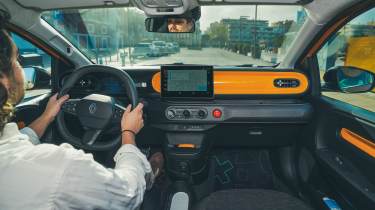
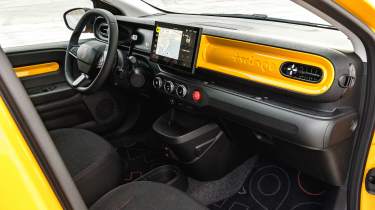
The cabin is a little more generic, but there are still enough Twingo references to know you’re not just in another humdrum city car. The body-coloured inserts on the dash do a lot of heavy lifting in this regard, so too its clever four-seat layout in which the rear ones can be folded independently. This is another reference to the original.
From a technology perspective, the Twingo’s standard 10-inch touchscreen and seven-inch driver’s display do all they need to in order to feel fresh and up to date. Google integration on upper-level models is a particular bonus at this level in the market, matching some of the best infotainment systems in the business for its usability and the voice-activated virtual assistant.
The only thing that drags the cabin down for us is the steering wheel, which is shared with mainstream Renault and Dacia models of a generation or so ago. It’s perfectly usable, but when surrounded by such strong design language, it can’t help but look out of step, aesthetically.
In terms of space, the near monobox shape outside makes the cabin feel bright and airy, but the tall dashboard takes some getting used to. The rear is a little tight for adults, but the rear seats are on rails, so you can balance legroom and boot space to suit your requirements. Push the seats fully forward and the boot is rated at a very impressive 360 litres – which is only around 30 litres less than the larger Renault Clio. Compared with a BYD Dolphin Surf it’s a little cramped, but against the Toyota Aygo it’s streets ahead.
The Twingo still has the run on its competitors when it comes to its technical bits, too. A 27.5kWh lithium iron phosphate (LFP) battery pack helps the Renault post an impressive 163-mile WLTP range figure. For context, the cheapest BYD Dolphin is capable of just 137 miles, and you’ll need to spend closer to £22,000 to achieve a 200-miles range in a higher specification. The £16k Leapmotor, however, does 175 miles with its 37.5kWh battery.
Charging isn’t the Twingo’s strong point, but then the car’s urban focus makes high-speed DC top-ups less of a priority. Renault quotes a 50kW peak, which means that despite the small battery, it’ll still take around 30 minutes to charge from 15 to 80 per cent. This is down on rivals, mind, with the Leapmotor capped at 70kW and the BYD capable of 65kW in its entry-level form.
The battery pack powers a front-mounted 80bhp electric motor, which is capable of getting the car from 0-62mph in 12.1 seconds and onto an 81mph top speed. These figures make the Twingo perfectly capable of keeping up with motorway traffic, although it’s definitely aimed more at urban driving.
That is apparent by the Twingo’s light steering and low-speed driving manners. Around town, Renault has found a satisfying balance between ease and engagement. The steering might be light, but it’s very accurate and makes it simple to manoeuvre the car in tight spaces. The 9.87-metre turning circle itself is also great.
You’ll be disappointed if you’re after a million driving modes, because there is none. A single Eco button is the only variation to the driving experience, and does its best to eke out the most available range by dulling the throttle response and pulling back on the air-conditioning.
A very welcome surprise, though, comes via ride and handling, which feel much more composed and refined than any of the Twingo’s low-cost rivals. The ride at urban speeds is good, even on our test car’s large 18-inch wheels, yet there’s still enough agility for the Renault not to feel leaden or unenthusiastic.
Both of these aspects are driven by the Twingo’s comparatively low kerbweight. At just 1,200kg, this is one of the lightest electric cars on sale, and you can feel it in the way the Twingo adeptly shrugs off potholes and tight corners. There’s no sense at all that this car was developed or engineered in just 100 weeks, nor that some of it’s been done outside of Europe in China, because the latest Twingo feels nothing other than European.
There are some compromises, however. Driving at speed reveals fairly high levels of road noise, and when you’re up at around 50-60mph acceleration can be tedious. It may get to 81mph at full chat, but it’s not going to be particularly comfortable doing so, so if your driving regularly involves motorways, the limitations of the Twingo’s overall capability will be obvious. Compared with its immediate electric rivals, it’s top of the class. But the new hybrid-powered Toyota Aygo X is more capable over a wider spectrum of driving circumstances – but then it is more expensive and isn’t a purely electric vehicle.
So on balance, has Renault nailed the 100-week car first time around? It’s a complicated answer for an uncomplicated car, because the Twingo achieves everything it needs to as a small, affordable and attractive city model. However, a great depth of capability isn’t really a requirement in the ‘A-segment’, so it remains to be seen whether something with a more demanding mandate – such as a next-generation Megane-E – could be achieved with the same fast-track toolset at Renault’s disposal.
In this case, though, the brand has once again proven that it’s capable of building a car with genuine appeal, even without taking the nostalgia and charisma into account. Just like the Renault 5, the Twingo is still an excellent model in context with its rivals. The fact it’s as sweet as anything you might find in a Parisian boulangerie is the icing on the top.
There are only really two questions that remain unanswered. Will the Twingo be quite as charming on a rainy afternoon, stuck in a queue on the M25 when it arrives in the UK early next year? And will all this pale in significance when Volkswagen’s electric city car based on the ID.Every1 concept arrives in 2027? We’ll have to wait and see.
Did you know you can sell your car through Auto Express? We’ll help you get a great price and find a great deal on a new car, too.
| Model: | Renault Twingo |
| Base price: | £19,000 (est) |
| Powertrain: | 27.5kWh battery, 1x e-motor |
| Transmission: | One-speed automatic, front-wheel drive |
| Power/torque: | 80bhp/175Nm |
| 0-62mph: | 12.1 seconds |
| Top speed: | 81mph |
| Range/charging: | 163 miles/50kW, 15-80% in 30 mins |
| Length/width/height: | 3,789mm/1,720mm/1,491mm |
| On sale: | Q1 2027 |