Suzuki Ignis vs Renault Twingo
Suzuki has taken cues from the crossover class with its new Ignis city car, but is it better than the equally individual Renault Twingo?

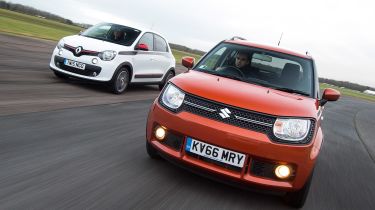
Suzuki has a strong small car tradition, so it’s no surprise to find it has introduced a fashionable new city car that aims to attract a raft of new buyers.
The Ignis takes its cues from rugged crossover models, and the runabout resurrects a badge last seen a decade ago. Featuring chunky proportions and a high-riding stance, the Suzuki aims to cut a dash in the mainstream city car class.
However, it’s not the only urban runaround that does things differently. The Renault Twingo snubs convention with its rear-engined layout, while its range of personalisation options helps it stand out further from the crowd. So which of our offbeat tots takes victory?
Head-to-head
| Model: | Suzuki Ignis 1.2 SZ-T | Renault Twingo Dynamique TCe 90 |
| Price: | £11,499 | £12,055 |
| Engine: | 1.2-litre 4cyl petrol | 898cc 3cyl turbo |
| Power/torque: | 89bhp/120Nm | 89bhp/135Nm |
| Transmission: | Five-speed manual, front-wheel drive | Transmission: Five-speed manual, rear-wheel drive |
| 0-60mph | 9.3 seconds | 11.2 seconds |
| Ttop speed: | 106mph | 103mph |
| Test economy: | 51.9mpg | 55.0mpg |
| CO2/tax: | 104g/km/£20 | 95g/km/£0 |
Suzuki Ignis
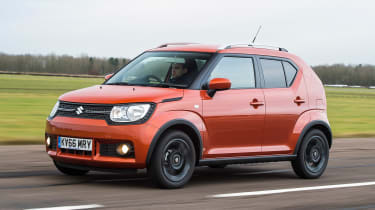
- • For: Strong performance, spacious and versatile interior, plenty of standard kit.
- • Against: Firm suspension, poor Euro NCAP score, high CO2 emissions.
After a decade away, the Suzuki Ignis is back. However, while its boxy predecessor took its design cues from practical MPV models, this all-new machine follows the rugged template set by the latest crossovers.
That means the Ignis is instantly more eye-catching than its rival here, particularly when finished in our test car’s bold £465 Flame Orange metallic paint.
Other visual highlights include the standard silver-finish roof rails and gloss black 16-inch alloy wheels. There’s also a wide range of personalisation options, including body decals and a contrasting black-painted roof panel.
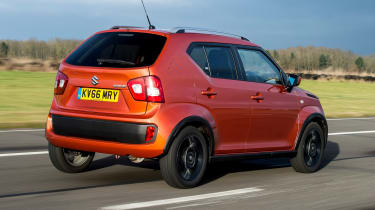
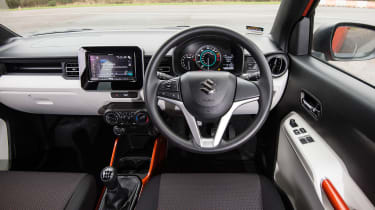
Suzuki has made an equally big effort with the interior, which is attractively styled and for the most part well finished – although our test car featured a poorly fitted gearlever surround. Body-coloured trim inserts create a cheery atmosphere, while standard equipment is generous. All models get air-con and Bluetooth, and our SZ-T adds sat-nav and LED running lamps.
Used - available now

2015 Mercedes
GLA
64,307 milesAutomaticDiesel2.1L
Cash £8,900
2015 Renault
Grand Scenic
139,735 milesManualDiesel1.6L
Cash £1,995
2021 Skoda
Octavia
51,925 milesManualPetrol1.0L
Cash £10,600
2024 Citroen
e-Berlingo
57,511 milesAutomaticElectric
Cash £11,270• Best crossovers on sale right now
Look beneath the SUV-influenced lines and you’ll discover a platform that’s related to the larger Baleno’s. However, the only engine is a 1.2-litre petrol (with or without the firm’s SHVS mild hybrid system) that comes with a choice of five-speed manual or automated manual gearboxes. Flagship SZ5 models can also be specified with ALLGRIP four-wheel drive.
With a kerbweight of 855kg, the Suzuki put on a sprightly display at the track. Its 89bhp naturally aspirated four-cylinder unit gets a bit buzzy when stressed, but the car sprinted from 0-60mph in just 9.3 seconds – 1.9 seconds faster than the Renault and 2.5 seconds up on Suzuki’s claimed time.
Out in the real world, the Ignis delivers zesty performance, and has no trouble keeping up with fast-flowing traffic. This feeling of eagerness is enhanced by the five-speed gearbox, which delivers snappy shifts. There’s also decent refinement, and while the engine noise never disappears at a cruise, it doesn’t feel intrusive.
A firm suspension set-up means the Suzuki isn’t quite as composed as the Twingo, particularly at lower speeds, where it fidgets, hops and crashes over lumps in the road. Mid-corner bumps are also an issue, occasionally knocking the car off line.
However, on smoother roads the Ignis feels more assured and planted. The steering lacks feel and self-centering, but it’s light and direct, helping to make the car a doddle to drive around town.
Testers’ notes:
- • Infotainment: Pioneer system isn’t that intuitive, but it features a large screen and clear graphics. it’s also packed with very useful features.
- • Connectivity: 12V and USB inputs are located ahead of gearlever. Body-colour surround on our car was loose.
- • Materials: Plastics are hard but durable, and look good. Only the SZ5 gets a leather steering wheel.
Renault Twingo
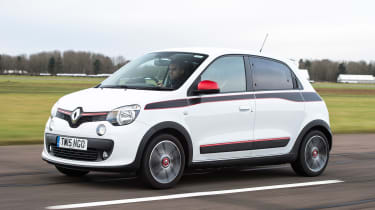
- • For: Punchy engine, tight turning circle, personalisation options.
- • Against: Small boot, not as spacious as class leaders, limited standard kit.
With its bold style, clever packaging and low running costs, the original Twingo turned the small car class on its head when it made its debut in 1993. However, its 2007 replacement was entirely conventional and failed to win the hearts of buyers in the same way. As a result, Renault went bold with the latest car, which was revealed in 2014.
Developed in partnership with Smart, this version features a novel rear-engined, rear-wheel-drive layout. These underpinnings give the car a purposeful wheel-at-each-corner stance, while the use of wider wheels at the rear provides a visual clue to the car’s mechanical make-up.
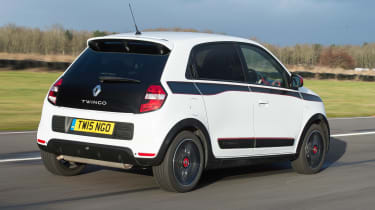
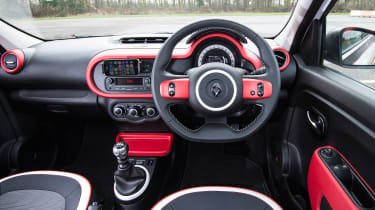
As with the Suzuki, there are a number of customisation options, including our car’s £200 Personality Pack, with exterior decals and red trim inserts for the grille, door mirrors and rubbing strips. The interior can be similarly upgraded, with contrasting colour finishes for the dashboard, steering wheel spokes and air vent surrounds. Decent-quality materials are used throughout, but there’s less kit than in the Suzuki, and features such as the pop-out rear windows feel a little low-rent.
All versions of the Twingo get the same 898cc three-cylinder engine, which is available in either 68bhp naturally aspirated guise or in 89bhp turbocharged form as tested here. Despite an identical power output to the Ignis, the Twingo was nearly two seconds slower from 0-60mph. However, with a 15Nm torque advantage, the Renault turned the tables during our in-gear tests, completing the 50-70mph dash in fifth 3.6 seconds faster, with a time of 11.6 seconds.
Away from the track, the differences aren’t quite as obvious. Not only is there a touch of turbo lag, the smooth and reasonably refined unit suffers from inconsistent surges in power delivery. This performance is further hobbled by the less precise action of the five-speed manual gearbox. On the plus side, the brakes are strong, stopping the Twingo from 70mph in a short 46.1 metres, compared with 50.4 metres for the Suzuki.
Turn into a bend and the Renault feels like a normal city car. Even when you brake hard mid-corner the car doesn’t lose composure and betray its rear-engined layout. In fact, with its skinny front tyres, it’s the front that slides wide first.
On a twisting back road the lifeless steering means the Twingo isn’t as much fun as the Ignis, but its smoother ride makes it more comfortable around town. It’s here that you can also revel in the car’s incredibly tight 8.6-metre turning circle, decent visibility and light controls.
Testers’ notes:
- • Infotainment: Seven-inch touchscreen and R-Link sat-nav are a £600 optional extra. As standard, you get an FM and DAB tuner equipped with Bluetooth.
- • Design: Colourful highlights brighten up the interior of the Twingo as part of the Personality Pack.
- • Material quality: A mix of bright colours and good materials is pleasant, but the cabin has no rev counter.
Verdict
First place: Suzuki Ignis
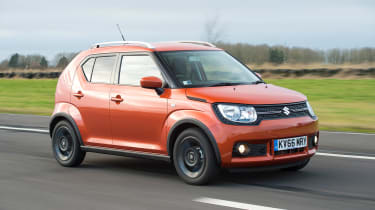
The boldly styled Ignis is a welcome addition to the crowded city car class. It doesn’t have the dynamic polish of the Skoda Citigo – especially the firm ride – but its blend of versatility, equipment, strong performance and value sees it finish ahead of the Twingo here. Optional Safety Pack is a must, though.
Second place: Renault Twingo
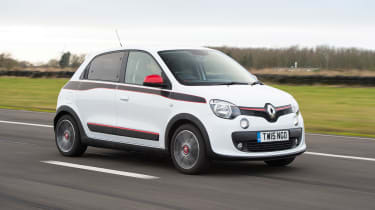
If you spend most of your time in town, then the nimble and compact Twingo makes a lot of sense. And while it’s not quite as accomplished on the open road as the Ignis, it’s still capable and composed. However, it’s not nearly as practical as its rival here, nor as well equipped.