Toyota Yaris Cross review
The Toyota Yaris Cross is cheap to run and surprisingly good to drive, but an EV will offer lower running costs if that’s your main requirement


Our opinion on the Toyota Yaris Cross
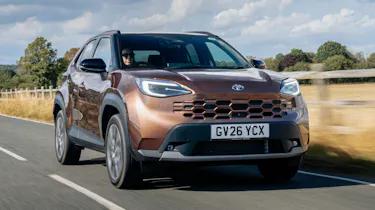
The Toyota Yaris Cross is now half a decade old, but exorbitant petrol prices mean it should, in theory, appeal to buyers more now than ever. Yet while it’s undoubtedly cheap to run and pleasant to drive, a high purchase price makes going electric the wiser alternative for most. Many EV rivals offer fresher, roomier and more tech-filler interiors than the Yaris Cross, plus the potential to charge at home opens the door to even lower fuel costs. Still, if you don’t have the provision to plug-in at home, Toyota’s small SUV should be your top choice if MPG matters most.
About the Toyota Yaris Cross
The Toyota Yaris has been a mainstay of the small hatchback market for decades. However, as buyers began pivoting towards more fashionable SUVs during the 2010s, the jacked-up Yaris Cross arrived in 2021 as a rival to the top-selling Ford Puma. Since then it’s been a smash-hit in Europe, still accounting for almost one in five Toyotas sold here in 2026.
No doubt bolstering this sustained interest is a recent facelift which, aside from a new front design and improved interior materials, has kept most of the Yaris SUV’s fundamentals the same. All Toyota Yaris Cross models have a 1.5-litre full-hybrid petrol engine, with the four equipment trim levels to choose from: Icon, Design, Excel (likely the best-seller of the line-up) and GR Sport. Excel models are also offered with the option of all-wheel drive, although this is more to benefit grip in slippery conditions, rather than transform the Yaris Cross into a miniature off-roader.
Used - available now

2024 Toyota
Yaris Cross
13,044 milesAutomaticPetrol1.5L
Cash £23,378
2024 Toyota
Yaris Cross
23,568 milesAutomaticPetrol1.5L
Cash £21,490
2024 Toyota
Yaris Cross
86,592 milesAutomaticPetrol1.5L
Cash £15,456
2026 Toyota
Yaris Cross
32,793 milesAutomaticPetrol1.5L
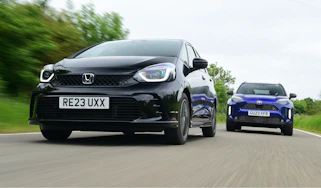
Cash £16,697We put the pre-facelift Yaris Cross through its paces when it first arrived in the UK, although it didn’t quite manage to woo our expert road testers when faced with the Honda Jazz in our real-world twin test. It was a narrow victory for the Jazz, though, because the Honda is just that bit cheaper to run. We also spent six months with a Yaris Cross in Design trim as part of our long-term test fleet. This allowed us to truly find out what this little SUV is like to live with, and it was a very trouble-free, if unexciting experience.
Engines, performance & drive
Pros |
|
Cons |
|
With a focus on efficiency rather than outright performance, the Toyota Yaris Cross doesn’t offer too much in the way of sprinting ability. Acceleration times are average at best, and the combination of a 1.5-litre three-cylinder petrol engine, a small electric motor, and a CVT automatic transmission won’t excite keen drivers in the same way a manual Ford Puma would. Similarly uninspiring is the groan the Yaris Cross elicits whenever you put your foot down; thankfully, the motor quietens down significantly once you’re up to speed.
Performance, 0-60mph acceleration and top speed
At launch, Toyota offered the Yaris Cross with two forms of the same 1.5-litre petrol-hybrid engine: one with 116bhp and another with 130bhp. As from 2026, Toyota only sells the latter, with a choice of front or all-wheel drive. Regardless of whether power goes to two or four wheels, 0-62mph is dispatched in a tame 11-or-so seconds; the instant response from the electric motor does make the Yaris Cross feel a little more sprightly when zipping around town, though.
The Toyota Yaris Cross offers a ‘B’ mode for its CVT transmission, which slows the car down as you lift off the accelerator. Unlike in an electric alternative such as the Renault 4, this won’t act as a total replacement for the brake pedal – one-pedal driving is usually the preserve for full-EVs – but it’s nonetheless easy to judge and makes driving just that bit more relaxing.
Town driving, visibility and parking
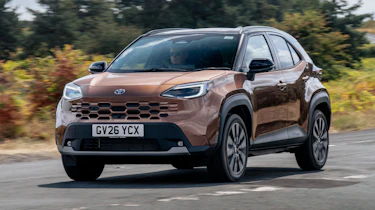
Urban areas are where Toyota expects the Yaris Cross to spend most of its time and has thus focused on making it easy to drive in town. The Yaris Cross can run on smooth electric power up to 30mph – provided you’re very gentle with the accelerator. When the petrol engine has to kick in, the switchover is barely noticeable as it kicks in to assist in increasing the pace. It’s a good set-up for driving in stop-start traffic for those after an automatic, feeling much less jerky than an auto Citroen C3 Aircross, Peugeot 2008 and Vauxhall Mokka.
Toyota has also refrained from adding too much artificial weight to the steering, meaning that despite being easy to manoeuvre in tight spaces – the Yaris Cross’ 10.6-metre turning circle straddles that of the Ford Puma and Citroen C3 Aircross – inputs refrain from feeling at all vague. Front visibility is also strong thanks to the raised driving position and thin A-pillars, although thick C-pillars and a slim rear window can make merging and reversing a tad more difficult; all models get blind-spot monitoring to help negate this problem, while Excel and GR Sport models take things a step further with a 360-degree camera system.
Country road driving and handling
Around bends, the Yaris Cross is a surprisingly composed and fun little car to chuck around, though ultimately, it isn’t as nimble as the aforementioned Puma. Similarly, while ride comfort is reasonably good at slower speeds, the car is a little bit fidgety on faster roads, and it certainly can’t match the plush ride of the Citroen C3 Aircross.
The GR Sport trim promises sharper steering than other versions and features tweaked suspension to make the Yaris Cross a bit more fun. However, we found the stiffer set-up gives it a fidgety ride at low speeds like a Nissan Juke, and feels a little more harsh over rougher surfaces at speed. The GR Sport does keep body lean in check better than the standard version, but the trade-off isn’t good enough to warrant the further reduction in ride quality.
Motorway driving and long-distance comfort
The Yaris Cross’s somewhat firm suspension means it feels more than stable enough at high speeds. The CVT gearbox is good at keeping the petrol engine from groaning too much when maintaining a consistent speed, while wind and tyre noise are kept mostly in check by the thick front glass.
| Model | Power | 0-62mph |
| Toyota Yaris Cross 1.5 (FWD) | 130bhp | 10.7 seconds |
| Toyota Yaris Cross 1.5 (AWD-i) | 130bhp | 11.3 seconds |
“Toyota offers a ‘B’ mode to boost engine braking when lifting off the throttle. It’s stronger than the Honda Jazz’s system, but the car’s engine tends to fire up more often in this mode, which cancels out the benefits of the additional energy recovery.” - Alex Ingram, former chief reviewer.
MPG, emissions & running costs
Pros |
|
Cons |
|
Low running costs are a particularly strong area for the Toyota Yaris Cross. Along with being relatively cheap to insure and maintaining decent residual values, the petrol-hybrid set-up means that you’ll benefit from superb economy figures and low CO2 emissions.
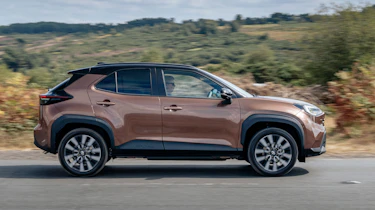
The Japanese giant claims that the Yaris Cross should return over and above the near 50mpg you’ll typically get from a Ford Puma. Toyota says its hybrid system will average between 55 and 64mpg, depending on specification, and we found this to be pretty accurate on our full day of driving the facelifted car at its UK launch, returning 55.3mpg. In fact, we were even able to push this as high as 77.5mpg in the mid-range Excel model with its 17-inch wheels and when switched into Eco mode.
We also lived with a pre-facelift FWD Yaris Cross in Design trim for several months, during which time it returned an average of 64.7mpg, although it indicated much higher figures on several occasions, so Toyota’s numbers certainly seem to stack up in real-world driving. During our time with the Yaris Cross we spent a lot of time driving on the electric motor alone, without any intervention from us telling the car when to switch from electric to petrol power.
| Model | MPG | CO2 | Insurance group |
| Toyota Yaris Cross 1.5 Icon (FWD) | 64.1mpg | 100g | 14E |
| Toyota Yaris Cross 1.5 GR Sport (FWD) | 58.8mpg | 110g | 15E |
| Toyota Yaris Cross 1.5 Excel (AWD-i) | 55.3mpg | 115g | 14E |
Insurance groups
The Toyota Yaris Cross’ insurance group rating of 14-15 is around average for this class of car. To put things in perspective, a mild-hybrid Ford Puma occupies group 12 and will thus be slightly cheaper to insure, whereas a full-hybrid Renault Captur E-Tech will be pricier to cover, starting at group 16. At the same time the Chery Tiggo 4, which costs less to buy than the Toyota, sits in group 24.
Tax
While the Yaris Cross is a pretty eco-conscious car, it can’t come close to fully electric cars when it comes to Benefit-in-Kind (BiK) company car tax savings. Small SUVs like the Hyundai Kona Electric and Ford Puma Gen-E will be better options for those seeking to save the big money here.
All Yaris Cross models are liable for the standard annual rate of VED road tax, but they do fall short of the £40,000 luxury car tax surcharge, even if you go for the range-topping GR Sport.
Depreciation
Our expert data suggests that after a typical three year or 36,000 mile ownership period, Toyota’s baby SUV will retain between 45 and 50 per cent of its original list price.
This is a very similar outcome to the Ford Puma, which holds on to 40 to 47 per cent. However, the electric Puma Gen-E only manages around 40 per cent.
To get an accurate valuation for a Toyota Yaris Cross, check out our free car valuation tool...
Interior, design & technology
Pros |
|
Cons |
|
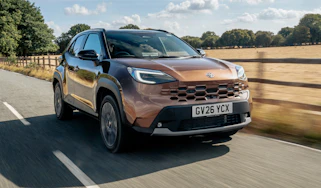
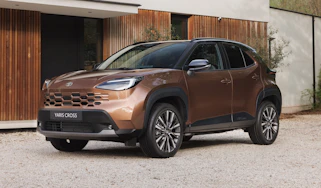
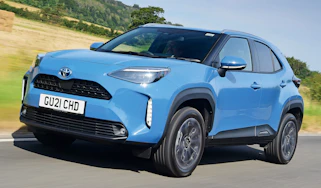
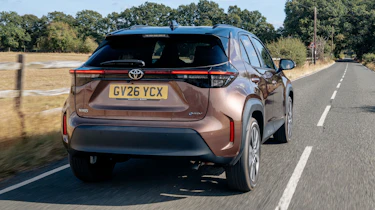
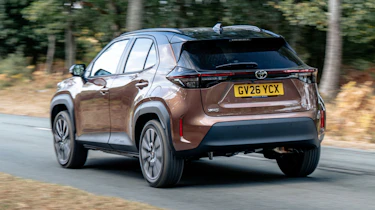
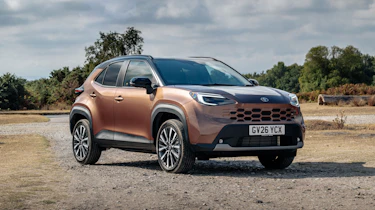
The Toyota Yaris Cross sits on the same platform as the Yaris supermini, but a recent facelift brought it more in line style-wise with the larger Toyota RAV4, with hexagonal grille elements and angry-looking headlights. This adds to the pre-existing black plastic cladding around the wheelarches and roof rails (standard on all but the entry Icon model), which help distinguish the Yaris Cross as a miniature SUV compared with the standard Yaris hatchback.
As the name suggests, the GR Sport version gives the Yaris Cross a slightly more athletic look, but don’t be fooled into thinking it’s any faster or could be Toyota's answer to the Ford Puma ST, it’s mainly just a few styling changes and some suspension tweaks.
Interior and dashboard design
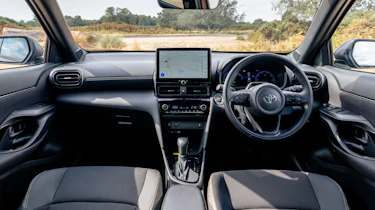
The cabin of the Yaris Cross is best described as functional because it isn’t particularly exciting. This refusal to adopt space-age minimalism means there are still physical dials for the climate controls, while we also enjoy the clicky switches and buttons found on the Yaris Cross’ perfectly-sized steering wheel.
If you’re after luxuries such as heated front seats and steering wheel, head-up display, JBL sound system, you’ll need to look towards the Excel and GR Sport trim levels. That’s not to say the Icon and Design specifications are poorly equipped; each includes alloy wheels, keyless entry, adaptive cruise control, and a reversing camera.
Materials and build quality
Toyota is renowned for its build quality and that combined with the Yaris Cross premium price might suggest a premium cabin experience. In reality, this isn’t quite the case, because while the Yaris Cross is far from feeling cheap and nasty, many of the materials are a lot harder and scratchier than we might hope; a Chery Tiggo 4 feels posher inside despite costing less.
Infotainment, sat-nav and stereo
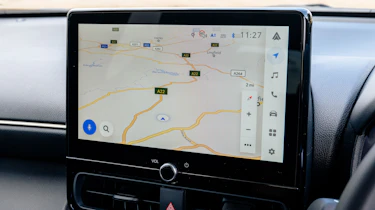
Post-facelift models have a nine-inch touchscreen with the Toyota Touch 2 infotainment system, which is relatively simple to navigate, and features wireless Apple CarPlay and Android Auto connectivity. This setup also has some shortcut buttons around the screen, which are handy while driving.
Go for Design trim and above, and the Yaris Cross features a 10.5-inch touchscreen, running Toyota’s latest ‘Smart Connect’ user interface system – the same one found in the Toyota bZ4X and Toyota C-HR. Compared to the other system, it’s sharper, quicker to respond and the menus are easier to navigate, although it’s not packed with features like the Google-based system in the Renault Captur.
The digital instrument cluster is similarly basic, with Design cars and up once again getting a larger display than entry-level offerings. Aside from looking a bit nicer, you don’t gain all that much functionality, despite the extra screen real estate.
“The Yaris Cross’s cabin oozes longevity and robustness, but lacks the plush materials you might expect at this price point” - Tom Jervis, consumer reporter.
Boot space, comfort & practicality
Pros |
|
Cons |
|
The Toyota Yaris Cross is taller and rides higher than the Toyota Yaris hybrid supermini it shares its underpinnings with, giving the raised driving position many drivers like. It’s a five-seat small SUV, although three across the back seat will be a squeeze and there isn’t a great deal of rear leg room for those travelling in the second row.
Slightly unusually, seatback pockets and underfloor boot storage are only standard on Excel trim and above, and if you want cupholders in the back, you have to upgrade to the Design trim level.
Dimensions comparison | |||
| Model | Toyota Yaris Cross | Ford Puma | Hyundai Kona |
| Length | 4,180mm | 4,226mm | 4,385mm |
| Width | 1,765mm | 1,805mm | 1,825mm |
| Height | 1,595mm | 1,550mm | 1,575mm |
| Wheelbase | 2,560mm | 2,590mm | 2,660mm |
| Boot space | 266/350 litres | 456 litres | 466 litres |
Seats & passenger space
The front seats in the Toyota Yaris Cross offer good support, while standard kit such as a central armrest, a reach and rake-adjustable steering wheel and front cup holders help to make things more comfortable. Step up to mid-range Design trim, and you get electrically adjustable lumbar support – a rarity in this class.
Interior storage, on the other hand, could be better; the door bins are only large enough to store a single bottle and nothing else. There isn’t any storage on the dashboard as in a Citroen C3 Aircross, although unlike that car, the Yaris Cross does at least ensure half the glovebox isn’t taken up by the fusebox.
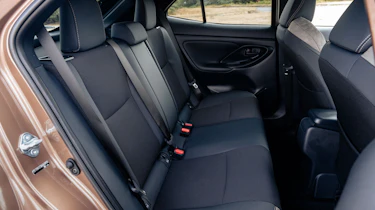
The rear bench in the Yaris Cross offers enough headroom for anyone around six foot tall, but legroom is in relatively short supply, so taller teenagers and adults probably won’t want to spend much time in the back of the Yaris Cross. They’ll also be disappointed by the lack of any USB charging ports, and access is compromised due to the small rear doors.
There are two sets of ISOFIX child seat mounting points in the back of the Yaris Cross, however, the small door openings and limited space will make it difficult to accommodate bulky child seats.
Boot space
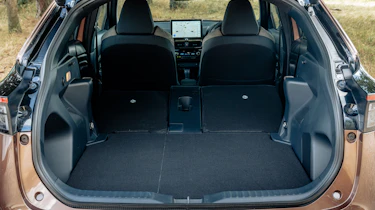
The front-wheel drive Toyota Yaris Cross provides 350 litres of luggage space up to the rather flimsy-feeling load cover versus the all-wheel drive version’s 266 litres. Fold the rear seats down, and the load volume expands to 1,097 litres in both variants. It’s worth noting that entry-level Icon cars get a 60:40 split-folding rear bench, while all others get seats that split 40:20:40.
More expensive models (Excel and above) include a false boot floor that can create a flush load area with the load lip and folded back seats. That’s pretty handy because the Yaris Cross has a hefty lip to try and get heavier items over. It’s a shame you can’t add this as an option on other trims, because an adjustable height boot floor is something that’s standard on the Volkswagen T-Cross.
Rivals have the Yaris Cross beat in this area, with the Ford Puma offering 456 litres of boot space. The Renault Captur also provides 422 litres as standard in petrol form, but the ace up its sleeve is its sliding rear bench, meaning you can push capacity to 536 litres when needed.
Towing
Towing capacity is nothing to write home about because no version can lug around more than a 750kg braked trailer, making the 13-pin tow bar option a bit pointless. A Kona Hybrid, meanwhile, can haul up to 1,300kg.
“The Toyota’s large, square boot offers more space than the Honda Jazz’s in five-seat mode, but the lightweight floorboards don’t feel particularly strong, while the fabric load cover is another disappointment. Take it off and it feels like it’ll blow away on a windy day.” - former Alex Ingram, chief reviewer.
Reliability & safety
Pros |
|
Cons |
|
Safety experts Euro NCAP originally awarded the Toyota Yaris Cross a maximum five-star crash safety rating when it was first tested in 2021. However, the car was retested in 2025 under a much more stringent regime, and it only managed four stars this time around.
There’s still a good amount of standard-active systems, though, such as adaptive cruise control to keep you a safe distance from the car in front, plus there’s a lane-keeping assist system to help you stay within your lane on the motorway. There’s also road sign assist, which reads the speed limit from road signs, and an autonomous emergency braking (AEB) system to mitigate or prevent collisions with other vehicles and vulnerable road users at low speeds around town.
Toyota Yaris Cross owners voted it as the 31st best car to own out of 50 models in our 2026 Driver Power satisfaction survey. They were particularly pleased with the Yaris SUV’s reliability and low running costs, but were less enamored with the lack of visibility and boot space.
A 10-year warranty, provided you get the Yaris Cross serviced at an official Toyota dealer every year, wasn’t enough to help the brand score higher than 19th out of 30 in our manufacturers survey, though.
| Euro NCAP safety ratings | |
| Euro NCAP safety rating |
Four stars (2025) Five stars (2021) |
| Adult occupant protection |
79% (2025) 86% (2021) |
| Child occupant protection |
85% (2025) 84% (2021) |
| Vulnerable road user protection |
83% (2025) 78% (2021) |
| Safety assist |
76% (2025) 81% (2021) |
Buying and owning
- Best buy: Toyota Yaris Cross 1.5 Design
While the pricier trim levels add in more elements of luxury, we feel that the Toyota Yaris Cross Design strikes the ideal balance between kit and affordability. It may come with the slightly less powerful hybrid powertrain, but efficiency is very much this car’s forte, rather than outright speed. That being said, it’ll cope with motorway speeds without much fuss.
Toyota Yaris Cross alternatives
The Toyota Yaris Cross will mostly appeal to single adults, couples or small families who are looking for low running costs. Equipment levels are strong across the board with plenty of driver-assistance tech, plus the option of all-wheel drive is a novelty in this class of car.
That said, the Yaris Cross is far from the most practical SUV, with the likes of the Renault Captur getting sliding seats to bolster practicality. A Ford Puma, aside from its ‘Megabox’ storage compartment underneath the boot floor, is a lot more fun to drive than the Toyota, while buyers looking for something a bit more luxurious should consider the Lexus LBX. This utilises the same underpinnings as the Toyota, but gets a plusher cabin and more desirable badge.
On the other hand, those looking to save money up-front should consider the Chery Tiggo 4, however, those looking for long-term savings might be better-off in a fully-electric car. The Renault 4 and Kia EV2 are both compelling alternatives at a similar price and with strong electric range figures for long-distance drives.
Toyota Yaris Cross pictures
Frequently Asked Questions
The Toyota Yaris Cross looks the part, is easy to pilot around town and offers excellent real-world fuel economy courtesy of its efficient hybrid system.