New Toyota GR Yaris Aero Performance review: a real rally car for the road
The Aero Performance pack enhances the incredible Toyota GR Yaris even more, adding a huge rear wing and new handbrake position


Verdict
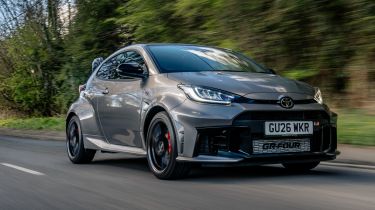
There’s no doubt that the Toyota GR Yaris is still one of the most thrilling new cars for sale today, and even though it’s edging towards £50,000, it’s as close as you can get to a road-going rally car. The Aero Performance upgrades don’t do much to enhance its ability unless you’re a track-day regular, where the grilles and wings will boost its capability. Moving the handbrake lever to its new position helps to deliver modern rally car vibes, but it restricts the car’s everyday usability a little.
When it was launched, the Toyota GR Yaris single-handedly revived the concept of the rally-derived performance car. In the past, the likes of Mitsubishi and Subaru created an almost spiritual connection between their motorsport activities and showroom products, but today Toyota is the only competitor in the World Rally Championship to offer a production car that mirrors its racing machine.
And what a machine it is. With a punchy 1.6-litre three-cylinder turbocharged engine under the bonnet, a six-speed manual gearbox and permanent four-wheel drive, it fits the template of the rally-bred heroes of the past. But Toyota, and the GR motorsport division in particular, haven’t just let the GR Yaris continue unchanged, with annual updates honing and refining the package. There’s a minor update coming later in 2026 when a revised steering wheel will be added, but in the meantime deliveries of the upgraded Aero Performance version are now taking place.
Used - available now

2020 Toyota
GR Yaris
28,254 milesManualPetrol1.6L
Cash £30,500
2020 Toyota
GR Yaris
10,392 milesManualPetrol1.6L
Cash £32,333
2020 Toyota
GR Yaris
25,865 milesManualPetrol1.6L
Cash £27,900
2020 Toyota
GR Yaris
32,100 milesManualPetrol1.6L
Cash £25,994As the name suggests, the Aero Performance package adds some exterior tweaks that help with cooling and aerodynamics. Toyota hasn’t quite gone as far as including the rally car’s wild wheelarch extensions, bumper scoops and multi-level rear wing, but the changes are designed to deliver improved performance, especially for owners keen to take their cars on a track day.
The most obvious addition to the exterior is the rear spoiler, which is manually adjustable. It’s a sizeable piece of plastic, and it rattles hard when you slam the boot shut. More aerodynamic adjustments are found up front, with a new lip spoiler added below the large air intake in the bumper, while unseen at the back of the car is a new undertray that has been designed to improve airflow beneath the car. The final piece of the aero package is a pair of ducts that are cut out of the back bumper, which are also designed to smooth the flow of air over and around the car.
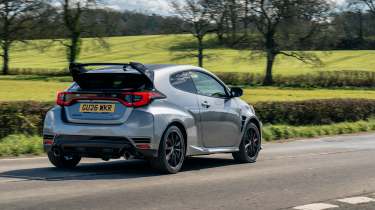
Other revisions are designed to keep temperatures in check. The standard aluminium bonnet now features a duct and grille that channel hot air out of the engine bay, while new ducts behind the front wheels do a similar job to help the brakes maintain performance.
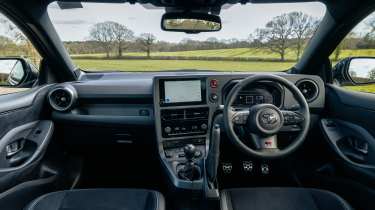
All of these adjustments are likely to have next to no effect on how the GR Yaris performs in everyday driving, but one final piece of the puzzle will. In an effort to instil the spirit of the rally car, the manual handbrake has been relocated from its slot next to the cup-holders and behind the gearlever to a new housing on the side of the centre console between the steering wheel and shifter. Its vertical position is designed to emulate the handbrake used in the racing model, which is conveniently located to help drivers such as Elfyn Evans to execute high-speed handbrake turns on twisting special stages.
The reality is that while it’s a neat homage, its location is a little inconvenient. It obscures some buttons on the dash, such as the driver’s temperature control, the heated steering wheel switch and the three-stage drive mode selector, while its close proximity to the gearlever means you have to reach around it a little when shifting between fifth and sixth gears.
It’s not a deal breaker, though – some buyers are likely to appreciate the novelty – and its upright position mirrors the look of the GR Yaris’s dashboard, with the facia clearly designed to be easily fitted with the data loggers and timing equipment that the rally car needs.
Either way, the handbrake certainly doesn’t hamper the GR Yaris’s ability to put a smile on your face. Once warmed up (there’s a warning on the dashboard asking you to avoid hard acceleration until everything is up to temperature), the GR Yaris is a hugely fun and entertaining machine, and one that offers a unique combination of talents these days.
The ride is on the firm side, but the car’s compact dimensions, that four-wheel-drive transmission and grippy Michelin Pilot Sport tyres at each corner combine to deliver a driving experience that’s well suited to narrow, twisting British B-roads. The punchy turbocharged three-cylinder engine packs 276bhp and 345Nm of torque, and 0-62mph acceleration in 5.2 seconds will keep you happy, especially because you’re in total control of what’s going on, courtesy of the short-throw six-speed gearbox. You can practise your heel-and-toe technique with the three pedals, too, or at the press of a button on the dashboard the electronics can match engine revs automatically on downshifts to make you look like a smooth-shifting hero.
The steering offers quick responses and high levels of grip, allowing you to carry plenty of speed through corners. The three driving modes on the GR Yaris are Normal, Gravel and Track, with each set-up altering the power distribution between the front and rear axles according to the surface. There are drive modes, too, including an Eco mode that seems to us not much more than a cursory acknowledgement of the hybrid Yaris, because we only saw fuel economy in the high 20s while at a cruise on the motorway.
The other big sacrifice the GR Yaris has to make over its hybrid sibling is in terms of practicality. Think of it more as a two-seat sports car, and you’ll find it’s a practical machine. But the back seats are made tighter by the large race buckets up front, while the four-wheel drive layout means that the boot is pretty hopeless. It measures a measly 174 litres, compared with 286 litres in the hybrid, a car that’s nowhere near being a front runner for practicality in the supermini class.
And then there’s the price. The GR Yaris was considered pretty weighty at around £30,000 when it was launched, but this Aero Performance model creeps north of £49,000. In black-and-white terms that’s a lot of cash for a supermini, but there’s nothing quite like the GR Yaris available today, and that means Toyota won’t have any trouble finding keen buyers.
Did you know you can sell your car through Auto Express? We’ll help you get a great price and find a great deal on a new car, too.
| Model: | Toyota GR Yaris Aero Performance |
| Price: | £49,145 |
| Powertrain: | 1.6-litre, 3cyl turbo |
| Power/torque: | 276bhp/345Nm |
| Transmission: | Six-speed manual,four-wheel drive |
| 0-62mph: | 5.2 seconds |
| Top speed: | 143mph |
| Economy: | 32.5mpg |
| Emissions: | 197g/km |
| Size (L/W/H): | 3,995/1,805/1,455mm |
| On sale: | Now |