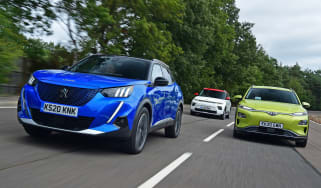
Hyundai Kona Electric review
The Hyundai Kona Electric is one of the best small SUVs around and a previous Car of the Year winner


Our opinion on the Hyundai Kona Electric
The original Hyundai Kona Electric was good, but the second-generation model is even better. It’s larger, which means it’s more practical than many of its rivals, while a combination of plush materials and the latest technology make the interior feel more upmarket than before. Its sole battery offering provides up to 319 miles of range from a full charge, which is more than enough for most people's needs.
About the Hyundai Kona Electric
We were so impressed with the improvements made to the second-generation Hyundai Kona Electric when it arrived in 2023, that we deemed it good enough to win that year’s coveted Auto Express Car of the Year trophy.
Even after being on sale for several years, the Kona Electric continues to be a fine choice thanks to its efficiency, comfort, and generous level of standard equipment. The range has been simplified since it first entered the market, with the smallest capacity battery option being dropped along with the least powerful electric motor.
There are four trim levels, which follow the rest of the Hyundai range. Our preferred option is the entry-level Advance combined with the optional Comfort pack, but you can pick the sportier looking N-Line, or if you want plenty of creature comforts, Ultimate or the more athletic appearance of the N-Line S has you covered.
Used - available now


We’ve tested petrol, hybrid, and electric versions of the Kona many times over the years, and our most recent twin test of the Hyundai Kona Electric versus the Honda e:Ny1 gave the Kona a clear victory. Our creative director, Darren Wilson, has also run an Ultimate trim Kona Electric as part of our long-term test fleet.
Performance & driving experience
Pros |
|
Cons |
|
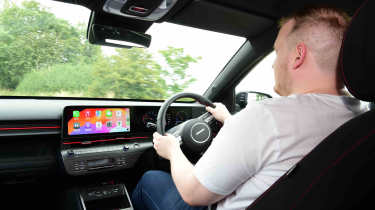
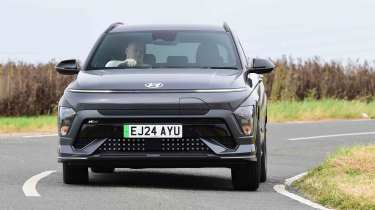
The latest Kona Electric is bigger than before in every dimension than its predecessor, but its turning circle hasn’t increased, remaining at 10.6 metres. The steering is light, and you can easily turn the wheel with one finger – although we obviously wouldn’t recommend this on the road. That might be good for parking, but there’s virtually no feedback at higher speeds, meaning the Kona Electric isn’t a particularly exciting car to drive on a twisty B road.
| Model | Power | 0-62mph | Top speed |
| Kona Electric Advance 65.4kWh | 215bhp | 7.8s | 107 mph |
Performance, 0-60mph acceleration and top speed
Officially, the Kona’s 7.8-second 0-62mph time is just 0.1 seconds shy of the e:Ny1 and higher capacity battery version of the Kia EV3. However, the Kona Electric still feels more than lively enough for a car of this type, even if it has a long throttle pedal travel. We found the Kona Electric wasn’t quite as eager to accelerate at higher motorway speeds as it was around town, but should you need to overtake a tractor on a B road, there’s enough punch to do so reasonably quickly.
Town driving, visibility and parking
The Hyundai is a little easier to drive smoothly than the Honda because the throttle has a softer initial response. The steering is light, and the brake regeneration has four strength levels, from complete coasting to strong deceleration; the ability to change these levels on the fly thanks to steering column-mounted paddles is a great feature. An adaptive mode adjusts the regen based on traffic and road conditions, but like most systems of this type, we found it unpredictable, so we preferred to turn it off.
One word or warning, though. If you switch the regenerative braking system off in the Kona and use the brake pedal instead, you need to give it a bit of a shove before the car starts to slow down.
Country road driving and handling
On more open roads, the Kona proves itself to have a softer, more forgiving ride than the Honda e:Ny1. There’s plenty of suspension travel to deal with cratered roads, but the suppleness doesn’t result in too much body lean in the corners. It’s a good balance with a clear focus on comfort.
Its steering is also less responsive, and it feels a little slower to turn into a corner. It’s predictable, but not particularly fun along a twisty road. However, the Hyundai has more grip than its rival, so it’s the more reassuring car to drive, regardless of the road conditions.
Motorway driving and long-distance comfort
That steady handling pays dividends at higher speeds, where the Kona feels stable and secure. It’s also slightly more peaceful than the e:Ny1 at a cruise. Two factors contribute to this: first, the Kona’s motor is much quieter (it’s rarely audible even under hard acceleration), and second, there’s less wind noise at higher speeds.
“Rather than my usual practice of getting to the nearest ‘fast’ road, we took a direct route on back roads. We got stuck behind some farm traffic, but I could safely and surprisingly quickly overtake it with the Kona Electric, much to the enjoyment of my passengers.” – Darren Wilson, creative director.
Range, charging & running costs
Pros |
|
Cons |
|
With the removal of the 48.4kWh version, the sole battery capacity currently available in a Kona Electric is the 65.4kWh version with up to 319 miles of driving range. If you opt for the N-Line, N-Line S, or Ultimate trim levels, the standard 19-inch wheels on these versions will reduce the range to just 282 miles.
However, on the Ultimate trim, you can specify the smaller 17-inch wheels used in the Premium trim, and this restores the range to 319 miles. We think it’ll be worthwhile doing so because our long-term Ultimate trim Kona Electric had the larger wheels, and we only achieved 3.2 miles per/kWh, or 210 miles to a charge.
The Kona gets a standard-fit heat pump, which is a more efficient way of heating the interior of a car in colder weather and should help preserve your driving range in chilly temperatures.
The peak charging figure is 101kW charging speed, allowing for a 10 to 80 per cent top-up time of 34 minutes. That’s on par with most of its rivals, but it’s by no means the fastest around, and is still beaten by alternatives like the Skoda Elroq or Volvo EX30, both of which have higher peak charging speeds and can handle a similar 10 to 80 per cent top up in around 25 minutes. For those charging up at home using a typical 7kW wallbox charger, refilling a flat Kona Electric to full will take around 10.5 hours.
| Model | Battery size | Range | Insurance group |
| Kona Electric Advance | 65.4kWh | 319 miles | 31D |
| Kona Electric Ultimate (with 19-inch wheels) | 65.4kWh | 282 miles | 33D |
Insurance groups
The Kona Electric might not be the cheapest EV of its kind to insure, though. With the loss of the less powerful version, this Hyundai now starts in group 31 instead of group 25 as before. That puts the Kona Electric on par with the Kia EV3, but for those looking for cheaper insurance, they should consider a Skoda Elroq, which starts in group 22.
Tax
EVs are no longer exempt from vehicle excise duty (VED) road tax, but at least the revised £50,000 threshold for electric cars means the Kona Electric won’t be subject to the luxury car tax surcharge. You may need to pay an eVED pay-per-mile fee if that comes into force from April 2028 onwards, though.
However, it’s company car drivers who will see the biggest savings due to extremely low Benefit-in-Kind (BiK) taxation for electric vehicles when compared with regular petrol and diesel cars. It’ll presently attract a four per cent for the ‘26 to ’27 tax year, but this will go up to five per cent from ‘27 to ‘28, seven per cent from '28 to '29, to nine per cent from '29 to '30.
Depreciation
The Kona electric should hang on to around 43 to 45 per cent of its original purchase price after three years and 36,000 miles, according to our expert data. That’s a little behind the EV3 (47 to 51 per cent) and Elroq (47 to 50 per cent), but a little better than the Peugeot E-2008, which is only expected to retain 42 per cent of its value over the same period.
Interior, design & technology
Pros |
|
Cons |
|
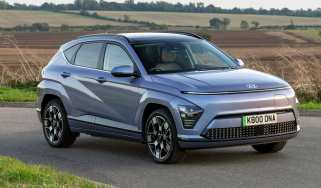
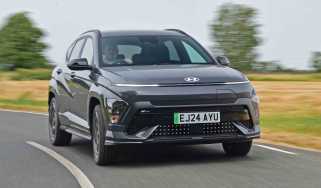
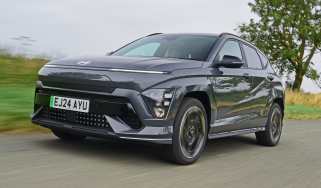
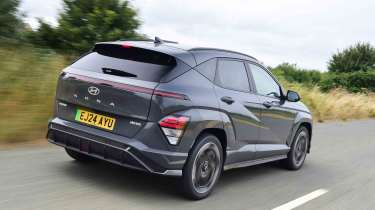
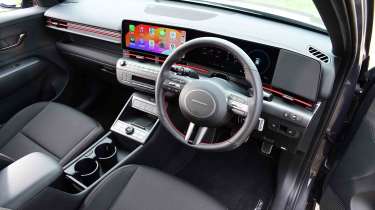
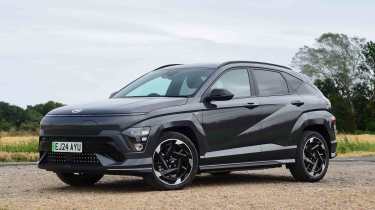
There’s some clear influence from the brand’s Ioniq range of cars with the Kona Electric, not just with the pixelated lightbars and eye-catching angular design on the outside, with a tasteful interior, too.
It’s well-equipped, too, with our preferred Advance trim getting all the basics, such as:
- A 12.3-inch infotainment screen with sat-nav
- Dual-zone climate control
- Front and rear parking sensors with a rear-view camera
- Android Auto and Apple CarPlay connectivity
- Two USB-C ports up front and two in the rear
We’d add to this the reasonably priced Comfort Pack for £600, which includes heated front and outer rear seats, a heated steering wheel, wireless smartphone charging, and rear privacy glass.
Mid-range N-Line includes the contents from the optional Comfort Pack found on the Advance trim, but has some sportier-looking exterior and interior styling.
Range-topping Ultimate and N-Line S trims cost the same and include many of the same high-end features, such as 19-inch alloy wheels, an upgraded Bose sound system, ventilated and electrically adjustable front seats, a head-up display system, an electric tailgate, and a blind spot monitoring and camera system. The only difference between the two is that Ultimate has a more conservative look and can be optioned with smaller 17-inch wheels to improve overall driving range, while N-Line S has more athletic styling.
All versions of the Kona Electric come with Vehicle to Load (V2L) charging capability, which means you can power anything from a kettle to a microwave using the three-pin socket in the centre console.
Interior and dashboard design
It’s a pleasant place to sit, with plenty of room front and rear, although it would be nice to be able to choose a different interior colour other than the standard grey. The N-Line trim and above feature ambient interior lighting to enhance the ambience and a couple of sportier touches to better differentiate them from the more conservative Advance and Ultimate trims.
Hyundai proudly states that the Kona’s interior is a result of customer feedback, which is usually reassuring. Yes, there are larger screens on the dash, which is customary for most EVs with premium aspirations, but we appreciate that they’ve kept physical buttons for frequently used functions like the radio and climate controls, making quick adjustments while driving easier than on rivals that rely solely on touchscreen controls.
Materials and build quality
Like the regular Kona, the Kona Electric certainly feels well screwed together and uses a good mix of materials inside. Some harder plastics are used in places, and it no longer feels quite as premium as rivals like the Skoda Elroq, but few should feel short-changed thanks to the quality of the leather around the steering wheel and the positive action of all the buttons and rotary controls.
Infotainment, sat-nav and stereo
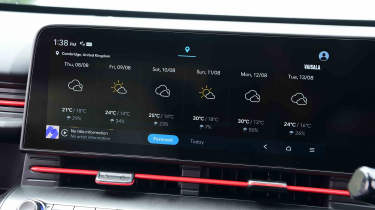
The infotainment system is a doddle to use in the Kona, and even the Advance version comes with sat-nav and EV route planning to help make sure you’re not scrambling to find a charger. Hyundai says over-the-air updates will be made available throughout the Kona’s lifespan, potentially including an ‘app shop’ to add more widgets and functionality to the menu.
There are a lot of menus to navigate through, though, and while you can save a shortcut to your most commonly used one on the star favourites button on the steering wheel, we’d advise you to use that for quick access to turn off the speed limit warning system, because that is very eager to tell you off and is a pain to silence once on the move.
Music lovers will likely want an N-Line S or higher trim level to get the better-sounding Bose sound system. Wireless smartphone charging is available as part of the Comfort pack on entry-level Advance trim, or as standard on N-Line trim and above.
“The N Line’s sports seats are not deep racing buckets, but have just enough side bolstering to feel supportive yet still comfortable on longer journeys. The black, grey and red colour scheme does make the interior feel a little gloomy.” – Ellis Hyde, News reporter.
Boot space & practicality
Pros |
|
Cons |
|
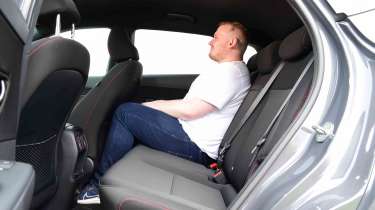
The larger exterior dimensions of the latest Hyundai Kona Electric over its predecessor mean that there’s more headroom, legroom and shoulder room than before.
Just below the main section of the dashboard, the Kona has a neat cubby to house a smartphone while it wirelessly charges, plus there’s a small shelf on the passenger side of the dash that’s useful for holding loose items.
Between the seats, there’s another deep bin with pop-out cup-holders, but there isn’t too much covered space available beneath the central armrest. The door bins are very generous up front, but those in the back only have space to carry a small bottle.
Dimensions and size
As we’ve already mentioned, the Kona Electric has grown in size, being 150mm longer, 12mm taller, and 25mm wider. In total, that makes the latest Kona 4,322mm long, 1,580mm tall, and 1,825mm wide.
That’s both longer and taller than the Volvo EX30 (although the EX30 is wider), but not quite as big as the Skoda Elroq.
| Dimensions comparison | |||
| Model | Hyundai Kona Electric | Kia EV3 | Skoda Elroq |
| Length | 4,355mm | 4,300mm | 4,488mm |
| Width | 1,825mm (2,100mm inc mirrors) | 1,850mm | 1,884mm (2,148 inc mirrors) |
| Height | 1,580mm | 1,560mm | 1,625mm |
| Wheelbase | 2,660mm | 2,680mm | 2,765mm |
| Boot space | 466-1,300 litres | 460-1,250 litres (plus 25-litre front boot) | 470-1,580 litres |
Seats & passenger space
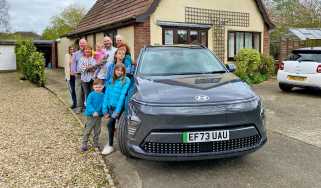
We found the amount of space inside the Kona Electric is not dissimilar to that of its larger Hyundai Tucson sibling, and even our creative director, Darren Wilson, found there to be plenty of room in the rear for three adults or two large child seats when he ran one as part of a long term test.
Up front, the driving position is higher up than it was before, giving the car a greater feeling of presence. There’s plenty of adjustment in the seats, but some testers found that the headrest – which can be adjusted to be closer to your head in order to help avoid whiplash injuries in a rear impact – poked out a little too far from the seat back, causing a slightly hunched driving position.
We also found it much less of a struggle to fit a child seat into the back of the Kona than in a Honda e:Ny1 because the Isofix mounts in the Hyundai poke out from the seat bases, and are easier to locate. In the Honda, they’re buried deep and are very hard to reach.
Boot space
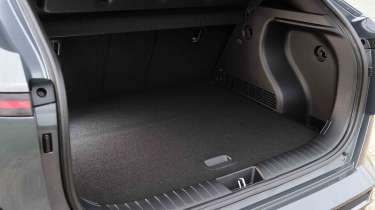
The boot provides a handy 466 litres of luggage capacity, up from 374 litres in the old car, and the space increases to 1,300 litres with the rear seats folded down. Both of those figures are significantly higher than what the Volvo EX30 offers, but while the Kona Electric almost matches the seats-up figure for the Skoda Elroq, the latter outperforms the Hyundai when all the seats are lowered, providing up to 1,580 litres of IKEA flat-pack furniture-swallowing capacity.
There’s more space under the boot floor for storing the charging cables, and although the Kona Electric doesn’t have a proper ‘frunk’ under the bonnet, there’s enough space for a handbag or small shopping bag.
“As is the case with a lot of small EVs, the Kona Electric isn’t really cut out for hauling a trailer given its weedy 750kg braked towing capacity. You can get a tow bar fitted around £800, but it’s more for fitting a bike rack than attaching a caravan.” – Max Adams, online reviews editor
Reliability & safety
Pros |
|
Cons |
|
The standard version of the second-generation Hyundai Kona received a disappointing four-star safety rating when tested by Euro NCAP safety experts in 2023. A poor performance in the vulnerable road user protection test and the absence of driver assistance systems on low-spec models were behind the less-than-stellar rating for the Hyundai.
On the plus side, every Kona Electric is fitted with multiple airbags, a driver attention warning, forward collision avoidance assist, lane-keeping assist, lane-follow assist, front and rear parking sensors, and a rearview camera.
We did find that some of the Kona’s driving assistance technology was a bit intrusive when we tested a high-end Ultimate trim version of the Hyundai Kona Electric against the Honda e:Ny1. The lane-keep assist was overly intrusive and was best switched off, while the driver attention alert system chimed in far too often.
The N Line S and Ultimate models are equipped with blind spot monitoring to warn you of vehicles alongside you when you change lanes, and a rear cross-traffic collision avoidance assist to alert you to potential hazards when you reverse into a road. There’s also a safe exit warning so you don’t open the door on an approaching cyclist, along with a parking distance warning system, and a surround view monitor to help make parking that little bit easier.
| Euro NCAP safety ratings | |
| Euro NCAP safety rating | 4 stars (2023) |
| Adult occupant protection | 80% |
| Child occupant protection | 83% |
| Vulnerable road user protection | 64% |
| Safety assist | 60% |
The Hyundai Kona was ranked as the 14th best car to own out of 50 in the 2026 Driver Power owner satisfaction survey. While this isn’t a class-leading finish, it is still a respectable one. Key highlights for owners included fuel economy and powertrain smoothness, but build quality wasn’t rated quite as highly as some might have expected.
The Hyundai brand placed 13th out of the 30 best car manufacturers list, comfortably beating its Kia sibling, which ranked 25th. Consistency was the key, with no major areas of discontent other than the 22nd-place position the brand scored for exterior styling. Owners were happy with the interior, infotainment, visibility, and back-seat legroom of their cars.
| Hyundai Kona | Position | Score |
| Overall | 14 | 85.89% |
| Powertrain | 8 | 89.61% |
| Exterior | 26 | 87.95% |
| Interior | 21 | 84.62% |
| Practicality & Bootspace | 24 | 83.37% |
| Ride & Handling | 20 | 88.84% |
| Safety Features | 24 | 83.18% |
| Economy & Running Costs | 5 | 83.78% |
| Quality & Reliability | 37 | 85.71% |
| Infotainment | 15 | 85.40% |
| Value | 19 | 84.38% |
What owners said
- “Good all-rounder with excellent running costs. Very practical for the size.”
- “Love the space inside for a small car. Safety features are excellent.”
- “Reliable and economical. The infotainment could be better.”
If you own a Hyundai Kona or any other car, let us know what you think of it: Take the Driver Power survey today...
Buying and owning
Best buy: Hyundai Kona Advance (Comfort Pack)
The Hyundai Kona Electric is among a growing number of EVs that are eligible for the Government's Electric Car Grant (ECG) announced in July 2025. All versions of the Kona Electric are eligible for the £3,750 ‘Band 1’ grant, which is applied automatically when you buy.
That helps make the Kona Electric more affordable against a growing list of electric small SUV rivals. Before the ECG grant, the Kona Electric range starts at just over £35,500 in Advance trim, while the mid-range N Line comes in at £37,000. The feature-rich Ultimate costs just under £39,500, while the range-topping N Line S costs a little over £41,500.
We suggest sticking with the entry-level Advance trim, because it comes with smaller alloy wheels that offer less rolling resistance and provide the best overall driving range. We recommend adding the Comfort Pack, because it enhances an already well-specified model by incorporating heated front and rear seats, a heated steering wheel (a particularly nice feature in winter), wireless phone charging, and rear privacy glass.
If you're interested in purchasing a Hyundai Kona Electric, we can assist you. Configure your ideal Hyundai Kona Electric now to get top offers from local dealers, check out the latest Hyundai Kona Electric leasing deals or search for used Hyundai Kona Electric models with our Buy A Car service. You can even sell your existing car for a great price with Auto Express Sell My Car.
Hyundai Kona Electric alternatives
The Kona Electric is one of five EVs currently offered by Hyundai (which is soon to be six with the arrival of the seven-seat Hyundai Ioniq 9). The Kona range also offers the choice of petrol and hybrid power, if you’re not quite ready to take the leap into EV ownership, and you can read more about those choices in our dedicated Hyundai Kona review.
Key rivals for the electric Kona include the Kia Niro EV, which uses the same K3 platform as the Kona Electric. There’s also the excellent Kia EV3 to consider, which uses a dedicated battery electric vehicle (BEV) version of that platform, but with significantly more battery capacity and even greater range.
Other electric small SUVs include the Cupra Born, Peugeot E-2008, Vauxhall Mokka Electric, and Volkswagen ID.3. But perhaps its most significant challenger comes in the form of the Skoda Elroq, which has already seen off competition from the EV3 to win its group test, thanks to its blend of practicality, efficiency, value for money, and exceptional comfort.
Hyundai Kona Electric pictures
Key updates of the Hyundai Kona Electric review
28 July 2026: Updated with the 2026 Driver Power customer satisfaction survey results, and because the Kona Electric is eligible for a higher £3,750 ‘Band 1’ electric car grant (ECG) discount
30 January 2026: Review updated to include a mention that the Kona Electric now qualifies for the £1,500 ‘Band 2’ electric car grant (ECG) for EVs.
Frequently Asked Questions
At least owners can rely on Hyundai’s excellent five-year unlimited mileage warranty. Although Kia offers cover for seven years, it’s worth noting that the mileage is capped at 100,000 miles.
Deals on the Kona Electric and alternatives
More reviews
Car group tests
In-depth reviews
Long-term tests
Which Is Best