New Polestar 4 SUV 2026 review: as good as the coupe, but more practical and cheaper
The new Polestar 4 SUV has arrived to sit alongside the coupe, but its cheaper, more practical and just as good to drive


Verdict
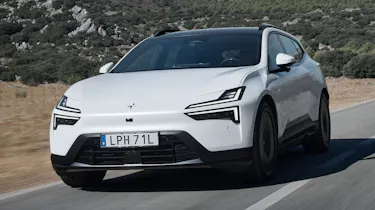
Polestar might have given itself a headache with the new 4 SUV, because it’s more practical, cheaper and will go further than its best-selling 4 Coupe. The two will be sold alongside each other, although the SUV will attract plenty of sales – not just from the Coupé, but from established electric SUV rivals, too.
When Polestar unveiled its fourth model, the creatively named Polestar 4, the automotive world was in shock because it boldly did away with a back window – favouring a camera and digital rear view mirror instead. Now the Polestar 4 has been given a Coupe moniker to make room for the new Polestar 4 SUV which sees the window's return.
Don’t think that’s Polestar backtracking on what was initially perceived as a controversial feature though. The Polestar 4 Coupe quickly became the brand’s best-selling car, despite commanding a premium of more than £10,000 compared with the Polestar 2 saloon. We’ve been told to expect even greater sales from the new Polestar 4 SUV sibling.
On paper it’s not hard to see why. Compared with the Polestar 4 Coupe, the new SUV is £2,000 cheaper than the base Rear motor specifications we’re testing here, while the Dual motor costs from £60,750 – a saving of £3,000 over the Coupe. As with the Coupe, the optional Prime pack adds £4,000, while the Performance pack adds £3,500.
Used - available now


Besides the cost-saving, the Polestar 4 SUV is unsurprisingly more practical. The boot space being only measured to the rear seatbacks which means it offers only six litres more than the Coupe, at 530 litres, but higher up there’s much more space. The window line means the Polestar 4 SUV can now accommodate dogs or tall items in the boot, plus the redesigned tailgate opening makes loading bulky objects far easier. The rear seats only fold in a 60/40 split, however.
The change in bodystyle only comes after the rear doors, so it’s pretty much the same as before in terms of passenger space inside, with only an extra 2.5 centimetres of headroom for rear passengers. That’s no issue though because, just as we found when we lived with the Coupe for six months, the Polestar 4 is very accommodating. The SUV is also brighter inside compared with the Coupe, with a larger window area, plus an expansive glass roof is fitted as standard. There is also the optional £1,200 electrochromic glass roof which can dim in four individual sections.
While there’s a proper rear window now, the SUV can be equipped with the Coupe’s digital rear view mirror as an option. We wouldn’t say it’s a necessity (like it is in the Coupe), but rear visibility during night driving is a lot better with the 8.9-inch digital display.
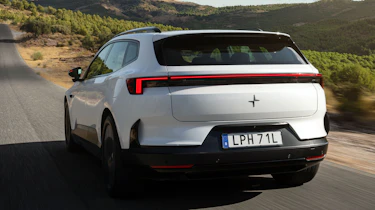
Despite the new SUV designation bringing visual changes, Polestar says the 4 SUV requires only 48 different parts over the Coupe. There are also new alloy wheel designs up to 22 inches, plus fresh colours including Ozone (a light purple) and Aurora (a silver-green finish). Overall though, the SUV stays true to Polestar’s slick, pared-back design ethos.
As we’ve come to expect from the Swedish brand, the materials feel upmarket throughout the 4 SUV. You have a choice of black or white leather from Scotland’s Bridge of Weir, although the standard upholstery is excellent, too. Most of the physical switchgear inside is without fault, but we’re not huge fans of the piano-black steering wheel buttons, which feel a little plasticky and cheap.
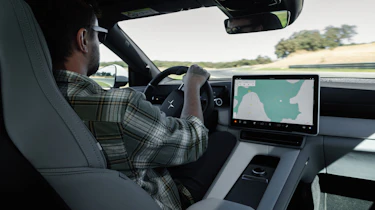
The massive central touchscreen is home to pretty much every function and as such it requires a bit of tweaking to set up the shortcut menus to your preference. Once you’ve acquainted yourself with the Google-based system (although Polestar has put its own slick design on top), the infotainment is a breeze to use on the move.
Under the new body, the 4 SUV uses the SEA (Sustainable Experience Architecture) platform from the 4 Coupe, with the same choice of battery and motor configurations. The 100kWh pack with the Rear motor is good for 391 miles, according to Polestar, while the Dual motor reduces this to 372 miles and the Performance pack only offers 323 miles. These are all slightly above what you get from the Coupe model, and the single motor beats the Tesla Model Y (387 miles) and the Audi Q6 e-tron (381 miles). But the 4 SUV’s ranges are still way off the Volvo EX60 and BMW iX3, which will exceed the 500-mile mark.
During our drive we found that the Dual motor returned 320 miles of range under steady motorway driving, while the Rear motor could top 330 miles – figures that are fairly in-line with our experience of the Coupe model.
While the range is pretty competitive, something that lets the Polestar down is top ups. While the 4 initially launched with 150kW charging, the 200kW maximum speed still isn’t up there with the aforementioned rivals – some of which have double the speed. The Polestar 4 SUV comes as standard with a 3.3kW vehicle-to-load charge, which we used to power two camping tents overnight, sapping only four per cent of range in the process.
When we first drove the Polestar 4 we found the car’s ride to be a little fidgety and the steering fairly inert – not something you expect of a brand with ‘Performance’ as one of its three pillars (sustainability and design being the other two). Polestar has since made a few small calibration tweaks to the 4 SUV, which will be introduced to the Coupe, to make it more compliant on the road while also providing greater feedback.
We drove the Rear motor, Dual motor and the Performance pack Dual motor SUV models. Immediately on the road we could tell our Dual motor car felt more settled, with its passive damping set up gaining new springs, plus fresh anti-roll bar settings and rebound stops to create a more fluid ride. The steering, which used to be quite vague off-centre, now has a much more consistent and natural weight to it.
Beyond the improvements on road, we took the Dual motor with the Performance pack on to the beautiful Ascari circuit in Spain to try out the revised active dampers. Various settings for the suspension’s stiffness can be applied, but one thing that really stood out was the lack of roll, thanks in part to the Performance pack’s excellent Pirelli P Zero tyres. The Dual motor’s hefty 2,265kg kerbweight does show itself via some understeer if you’re a little ham-fisted in your cornering.
We also had the chance to take the Rear motor out on track, where the gap in straight-line performance to the Dual motor becomes very obvious. However, at low speed on tighter corners, the less powerful rear-driven model felt a little more playful, with the steering just about quick enough to keep things in check.
Very few Polestar owners will take their cars on track, and that’s true for off-roading, but Polestar took us out on an off-road course anyway to showcase the depths of the Dual motor’s ability. The all-wheel-drive system got us out of some startlingly deep pits and up some severe inclines without any fuss, all on road tyres, too.
As with the Coupe, the SUV gets three brake regeneration settings: Off, Low and One-pedal. We found that Low had the best balance, essentially providing the same amount of deceleration as traditional engine braking.
We’ve mentioned Polestar’s ‘Sustainability’ pillar and with the 4 SUV that thinking has been integrated throughout. Beyond the wide usage of recycled material inside, there’s also 100 per cent renewable energy in the battery’s production. Customers can also check on Polestar’s ‘cradle-to-gate’ production on the company’s website. Another interesting point for the Polestar 4 SUV’s production is unlike the Chinese-built 4 Coupe, the SUV is built solely in South Korea, thanks to a partnership with the Renault Group. From our first inspection this appears to have no effect on the already excellent build quality of the Polestar 4.
Did you know you can sell your car through Auto Express? We’ll help you get a great price and find a great deal on a new car, too.
| Model: | Polestar 4 SUV Rear motor |
| Price: | £54,750 |
| Powertrain: | 100kWh battery, 1x motor |
| Power/torque: | 268bhp/343Nm |
| Transmission: | Single-speed automatic, rear-wheel drive |
| 0-62mph/top speed: | 7.1 seconds/99mph |
| Range: | 391 miles |
| Max charging: | 200kW (10-80% in 30 mins) |
| Size (L/W/H): | 4,840/2,067/1,556mm |
| On sale: | Now |