Volvo EX30 review
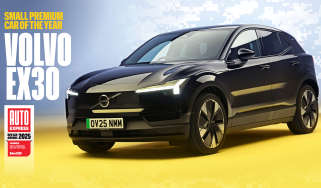
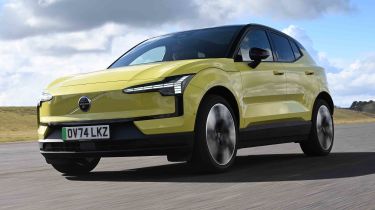
The Volvo EX30 is a small electric SUV with strong premium appeal


Our opinion on the Volvo EX30
The Volvo EX30 has impressed us whether it be during the group tests we've conducted or living with one on our long term test fleet. The minimalist interior feels special, features plenty of standard safety features and equipment, plus there’s decent performance coupled with a competitive electric driving range. The P8 AWD models are expensive, but quick enough that they could make for an intriguing alternative to a hot hatch, while the range-topping Cross Country version is a slightly more lifestyle version thanks to its additional body cladding. The only real issues we have with the EX30 are the relatively tight rear space and ergonomic question marks surrounding the touchscreen.
About the Volvo EX30
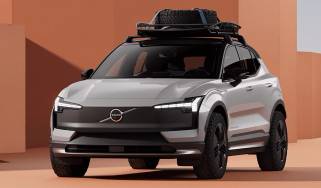
The Volvo EX30 is the smallest car that the Swedish company makes, and it outclasses almost all other vehicles of its type and price when it comes to luxury and quality. There are standard and long-range battery sizes to choose from, along with rear- or four-wheel drive options. Besides the standard EX30, there's also a more rugged-looking Cross Country version if you fancy a more outdoorsy appearance.
Trim levels comprise Core, Plus and Ultra, although Core spec isn’t offered with the P8 AWD set-up. All models are generously equipped for the price. If you’re looking for an EX30 with a more moody aesthetic, a ‘Black Edition’ is available to essentially turn every exterior trim black. It’s also only offered in Plus and Ultra trims with the higher-capacity battery in rear or four-wheel drive forms.
Used - available now


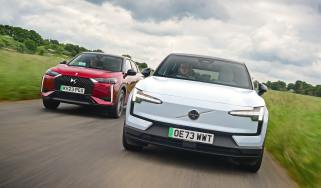
We've tested an Ultra version of the Volvo EX30 against the DS 3 E-Tense, a trim Plus Volvo EX30 against the Abarth 600e, and we've even run a Volvo EX30 as part of our long-term test fleet.
Performance & driving experience
Pros |
|
Cons |
|
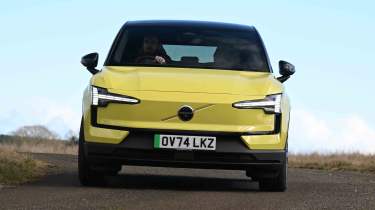
The Volvo EX30 offers strong performance and a well judged chassis. It isn’t truly exciting to drive, but it’s above average in this class.
As with most modern EVs, you can adjust how much regenerative braking you get when you lift off the throttle, as well as how heavy the steering is. But unlike most cars, the Volvo hides these features in a sub-menu on the main screen, rather than having them available at the touch of a physical button.
Most versions come with rear-wheel drive, but there's also a 4WD model that does seem quite suited to the EX30’s SUV shape. It isn’t really designed for off-roading – even in Cross Country form – because there isn't a huge amount of ground clearance. The extra driven axle is more for performance gains rather than traction on rough surfaces.
Performance, 0-60mph acceleration and top speed
The most powerful Volvo EX30, the P8 AWD, which takes just 3.6 seconds to accelerate from 0-62mph – the same time as a Porsche 911 Carrera 4S or even a Ferrari Enzo. The better-value P5 Long Range model isn’t supercar-fast but still manages the sprint in 5.3 seconds, and the standard EX30 P5 manages it in 5.7 seconds, but even these times are faster than you’ll ever likely need.
Since 2020, all new Volvos have been electronically limited to 112mph. In our experience on the test track, the limiter is fairly soft, so power tails off smoothly rather than shutting down suddenly when you reach it.
| Model | Power | 0-62mph | Top speed |
| EX30 P5 | 268bhp | 5.7 seconds | 112mph |
| EX30 P5 Long Range | 268bhp | 5.3 seconds | 112mph |
| EX30 P8 AWD | 422bhp | 3.6 seconds | 112mph |
Town driving, visibility and parking
The Volvo’s punchy electric powertrain provides strong performance off the line and from low speed, so you’ll never want for more power around town. The Swedish EV also deals with potholes and bumps pretty well, although the large 19-inch alloy wheels and heavy kerbweight are most apparent in city driving.
The EX30’s solution to this is its super-comfortable seats, because not only are they supportive, they are also soft enough to take the edge off of any bumps you can feel through the seat of your pants.
Country road driving and handling
Even though single-motor P5 versions of the EX30 are rear-wheel drive, they don’t feel very sporty on twisty B-roads. Accelerate hard out of a corner, and you can feel the power shifting between the wheels automatically to maintain traction. It’s not as predictable as you would expect if you’re used to rear-wheel-drive petrol cars, because it relies heavily on traction control at each wheel. There’s not really any scope to play with the throttle during cornering, and it’s clear that the EX30 has been designed with commuting and efficiency in mind rather than sporty, rear-driven dynamics.
The EX30 rides on slightly firm suspension, but it’s very well judged, providing good body control without being uncomfortable. The steering and pedals feel numb, but that’s true of virtually any car in this class, although the Abarth 600e’s set-up feels more responsive. You can change the weight of the steering in the Volvo’s settings menu, but it doesn’t make a huge difference to how it feels.
A fairly firm squeeze of the brake pedal is needed to deliver a strong braking force. That’s partly because there’s not much feedback through the pedal and partly because the car’s weight means it takes more effort to stop than many similarly sized petrol or diesel cars. There is a one-pedal mode that we found to be smoothly integrated into the braking system.
We’ve driven the Cross Country version, too, on both smooth Swedish roads and frozen lakes. The only major chassis tweak is that the suspension has been jacked up by 12mm, so it drives pretty much the same as the regular P8 four-wheel drive EX30.
Motorway driving and long-distance comfort
Comfortable seats, smooth suspension and low road and wind noise mean the Volvo EX30 is a great car for motorway driving. It’s relaxing, but performance in a straight line is really strong, even in the P5 model. The initial low-speed punch doesn’t dissipate at higher speeds, and you have all the torque needed to make overtaking a breeze.
“The EX30’s keen driving dynamics are just as apparent on the Cross Country version, although thanks to its lifted suspension, the latter has a slightly greater amount of body lean in the bends." - Alastair Crooks, senior news reporter.
Range, charging & running costs
Pros |
|
Cons |
|
The Volvo EX30 comes with two battery sizes, 51kWh and 69kWh, while the useable capacities are 49kWh and 64kWh, respectively. The 69kWh battery comes with a heat pump as standard, which is worthwhile having because this is a more efficient way of heating the interior in colder weather and helps to maintain driving range. It can also automatically preheat the pack when you select a charging station as a destination, allowing the car to accept a higher rate of charge earlier in the charging process, reducing the overall time you spend waiting to top up the battery.
Electric range, battery life and charge time
The standard 51kWh battery option provides up to 214 miles of range, but the 69kWh Long Range car increases that to 296 miles. After several thousand miles of day-to-day driving, we averaged 3.2 miles/kWh from this version, which translates to 221 miles of real-world range. The P8 four-wheel drive model saps a little range due to the weight penalty of the second electric motor up front, and because of the extra performance on offer, it has an official range of 280 miles. Range decreases even further with the Cross Country variant, thanks to its taller profile. It maxes out at 264 miles or around 230 miles if you go for its optional off-road tyres.
In our experience, we found that even in cold weather with a fully laden car, the Long Range model’s efficiency doesn’t drop much, which is impressive for a small EV.
Some rivals drive further, but the EX30’s charging speeds are impressive. The entry-level 51kWh battery model tops out at 134kW, which means a 10-80 per cent charge takes around half an hour. This goes up to a 153kW rate in the 69kWh Long Range version, which allows a 10-80 per cent top-up in less than 30 minutes.
Most owners will probably use a 7.4kWh home wallbox charger to top up their EX30, and utilise cheaper overnight electricity rates - if they have the right electricity tariff. This means refilling the 51kWh battery should take less than 10 hours, while the 69kWh model has a sub-12 hour time.
| Model | Battery size | Range | Insurance group |
| EX30 P5 | 51kWh | 214 miles | 35 |
| EX30 P5 Long Range | 69kWh | 296 miles | 37 |
| EX30 P8 AWD | 69kWh | 280 miles | 40 |
Insurance groups
All versions of the EX30 sit in at least group 35, and the more powerful models go up to group 40. That’s higher than many other electric SUVs, but when you consider that the Volvo is faster than many petrol cars in the maximum group 50, it isn’t so bad.
Tax
Road tax is the same as for all other zero-emission EVs, at £195, while the standard low Benefit-in-Kind (BiK) rate for electric cars means that the EX30 is great for company car drivers, especially when you consider the Volvo’s competitive P11D costs.
Depreciation
According to our expert data, the EX30 is expected to retain between 41 and 45 per cent of its original value after three years or 36,000 miles. That's better than the Jeep Avenger (40 per cent) and Peugeot E-2008 (36 per cent), but some way short of Skoda Elroq (47 to 51 per cent), Kia EV3 (49 to 52 per cent), or MINI Countryman (54 to 61 per cent).
Interior, design & technology
Pros |
|
Cons |
|
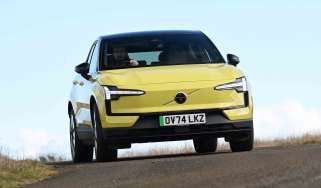
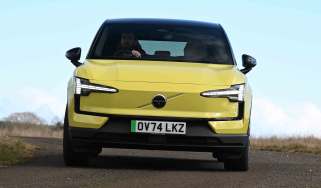
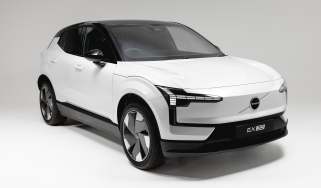
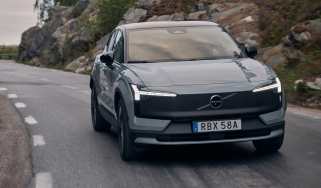
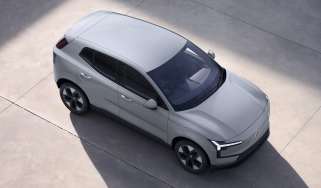
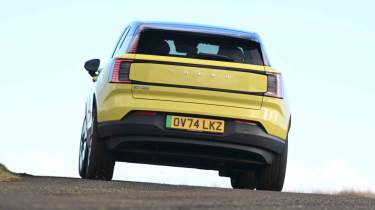
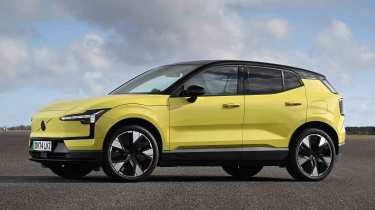
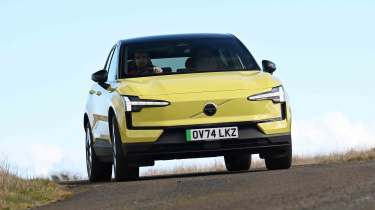
The EX30 looks familiar to the brand's other SUVs, thanks in no small part to details such as the ‘Thor’s’ hammer LED headlights and high-mounted rear lights. It’s chunky and substantial at first glance, even if, in reality, it is actually shorter than a Volkswagen Golf.
There are five exterior colours to choose from, and thankfully, all of them are free. You can also pick between four interior colours, although your options might be limited by the trim you choose. Pine is exclusive to Plus trim, and the top-of-the-range Ultra adds Breeze and Mist colour schemes to the mix. The Cross Country adds some black exterior panelling, but if you look closely at the front you’ll notice the topography of the Swedish mountain Kebnekaise with its coordinates included, which we think is a pretty cool and unique touch.
The EX30’s cabin is close to being one of the best cars in its class, thanks to its luxurious, tech-packed interior, but ultimately the ergonomics let it down.
Interior and dashboard design
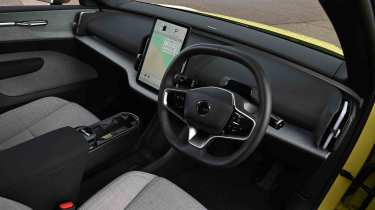
Interior materials include woven fabrics and recycled materials rather than the typical plastic and leather you’d find in similar models, which helps the Volvo feel upmarket. Another factor is the minimalist dash; while this looks smart initially, when you come to drive the car, it doesn’t seem worth it – it compromises usability too much.
Almost everything is controlled via the touchscreen, and many things that you need to access regularly require too many touches to get to – put simply, it’s annoying. Even things such as the window switches are irritating because you can’t quickly lower the rear windows – you need to press a second button and use the same switch as for the front.
Materials and build quality
The materials in the EX30 are excellent, and the build quality is great as well. We didn’t hear any rattles or movement in the trim while driving, and special mention has to go to the seats, which are very comfortable and have equally smart covers. There are a few cheaper-looking bits around the cabin, but the key places you’ll interact with daily are good.
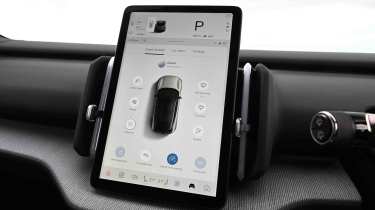
Infotainment, sat-nav and stereo
All models in the range have a 12.3-inch touchscreen, which controls virtually everything in the car. Volvo seems to have taken a leaf out of the Tesla book in this regard – even the speedometer and driving functions are on the main screen, because there’s no display behind the wheel at all. We’re not sold on it in Tesla cars, and it’s the same here because you have to turn your head and look away from the road for longer than is comfortable to read your speed.
During our time living with the EX30, we developed a start-up routine that included turning off the annoying speed-limit alert and driver monitor, although switching on things such as the heated rear screen in winter months takes too many touches of the screen. The Harman Kardon sound system is great, but it does start up at a very high volume setting.
Putting aside the issues with usability, it’s a very good system that has all the features you could need. It’s easy to flick between functions, while the screen is responsive and loads up quickly enough. The Google-made interface looks more like a tablet PC than an in-car system, with lots of features, while the default Google Maps navigation is superb. We’ve also enjoyed how easy it is to connect to the Volvo app through our smartphone, which also has a classy interface that matches the car.
The screen is quick to respond to inputs and loads quickly. There were a few bugs that could be fixed in software updates, such as when charging at home, the readout was blocked by the “door open” notification.
Boot space & practicality
Pros |
|
Cons |
|
Although the EX30 looks like a large SUV, it’s not all that spacious inside, so will be mainly suitable for families with younger children.
Dimensions and size
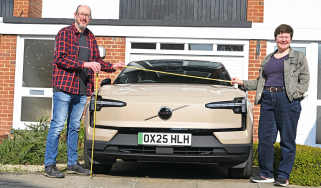
The proportions are those of a compact SUV, but the EX30 is a small model that’s about the same length as a Volkswagen Golf. Cars with similar dimensions include the Abarth 600, Fiat 600 and Jeep Avenger.
| Dimensions comparison | |||
| Model | Volvo EX30 | Jeep Avenger | Peugeot E-2008 |
| Length | 4,233mm | 4,088mm | 4,304mm |
| Width | 1,940mm | 1,797mm | 1,770mm |
| Height | 1,555mm | 1,541mm | 1,550mm |
| Wheelbase | 2,650mm | 2,560mm | 2,610mm |
| Boot space | 318 litres | 321 litres | 434 litres |
Seats & passenger space
The front seats are supportive, soft and very comfortable to sit in for a long trip. There’s lots of head and shoulder room, plus there’s enough adjustment in the base, back and steering wheel for all sorts of drivers to get comfortable, even taller ones.
Storage up front is pretty good, because there’s a centre console cubby and a hidden section underneath where you can plug your phone into the USB ports unseen. A central section pops out with cup-holders, or you can remove the frame and use it as extra storage as well. Because it slides away, you can access the lower section more easily when needed.
Adults and teenagers will find that the high floor and limited legroom mean the rear seats feel rather cramped. Headroom is okay, but the tallest passengers might still brush against the headlining. With the front seats in an average position, there’s also not all that much room for your feet, so the rear feels as though it was designed for kids only. Access is fine, and it feels quite light in the back, which is unusual for a compact SUV.
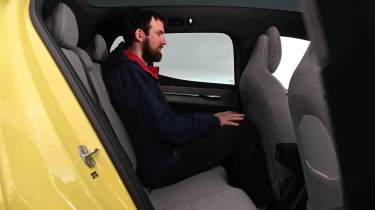
Boot space
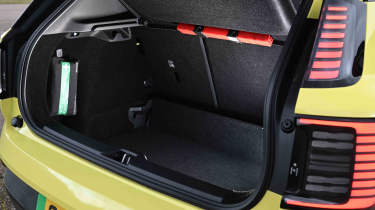
While the boot size looks fairly normal for a crossover, at 318 litres, it’s one of the smaller storage spaces in its class. There’s also a compact 19-litre area under the bonnet, which is useful for charging cables. The 60:40 split-folding rear seat increases the load area to 904 litres, which is still small even for a compact SUV. A Hyundai Kona provides 466 litres of space with the rear seats up, for example, and 1,300 litres with them folded. Even the sporty Abarth 600e has quite a bit more volume in either configuration.
We have found that the EX30 makes good use of its seemingly limited boot space, with a nice, square opening making it easy to load and unload bulky items.
Towing
The Single Motor model has a 1,000kg braked trailer towing capacity, while the Extended Range versions can pull up to 1,600kg, which is rather good for this size of electric car, and puts it above even the likes of the larger Skoda Enyaq and Volkswagen ID.4.
If you’re going to tow a large trailer or caravan, we would suggest you take a look at your mirror set up. As with the Polestar 2, the EX30 has frameless door mirrors, which will make it difficult to attach extension mirrors – you may need to invest in an alternative solution.
“Sitting at the bottom of the Volvo range, the EX30 feels it in terms of interior space. It’s not terrible compared with rivals, but if you’re prioritising practicality then the Volvo is a hard sell – something we’ve not traditionally associated with cars from Swedish manufacturer.” - Alastair Crooks, senior news reporter.
Reliability & safety
Pros |
|
Cons |
|
The EX30 is yet to appear in our Driver Power owner satisfaction survey, but Volvo finished 13th out of 32 brands in 2025 – a rise of three places over the previous year. Safety, interior quality and front-seat comfort have been amongst Volvo’s highlights, but powertrains, running costs, and value for money weren’t. Still, the EX30 solves many of these issues, given its electric powertrain and decent price tag.
Safety expert Euro NCAP has awarded the EX30 the same five-star maximum rating as its sibling, the Smart #1. The EX30 scored higher than its other electric rival, the MINI Countryman Electric, in the adult occupancy and safety assistance categories, but the MINI was ahead in protection of children and vulnerable road users.
In early 2026, Volvo EX30 owners were warned of a potential fire risk due to battery overheating issues. The issue was only related to 2024-2026 EX30 Single Motor Extended Range and Twin Motor Performance cars. Volvo said it would contact all affected owners to ask them to limit charging their cars.
The Volvo EX30 comes with many standard safety features. For motorways and dual-carriageways, you have adaptive cruise control to keep you a safe distance from the car in front, a lane-keeping assist system to help keep you within your lane, and a blind-spot monitoring system to warn you of any vehicles alongside you as you go to change lanes. Around town, you have an autonomous emergency braking system to either mitigate or prevent low-speed collisions with other vehicles or vulnerable road users, such as pedestrians or cyclists. There’s also a road sign warning system that will, amongst other things, warn you of the current speed limit.
| Euro NCAP safety ratings | |
| Euro NCAP safety rating | Five stars (2024) |
| Adult occupant protection | 86% |
| Child occupant protection | 85% |
| Vulnerable road user protection | 79% |
| Safety assist | 80% |
Buying and owning
Best buy: Volvo EX30 Plus P5 Long Range
The mid-range Plus trim in P5 rear-drive form with the higher-capacity Long Range battery offers the longest range from a charge and is more than fast enough. It's not the cheapest EV around, but it fulfils the premium billing of the EX40 the best.
Pricing for the EX30 starts from around £33,000 in Core P5 form, rising to just under £37,500 for the Core P5 Long Range. Mid-range Plus trim comes in at £35,000, or around £40,000 for our preferred Plus P5 Long Range. The least expensive Black Edition EX30 comes in Plus P5 Long Range form and costs from around £40,500, while the most expensive EX30 – the Cross Country Ultra P8 AWD – comes in at around £47,000.
If you're interested in getting yourself a Volvo EX30, we can help. Configure your ideal Volvo EX30 now to get top offers from local dealers, check out the latest Volvo EX30 leasing deals or search for used Volvo EX30 models with our Buy A Car service. You can even sell your existing car for a great price with Auto Express Sell My Car.
Volvo EX30 alternatives
The Volvo EX30 is an appealing small electric SUV for those who need a smart-looking, premium small car that’s zippy enough to nip into traffic in the city, yet still has the range and swift charging speeds that make the occasional long trip a possibility. There are rivals on all fronts, such as the Hyundai Kona Electric, Kia EV3, Jeep Avenger, Peugeot E-2008, and award-winning Skoda Elroq. Plus there are plenty of similarly priced electric hatchbacks, including the Cupra Born, Renault Megane E-Tech and Volkswagen ID.3, to name but a few.
Volvo EX30 pictures
Key updates of the Volvo EX30 review
3 June 2026: General update with the latest resale valuation information.
Frequently Asked Questions
Like the rest of the Volvo electric car range, the EX30 requires servicing every 24 months or 18,000 miles.
Deals on the EX30 and alternatives