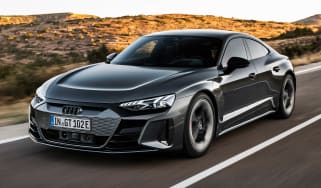
Audi e-tron GT review
Sleek electric saloon has excellent dynamics and huge performance, but tech is a notch behind the class standard

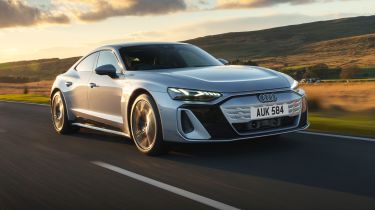

Our opinion on the Audi e-tron GT
It took some time, but the Audi e-Tron GT has been polished into one of the best high-end EVs on sale. It’s expensive, and there’s not a huge amount of space inside, but the e-Tron GT drives with exceptional poise and precision, without being uncomfortable day to day. If you’re willing to pay the money, high-end RS and RS Performance models also offer impressive levels of speed, and if you spend a little more, the active suspension really does set the class standard for ride and handling.
About the Audi e-Tron GT
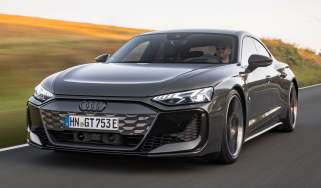
The year 2021 might not feel like it was that long ago, but in EV years it’s an age. And yet, despite this being the year Audi introduced its eccentric, low-riding e-Tron GT sports saloon, it’s only become more impressive in 2026 thanks to a set of wide-ranging yet deftly-applied updates. Available in four different models, the e-Tron GT – and the Porsche Taycan that is ideologically connected to it – are still the benchmarks in high-end EV engineering and calibration.
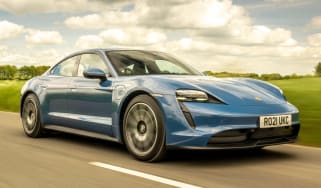
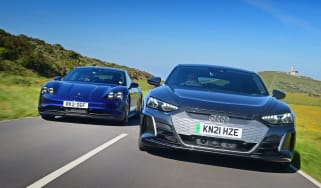
The all-electric Audi e-tron GT four-door is similar to the Porsche Taycan in more than concept, too, because the pair share a fundamental architecture. Audi’s take on a four-door high-performance EV is a little less focused than Porsche, though, trading the latter’s firm suspension and meaty steering for a softer ride and less demanding character. In other words, it rides and drives with a more laid-back manner.
Used - available now

2024 Audi
E-Tron GT
26,625 milesAutomaticElectric
Cash £38,186
2024 Audi
E-Tron GT
27,272 milesAutomaticElectric
Cash £32,384
2024 Audi
E-Tron GT
30,592 milesAutomaticElectric
Cash £35,990
2024 Audi
E-Tron GT
40,808 milesAutomaticElectric
Cash £34,477One ramification of sharing so much with the Porsche, though, is the interior cabin space, or lack thereof, because this low-riding model is more of a four-seater coupe than a traditional saloon. Those hoping for cutting-edge tech will also be disappointed; the in-car tech is pretty old-hat in 2026 even though the chassis, battery and charging capabilities are all still top of the class.
Regardless of its age, though, this is a superb cruiser, so on top of the impressive new range figures, the e-Tron GT is also one of the most comfortable cars on the road – so long as you tick the right option boxes. It’s also incredibly fast in its RS forms.
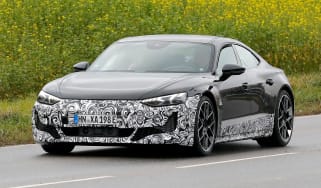
The update that came along in 2025 brought with it a new range structure, the newest of which has only just joined the line-up.
Audi e-tron GT prices and latest deals
All e-tron GTs feature a dual-motor layout and 105kWh-gross battery pack, but differ in outputs and performance. The entry-level Quattro opens the bidding at £89,505, with the S e-Tron GT coming in at £108,775, the RS e-Tron GT at £127,375, while the top-ranking Performance will set you back £143,875.
Of course, you can spend yet more if you wish, beacuse Audi’s usual trim levels apply across the range. For each variant, you can upgrade to the Vorsprung variant for anywhere between £20,000 and £25,000. In effect this throws in a kitchen-sink’s worth of options, and gives all models rear-wheel steering, a glass roof with switchable transparency, massaging seats, a head-up display and more.
RS models then add a further Carbon Black variant in the middle that brings with it some styling additions, but not the added tech features. The absolute pinnacle of the e-Tron GT, and therefore entire Audi range, is the RS e-Tron GT Performance Vorsprung, which costs a colossal £166,425. It is worth noting that this model also then adds in features such as ceramic brakes, active ride control, and forged 21-inch wheels in a package with a 0-62mph time of just 2.5 seconds.
Build your perfect Audi e-tron GT with the Auto Express Buy a Car service and you can save thousands of pounds. We also have a number of e-tron GT leasing deals to choose from, and we can even help you to sell your car.
Performance & driving experience
Pros |
|
Cons |
|
Having been on sale now for the best part of five years, you could be forgiven for thinking the game had moved on when it comes to high-end EVs. This is not the case with Audi’s e-Tron GT.
It is built on the ‘J1’ platform developed jointly with Porsche, and assembled in the high-tech German factory that previously built the R8 supercar. Yet thanks to a set of key, and very impressive updates, it has aged into a finely honed product. The Porsche Taycan-derived base was always there, it just needed some time and a more focused rationale to realise it.
As with the Porsche, all e-tron GT models have a quoted peak horsepower figure and an overboost figure that’s available for short bursts or during a launch-control sequence. They have a staggered powertrain set-up, meaning the rear motor produces more than the front, which gives a distinct rear-drive feel. The back-axle motor also has a two-speed gearbox, giving it an ‘acceleration’ gear and ‘cruising’ gear that help with performance and economy.
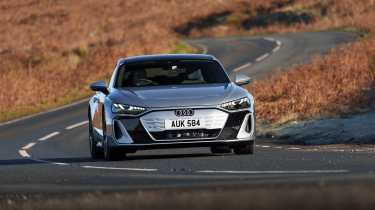
The e-tron GT is a big and heavy car, at 2.3 tonnes, but by positioning all the battery weight low down in the floor it means the Audi is very well balanced and isn’t prone to leaning much in bends. As with the Taycan, there’s an impressive sense of poise when cornering, although the e-tron GT’s softer suspension settings plus its lighter steering means the Taycan feels more engaging.
There’s still a directness and precision to the e-tron GT’s steering that makes it easy to place the front end of the car through corners, though. Its weight is effectively masked by the air suspension over all but the most challenging roads, while the four-wheel steering of Vorsprung models reduces the turning circle to that of a family hatch.
Cast-iron discs handle braking as standard, although more fade-resistant carbon discs are available on RS e-tron GT models. There’s also a regenerative-braking function from the twin electric motors, and it’s this which has been substantially updated in these new models. Not only are the powertrains more efficient, thanks to higher levels of brake regeneration, but the pedal feel is also much better than on the original car. This is due to brand-new hardware across the entire braking system, and doesn’t just make it easier to drive at low speeds, but gives you the confidence that you’d expect of such a heavy car with such massive speed capabilities.
| Model | Power | 0-62mph | Top speed |
| e-Tron GT Quattro | 495bhp (575bhp) | 4.0 | 155mph |
| S e-Tron GT | 583bhp (671bhp) | 3.4 | 155mph |
| RS e-Tron GT | 764bhp (845bhp) | 2.8 | 155mph |
| RS e-Tron GT Performance | 831bhp (912bhp) | 2.5 | 155mph |
Performance, 0-60mph acceleration and top speed
Entry-level Quattro models produce 495bhp, (with 575bhp on overboost) that’ll get it from 0-62mph in four seconds during a launch-control sequence. The mid-spec S e-Tron GT ups this to 583bhp (671bhp) and drops the acceleration time to 3.4 seconds. Both of these models are more suited to cruising, despite the impressive figures, and come with the same more understated design.
At the higher-end of the spectrum are the two RS models, starting with the base car, which comes with 764bhp (854bhp) and can dip down to 2.8 seconds on the 0-62mph sprint. But it’s the headline-grabbing Performance with its 831bhp (912bhp) total and 2.5 second 0-62mph time that is most impressive.
Performance in this flagship model is truly incredible. Traction and road-holding are equally spectacular, and even on a greasy road it’ll have your guests (and their lunch) pressed firmly against the soft Nappa leather sports seats.
What might even be more impressive than the outright performance, though, is how it’s metered out to the driver. There’s a natural and responsive feeling to the throttle and brakes that makes it feel intuitive, and not uncontrolled. As many new-age manufacturers are finding out, it can be relatively easy to produce big power outputs from electric motors, but it’s quite another to apply them to a car in a way that feels natural and controlled.
Outright throttle, steering and brake response might not quite be at the levels of the benchmark Taycan, but in their place is a more relaxed, rounded and low-effort experience. Critically, it feels like a totally different beast to the e-Tron GT that arrived back in 2021.
Town driving, visibility and parking
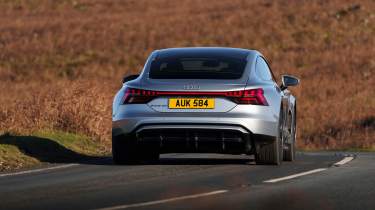
The e-Tron is something of a packaging paradox in many ways, because somehow it’s quite easy to see out of and yet difficult at the same time. Thanks to its Porsche-derived bones, the seating position is very low, and the shallow windscreen means you have to stay low, but the scuttle is also low, so it’s not too hard to see out up front. The new steering wheel also helps, because its smaller-diameter wheel better fits the cabin volume.
However, take a look over your shoulder and rearward visibility is very tight, and the thick B-pillar and rising windowline make it tricky to place the rear of the car.
When it comes to the low-speed driving, though, the GT is a joy. The general setting of the suspension is soft, calm and controlled, and even with bigger 21-inch alloys fitted it serenely filters out bumps and lumps in the road. Cars on active suspension have an uncanny ability to make most imperfections disappear completely, although physics does rear its head if you hit the sharp edge of a pothole. It can send a crash through the cabin.
Cars with rear-wheel steering are easy to manoeuvre. However, it can be a little trickier to parallel park because the rear pivot point is no longer stable. Some brands, such as BMW, do well to minimise this, but others like Mercedes make it nearly impossible to smoothly reverse park without constant corrections. This Audi sits somewhere between.
A final note is that all models sit low to the ground, so you’ll have to keep an eye out for tall speed humps and steep driveways. All versions have a suspension lifter function, but the actual control for it is buried inside the Drive Select interface. It also doesn’t have a Mercedes-like GPS tag function to automatically lift when hitting that location.
Country road driving and handling
High-speed driving on open roads is where the e-Tron comes into its forte. The chassis has a wonderful balance and a low centre of gravity, yet the overall suspension tune is relatively soft. This makes it a wonderful companion for flowing down a fast A or B-road, something made better in this latest generation thanks to the steering having more feel and accuracy, plus the much-improved brake feel.
When the roads tighten up, there’s a huge amount of grip at both ends, and even in RS models, with their incredible surplus of power, traction is not an issue. Opt for Sports mode in the Drive Select screen and the dampers do appreciably tighten up to help nail down the body control, and cars with active suspension take this one step further by all-but totally eliminating body-roll – yet it does so without removing too much feel.
Get really excited and the rear-bias of the power delivery starts to make itself noticeable, but thanks to the much improved brakes, the feeling of mass is now much less apparent. Driving the e-Tron GT in Comfort mode is like operating in a high-speed vacuum cleaner, but if you want to be more involved, Sports and RS drive modes (the latter specific to the RS models) give you just enough extra feedback to feel genuinely engaging.
Motorway driving and long-distance comfort
At motorway speeds, the e-Tron is a superbly refined and comfortable cruiser. At 70mph, models on active ride could just be one of the best-riding cars on sale, and they do so without the sometimes ‘baggy’ feeling that comes with very high-end luxury cars.
The only chink in the armour here is road noise, which is inevitable on a car with such large tyres. Ultra-high-performance rubber on the RS models only add to this, but it’s not as pronounced as on the rival Porsche Taycan, and the laminated glazing on higher-spec variants further helps to minimise the roar.
"The e-Tron GT has improved a huge amount over the first one, and it’s across the board. Audi’s high-end EV has finally hit the highs it always should have reached." - Jordan Katsianis, news editor.
Range, charging & running costs
Pros |
|
Cons |
|
No car costing more than £87,000 is going to be a cheap date for a private buyer, electric or otherwise. However, anyone who can run the e-tron GT as a company car is onto an absolute winner thanks to HMRC's efforts to incentivise the uptake of electric vehicles.
The Benefit-in-Kind (BiK) company car tax rates for the e-tron GT are far lower than they would be for a regular petrol, diesel, hybrid, or plug-in hybrid. This means even a higher-rate tax payer will save thousands running an e-tron GT compared with the equivalent Audi S8.
However, you can expect hefty service and maintenance costs from your Audi main dealer, while the combination of vehicle weight and performance means there’s the potential for frequent tyre replacements. You can claw some money back in reduced brake pad and brake disc wear by utilising regenerative braking more often to slow down, though.
Electric range, battery life and charge time
All versions of the e-tron GT share the same 105kWh (97kWh usable) battery, this is around 12kWh up on the previous version, and together with efficiency improvements and more effective regenerative braking, the on-paper range figures are much improved.
Audi quotes an official maximum of up to 386 miles for the e-tron GT Quattro, this is 79 miles more than the original Quattro variant. Each of the more powerful models have lower values in each step, but none catastrophically affect the range. The S, RS and RS Performance models post 375 miles, 368 miles and 365 miles respectively, and all represent similar figures to the equivalent Porsche Taycan.
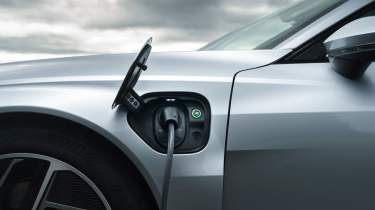
Charging an e-tron GT on an 800V charger from 10 to 80 per cent should take around 18 minutes. Most owners will probably look into the convenience of home charging, and using a standard 7kW wall box installation should take around 14 hours to fully recharge a flat battery.
| Model | Battery size | Range | Insurance group |
| e-Tron GT Quattro | 105kWh | 386 miles | 50 |
| S e-Tron GT | 105kWh | 375 miles | 50 |
| RS e-Tron GT | 105kWh | 368 miles | 50 |
Insurance groups
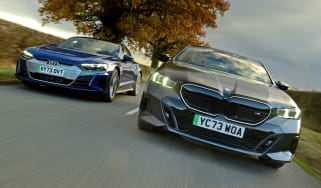
Insurance costs are not an area where e-tron GT drivers will be able to make savings, because the combination of extreme performance and expensive repair costs means premiums for all models are in the highest Group 50 bracket. If you need something cheaper, you should look at a BMW i5, which starts in group 43.
Tax
VED road tax is capped at £195 for EVs, plus the £425 luxury car tax surcharge, equating to a £625 bill. This is payable from the second to the sixth year of ownership. EVs are no longer exempt from the Congestion Charge in London, but they do have a discounted rate of £13 per day.
Depreciation
German high-performance saloons have typically looked like extremely good value on the used market thanks to crippling depreciation figures. Unfortunately, the e-tron GT continues this trend, because our experts predict that after three years and 36,000 miles, the Audi will retain between 37-44 per cent of its original value, with the pricey Vorsprung trim being the worst performer.
We’d suggest looking at the BMW i5 instead if you need something that depreciates less, because that is predicted to be worth between 49-52 per cent over the same time period.
Interior, design & technology
Pros |
|
Cons |
|
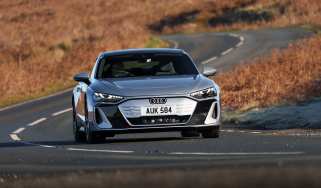
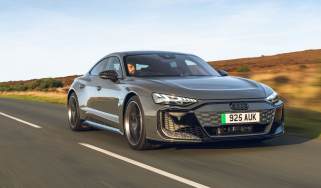
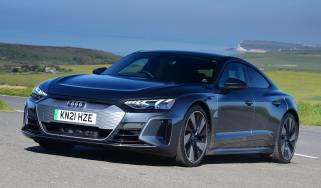
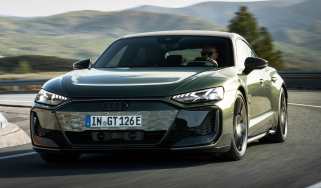
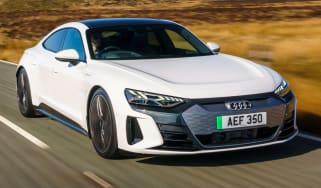
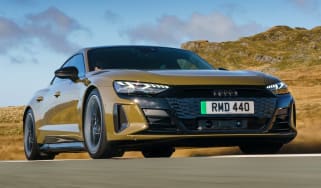
There’s no doubt the e-Tron GT is a striking-looking car, but despite once being the template for future Audi models across the range, reality looks quite different. Audi is about to employ a much cleaner and less cluttered styling language under a change in design leadership. This will likely date the e-Tron GT quicker than its sister Porsche. However, while styling is a subjective matter, its proportions are definitely dramatic enough to look like more than just a simple saloon car.
The low-slung look is not a design trick, but enabled by an underfloor battery pack with built-in footwells for rear passengers. This gives passengers in the rear a place to put their feet, and means the seats can be set lower, allowing for its low-profile coupé-style roofline without harming practicality.
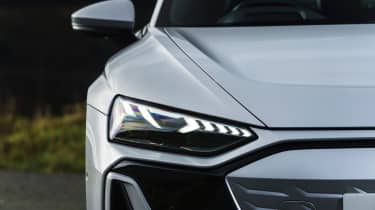
As you’d expect, the e-tron GT’s profile is similar to the Porsche Taycan’s, but the two cars have distinctly different front and rear ends. The e-tron GT has a flat and wide bonnet and muscular haunches, while closer inspection reveals details such as the active air vents in the grille that close for streamlining and the wide rear diffuser and extendable rear spoiler. Indeed, the active-aero features help reduce the drag coefficient to just 0.24.
Interior and dashboard design
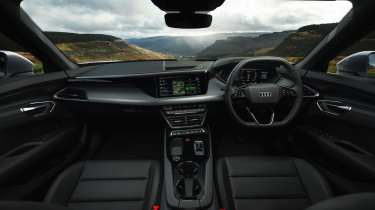
Inside the e-Tron’s ambience is less futuristic than one might have expected from a flagship electric Audi saloon. Although the Virtual Cockpit instrument display and central touchscreen are crisp and tidy, you don’t quite get the wall-to-wall tech feeling that the extended double screens of some contemporaries provide, such as the BMW i5.
There is something quite sculptured and interesting about the scalloped-out surfaces, though, and the Audi-familiar materials are all underpinned by an almost Porsche-like solidity – funny that. The GT’s cabin isn’t a highlight, but unless you want huge screen sizes, neither is it a detractor. It would just be nice if more colour and trim options were available considering the price point.
Materials and build quality
The interior design itself is relatively restrained, and even somewhat traditional, although Audi makes much of its use of environmentally-sourced trim materials such as a vegan ‘leather’ and recycled wood finishes. You can’t fault the fit and finish either, which is up to the standards you would expect of a top-level Audi.
We would love to see more variety in the colour and trim options, though. Compared with some rivals, such as the Porsche, there’s a lack of personalisation, and while elements like wool-fibre interiors and open-pore wood were once enough to lift it above the average, customers looking for something a little more special will be disappointed by the lack of variety.
Infotainment, sat-nav and stereo
The e-tron GT gets Audi’s MMI Touch navigation system running on a 10.1-inch colour display in the centre of the dashboard, which is linked to the 12.3-inch Virtual Cockpit screen that replaces a traditional instrument pack in the binnacle ahead of the driver. You also get the Audi Wireless Smartphone Interface with Apple CarPlay and Android Auto connectivity and wireless charging.
"It’s almost a novelty, climbing into a high-end luxury car and not being bombarded by screens. But unlike future Audis, which will use this technique as a point of difference to screen-reliant rivals, the e-Tron GT is a few steps away simply because Audi didn’t put enough investment into bespoke fittings in the first place." - Jordan Katsianis, news editor.
Boot space & practicality
Pros |
|
Cons |
|
In spite of its low-profile sporty looks, the e-tron GT is a comfortable and spacious cruiser. The interior layout is focused around the driver, who is separated from the passenger by a wide centre console, while the central touchscreen is angled toward the driver, too.
A pair of large drink holders are located between the seats, and the wireless phone charging pad lives in a recess on the console. The doorbins are a little shallow, and have limited access due to the armrests above them, making it difficult to store a large bottle of water. The glovebox is complemented by an additional lidded compartment under the centre armrest for stashing items out of sight. It’ll be fine for some, but the BMW i5 offers greater storage options.
The high quality of fixtures and fittings add to a generally welcoming ambience throughout the cabin, while the lack of engine noise helps to create a relaxed travelling environment for all onboard.
Twin charging flaps – one on each side behind the front wheels – make access easy. Two charging cables are supplied as standard; a Type 2 cable for public AC chargers, and a three-pin plug adaptor for home charging without a dedicated wallbox.
Dimensions and size
The e-tron GT isn’t unusually big for a luxury executive model, but it is unusually low. Its 4,990mm length and 1,964mm width compare closely with the Porsche Taycan, but are a little smaller than the Polestar 5.
Dimensions comparison | |||
| Model | Audi e-tron GT | Porsche Taycan | Polestar 5 |
| Length | 5,004mm | 4,963mm | 5,087mm |
| Width | 1,964mm | 1,966mm | 2,015mm |
| Height | 1,402mm | 1,381mm | 1,425mm |
| Wheelbase | 2,900mm | 2,900mm | 3,054mm |
| Boot space | 405 litres | 407 litres | 365 litres |
Seats & passenger space
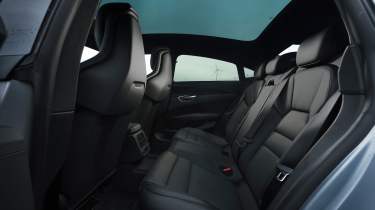
The Audi e-tron GT cabin is roomy up front in spite of its low-slung appearance. While you might expect to find headroom restricted, especially in the back, the battery pack has been designed with a footwell recess built into it, adding to the available space for rear passengers’ feet under the front seats.
The design requirement for a large battery also necessitated a long wheelbase, which means there’s no shortage of legroom. There’s loads of shoulder room upfront, but the heavily sculpted outer rear seats – which feel like individual armchairs – mean the raised central position isn’t as welcoming for three adults to sit comfortably in the back compared with something like a BMW i5. It’s definitely not as spacious in the second row as the Polestar 5, either.
The rear doors open wide to give good access, too, but the car’s low cabin means you need to be relatively supple to spring in and out gracefully, and it could make putting a child into a car seat a bit difficult. The e-tron GT has two Isofix child-seat mounting points on the two outer rear seats.
A panoramic sunroof gives the e-tron GT a light and airy feel in a cabin that might otherwise seem a little claustrophobic. With that in mind, we’d suggest you think carefully about the carbon roof option on an RS model.
Boot space
The e-tron GT doesn’t have a huge boot, although its 405-litre capacity is respectable, especially next to the 365 litres of the Polestar 5. The e-tron GT does at least have a further 85 litres available under the bonnet, where owners can conveniently keep grimy charging cables well away from their clean luggage.
The car’s practicality is compromised a little by the shape of the narrow boot opening, but if you want a luxurious electric load-lugger, Audi will happily direct you to its Q8 e-tron SUV.
Towing
There is no option for a factory towing kit on an e-Tron GT, despite Porsche offering such equipment on the technically related Taycan Cross Turismo. If this is something you’d like to do, we’d suggest heading to the more versatile Porsche.
"The cabin isn’t quite as high-class or tech-forward as some rivals, but it is well built and should remain relatively timeless because of that." - Jordan Katsianis, news editor.
Reliability & safety
Pros |
|
Cons |
|
To date, the Audi e-tron GT hasn’t been crash-tested by safety experts Euro NCAP, and while its closely related sibling, the Porsche Taycan, has been (and received the maximum five-star rating in 2019), that result hasn’t been validated for the e-tron GT.
Unless you opt for the pricier Vorsprung trims, some of the advanced safety systems are optional. You’ll need the Tour pack for adaptive cruise control and traffic-sign recognition, while the City Assist Pack includes lane-change assistance and cross-traffic warnings.
The Audi brand came 19th out of 31 in the most recent Driver Power best manufacturer rankings, while Mercedes was second and BMW eighth. Porsche didn’t feature in last year’s survey, but has performed well when it has in recent years.
The overall build quality, and the integrity of the e-tron GT’s fundamental engineering is highly impressive, though. The car can receive over-the-air updates, so new software can be sent remotely, minimising the need to visit the dealer.
Buying and owning
- Best buy: Audi e-tron GT engine trim level
As with all cars in the Audi line-up, the e-tron GT is covered by a three-year or 60,000-mile warranty. That’s fairly standard in the luxury-car sector, lagging behind the three-year/unlimited mileage policies of BMW and Mercedes, or the five years of cover provided by Genesis.
Audi also issues an eight-year or 100,000-mile warranty that guarantees battery performance above 70 per cent capacity during that period – hopefully eliminating a major cause for concern amongst some potential electric car customers. It’s worth adding that Genesis has a longer 120,000-mile guarantee, while Mercedes goes even further by guaranteeing the battery for 10 years and up to 155,000 miles.
Audi e-tron GT alternatives
It’s impossible not to consider the Porsche Taycan when thinking about a high-end EV saloon, but now more than ever there’s a good reason to consider the Audi over the Porsche. The Taycan is a more aggressively set-up car than the Audi, with a stiffer ride and heavier steering. This yields more feel and response for some customers, but Audi's more balanced and laid-back approach will likely suit most drivers better.
If you’re looking for the ultimate in high performance, though, the Porsche still pips the Audi, with its Turbo S and Turbo GT models advancing on even the RS Performance model’s incredible statistics.
Polestar’s all-new 5 is a force to be reckoned with, because while it may lack some of the headline tech and performance toys of its German rivals, it hits back with hardcore engineering. The Polestar 5 Dual Motor Performance drives with a more natural feel and poise than the high-tech competition. It’s also more spacious inside and is considerably less expensive.
At the other end of the scale, Mercedes-AMG is about to drop its new four-door EV, which promises to change the stakes when it comes to high-end electric performance cars. Its 1,000bhp-plus power figure, cutting-edge battery tech and axial flux motors will all move the game on in a similarly sized and formed four-door supercar body.
Whether the Audi will still feel as advanced in the near future will be a hard question to answer; but the end of its production won’t be far away anyway as the brand readies its manufacturing facility for Audi’s next Porsche-derived EV performance car: a road-going version of the fascinating Concept C.
Frequently Asked Questions
Yes, this is a refined and elegant cruiser that also has good range capabilities and a nicely built cabin.
Deals on the e-tron GT and alternatives