Skoda Kodiaq review
The Skoda Kodiaq is a roomy SUV that offers plenty of ‘simply clever’ touches and up to seven seats

Our opinion on the Skoda Kodiaq
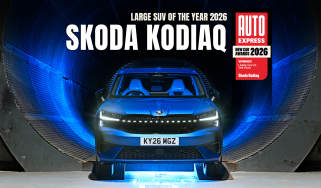
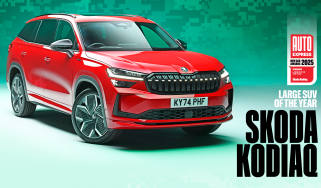
We’re fans of the second-generation Skoda Kodiaq because it builds on the proven formula of the original model. It’s spacious and efficient, with plenty of clever touches, while the cabin has taken a step upmarket compared with the first Kodiaq. This combination of talents has led to the Kodiaq winning our Best Large SUV award on multiple occasions.
Unlike rivals such as the Hyundai Santa Fe and Kia Sorento, not every Kodiaq is a seven-seater, which means its starting price is a little lower than those models. If you do have fewer passengers to ferry around, the other upside of the cheaper five-seater is even more luggage space, so you can’t go too far wrong.
About the Skoda Kodiaq
Where the Skoda Kodiaq has an advantage over many of its rivals is in terms of price, with the range starting at around £40,000. That might sound expensive for a Skoda, but when you compare it with rivals, the entry-level Kodiaq is on a par with some smaller mid-size SUVs. Higher-spec versions are better value for money than most other seven-seat rivals, too.
For the money, you get a family SUV with plenty of space and practical touches. The engine range comprises conventional petrol and diesel choices, plus there’s a plug-in hybrid Kodiaq iV that offers a long range on electric power alone. Both front and four-wheel drive options are offered, while higher-spec versions come with seven seats (they’re an option for the rest of the range, too).
Used - available now

2024 Skoda
Kodiaq
32,194 milesAutomaticPetrol1.5L
Cash £23,964
2022 Skoda
Kodiaq
56,918 milesAutomaticDiesel2.0L
Cash £21,011
2024 Skoda
Kodiaq
30,487 milesAutomaticPetrol1.5L
Cash £24,276
2022 Skoda
Kodiaq
60,938 milesManualPetrol1.5L
Cash £17,337The Kodiaq line-up consists of six trim levels, along with a range of ‘Design Selections’. These are taken from the Skoda Enyaq electric SUV and feature ‘coordinated colours and materials’, according to Skoda. ‘Loft’ gets grey recycled fabric seat upholstery, and ‘Lounge’ uses grey suede microfibre upholstery with a combination of wool, artificial leather, and x-shaped yellow stitching. ‘Suite black’ has perforated artificial leather with grey stitching, whereas ‘Suite Cognac’ uses leather upholstery in black with x-shaped needlework in a ‘Cognac’ brown colour.
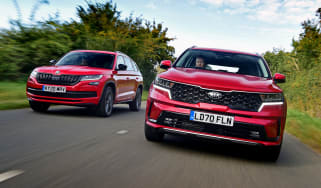
Our experts have tested every variant of the Skoda Kodiaq, including a real-world twin test alongside the Hyundai Santa Fe.
Performance & driving experience
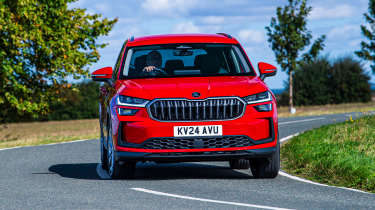
While some rivals are embracing hybrid drive, the Skoda Kodiaq is more cautious with its electrification options. The entry point to the range is the 148bhp 1.5 TSI e-TEC four-cylinder petrol, which has mild-hybrid assistance and a cylinder-deactivation system that cuts in under light throttle loads. This powertrain is fitted with a seven-speed DSG twin-clutch gearbox.
The 2.0 TDI diesel is available in two power outputs, with 148bhp and front-wheel drive, or 190bhp and four-wheel drive. Both come with the same seven-speed dual-clutch auto as the 1.5 TSI.
The Kodiaq iV plug-in hybrid makes a combined 201bhp and 250Nm. These models are front-wheel drive and, unlike the rest of the lineup, are fitted with a six-speed automatic gearbox instead of a seven-speed auto.
Anyone planning on taking their Kodiaq off-road should specify the Rough Road Package, which gives you extra underbody protection to shield vulnerable parts from rocky terrain. If you just need a car to get you down a muddy farm track, we found the two-wheel drive version still coped perfectly well.
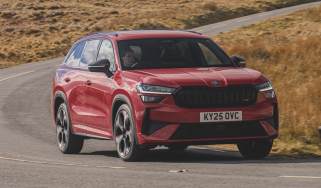
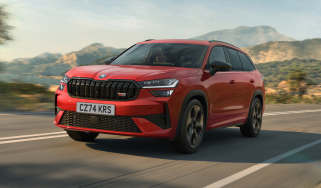
If you’re more bothered about on-road performance than off-roading prowess, you'll need to look towards the Kodiaq vRS. Its beefy 2.0-litre TSI petrol engine delivers 261bhp and 400Nm to all four wheels through a seven-speed DSG gearbox.
| Model | Power | 0-62mph | Top speed |
| Kodiaq 1.5 TSI e-TEC 150 (7 seats) | 148bhp | 9.9 seconds | 127mph |
| Kodiaq 2.0 TDI 193 4x4 | 190bhp | 9.0 seconds | 134mph |
| Kodiaq 2.0 TDI 150 | 148bhp | 9.6 seconds | 127mph |
Performance, 0-60mph acceleration and top speed
The 1.5 TSI e-TEC 150 delivers a 0-62mph time of 9.7 seconds and a top speed of 128mph when fitted to the five-seater Kodiaq. The heavier seven-seat version has a mildly slower 0-62mph time of 9.9 seconds and a 127mph top speed.
Models fitted with the 2.0 TDI 150 offer similar performance at 9.6 seconds and 127mph in five-seat guise, while the seven-seater manages 0-62mph in 9.8 seconds and has a top speed of 126mph.
Choose the more powerful 2.0 TDI 193 that comes with four-wheel drive and seven seats as standard, and your car will have an official 0-62mph time of 8.0 seconds, plus a top speed of 134mph.
The five-seat Kodiaq iV plug-in hybrid provides even more power, but the extra weight of the hybrid system blunts this car’s outright performance. It’s capable of 0-62mph in 8.4 seconds on the way to a top speed of 130mph.
Naturally, the Kodiaq vRS is the quickest of them all. This variant will blast from 0-62mph in 6.4 seconds, which certainly isn’t sluggish for a car of this size and weight. Top speed stands at an equally brisk 143mph. For the sake of comparison, the fastest Hyundai Santa Fe covers the 0-62mph sprint in 8.0 seconds.
Town driving, visibility and parking
All of the engines offered in the Kodiaq respond strongly from low revs, so you don’t have to work them too hard to get this large SUV going. There’s no hiding its size in narrow streets, but front and rear parking sensors and a reversing camera are fitted as standard on all models, while light steering and controls mean positioning the car is relatively easy.
For the most peaceful and smoothest experience, you’ll want the PHEV, as this spends most of its time in electric mode at lower speeds.
Country road driving and handling
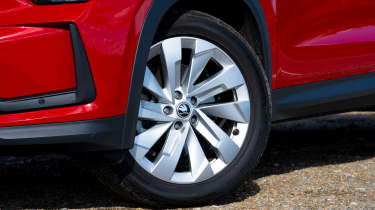
At higher speeds, the Kodiaq delivers decent comfort, although the ride can become a little fidgety over minor bumps and undulations. This is an issue that’s amplified on cars that are fitted with the larger 19- and 20-inch wheel options (18-inch wheels are standard on SE models).
While there’s fidgeting, the overall set-up is soft, so there’s body roll in corners, but it’s not as severe as you’ll experience in some rivals, because the Kodiaq has a relatively low kerbweight for a seven-seat SUV. The light steering doesn’t offer much feedback, but the Skoda feels more like a large hatchback to drive than a big 4x4, and for many people, that will help inspire confidence that they can manage this SUV.
Motorway driving and long-distance comfort
At smaller throttle openings, the Kodiaq’s twin-clutch gearbox short-shifts to help fuel efficiency. When you’re accelerating harder, there’s some engine noise to be heard: the 1.5 TSI isn’t bad, but the 2.0 TDI can get a bit raucous when pushed.
Thankfully, things settle down once you’re up to speed, and the Skoda is a comfortable cruiser on the motorway, with minimal road and wind noise to be heard. On the 1.5-litre petrol, Skoda’s cylinder-deactivation system is imperceptible in its operation – the only clue that it’s working is a small icon that appears within the dials.
“Neither car is designed to be entertaining in corners, but it’s the Kodiaq that is more agile than the Hyundai Santa Fe.” - Dean Gibson, senior road test editor.
MPG & running costs
Pros |
|
Cons |
|
The Skoda Kodiaq offers something to suit every driving scenario, with hybrid, plug-in and diesel power options that provide optimal efficiency in different conditions.
If you don’t have the ability to charge the PHEV, the mild-hybrid offers something of a compromise, and claimed fuel economy of up to 46.3mpg for the seven-seat SE version is reasonable for a large petrol-powered SUV such as the Kodiaq. However, this will be difficult to achieve in the real world if you regularly drive with a full complement of passengers.
The diesels will be able to deliver good long-distance economy, and shouldn’t suffer too much of a penalty when fully loaded or towing. The less-powerful unit claims up to 53.4mpg, while the punchier 190bhp isn’t too far behind at 45.5mpg.
As is very often the case, maximum performance means minimum efficiency in the case of the Kodiaq vRS. This pure-petrol flagship only manages up to 33.8mpg on paper, but flooring the right pedal will inevitably cause this figure to drop even further.
Opting for four-wheel drive also takes its toll on efficiency. When we tested the 2.0-litre petrol 4x4 in Sportline trim, we only managed an average of 33.3mpg after a mixture of driving. That being said, this was at least reasonably close to the official WLTP figure of 36.6mpg.
| Model | MPG | CO2 | Insurance group |
| Kodiaq SE 2.0 TDI 150 2WD | 53.4mpg | 139g/km | 20 |
| Kodiaq SE 1.5 TSI e-TEC 2WD | 47.1mpg | 136g/km | 18 |
| Kodiaq 2.0 TSI vRS 4x4 | 33.8mpg | 190g/km | 31 |
Electric range, battery life and charge time
The Kodiaq iV plug-in hybrid features a 25.7kWh battery under the boot floor that offers a claimed maximum range of up to 76 miles from a full charge. If you’re able to keep the battery topped up, then there’s a high possibility that you could cover a day’s driving on electricity alone, although it’s reassuring to know that it’s backed up by the petrol engine.
The latest version of the big Skoda’s plug-in hybrid powertrain features DC charging rated at up to 40kW. This means the Kodiaq’s battery can go from 10 to 80 per cent capacity in less than half an hour. If you’re charging at home using a typical 7.4kW home wallbox charger, it’ll take around three and a half hours to fully charge the battery.
| Model | Battery size | Range | Insurance group |
| Kodiaq 1.5 TSI iV SE | 25.7kWh | 76 miles | 24 |
| Kodiaq 1.5 TSI iV SE L | 25.7kWh | 74 miles | 25 |
| Kodiaq 1.5 TSI iV L&K | 25.7kWh | 72 miles | 26 |
Insurance groups
Insurance groupings for the Kodiaq range from 18 to 26 (out of 50), with engine power outputs determining each model’s ranking. There’s no increase in the insurance group if you choose a seven-seat model over a five-seater. The Hyundai Santa Fe, meanwhile, will be quite a bit pricier to cover because it resides in groups 33 to 36, while the Volkswagen Tayron is in groups 25 to 35.
Tax
The base SE five- and seven-seat Kodiaq models, along with the Edition X trim, once the first year’s VED and registration fee are discounted, dip below the £40,000 combustion luxury car tax threshold. You’ll need to completely avoid the options list in order to keep it that way, though. If you do cross this threshold, you’re looking at a combined annual bill of £640 between years two and six after the car is first registered. This covers the luxury car tax and the standard rate of VED road tax.
While the PHEVs offer slightly reduced company car tax rates, business buyers will benefit from far bigger savings if they opt for a fully electric car like the Skoda Elroq or Skoda Enyaq instead. If you require seven seats, you’ll need to look towards models like the Peugeot E-5008. There are other options like the Kia EV9 and Hyundai Ioniq 9, but these are much more expensive.
Depreciation
Our market data suggests that the Kodiaq retains its value well compared with rivals. This large SUV should retain between 49 and 53 per cent of its initial value after an ownership period of 36,000 miles or three years. It’s a very similar story with the Hyundai Santa Fe, which holds on to 49 to 52 per cent after the same period. The Kia Sorento is a little better, retaining 52 to 61 per cent.
To get an accurate valuation of a specific model, check out our free car valuation tool…
Interior, design & technology
Pros |
|
Cons |
|
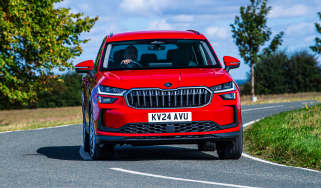
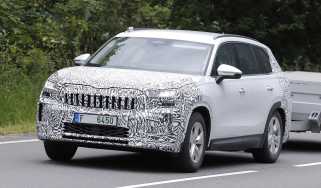
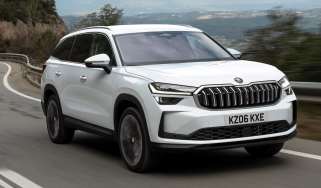
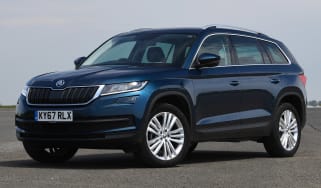
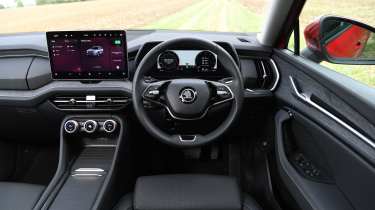
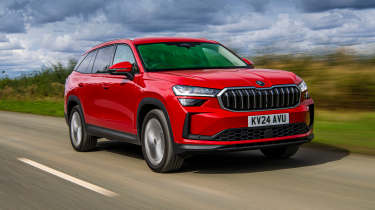
From the outside, the shape of the Skoda Kodiaq is an evolution of the previous generation’s, with sharper lines and a few more angles. It’s a similar story inside, where the car features digital dials, more shapes and a large central touchscreen that incorporates plenty of familiar Skoda cues.
Interior and dashboard design
The Kodiaq’s layout is similar to that of the Skoda Superb, with most of the car’s controls on the main touchscreen, while a trio of rotary dials with digital displays beneath the central air vents adjust various climate functions. The steering wheel is a two-spoke design seen in several other Skoda models (SportLine and vRS versions replace it with a racier three-spoke wheel), and it features a pair of neat knurled volume and station-selection switches.
Materials and build quality
The standard of the materials used in the Kodiaq is pretty good, and the grey plastic trim on the doors and across the middle of the dashboard has been given a unique finish that’s somewhere between rubber and fabric. There’s a surprisingly plush centre armrest for the back seats, too.
The three separate rotary climate controllers are a welcome addition, but they do feel a little flimsy. A silver finish gives the look of metal, but the knobs feel plasticky to the touch and shift in your hand when you use them. The rotating action isn’t very smooth, either, which leaves you with the impression that they’re cheaply made.
Infotainment, sat-nav and stereo
All Kodiaqs come with a 13-inch landscape display that’s squarer than many rival systems. The home screen features large tiles that can be configured to show the most frequently used functions, while there are smaller shortcut keys across the top and bottom of the display.
The system works well and looks sharp, although the flat-screen layout makes the far corners difficult for the driver to reach. The live feed from the reversing camera isn’t as crisp as the rest of the display, either.
As part of Skoda’s ‘Simply Clever’ solutions, a lipstick-sized screen cleaner is included that allows you to wipe greasy fingerprints off the display.
There’s a 10.25-inch driver’s display, too, which is controlled via the steering wheel and offers a variety of layouts, including the option to display navigation maps.
An eight-speaker sound system with a DAB radio is standard, but there is an optional 12-speaker Canton sound system available on all trims as part of the Convenience Plus Package.
“Prices are lower than they are for the Hyundai, but the Kodiaq doesn’t feel any less well equipped, while the broader range of engine options make it more attractive.” - Dean Gibson, senior road test editor.
Boot space & practicality

Pros |
|
Cons |
|
The Skoda Kodiaq is an undeniably versatile and user-friendly family SUV, although some rivals are better seven-seaters.
Dimensions and size
This Kodiaq is 61mm longer than the old model, but it’s still slightly shorter than the Hyundai Santa Fe. The Kodiaq is one of the easier large SUVs to thread through urban streets because it’s narrower than both the Santa Fe and Volkswagen Tayron.
| Dimensions comparison | |||
| Model | Skoda Kodiaq | Hyundai Santa Fe | Volkswagen Tayron |
| Length | 4,758mm | 4,830mm | 4,792mm |
| Width | 1,864mm | 1,900mm | 1,866mm |
| Height | 1,659mm | 1,780mm | 1,668mm |
| Wheelbase | 2,790mm | 2,815mm | 2,790mm |
| Boot space |
910 (5 seats) 745 litres (PHEV) 340 litres (7 seats) |
628 litres (hybrid) 621 litres (PHEV) |
705 litres (5 seats) 345 litres (7 seats) |
Seats & passenger space
There are no complaints about front passenger space, with lots of wheel and seat adjustment to get comfortable. Storage is good, too, with twin gloveboxes, deep bins in the doors and armrest, and a centre console that features a pair of wireless smartphone charging pads. There are two USB-C sockets beneath the climate controls, and a third is next to the rear-view mirror for powering a dash cam.
The Kodiaq’s second row is good, but it’s not the widest bench if you’re travelling three abreast – rivals such as the Hyundai Santa Fe and Kia Sorento have more space in their middle seats. At least a light-coloured headlining helps the cabin feel bright, and there are climate controls in the back and twin USB-C sockets. However, while the door bins up front are lined with flock to stop items from rattling around, this luxury isn’t available in the rear.
The rearmost row is also a little tighter than in rivals. Access is fair, but the seating is suited to kids rather than adults.
Boot space
The rear of the Kodiaq is better suited to carrying cargo than some rivals, and there’s a decent amount of space for the weekly shop even when all three rows are in use. If all of the seats are folded, then there’s space under the floor to stow the load cover. A cargo volume of 2,035 litres is among the best of any seven-seat SUV on sale, while the five-seat model has slightly more cargo capacity at 2,105 litres.
Towing
The Kodiaq should be a popular model among caravanners, thanks to its spacious interior and the towing capability of its engines. The 2.0 TDI can haul a trailer weighing up to 2,000kg in 148bhp guise, while the 190bhp 4x4 model has a towing capacity of up to 2,300kg. Even the plug-in hybrid Kodiaq iV can tow 1,800kg – 700kg more than a Hyundai Santa Fe, which can only manage up to 1,100kg irrespective of the powertrain chosen.
“If your family car needs to prioritise carrying passengers, then the Santa Fe is the better option. But if it’s cargo capacity that you’re after, then the Kodiaq edges ahead.” - Dean Gibson, senior road test editor.
Reliability & safety
Pros |
|
Cons |
|
The Skoda Kodiaq uses VW Group’s MQB Evo running gear, and as the name suggests, it’s a new generation of the same platform that was used by the original Kodiaq. That means lessons learned with that car are integrated into the current one, which will further ensure reliability.
All of the engines and gearboxes that feature in the Kodiaq – even the plug-in hybrid system – are used in a wide variety of VW models, and they have been developed over many years, so should run smoothly.
The Kodiaq didn’t appear in the most recent Driver Power owner satisfaction survey, but the Skoda brand only managed a below-average 20th out of 30 in the best manufacturer results. Practicality was a strong point, but drivers have been less than impressed with the brand’s technology. Hyundai, meanwhile, wound up in 13th place, while Volkswagen languished in 26th place.
Skoda Kodiaq alternatives
The Skoda Kodiaq has a lot of bases covered as a large family SUV, but there are a number of rivals to choose from. The likes of the Peugeot 5008, Hyundai Santa Fe and Kia Sorento all cover a similar brief, plus there’s further competition from within the VW Group in the form of the Volkswagen Tayron.
While the Kodiaq is one of the cheapest seven-seat SUVs around, if you’re looking for similar practicality on a smaller budget, then there are alternatives such as the Dacia Jogger and van-based MPVs such as the Citroen Berlingo, Ford Tourneo Connect, and Vauxhall Combo Life to consider, all of which offer petrol, hybrid and all-electric options. While they’re all pricier than the Kodiaq, the Kia EV9, Hyundai Ioniq 9, and Volvo EX90 provide three further zero-emission choices in this market.
Skoda Kodiaq pictures
Key updates of the Skoda Kodiaq review
3 August 2026: Latest driving impressions and model information.
Frequently Asked Questions
There are seven-seat versions of the Skoda Kodiaq, but not all cars come with seven seats as standard. It’s an optional extra that costs around £900 for cars in SE trim. The other exception is the Kodiaq iV PHEV - the large drive battery takes up room under the boot floor, so there’s no space for a second pair of passenger seats in the back, meaning this version is five-seat only in all trim levels. SE L and SportLine versions of the Kodiaq with petrol or diesel power are seven seaters as standard.
Deals on the Kodiaq and alternatives