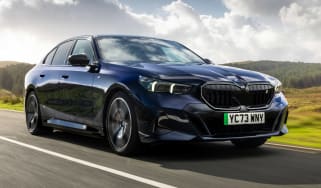
BMW i5 review
Company car users will appreciate the low tax, exceptionally luxurious interior and outstanding refinement of the BMW i5

Our opinion on the BMW i5
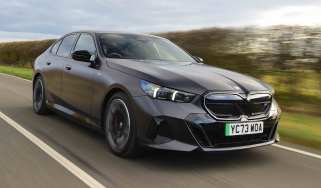
The BMW i5 is an highly impressive executive car because it is supremely well-finished inside, comes with an array of high-end technology, and can travel around 300 miles on a single charge.
Sure, the i5 isn’t the cheapest EV around, but it’s compelling enough to make you question the even pricier BMW i7. We’d like a little improvement in overall efficiency, and it could be a touch better to drive, but if you want a refined long-distance EV, the BMW i5 is one of the more complete options.
About the BMW i5
The i5 is BMW’s response to an ever-increasing number of full-size electric executive cars. While the BMW i4 was a pioneer in the compact exec market, it took the brand a fair while to throw the i5 into the ring with cars like the Audi e-tron GT, Genesis Electrified G80 and Mercedes EQE.
Just like the BMW i4, the i5 uses the same familiar styling of the combustion-powered BMW 5 Series, rather than following a completely bespoke design. It’s this sense of familiarity that’s intended to lure traditional executive car customers — many of whom snap these models up as company cars — into making the switch to an EV.
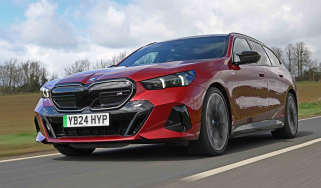
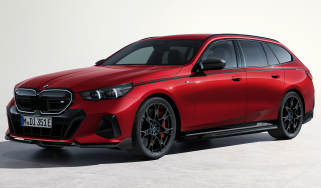
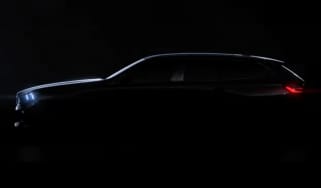
This review focuses on the BMW i5 saloon, but we also have a dedicated review of the BMW i5 Touring Estate. If you’re more inclined towards the combustion models, be sure to check out our in-depth review of the BMW 5 Series.
Used - available now


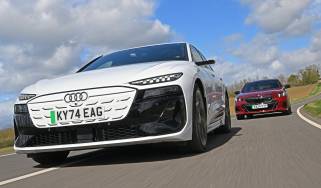
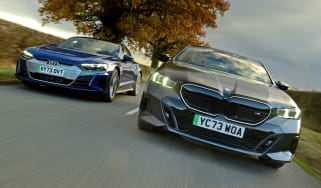
Our expert road testers have put the BMW i5 through plenty of trials since it first went on sale, including a head-to-head twin test against the Audi e-tron GT.
Performance & driving experience
Pros |
|
Cons |
|
Our preferred version of the i5 is the single electric motor eDrive40, which in either Sport Edition, M Sport, or M Sport Pro form puts out 335bhp and 400Nm of torque. With numbers like that, you’d be forgiven for thinking that its 6.0-second 0-62mph sprint is a little conservative, but you must remember, this is no lightweight. Indeed, at 2,205kg, this is a rather portly executive saloon. We still think most will find its initial acceleration off the line brisk enough, but you’ll notice this surge tails off fairly quickly as you approach motorway speeds.
The dual-motor M60 xDrive somewhat solves this problem. It’s the all-wheel drive model with additional four-wheel drive traction, plus 593bhp and an earth-moving 795Nm of torque. This all means the M60 can launch from rest to 62mph in 3.8 seconds – provided you engage the ‘Boost’ mode paddle on the steering wheel before setting off.
| Model | Power | 0-62mph | Top speed |
| BMW i5 eDrive 40 Sport Edition | 335bhp | 6.0 seconds | 120mph |
| BMW i5 eDrive40 M Sport | 335bhp | 6.0 seconds | 120mph |
| BMW i5 M60 xDrive | 593bhp | 3.8 seconds | 143mph |
Town driving, visibility and parking
The i5 is almost eerily quiet at low speeds, and road imperfections are largely kept at bay. You can add Adaptive Suspension Professional for M Sport and M Sport Pro models, and this gives you ‘integral active’ four-wheel steering which helps to reduce the turning circle and make low-speed manoeuvres and parking much easier. Front and rear parking sensors are provided as standard, along with a reversing camera to improve visibility. The Technology pack can upgrade this camera to a full 360-degree system with a top-down view.
Unlike many of its rivals, the i5 doesn’t feature paddles behind the steering wheel to alter the strength of the regenerative braking. You can alter whether you have adaptive or a low amount of regen in the drive modes menu or you can put the gearbox in a stronger B-mode regenerative braking setting, although the rate at which you slow down once you lift off the accelerator isn’t strong enough to offer a one-pedal driving mode, as you’ll find in the cheaper BMW iX3.
Country road driving and handling
Despite its maker's claims, the standard i5 certainly doesn’t handle as deftly as the BMW i4. It feels suitably tied down in a typical BMW way and offers plenty of grip, but we didn’t find the steering to be as sharp or reactive as the existing 5 Series. It doesn't have the responsiveness, precision, or satisfyingly progressive feeling of weight as the Audi e-tron GT, either. The i5 feels like a car designed for comfort over outright driving fun.
The Pro version on M60 models adds active roll control to help keep the i5 on an even keel when cornering hard at speed, and give the impression of greater agility. We weren’t sure that this technology could make the M60 feel nimble given this model’s 2,305kg weight, but it does a remarkable job of disguising such heft through the bends, giving this version far better handling than most large electric saloons.
Motorway driving and long-distance comfort
While it’s a bit lacking in excitement, the i5’s ride quality is excellent, and it controls body movements so well that it’s unflappably stable at high speeds. That’s in contrast to the Mercedes EQE, which feels floaty over undulations on the motorway. Once again, the optional adaptive suspension pays off here, because you can tailor it for an even more comfortable ride on rough sections of road.
The acoustic glazing and quiet electric motor help contribute towards low ambient noise levels, which boosts refinement even further. Below 30mph, road noise is almost imperceptible, while at higher speeds, you’re very well insulated from the sound of wind rushing over the car or from the roar of the tyres on the road surface.
Range, charging & running costs
Pros |
|
Cons |
|
Following our time driving the eDrive40 M Sport, we reckon you’re more likely to see 300 miles of range in the real world rather than the claimed 371 miles.
The 3.1 miles/kWh efficiency figure we got from an M60 version during our Audi e-tron GT vs BMW i5 twin test suggests this model will likely need a recharge after roughly 252 miles. Once again, this falls short of the official WLTP combined figure of 331 miles, although it wasn’t alone in that because the e-tron GT only managed 2.5 miles per kWh, which suggested only 234 miles from its larger 93.4kWh battery.
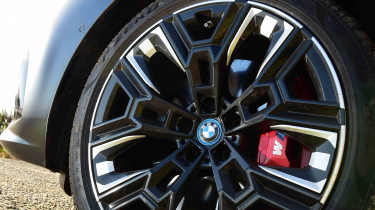
You can use the BMW’s regenerative braking to help harvest energy while slowing to boost efficiency, but there’s also a standard heat pump to provide a more efficient way of heating the interior on a cold morning. Our best advice is to avoid larger wheel sizes because they add rolling resistance that hurts range.
A lofty 205kW peak charging speed means a 10 to 80 per cent top-up should be possible in around 30 minutes. That’s a few minutes quicker than the Mercedes EQE, which has a slower 170kW maximum charging speed and a larger battery pack.
However, many EV drivers use a 7.4kW wallbox charger to charge at home due to convenience and lower costs. A full charge from empty for the BMW i5 using this method will take about 13 hours.
The entry-level Sport Edition comes standard with the AC Charging Professional pack, which increases this capability to 22kW and reduces charging time to just over four hours. That’s handy, but you’ll need a three-phase electricity supply to power it, and most UK homes do not have such a supply.
| Model | Battery size | Range | Insurance group |
| BMW i5 eDrive 40 Sport Edition | 83.9kWh | 369 miles | 43 |
| BMW i5 eDrive40 M Sport | 83.9kWh | 374 miles | 43 |
| BMW i5 M60 xDrive | 83.9kWh | 331 miles | 49 |
Insurance groups
Insurance will be costly due to the i5’s performance and high list price, but at least the eDrive40 M Sport models in group 43 should be cheaper to insure than the Genesis Electrified G80 and Mercedes EQE, because both of these sit entirely within group 50. In fact, even the M60 just about manages to undercut them in group 49.
Tax
If you’re fortunate enough to have the means to run an i5 as a company car, a higher-rate taxpayer could save a fortune on Benefit-in-Kind (BiK) tax compared with the regular 5 Series.
Be aware that all i5 buyers will face the luxury car tax, which adds £440 to your annual VED road tax bill between the second and sixth year of ownership. The planned eVED pay-per-mile tax will also come into play from 2028.
Depreciation
Our market data shows that the BMW i5 takes a bit of a hammering in terms of depreciation. After three years or 36,000 miles, this electric exec only retains between 31 and 35 per cent of its original value. However, this isn’t unique to the i5, because the Mercedes EQE has predicted residual values of only 31 to 34 per cent, while the Genesis Electrifed G80, meanwhile, sits between 35 and 36 per cent. The Audi e-tron GT suffers the most, though, at between 30 to 33 per cent retained value.
Interior, design & technology
Pros |
|
Cons |
|
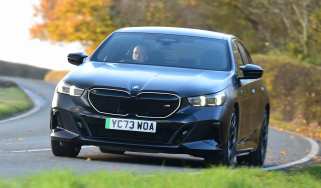
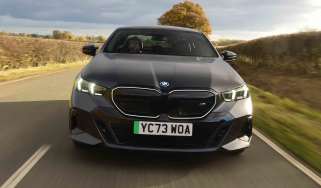
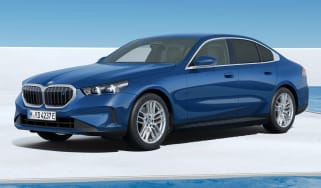
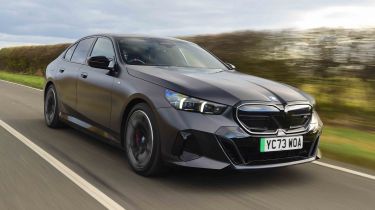
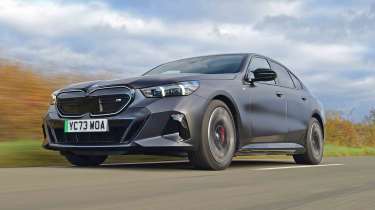
Styling is always subjective, but compared with some of the German brand’s more controversial-looking offerings of late (in particular, the BMW XM), the i5 is reasonably conservative. Sure, it looks more bloated than the previous generation BMW 5 Series, but the i5 is a bigger car.
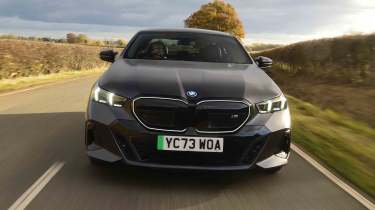
Regular M Sport specification features the most traditional grille in matt grey, while M Sport Pro and M60 models have a version in black trim. The M60 also has a smooth nose that some may find a little odd.
Aside from Sport Edition models that come with a model-exclusive Phytonic Blue metallic as standard, Alpine White is the complimentary colour across the trim line-up. Nine metallic and three pricey ‘Individual’ colour choices follow. The M60 version lets you specify one of the nine metallic choices for free, although given the near six-figure price tag, it’s not a huge saving.
Interior and dashboard design
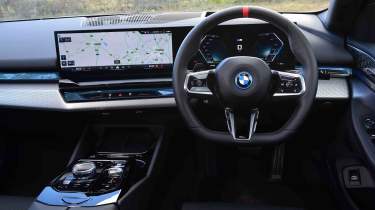
The interior features two large curved screens merging into one another across the top of the fascia, along with the BMW Interaction Bar that bisects the dashboard. This bar changes colour depending upon specific inputs, such as flashing red when the hazards are switched on, or turning from blue to red when the temperature is increased on the climate control system.
Speaking of the climate control system, the vents are hidden in the i5. The air is diffused around the interior to avoid any uncouth gusts of wind hitting your face. It’s said to provide a classier driving environment, but going into the infotainment menu to change the direction of the air flow is an additional complication we could do without – especially while driving.
There are some oddities, too, such as the single left paddle behind the steering wheel. It’s a bit unusual to behold, but this does provide easy access to the car’s Boost function. This ups the performance ante for short bursts and delivers peak power at the flex of your right foot.
Materials and build quality
The i5’s interior is a far more premium offering than the Mercedes EQE, which we’ve found to be a little underwhelming with its cheap plastics that are all too readily on show. Nothing could be further from the truth in the BMW because it’s absolutely beautiful inside.
The standard Veganza leather-alternative seat trim looks great, and you can take it further by adding genuine BMW Individual Merino leather. There’s also a choice of inlays (some of the open pore wood choices look particularly classy), and specify the Crafted Clarity controls that replace the gear selector, iDrive wheel, volume wheel and start/stop button with crystal alternatives to really push the boat out.
Infotainment, sat-nav and stereo
The widescreen infotainment system runs the latest operating system. It feels like an upgrade on the brand’s earliest OS efforts – not least because it reintroduces the intuitive click wheel on the centre console. The graphics are super-sharp, and there’s no end to the list of features buried within – many of which can be accessed via QuickSelect tabs.
The standard 12-speaker, 205-watt Harman Kardon sound system is great, but you can upgrade it to an 18-speaker, 655-watt Bowers and Wilkins audio system (it comes as standard with M60) if you really value your music. Apple CarPlay and Android Auto phone connectivity are provided as standards, plus two wireless charging pads ahead of the gear lever.
To appease Tesla drivers and those waiting at electric car chargers, you can play video games on the 14.9-inch screen using AirConsole. You use your smartphone as the controller to play an arcade-style game on the car’s central display, allowing you to pass the time while charging up.
You can add to the on-board technology with either the Technology Pack, or the Technology Pack Pro, which gives the driver a head-up display projected onto the windscreen. This display shows helpful information such as sat-nav instructions (including which lane you need to be in), your speed, and the current speed limit.
Boot space & practicality
Pros |
|
Cons |
|
There’s no denying that the BMW i5 Saloon is a bulky car, but fortunately its size has been put to good use in terms of space. However, those considering this upmarket EV as a family car may wish to look towards the BMW i5 Touring estate car instead.
Dimensions and size
The i5 takes up plenty of space, but the Genesis Electrified G80 is even longer. That being said, the BMW has plenty more room for your shopping and suitcases.
| Dimensions comparison | |||
| Model | BMW i5 | Audi e-tron GT | Genesis Electrified G80 |
| Length | 5,060mm | 5,004mm | 5,135mm |
| Width | 1,900mm | 1,964mm | 1,925mm |
| Height | 1,515mm | 1,402mm | 1,480mm |
| Wheelbase | 2,995mm | 2,900mm | 3,010mm |
| Boot space | 490 litres | 405 litres | 334 litres |
Seats & passenger space
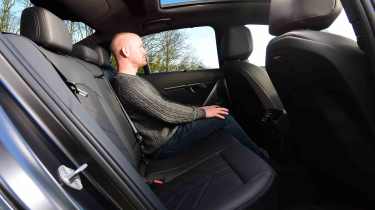
As you’d expect for such a large car, the BMW i5 has five seats, and everyone has plenty of space to stretch out. The driving position is spot on, with loads of adjustment in the steering wheel – although we would advise adding the affordable lumbar adjustment option to Sport Edition models (standard on M Sport and above) because it provides extra comfort on long trips. The Comfort Plus Pack has memory settings for both front seats. Oddly, for an electric car, you sit nice and low, rather than feel like your seat is perched on top of a sizable battery pack.
There’s plenty of space in the back for adults, too, so much that we wonder if many people will even see the need to step up from this to get into the bigger BMW i7. As per most cars, two Isofix child seat mounting points are provided on the rear bench's outer positions and are easy to reach behind some folding plastic clips.
Boot space
Boot capacity is a decent 490 litres – a little down from the 520 litres in a regular petrol BMW 5 Series, but some 30 litres up on the Mercedes EQE. It’s a decent shape and hides a helpful underfloor storage cubby that’s big enough for all your charging cables. It is a shame that, unlike many other EVs, space hasn’t been freed up under the bonnet for an additional storage area.
The standard 40/20/40 split-folding rear seats can extend the load area for the obligatory IKEA flat-pack furniture run. The EQE also has this arrangement of split-fold rear seats, but it has an awkward step in the floor, whereas the seats in the i5 have a much gentler incline, making it easier to load longer items.
Reliability & safety
Pros |
|
Cons |
|
The i5 should be a very safe car because it was awarded the same maximum five-star rating as the 5 Series (the car upon which it’s based) by safety experts Euro NCAP in 2023. It was criticised for not having a rear seat child presence detection system, or a way of monitoring the driver’s attention. We’d like to think parents would notice when their children are in the back of the car, and, in our experience, driver attention alert systems can be highly irritating in the real world, so these shouldn’t be things to put you off buying an i5.
The BMW 5 Series landed in 17th place out of 50 on the latest Driver Power best cars to own scoreboard. This is indeed an admirable score, and owners praised their cars’ comfort and visibility. However, running costs kept it from a higher rank. Fortunately, the fully electric i5 goes some way toward solving that problem – especially if you can take advantage of cheaper overnight charging at home.
| Euro NCAP safety ratings | |
| Euro NCAP safety rating | Five stars (5 Series, 2023) |
| Adult occupant protection | 89% |
| Child occupant protection | 85% |
| Vulnerable road user protection | 86% |
| Safety assist | 78% |
Buying and owning
Best buy: BMW i5 eDrive40 Sport Edition
Considering that it offers ample power, battery range and on-board features for just about every need, we see little reason in moving away from the entry-level eDrive40 Sport edition. This model starts from around £68,000, which is significantly cheaper than the M Sport version starting at over £74,000, or the M60 xDrive that’ll set you back at least £98,000.
You can save on the list price by building your perfect BMW i5 with the Auto Express Buy A Car service. We also have a range of i5 leasing deals to choose from, along with new i5 models in stock right now.
BMW i5 alternatives
BMW’s long-standing, traditional competitors are Audi and Mercedes, and both of those brands have a rival for the i5 to face. Both the Audi e-tron GT and Mercedes EQE are getting on in years, but both are still worth a look if you’re in the market for a premium German saloon. If performance is your priority, consider the Porsche Taycan.
Move away from Germany, and there are yet more competitors to choose from. Sweden has the Polestar 5 and Volvo ES90, while Korea has the Genesis Electrified G80.
BMW i5 pictures
Key updates of the BMW i5 review
15 September 2026: Latest model information and pricing data.
Frequently Asked Questions
The standard BMW manufacturer’s warranty is three years with unlimited mileage. The battery pack has a separate warranty of eight years or 100,000 miles.
Deals on the i5 and alternatives
More reviews
Which Is Best
Most Economical
- Name250kW eDrive40 Sport Edition 84kWh 4dr Auto [Tec+]
- Gearbox typeAuto
- RRP£72,695