Used Hyundai Kona (Mk1, 2017-2023) review
A full used buyer’s guide on the Hyundai Kona covering the Kona Mk1 (2017-2023)

Verdict
The Hyundai Kona isn’t the best compact SUV to drive, nor is it the most practical or the cheapest. It does, however, strike a very good balance between all these points. The Kona Electric is the best of the bunch, if your budget can stretch, but the other powertrains aren’t bad – the cheap-to-run hybrid version also stands out. What’s clear from our last Driver Power new-car survey is Kona owners are highly impressed with their motors.
When the Mk1 Hyundai Kona arrived in 2017, we liked it, but we weren’t bowled over. Yet the Kona was Hyundai’s first small SUV in a fast-growing segment, and it was obvious that for some buyers this distinctively styled crossover hit the spot.
However, it’s likely the major reasons for buying a Kona were because it stood out from the crowd and represented an easy ownership experience, rather than anything more exciting. Then along came the Kona Electric, and suddenly this small SUV offered something largely unavailable elsewhere: an EV with a range long enough to make it a genuine rival to myriad petrol and diesel models available elsewhere.
Models covered
- Hyundai Kona Mk1 (2017-2023) – This compact SUV is a great all-rounder that owners find hard to fault.
History
The Hyundai Kona went on sale in the UK in November 2017. Initially buyers could choose between 119bhp 1.0 T-GDi and 174bhp 1.6 T-GDi petrol engines, but in July 2018 Hyundai added a 1.6 CRDi diesel. This came in 114bhp manual, or 134bhp dual-clutch transmission (DCT) forms.
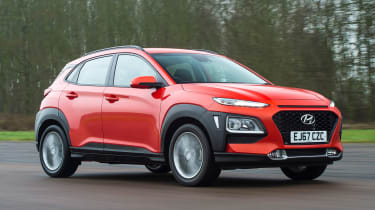
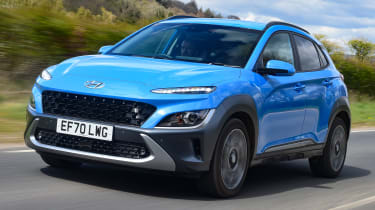
The new powertrains kept coming and Hyundai introduced the Kona Electric in August 2018. This came with a 39kWh battery and a 134bhp motor, or a 64kWh pack and a 201bhp motor. In September 2019 Hyundai added a Kona 1.6 GDi Hybrid to the range, with a modest 1.56kWh battery, so there was no facility to plug it in. A heavily updated Kona arrived in spring 2021, with bolder styling, an overhauled interior and extra driver-assistance systems, along with a wider colour palette.
The Mk2 Hyundai Kona arrived in 2023 to replace this car.
Which one should I buy?
The diesel is worth a look, but incredibly rare. If much of your driving is in urban traffic, a hybrid should be perfect; if you undertake longer journeys, a petrol or electric Kona will make sense. The running costs of the latter should be lower, but the purchase costs will be much higher.
Used - available now


The entry-level Kona S has 16-inch alloys, air-con, a six-speaker hi-fi, cruise control and automatic headlights. The SE adds 17-inch wheels, a seven-inch touchscreen, electric lumbar adjustment for the driver’s seat, rear parking sensors and a camera.
The Premium has climate control, nav, 18-inch alloys, automatic wipers and privacy glass. The Premium SE also has heated and ventilated leather seats, a heated steering wheel and front parking sensors. The range-topping Premium GT adds LED headlights.
Alternatives to the Hyundai Kona
Supermini-sized SUVs are common, but if you want one that’s powered by electricity, your options are limited. The Kia e-Niro is the closest alternative, but the Peugeot e-2008, MG ZS, Vauxhall Mokka-e and Mazda MX-30 are all too new to be available in significant numbers.
Stick with petrol or diesel power and the choice is wider, taking in the Nissan Juke and its cousin, the Renault Captur, the Kia Stonic plus the Mazda CX-3 and Peugeot 2008, as well as the Vauxhall Mokka.
A newer arrival that’s well worth a look is the Ford Puma (which is far better than the firm’s EcoSport), while the SEAT Arona, Skoda Kamiq and Volkswagen T-Cross are also worth investigating. So are the Citroen C3 Aircross and Toyota C-HR, the latter generally coming in hybrid form.
What to look for
Safety
Autonomous emergency braking was only fitted as standard to the Premium GT; it was optional on all other editions.
Spare wheel
The S had a repair kit, but SE and above came with a space saver. It’s possible to buy one for the S, though.
Noises
The 1.0 T-GDi can rattle when starting cold due to a lack of clearance for the camshaft chain, so it touches the cam cover; fixes are elusive.
Warranty
The Kona has a five-year unlimited-mileage guarantee which is transferable between owners. This is one of the key reasons for buying this car.
Interior
There are plusher cabins in this sector, but the Kona’s interior is well screwed together and very easy to live with. Comfort is good, with supportive front seats, but those in the back might grumble because legroom is in short supply.
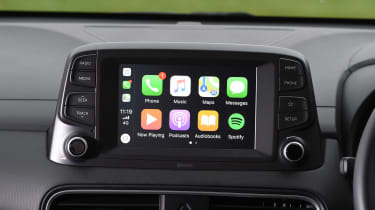
Boot space is 334 litres, or 1,116 litres with the seats folded, while the Kona S has 40 litres more, thanks to the lack of a spare wheel. Hyundai offers user-friendly infotainment systems, and the Kona is no exception, with a clear display and great responses from the touchscreen.
Running costs
Petrol and electric models have annual or 10,000-mile intervals, whereas the diesels stretch this to 20,000 miles. Services are minor and major, which are priced at £150 and £240-£340 for petrol and diesel editions.
The 12th service sees the coolant replaced and costs £450.
Minor and major services for the Kona Electric are £60 and £172, while the battery pack’s coolant is replaced at every fourth service, so the bill comes in at a hefty £495.
Recalls
THE Kona has been the subject of three recalls so far, while the Electric has been the subject of three different recalls, one of which also affected the Kona Hybrid. The three recalls that affected the Kona petrol and diesel kicked off with one in January 2019 because of faulty airbags. This was followed by another recall in May 2019 due to damaged brake pipes, then another in February 2021 because of a faulty e-call system.
The Kona Electric recalls came in October 2020 (a faulty management system could lead to the battery being damaged), January 2021 (faulty software in the auto emergency braking) and April 2021 (potential
short circuits within the battery). The auto emergency braking problem also affected the Kona Hybrid, but
all that was needed was a software update.
Driver Power owner satisfaction
The Kona made its Driver Power debut in 2020, with a 60th place in the new-car poll. Then in 2021 it followed this up with a far more impressive first place out of 75 cars.
Owners don’t like the shortage of rear legroom and the small boot, but there were top scores for connectivity, ergonomics, brakes, refinement, and the ride and handling balance. Hyundai also notched up 13th out of 30 in our 2020 manufacturer survey.
Hyundai Kona (2018-2023) review: What we said
Below are extracts from our 2023 in-depth review of the Mk1 Hyundai Kona...
he Hyundai Kona is a car that clearly uses its design to draw in buyers. It's not that rewarding to drive, with lifeless steering and not much dynamic polish, although Hyundai has attempted to address this shortcoming with revisions to the 2021 facelifted model's chassis and suspension set-up.
The manufacturer has succeeded in improving the Kona's ride, particularly over pockmarked surfaces, but there's not as much passenger or luggage space on board as you'll find in some competitors.
About the Hyundai Kona
The Hyundai Kona is the South Korean brand's entry in the small SUV and crossover segment, with its long list of rivals including the Nissan Juke, Renault Captur, Peugeot 2008, Citroen C3 Aircross, Vauxhall Mokka and SEAT Arona, not to mention the Stonic from sister brand Kia. So it's clearly an important model for Hyundai, which gave the Kona a facelift in 2021 and is launching an all-new second generation model in 2023.
The outgoing Hyundai Kona is available with a choice of petrol and electric powertrains. The entry-level Kona features a 1.0-litre petrol engine and mild-hybrid tech, while the full hybrid version – simply called the Kona Hybrid – employs a 1.6-litre petrol engine and a 34bhp electric motor, allowing it to cover to short distances on electric power alone.
Of course, the Kona Electric is the greenest version in the range, and offers a range of up to 300 miles if you get the larger 64kWh. Stick with the standard 39kWh battery however, and the Kona EV will cover 189 miles on a single charge, according to Hyundai. If you're more interested in straight line speed, the Kona N performance model uses a 276bhp 2.0-litre petrol engine and will do 0-62mph in 5.5 seconds.
The Kona is offered in Hyundai's usual selection of SE Connect, Premium, N Line and Ultimate specifications, with prices starting from around £23,600 for the entry-level mild-hybrid version, or roughly £26,300 for the Kona Hybrid. The all-electric Kona starts from around £32,000 to nearly £40,000 for the Ultimate version with the bigger battery, while the Kona N is somewhere in the middle, starting at just over £36,000.
Standard equipment on all Konas includes alloy wheels, rear parking sensors, cruise control and a 10.25-inch digital instrument display, plus Apple CarPlay and Android Auto smartphone connectivity. All but the base model also come with a 10.25-inch central touchscreen, front parking sensors, heated front seats and steering wheel, and Krell hi-fi, but N Line specification adds with more aggressive front and rear styling, on top of the extra kit.
Engines, performance and drive
We haven't really seen a small SUV that's genuinely involving to drive, and the Kona doesn't come close to bucking this trend. It has few vices, admittedly, but there is precious little scope for enjoyment either.
The 1.0-litre petrol engine in the base Kona has just about enough grunt for most everyday situations, although you'll need to keep an eye on the rev-counter if you're about to attempt overtaking. That's because the three-cylinder turbocharged engine has a pretty narrow power band; Hyundai claims peak torque between 1,500rpm and 4,000rpm, but it feels like it starts about 700rpm higher than that.
Drop out of the zone and you'll soon find yourself becoming impatient as you wait for the motor to spin up to its best potential again. Other three-cylinder units on the market are punchier – notably Citroen's and Peugeot's excellent 1.2 PureTech.
We didn't find the mild-hybrid Kona's six-speed manual gearbox was the slickest when we drove it, but it’s quick enough as long as you’re positive with shifts. The squared-off gear lever feels awkward in your hand, however.
The facelifted Kona has benefitted from tweaks to its chassis and suspension, which provide a little more dynamic polish over the previous model – particularly in its ability to now absorb the bumps and jolts from rutted urban roads, even when riding on bigger 18-inch alloy wheels.
Once it’s up to speed, the Kona is pretty quiet, as the characterful three-cylinder note fades away. Wind noise seems well isolated, too, so there’s not much of a rush from around the side mirrors.
If you’re willing to stretch a couple of grand beyond the cost of the 1.0-litre Kona, the Kona Hybrid makes for a compelling choice. It’s powered by a 1.6-litre petrol engine and a small electric motor, with the main benefit being fuel economy: on paper it’s significantly more frugal than any other petrol-powered Kona.
The Kona Electric goes around corners in much the same way as its combustion-engined counterparts, but it quieter, smoother, more powerful drivetrain makes it by far the most pleasant model variant to drive.
There's no shortage of straight-line speed from the 276bhp Kona N performance model, and it has enough electronic trickery to keep keen driver's entertained. The rest of the family won't feel quite so positive towards the racy Kona model, as it's firm set-up makes things a little uncomfortable when on the move – even motorway trips become tiring with plenty of road noise entering the cabin.
0-62mph acceleration and top speed
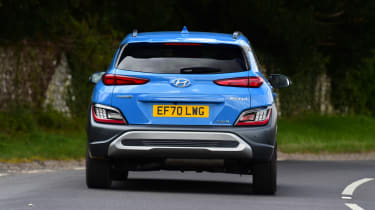
The Kona comes with a choice of engines – although in truth, we expect the vast majority of customers will end up in the more modest base model. It's powered by a turbocharged 1.0-litre three-cylinder motor, producing 118bhp and 172Nm of torque.
On the whole, this engine is punchy enough for a car like the Kona. But in practice, we find its powerband a little narrow - and it's quick to punish you with sluggish progress if you allow the revs to dip much below 2,000rpm. You certainly won't be able to hurry the Kona into much of a sprint, as Hyundai claims the 0-62mph time is a rather sedate 11.9 seconds
The full hybrid's mix of 1.6-litre four-cylinder engine and electric motor results in a total output of 139bhp and 265Nm of torque, although it's still not blisteringly quick – taking 8.9 seconds to reach 62mph from a standstill. However, this set-up allows you to cover short distances in fully electric mode, which is most noticeable at low speeds when the Kona will move off smoothly and silently.
Hyundai offers the Kona Electric with either a 39kWh battery and 134bhp electric motor, or a 64kWh unit paired with a 201bhp e-motor. Both are more capable sprinters, taking 9.9s and 7.9s to 62mph, respectively.
The 2.0-litre, four-cylinder unit in the Kona N produces 276bhp and a healthy 392Nm of torque, which means 0-62mph is taken care of in 5.5 seconds. Top speed is 149mph.
MPG, CO2 and running costs
Hyundai believes that it can attract downsizers and hip, trendy young families into the Kona, and has kept prices for the facelifted range competitive with rivals. Entry into Kona ownership starts from around £23,600, while the popular Ford Puma is more expensive to buy at nearly £25,000, but it's worth bearing in mind that this is with the well-equipped Titanium spec and also brings a little extra power at 123bhp.
Opting for a Kona 1.0-litre SE Connect with 48-volt mild-hybrid assistance gives a claimed economy figure of 47.1mpg, with CO2 emissions of 135g/km. Efficiency is slightly affected if you choose a higher-spec version, with the same car in Ultimate trim returning 46.3mpg and 138g/km.
The Kona Hybrid is around £2.5k more expensive than the entry-level car, but you'll benefit from improved economy of around 55-57mpg and reduced emissions of 112 to 115g/km. When we pitted the full-hybrid Kona head-to-head against a Vauxhall Mokka and Nissan Juke, the Hyundai managed an impressive 53.6mpg, while neither the Vauxhall or the Nissan got close to 40mpg in the real world.
Buyers looking towards performance over efficiency might find that the Kona N model appeals, although average fuel economy of 33.2mpg is still acceptable (CO2 emissions of 194g/km possibly less so). Meanwhile the Kona Electric is offered with a choice of 39kWh and 64kWh batteries, which provide a range of 189 and 300 miles respectively.
Interior, design and technology
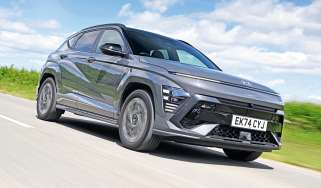
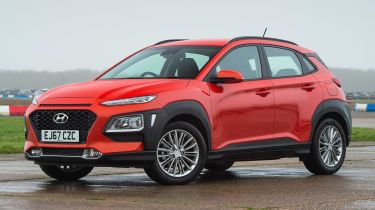
We're not about to deliver a verdict on how the Kona looks; that's for customers to decide. But there's no doubt that the car's exterior styling is going to split opinion. Hyundai is counting on it, in fact, because there's nothing worse in the image-conscious small SUV market than having a car that fails to provoke a reaction.
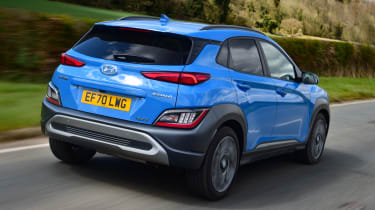
The Kona certainly errs towards the 'rugged' end of the baby SUV market. It has aggressive-looking headlights, complex body surfacing with plenty of creases, and swathes of black plastic around the wheelarches to give it at least the look of something that could go off road.
Hyundai facelifted the Kona for 2021, with reworked front and rear bumpers, slimmer LED headlights and a 40mm increase in overall length.
The facelifted model is offered with a more refined choice of exterior colours, which means no more outlandish 'Acid Yellow' paint and contrasting roof options. The standard 'Dive in Jeju' solid paint offers a turquoise hue, but after that the choice is one of darker grey, black, red and blue metallic and pearl finishes – with the ubiquitous solid white also on the options list for an extra £300. The entry-level SE Connect version of the Kona gets 17-inch alloy wheels, while all other trims receive 18-inch wheels.
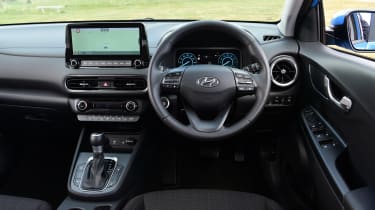
Some fresh trim and new materials were also added to the cabin as part of the facelift, but they struggle to lift the ambience. Overall quality is good, but some might find the interior too dark.
The updated Kona comes as standard with a 10.25-inch digital instrument cluster, plus an eight-inch central touchscreen in base SE Connect trim models or a 10.25-inch infotainment display if you upgrade to Premium or Ultimate spec. Go far enough up the range and you'll get some extra tech to make the front cabin feel a teeny bit more special; there's a head-up display, for example, which is still a relatively rare feature in this class.
Sat-nav, stereo and infotainment
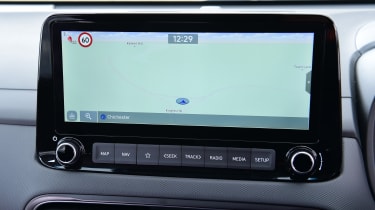
The Kona's infotainment set-up is still one of the best compared to its rivals like the MG ZS and Vauxhall Mokka, offering clear graphics and quick responses to any inputs. The home page splits into either two or three modules, allowing both entertainment and detailed mapping functions to be shown at the same time.
Entry-level SE Connect cars include an eight-inch touchscreen with Android Auto, Apple CarPlay and a rear-facing parking camera, while top-spec models feature a larger 10.25-inch display and an uprated eight-speaker Krell audio system.
Practicality, comfort and boot space
The level of practicality in the Kona illustrates just how quickly the small SUV market is developing. When Hyundai started work on its small SUV, it presumably benchmarked cars like the Nissan Juke and Renault Captur for passenger space and boot capacity.
Compared with those cars, the Kona doesn't do badly. But the game has moved on since the Kona landed, because it feels less capable of dealing with family life than, say, the Citroen C3 Aircross or MG ZS.
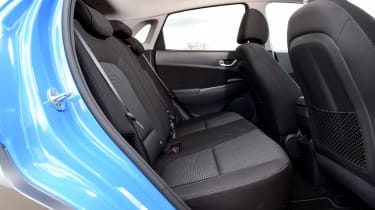
For instance, we found during our testing that there's the plenty of space in the cabin for the driver and front passengers, but those in the back seats may complain about a shortage of leg and knee room on longer journeys. Many buyers won't be put off by this relative shortage of versatility, of course – however, to us the Kona doesn't quite feel like a vehicle that could cope with the lifestyle of a small family.
Size
The Hyundai Kona measures 4,205mm long, 1,800mm wide (2,070mm including mirrors) and up to 1,568mm high, depending on which wheel size you opt for. By comparison, the Vauxhall Mokka is slightly shorter at 4,151mm and narrower at 1,791mm.
Leg room, head room & passenger space
The Kona is a nominal five-seater, of course, but it's still fundamentally a supermini-sized cabin - and you should factor that in if you regularly need to carry four adults. There's plenty of space up front for six-footers, and they shouldn't have any problems with headroom either. But if there's a pair of six-footers up front, the rear cabin looks a little bit tight for knee and legroom.
Boot
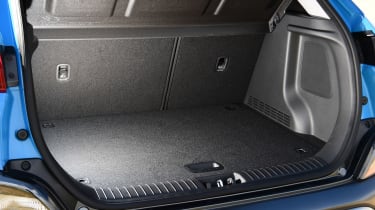
The standard mild-hybrid and full hybrid Hyundai Kona both feature a 374-litre boot, while the all-electric model has a reduced 332-litre load space, which is barely any more than a lot modern superminis. For example, a Volkswagen Golf for example has a 381-litre boot. Fold the Kona's rear seats down and you get 1,156 litres, which to us is no better than respectable. There's no clever boot tricks like a variable-height floor or dividers, either.
Towing
If you're looking for a Kona model to use for everyday towing duties, then you'll be better off with either the mild-hybrid or full-hybrid models which have maximum towing capacities of 1,200kg and 1,300kg respectively. The 276bhp Kona N performance model is able to pull up to 1,600kg.