Hyundai Bayon review
The Hyundai Bayon is a high-riding alternative to the i20 supermini matches it for tech and practicality

Our opinion on the Hyundai Bayon
You’d be forgiven for forgetting that the Hyundai Bayon existed. With so many strong models in its line-up, Hyundai’s small SUV is easy to overlook. There’s nothing wrong with it per se, because it takes the formula of the i20 supermini and adds more space and an SUV-inspired look, but it doesn’t really stand out in any key area to make it a solid alternative in the small SUV class. It’s a safe purchase, rather than an interesting one.
About the Hyundai Bayon
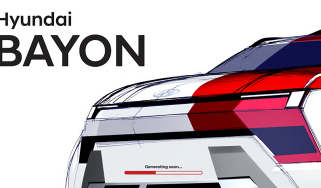
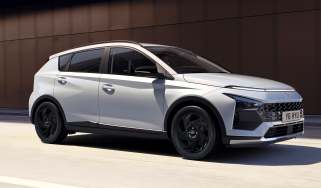
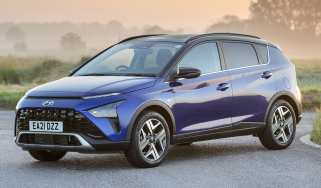
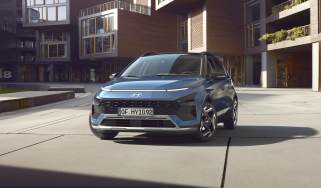
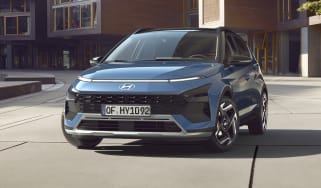
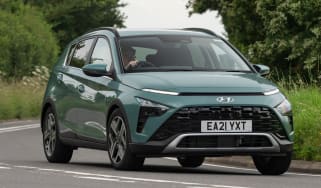
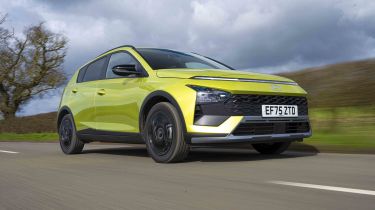
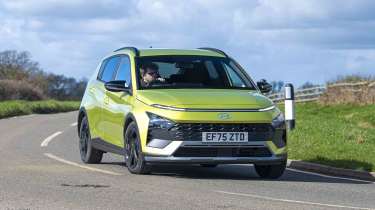
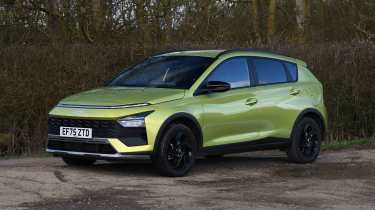
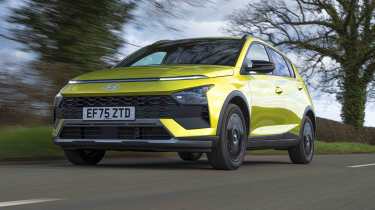
To help the Bayon stand out from the crowd, Hyundai gave its smallest SUV an unusual exterior design, which has now been enhanced with a 2025 facelift that added a new lower grille and a different rear bumper. You’d be forgiven for thinking those looks are hiding some trick hardware, but in actual fact, the Bayon’s underpinnings are rather ordinary – it’s based on the same platform as the Hyundai i20 supermini.
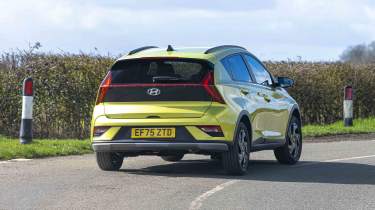
The Bayon’s slim lights, split grille and angular bodywork give it a unique appearance, while the rear end features a zig-zag look with inward-pointing tail-lights and only a small section of painted bodywork on the boot door.
While the larger Kona has petrol, hybrid and electric options, the Bayon is offered with just one engine, a 1.0-litre three-cylinder turbo petrol producing 89bhp and 172Nm of torque. There used to be a more potent 118bhp version, but that disappeared from the order books after the Bayon’s facelift, along with its 48V mild-hybrid assistance that improved efficiency and gave a small boost while accelerating. The Bayon is still available with a six-speed manual or a seven-speed dual-clutch automatic gearbox, though.
Used - available now

2023 Hyundai
Bayon
4,395 milesManualPetrol1.0L
Cash £12,590
2023 Hyundai
Bayon
3,060 milesAutomaticPetrol1.0L
Cash £14,292
2023 Hyundai
Bayon
14,010 milesAutomaticPetrol1.0L
Cash £13,502
2023 Hyundai
Bayon
32,500 milesAutomaticPetrol1.0L
Cash £11,994The trim range has also been revamped, with only two versions now offered, the Black Line or the Tech Line. Both are very well equipped, with kit such as auto main beam LED lights, cruise control, rear parking sensors, a pair of 10.25-inch screens for the infotainment and driver, reversing camera and smartphone connectivity all fitted as standard.
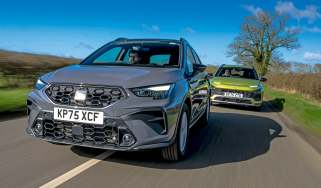
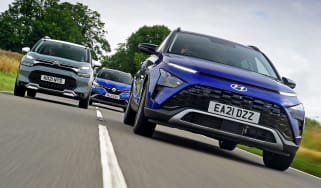
We’ve group tested the Bayon a few times over the years. Our first test was of the pre-facelift version in the Hyundai Bayon, Citroen C3 Aircross, and Renault Captur triple test where the Renault took the honours. We have also put the post facelift Bayon against the revised SEAT Arona.
Hyundai Bayon prices and latest deals
Prices for the Hyundai Bayon start at around £24,000 for the Black Line version, with a £1,500 premium to pay for the higher-spec Tech Line model. Adding a seven-speed automatic gearbox to either trim will cost £1,250 extra.
If you're interested in the Hyundai Bayon, you can configure your ideal car now to get top offers from local dealers, check out the latest Bayon leasing deals or search for used models with our Find A Car service. You can even sell your existing car for a great price with Auto Express Sell My Car.
Performance & driving experience
| Pros |
|
| Cons |
|
The majority of small SUVs deliver a competent-yet-forgettable driving experience without much excitement to be had, and the Hyundai Bayon isn’t a car that you’d take out for a drive just for the sake of it.
Performance, 0-60mph acceleration and top speed
Hyundai has trimmed back the Bayon’s engine line-up to just one powerplant, which is its 1.0 T-GDi three-cylinder, turbocharged, direct-injection petrol unit. It’s even been shorn of any 48-volt hybrid assistance, and with only 89bhp on tap, it’s not going to set the world alight with its performance.
Power is sent to the front wheels via either a six-speed manual gearbox or a seven-speed dual-clutch transmission (DCT), but neither set-up delivers anything like exhilarating pace. There’s just enough performance to get by with the manual model, while the slow-witted auto blunts the car’s performance even further, as demonstrated by its 13.3-second 0-62mph time, which is 1.4 seconds slower than the manual model.
| Model | Power | 0-62mph | Top speed |
| Bayon 1.0 T-GDi 90 | 89bhp | 11.9 seconds | 108mph |
| Bayon 1.0 T-GDi 90 DCT | 89bhp | 13.3 seconds | 107mph |
Town driving, visibility and parking
The Bayon’s steering, gearbox and pedals are all very light and don’t offer much feel or feedback. Large door mirrors aid visibility when pulling out into traffic, while standard rear parking sensors and a reversing camera make it a little easier to slot the Bayon into a bay in a multi-storey car park.
We don’t have any particular issue with the action of the manual gearbox, but we do find it irritating that first gear is short, to help get you off the line more quickly, but then second gear is really long to keep the revs down to improve fuel economy and emissions. Unfortunately when you change up, this causes the engine to bog down out of its power band, which is especially noticeable now that the Bayon no longer has a mild-hybrid system to provide a boost of power at low revs. Rivals like the Ford Puma, which features a mild-hybrid system, are much easier to drive smoothly at low speeds.
Country road driving and handling
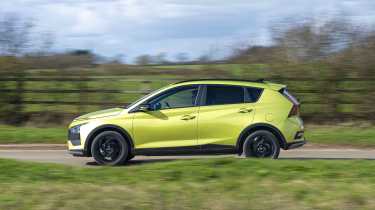
On twistier roads, the Bayon feels reasonably agile. Thanks to a decent amount of grip, you can confidently carry some speed into corners, and the body doesn’t lean over too much, helping it to feel safe and stable. The steering, although light and lacking feedback, is precise enough at higher speeds. You can switch to Sport mode using a button on the centre console, but this adds artificial weight and doesn’t change much about the driving experience, which is a bit dull in general, while the ride is a little unsettled on bumpy roads.
Unlike many small SUVs, the Bayon’s driving position feels barely any higher than the i20 supermini’s, so you don’t really benefit from a better view ahead, which is a reason why many buyers like the idea of this kind of car in the first place.
Motorway driving and long-distance comfort
Once you’re up to speed, the engine quietens down and is absorbed into the general background hum from the tyres, while wind noise is reasonably well contained. Despite being a small SUV, you can tackle a relatively long motorway journey without feeling tired, although the car’s ride never really settles even at higher speeds.
"One of the main reasons why buyers are keen to step into small SUVs is the ease of access that they offer, but the Bayon is more like a supermini than many of its closest rivals. We measured a sill height of 370mm for the Hyundai, while the SEAT Arona is 50mm higher, at 420mm. That’s enough of a difference to ensure that the Spanish SUV is easier to get into, plus it means it has a taller driving position even when the height-adjustable seat is at its lowest setting." – Dean Gibson, senior test editor
MPG & running costs
Pros |
|
Cons |
|
The Hyundai Bayon uses a 1.0-litre petrol unit with a meagre 89bhp, and while in the past it came with a 48-volt mild-hybrid system (as well as more power), this was removed as part of the facelift. Due to the omission, fuel economy and emissions are slightly worse, at 47.9mpg for the manual and 48.7mpg for the automatic, while emissions are 133g/km and 131g/km respectively. That’s down from the best figures of 53.3mpg and 119g/km that were offered by the pre-facelift Bayon.
We tested the Bayon on similar roads to the SEAT Arona, and while fuel economy was similar between the two of them, the Hyundai came closer to its official economy figure during our time with us. It achieved 47mpg, and based on its 40-litre fuel tank, that’s enough to give a range of around 410 miles.
| Model | MPG | CO2 | Insurance group |
| Bayon 1.0 T-GDi 90 | 47.9mpg | 133g/km | 15 |
| Bayon 1.0 T-GDi 90 DCT | 48.7mpg | 131g/km | 13 |
Insurance groups
The automatic Bayon sits in a lower group than the manual car, with a group 13 or 14 rating depending on the trim level chosen. Both versions with the manual sit in group 15. Either way, that modest 1.0-litre engine with less than 100bhp should help keep cover costs down.
In comparison, the SEAT Arona falls into group 11 in its lowest-powered guise, or group 14 with the automatic gearbox.
Tax
Every version of the Bayon will be charged the standard rate of annual vehicle excise duty (VED) road tax, but without any fuel-saving hybrid tech on board, emissions are on the high side for company car users, making it a poor choice with high annual deductions.
Depreciation
Residual values for the Bayon are on a par with most rivals, according to our expert data. It should hold on to around 45 per cent of its original value after a typical three-year/36,000-mile ownership period. There are better options available, though, such as the Ford Puma (49-55 per cent over the same period).
To get an accurate valuation for a specific model, check out our free car valuation tool...
Interior, design & technology
Pros |
|
Cons |
|
The Bayon slots between the electric Inster and petrol/hybrid/electric Kona in the Hyundai SUV line-up, but it has a look that’s completely different to both. It’s more of a high-riding hatchback than anything, but that shouldn’t be a surprise since it uses the same platform and running gear as the i20 supermini.
Interior and dashboard design
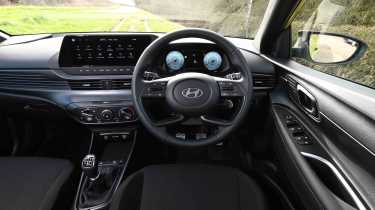
The Bayon’s interior is rather ordinary when compared with the exterior, with the only piece of design detail being the air-vent slats that stretch across the width of the dashboard in front of the passenger. The rest of the layout is fairly standard, with the 10.25-inch touchscreen mounted high on the centre console for ease of access, and air vents lower down.
Materials and build quality
The materials used in the cabin feel a little hard to the touch when compared with some rivals. Yes, there are artificial leather armrests on the doors, but the tops of the doors are made of hard plastic, there’s more of the material on the centre console, plus the hard plastic trim above the climate controls doesn’t feel as premium as it could.
Infotainment, sat-nav and stereo
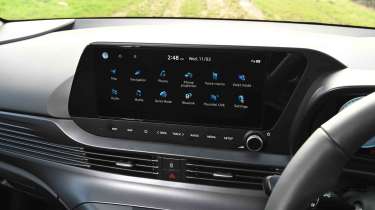
The Bayon features the same 10.25-inch touchscreen infotainment system that’s used across the Hyundai range. It’s a pretty decent set-up, with plenty of functions and connectivity included, plus navigation with live services.
There are a few too many screens to scroll through when selecting different options, but the shortcut buttons across the bottom of the screen offer faster access, while the star button can be preset with a favourite option that you want to get to quickly.
Another 10.25-inch screen is used for the driver’s display. This can be set up to show the dials in different formats, including traditional clocks, and is controlled via buttons on the steering wheel.
One of the few options that’s available on the Bayon is the £1,000 Tech Pack for the Tech Line model. This adds a Bose premium sound system, which is hopefully an improvement on the standard system we tried in the Black Line model, which seemed tinny and had problems dealing with reverberations running through the car.
"The Bayon line-up has been slimmed to Black Line and Tech Line trims only. Obviously, the Black Line adds black detailing, while the extra kit on the Tech Line includes larger 17-inch wheels, automatic climate control, rain-sensing wipers, front parking sensors, keyless entry, wireless charging and a third USB socket for back-seat passengers. Both cars get the same level of safety kit, and unless you really need any of the above equipment, we’d save some cash and pick the Black Line model instead." – Dean Gibson, senior test editor
Boot space & practicality
Pros |
|
Cons |
|
The Hyundai Bayon is a small SUV, so if you’re expecting endless space inside, you might be disappointed - but it’s still a reasonably practical car.
Dimensions and size
The Bayon is 4,180mm long and 1,775mm wide (excluding door mirrors), making it smaller than Hyundai’s other small SUV, the Kona, which is 4,350mm long and 1,825mm wide. Plus, the Bayon is 1,500mm tall, which is about 85mm shorter than its stablemate.
The Bayon is much closer in length to the Ford Puma, although that rival is both taller and wider, helping to explain why the Ford has the edge over this Hyundai in terms of practicality.
| Dimensions comparison | |||
| Model | Hyundai Bayon | Ford Puma | SEAT Arona |
| Length | 4,180mm | 4,186mm | 4,164mm |
| Width | 1,775mm | 1,805mm | 1,780mm |
| Height | 1,500mm | 1,550mm | 1,538mm |
| Wheelbase | 2,580mm | 2,588mm | 2,566mm |
| Boot space | 411-1,205 litres | 456-1,216 litres | 400-1,280 litres |
Seats & passenger space
The front of the cabin isn’t huge, but there aren’t any issues with legroom or headroom for the driver and front passenger. There’s a good amount of interior storage, including a big glovebox – although the owner’s manual takes up a hefty amount of this space – and the door bins are a little disappointing.
There’s a convenient slot for your phone ahead of the gearlever, although only Tech Line trim has a wireless charging pad located there. Both versions feature two USB sockets up front, but only one can be used for connecting your phone to use CarPlay or Android Auto.
There’s a good amount of legroom for those in the back seats, so you should be able to fit in two adults on the back row comfortably, and a third in the middle for a short journey. It isn’t the best for headroom, though, with rivals like the SEAT Arona offering a little more head space.
A pair of Isofix child-seat mounting points are provided on the outer positions of the rear bench. However, unlike some rivals, the Bayon lacks a third child-seat mounting point for the front passenger seat.
Boot space
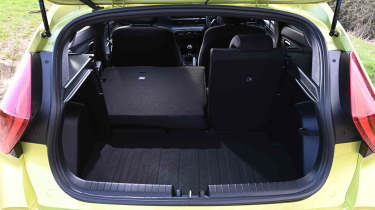
There are 411 litres of boot space available in all versions of the Bayon, which is reasonable for the class, and marginally bigger than the SEAT Arona. The similarly-sized Ford Puma has a more generous 456-litre boot, though, while the cheaper mild-hybrid Dacia Duster offers up the amount of space you’d expect of a compact SUV, with 594 litres.
Unfortunately, the Bayon has a higher load lip than the Arona, which makes it harder to lift items in and out. The boot expands to 1,205 litres with the rear seats folded using the standard 60:40-split rear bench, but there’s a step in the floor that could prove fiddly when trying to load longer items.
"If you’re carrying taller cargo in the boot but are still using all five seats, you can store the parcel shelf upright against the seat backs. There are runners on either side behind the rear seats for it to slot into, and it means you can keep it in the car when it’s not in use." – Max Adams, online reviews editor
Reliability & safety
Pros |
|
Cons |
|
Standard safety kit is good, and all versions of the Bayon come with autonomous emergency braking, driver-attention alert, emergency call, hill-start assist, pedestrian detection, lane-keep assist, parking sensors and tyre-pressure monitoring.
Move up to the top-spec Ultimate model (or add the Driving Convenience Pack to an automatic-equipped car with Premium trim) and you also get blind-spot warning along with adaptive cruise control.
It’s fairly easy to switch off some of the more intrusive safety-assistance technology – for instance holding down the lane-keep assistance button until the steering symbol in the instrument cluster goes amber – and you can pre-save the speed recognition on/off function to the star button on the steering wheel.
However, the Bayon received a four-star rating (out of five) from crash test body Euro NCAP, with rear-occupant chest protection rated as weak. For those looking for a small SUV with a five-star rating, consider the SEAT Arona or the Toyota Yaris Cross.
The Hyundai brand came in 20th place out of 31 manufacturers in our latest Driver Power customer satisfaction survey, which is a bit behind stablemate Kia (18th), Nissan (15th), Skoda (12th), and Renault (6th), but ahead of Ford (23rd), SEAT (24th), and VW (27th).
| Euro NCAP safety ratings | |
| Euro NCAP safety rating | Four stars (2021) |
| Adult occupant protection | 76 per cent |
| Child occupant protection | 82 per cent |
| Vulnerable road user protection | 76 per cent |
| Safety assist | 67 per cent |
Buying and owning
Best buy: Hyundai Bayon 1.0-T-GDi Black Line
With just one engine to choose from, it all depends if you’re feeling flush enough to spend an extra £1,500 to upgrade from Black Line to Tech Line. The base model is well enough equipped for the price, and we’d only upgrade if you must have climate control or front parking sensors. You have to do this to add a sunroof and Bose stereo, which is a £1,000 add-on for Tech Line anyway. We’d avoid the sluggish automatic and pick the manual every time.
Hyundai Bayon alternatives
The Hyundai Bayon is a small SUV that takes on the SEAT Arona, Volkswagen T-Cross, Skoda Kamiq and Ford Puma. Those wanting a more entertaining drive will go for either the Puma or Arona, while those looking for a more refined package will do better with either the Kamiq or T-Cross.
In our opinion, the best choice is the Dacia Duster, which is more affordable than the Bayon. It also gives you the chance to go for a much more efficient hybrid model, or something with four-wheel drive and some genuine off-road capability. Plus it’s bigger and more practical than the Bayon, making it a better choice for family car buyers.
There are plenty of other rivals as well, including the funky Citroen C3 Aircross, the premium-feeling Peugeot 2008, the versatile Renault Captur, the highly efficient Toyota Yaris Cross, or the varied engine range of the Vauxhall Mokka.
Key updates of the Hyundai Bayon review
20 March 2026: General review update and the inclusion of impressions from our Hyundai Bayon versus SEAT Arona twin test
Deals on the Hyundai Bayon and alternatives
Hyundai Bayon pictures
Frequently Asked Questions
As with all Hyundais, the Bayon has a five-year unlimited mileage warranty. While Kia offers a longer seven-year warranty, it has an upper limit of 100,000 miles.