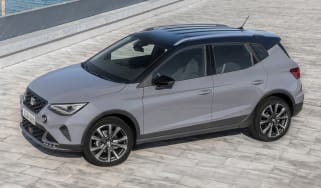
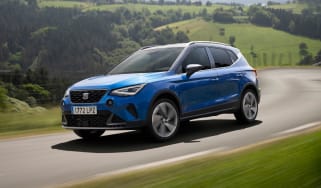
SEAT Arona review
It’s getting on a bit, but the SEAT Arona small SUV still offers plenty of appeal from behind the wheel

Our opinion on the SEAT Arona
It’s been on sale for nearly a decade, but the SEAT Arona still offers plenty of appeal in a busy small SUV market. There’s no electric variant, and not even hybrid tech is offered, but the petrol engines are still fairly economical as they are, although not at the expense of performance. Overall, the Arona offers a composed and refined drive, while standard equipment is decent.
Small dimensions mean the Arona is easy to position on the road, but this is offset by the car’s limited practicality, which falls behind class rivals. Updates to the SEAT’s styling and tech have helped it remain competitive, while drivers benefit from the elevated driving position that makes small SUVs such as this so appealing.
About the SEAT Arona
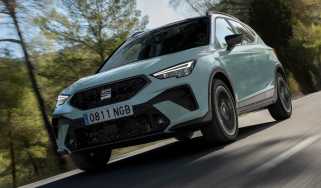
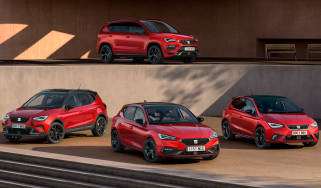
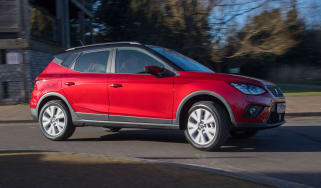
Launched in 2017, the SEAT Arona is the smallest SUV in the Spanish firm’s line-up, although now that the Tarraco is no longer offered, the only other option is the SEAT Ateca. Under the skin, the Arona uses the same platform as the Ibiza supermini, and like that car, it’s only available with front-wheel drive. As with the Ibiza, SEAT updated the Arona in 2025 to help prolong its life in showrooms.
Power comes from a choice of two petrol engines: either a 1.0 TSI three-cylinder turbo in two power outputs, or a 1.5 TSI four-cylinder turbo. There’s a choice of manual or automatic gearboxes for the 1.0-litre, while the 1.5 comes with a DSG twin-clutch auto as standard.
Used - available now

2026 Seat
Arona
4,810 milesAutomaticPetrol1.5L
Cash £16,819
2026 Seat
Arona
17,870 milesManualPetrol1.0L
Cash £11,995
2026 Seat
Arona
31,338 milesManualPetrol1.0L
Cash £12,490
2021 Seat
Arona
24,449 milesAutomaticPetrol1.0L
Cash £12,895Engine choice depends on the trim level you choose. The SE and SE Technology come with a 94bhp unit with a manual gearbox, but this is uprated to 113bhp when a DSG automatic is fitted. This 113bhp motor comes with a manual or auto in FR and FR Sport versions, while these trims can also be had with a 148bhp version of the VW Group’s 1.5 TSI four-cylinder.
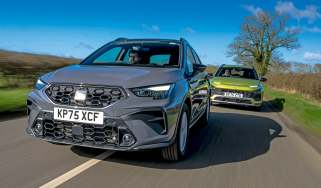
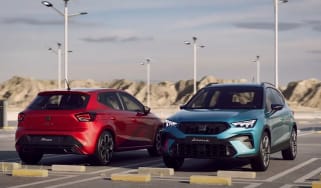
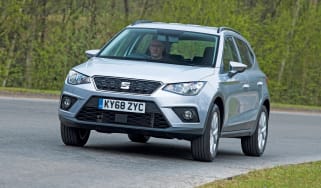
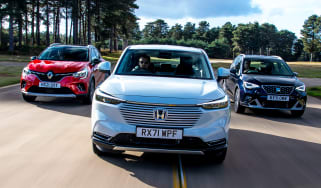
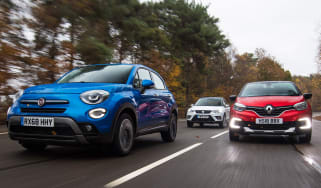
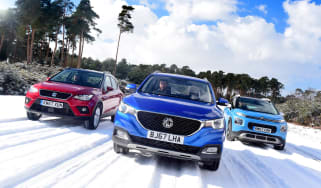
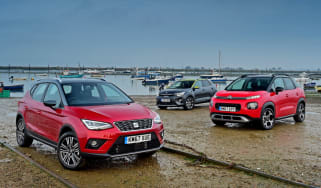
We've tested this small SUV many times over the years, with our most recent test being the SEAT Arona versus Hyundai Bayon twin-test. We have also run a pre-facelift FR trim Arona as part of our long-term test fleet, and pitted a 1.0-litre DSG automatic Arona against the Honda HR-V and Renault Captur in a group test.
SEAT Arona prices and latest deals
Prices for the Arona start from around £23,000 for SE trim, while adding the auto gearbox and more powerful 1.0 TSI costs £1,500 extra. SE Technology adds around £1,000 to the list price and is a worthwhile upgrade.
FR models start from £27,500 for the 1.0 TSI manual, with the auto adding £1,000 to the price and another £1,000 needed to upgrade to the 1.5 TSI auto. At the top of the range, the FR Sport has a racier look for around £1,000 extra over the FR versions.
To find the best deals on the SEAT Arona, check out the Auto Express buy a car portal, where you can find discounted deals for the whole Arona line-up.
Performance & driving experience
Pros |
|
Cons |
|
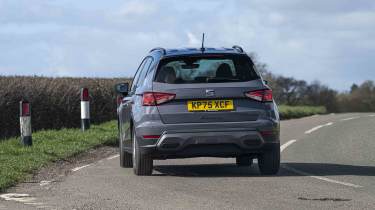
Not many small SUVs manage to be entertaining to drive, but the SEAT Arona makes a decent case for itself with its punchy petrol engines and handling that feels assured.
Performance, 0-60mph acceleration and top speed
Power for the SEAT Arona comes from either a 1.0 TSI three-cylinder, or a 1.5 TSI four. Both are turbocharged and front-wheel drive is standard across the range, with no option of four-wheel drive available, although that’s largely standard for the small SUV class.
The 1.0 TSI comes in two power outputs, with SE and SE Technology models featuring a 94bhp version with a five-speed manual gearbox, while upgrading to the seven-speed DSG auto bumps the power up to 113bhp. This more powerful unit can be found in FR models with either the six-speed manual or seven-speed DSG. The lower-powered 1.0 TSI is still fairly tractable, courtesy of 175Nm of torque that’s available from 1,600rpm, while the more powerful unit has 200Nm from 2,000rpm, and feels pretty punchy. It’s accompanied by a gruff three-cylinder thrum, although this isn’t unpleasant and gives the car a bit of a sporty character.
The 1.5 TSI is a strong performer in a car of this size, and with 250Nm of torque from 1,500rpm you don’t have to rev it very much to get the Arona going. If you do make the most of its performance, it’s more refined than the 1.0 TSI, thanks to its smoother four-cylinder configuration.
| Model | Power | 0-62mph | Top speed |
| Arona 1.0 TSI 95PS | 94bhp | 11.1 seconds | 113mph |
| Arona 1.0 TSI 115PS DSG | 113bhp | 9.9 seconds | 121mph |
| Arona 1.5 TSI 150PS DSG | 148bhp | 8.3 seconds | 132mph |
Town driving, visibility and parking
Compact dimensions and a tall driving position make it easy to place the Arona on the road, while the revvy nature of the engines and direct steering mean the car is well suited to the cut and thrust of urban driving. The suspension soaks up bumps pretty well, although FR cars with larger 17 or 18-inch wheels do crash a bit over bigger potholes.
All Aronas come with rear parking sensors as standard, while SE Technology models and above add a reversing camera, and FR cars have front parking sensors, too. These aren’t desperately needed because the tall driving position allows you to judge the extremities of the car pretty easily, but are still useful to have.
One drawback for the Arona is that the DSG twin-clutch gearbox can be a little hesitant on occasion. It’s not a deal breaker, but if you’re approaching a roundabout and ask for a quick response when accelerating, the gearbox can sometimes be delayed in its reactions.
Country road driving and handling
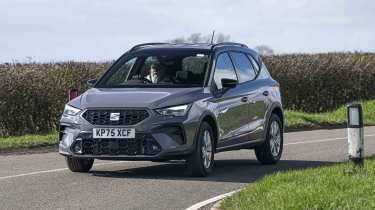
The revvy character of the Arona’s engines mean it feels responsive on the open road, which adds a fun factor to the car that’s lacking in many small SUV rivals. There’s enough power to keep up a decent pace, but it’s only the 1.5 TSI that has enough punch for overtaking.
While the Arona has a tall ride height when compared with the Ibiza that it shares a platform with, it still feels pretty stable and has a decent amount of grip. The smaller 16-inch wheels used by SE models offer decent comfort, but body roll is well contained so there’s still a sporty edge to the car’s handling. There’s a bit more pitch under brakes than you would get in a supermini, but it’s nothing alarming.
Motorway driving and long-distance comfort
Once you’re up to motorway speeds, the Arona is pretty comfortable. The tall body doesn’t suffer in crosswinds, while the suspension soaks up bumps pretty well, so it’s easy to cover long distances in the Arona. There’s not much overtaking urge in the 1.0-litre model, while adaptive cruise control is part of a £275 pack that also adds a more advanced forward collision alert and main beam assist.
"While the extra power of the 1.5 is nice and shaves 1.6 seconds off the 0-62mph time, it costs an extra £1,000 over the 113bhp 1.0-litre unit. If you mostly spend your time in town, then the three-cylinder has more than enough performance to cope. Officially, there isn’t much between the two engines in terms of fuel economy, with both offering a best case of 50.4mpg, which should be enough to deliver a range of more than 400 miles from a tank.” – Dean Gibson, senior test editor
MPG & running costs
Pros |
|
Cons |
|
The Volkswagen Group hasn’t really embraced hybrid technology on its combustion engined models, and since the Arona is based on older tech, it should come as no surprise to learn that there is no electrical assistance available. All models feature stop-start, while the 1.5 TSI has VW’s clever cylinder deactivation tech, where the engine runs on two cylinders instead of four when under light throttle loads.
The 1.0 TSI manual has the best official figures, with a figure of 53.3mpg quoted for both the 95PS and 115PS engines. Adding the DSG twin-clutch automatic to the 115PS unit doesn’t harm the official figures too badly, with a best of 51.4mpg quoted, although the larger wheels of the FR and FR Sport versions have a negative impact on that figure.
We tested the 1.0 TSI DSG in SE Technology trim on a variety of roads, and saw overall economy of 47.1mpg, around 4mpg down on the official figures. That still means a range of more than 400 miles is possible on a tank of fuel.
At the top of the range, the 1.5 TSI with the auto gearbox isn’t far behind the 1.0 TSI auto at 50.4mpg, while the larger wheels of FR Sport cars peg that back to 48.7mpg.
| Model | MPG | CO2 | Insurance group |
| Arona 1.0 TSI 95PS | 53.3mpg | 120g/km | 11 |
| Arona 1.0 TSI 115PS DSG | 51.4mpg | 126g/km | 14 |
| Arona 1.5 TSI 150PS DSG | 50.4mpg | 129g/km | 20 |
Insurance groups
Every 1.0-litre Arona sits between groups 11 and 15, so is on a par with its rivals from Citroen and Hyundai. A Nissan Juke will cost you more; the standard petrol model range occupies groups 12 and 13 (out of 50), while the hybrid is a little higher, in groups 14 and 15.
The more powerful 1.5-litre Arona jumps to group 20, making it the priciest to insure in the range. That’s still less than a hybrid-powered Hyundai Kona, though.
Check if your car needs an MoT and view its complete history with our MoT History Checker...
Tax
Road tax is at the standard rate across the range, while the lack of hybrid tech means emissions are higher than they are for some rivals, making the Arona a poor choice for company car buyers. Small electric SUVs are consistently going to be a better option courtesy of their low Benefit-in-Kind (BIK) rates.
Depreciation
Our experts predict that the Arona will retain between 46-48 per cent of its value after three years and 36,000 miles of ownership. That’s a little behind rivals such as the Skoda Kamiq and Toyota Yaris Cross, which both manage to maintain over 50 per cent over the same period. The mechanically similar Volkswagen T-Cross and Taigo both have retained values that are in the 48-50 per cent range.
To get an accurate valuation on a specific model check out our free car valuation tool...
Interior, design and technology
Pros |
|
Cons |
|
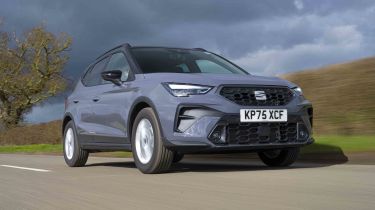
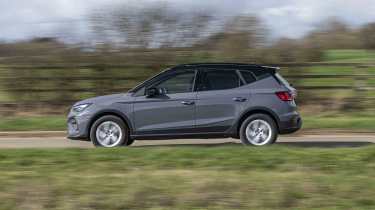
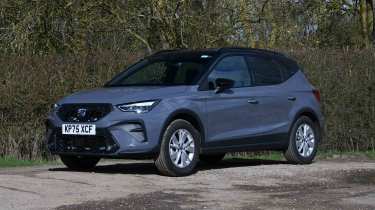
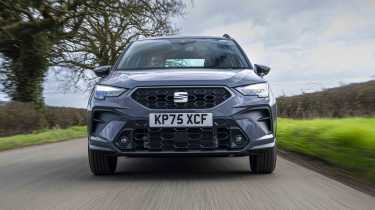
A big update to the Arona in 2023 freshened the looks and introduced LED headlights for all models, while more revisions at the end of 2025 further enhanced the car inside and out. Standard equipment on all models includes metallic paint (most rivals in this class offer it as a £500-£750 option) and a contrast black roof, alloy wheels, full LED headlights, an infotainment touchscreen (8.25 inches on SE models, 9.2 inches for the rest of the range), digital dials, rear parking sensors plus a suite of safety kit.
Interior and dashboard design
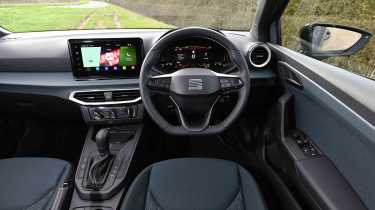
The Arona’s dashboard layout is a little dated when compared with newer rivals in the class, with the rotary climate controls feeling like they come from a car that’s a couple of generations old. However, many drivers will welcome the fact that there is physical switchgear to use, rather than anything on the touchscreen, while placing some of the switchgear around the gearlever means it’s easy to access.
Materials and build quality
The layout is fine, but the most obvious sign that the Arona is an older car is with the quality of the materials used. There are more hard plastics on show here than you might find in some rivals, although not all. While the Hyundai Bayon, for example, is a newer car, it features more hard plastics in obvious places, and the Arona does at least have a soft dashtop and a smart piece of plastic trim that runs the full width of the dashboard.
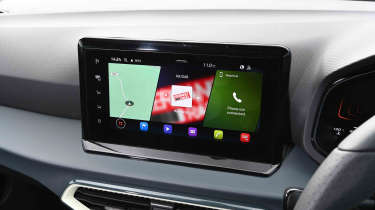
Infotainment, sat-nav and stereo
Touchscreen infotainment comes as standard across the range, with an 8.25-inch display for SE cars and a 9.2-inch layout for the rest of the range. It’s mounted at the leading edge of the dashboard, so it’s easy enough to use.
Every model also features an eight-inch digital cockpit (upgraded to 10 inches on FR Sport cars). The display is clear with crisp graphics, just like the main touchscreen, but navigating through the different settings takes some practice. Buttons on the steering wheel change the view, while two others are used to alter the information visible in the two read-outs on either side of the display. This is a bit involved, and requires you to use one button to select the display you want to change, then use the scroll wheel on the other steering wheel spoke to scroll through the different options.
"In an effort to keep the Arona feeling fresh, SEAT has upgraded the circular air vents at either end of the dashboard with Art Deco-looking ivory trim with backlighting. However, much like VW’s touch sensitive temperature and volume controls, we wonder if this feature was ever tested on the road at night before being signed off for production, because the soft white glow from the vents reflects in the side windows. That’s fine in most instances, but when there’s no street lighting, it means the door mirrors and rearward visibility are impaired." – Dean Gibson, senior test editor
Practicality, comfort and boot space
Pros |
|
Cons |
|
The Arona’s small size means it’s not the roomiest small SUV around, but there’s decent space for four, with headroom being especially generous.
Dimensions and size
The Arona typifies how tightly knit car manufacturers’ ranges are these days. It’s 4,138mm long, 1,780mm wide and 1,543mm tall – which makes it longer than a SEAT Ibiza and considerably taller than a SEAT Leon.
However, the car’s wheelbase – always a good guide to how much interior space there will be – is 2,566mm. That’s only a couple of millimetres more than an Ibiza’s, showing that, despite the increase in length, there’s not that much extra kneeroom or legroom when compared with the supermini.
| Dimensions comparison | |||
| Model | SEAT Arona | Hyundai Bayon | Ford Puma |
| Length | 4,164mm | 4,180mm | 4,186mm |
| Width | 1,780mm | 1,775mm | 1,805mm |
| Height | 1,538mm | 1,500mm | 1,550mm |
| Wheelbase | 2,566mm | 2,580mm | 2,588mm |
| Boot space | 400-1,280 litres | 411-1,205 litres | 456-1,216 litres |
Seats & passenger space
There’s plenty of space for two up front, although the narrowness of the cabin is given away by the fact that there’s no armrest between the front seats, and you might occasionally brush elbows. Thankfully there’s plenty of steering wheel and seat adjustment, so most body shapes will be able to get comfortable, and the tall driving position offers easy access, as well as a good view out.
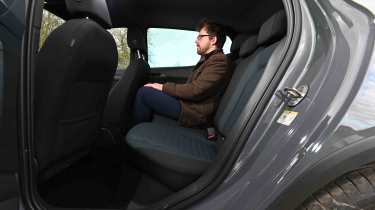
Headroom is the Arona’s big plus point, with plenty of space front and rear. Those in the back will be tight for kneeroom, though, especially if the front seats are pushed back. There’s not much in the way of luxury in the back, either, with no air vents or USB sockets.
Boot space
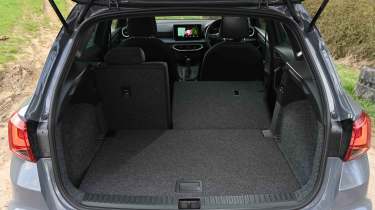
There’s a 400-litre boot in the back of the Arona, which is more than is offered in a SEAT Ibiza supermini, but plenty of rival small SUVs provide more space. The floor is square, though, and the load lip is relatively shallow, too. Folding the seat backs creates a completely flat cargo area and a total capacity of 1,280 litres. Beneath the floor is a deep well that has space for a spare wheel, and SEAT offers a space-saver as an option for £200.
"There’s not really enough space in the back seats for three people to sit comfortably, but at least SEAT offers a third seatbelt for the middle chair. Folding the back seats is simple enough via catches on the shoulders, while SEAT has fitted hooks on either side of the seat so that the seatbelts can be tucked out of the way and don’t get caught in the mechanism when flipping the seats back up." – Dean Gibson, senior test editor
Reliability and safety
Pros |
|
Cons |
|
As with all modern-day SEATs – and their VW Group counterparts – every Arona should fit the bill as safe family transport. The Arona was awarded a full five-star Euro NCAP rating when it was retested in 2022. It did better than the four-star results of the Honda HR-V and Vauxhall Mokka, but the five-star Toyota Yaris Cross tested under the same regime scored higher than the Arona across the board.
Every Arona gets tyre pressure monitoring, autonomous emergency braking (AEB), front and rear seat belt reminders, six airbags, Isofix child seat mounts and tiredness recognition. Adaptive cruise control is an option, but blind spot monitoring isn’t available.
SEAT had a disappointing result in the 2025 Driver Power survey, with the manufacturer coming in 24th place out of 31 brands.
| Euro NCAP safety ratings | |
| Euro NCAP safety rating | Four stars (2022) |
| Adult occupant protection | 83 per cent |
| Child occupant protection | 83 per cent |
| Vulnerable road user protection | 65 per cent |
| Safety assist | 70 per cent |
Buying and owning
Best buy: SEAT Arona 1.0 TSI 115 DSG SE Technology
There’s not much of a performance gap between the 1.0 and 1.5 TSI engines, while the DSG auto offers slick shifts that make the Arona easy to drive. Moving up a step from SE to SE Technology introduces some useful extras, such as a larger 9.2-inch touchscreen with navigation and connected services, a reversing camera and tinted windows.
SEAT Arona alternatives
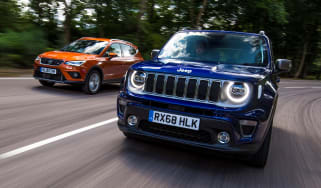
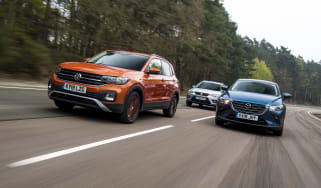
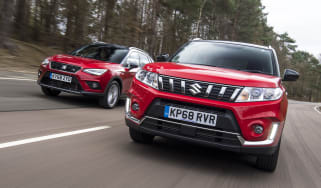
The Arona sits in a very busy part of the new-car market, and has a long list of rivals, many of which are newer, roomier, better to drive or more efficient, although not many manage to combine all of these characteristics together in one car. The closely related Volkswagen T-Cross/Taigo duo, plus the Skoda Kamiq, are worth considering, while the Stellantis group offers rivals such as the Peugeot 2008 and Vauxhall Mokka. The Renault Captur and Nissan Juke are also strong contenders, while the Hyundai Bayon or larger Kona, plus the Kia Stonic are available, too. It’s a big seller, but the Ford Puma is a great all-rounder and is the best car to drive in the class.
Key updates of the SEAT Arona review
20 March 2026: General update and the inclusion of impressions from our SEAT Arona versus Hyundai Bayon twin test
Deals on the SEAT Arona and alternatives
Frequently Asked Questions
SEAT’s standard warranty lasts for three years or 60,000 miles, whichever comes first. That’s the bare minimum that’s offered by any car maker these days, while the likes of Kia, Hyundai, MG and others offer longer terms. There are extended warranties on offer at extra cost that can cover the car for up to five years or 90,000 miles.
More reviews
Car group tests
Used car tests
Which Is Best