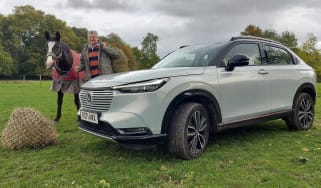
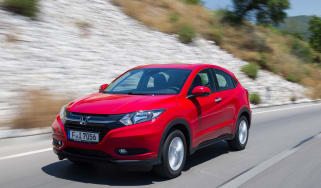
Honda HR-V review
Honda HR-V is a practical and refined SUV, although it’s expensive and faces strong competition

Our opinion on the Honda HR-V
The Honda HR-V is a worthwhile option for buyers wanting a compact SUV that delivers great fuel economy and a useful amount of passenger space. It’s quite handsome, too, and an extensive list of standard safety kit and decent on-board tech further enhances its family car credentials. However, it’s more expensive than many of its closest rivals, and it has a relatively small boot for the class. Ultimately, it performs the basics well, but doesn’t do enough to outshine the best in a highly competitive section of the market.
About the Honda HR-V
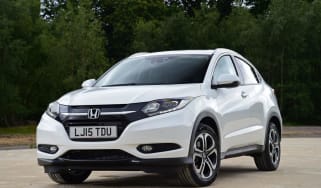
The Honda HR-V is now in its third generation, although you might struggle to remember the last version of this Japanese crossover. Yes, the old model was smart enough, with useful practicality and generous standard kit, but it suffered from a level of anonymity that never really allowed it to become a big hit with buyers.
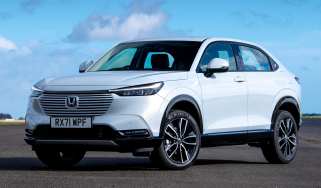
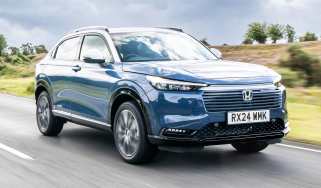
Honda has got the basics right with its latest HR-V: the exterior looks subtly stylish, while a peek inside reveals a simple and well-executed cabin design, with good build quality and a pleasing material fit and finish.
Elegance, Advance, Advance Style and Advance Style Plus make up the available trim levels, and buyers won’t have to spend any time wrangling over what power option to go for, because the HR-V is offered solely with a 1.5 i-MMD (Intelligent Multi-Mode Drive) full hybrid set-up. All models are front-wheel drive only, so there’s nothing to fret about there, either.
Used - available now


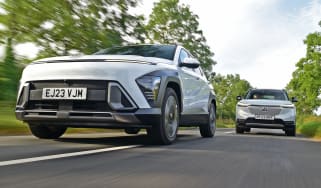
One of the Honda HR-V’s strongest competitors is the Hyundai Kona, so we were quick to pair these two small SUVs up in a twin test. Due to its vast interior space, lengthy list of safety features, and overall refinement, we made the Kona the winner.
Honda HR-V prices and latest deals
Prices start from just under £31,500 for a base-level Honda HR-V Elegance, rising to nearly £34,000 for the Advance. Advance Style comes in towards £37,000, while the fanciest Advance Style Plus commands around £38,000.
There are plenty of savings to be had when you build your ideal Honda HR-V with the Auto Express Buy a Car service. We also have a selection of HR-V leasing deals, along with plenty of used HR-V models to choose from. You can also sell your car with us.
Performance & driving experience
Pros |
|
Cons |
|
Honda has a reputation for doing things its own way, and while other manufacturers have looked towards plug-in power to deliver lower emissions and help reduce running costs, the innovative Japanese firm has chosen to go with a self-charging hybrid set-up for the HR-V.
Badged e:HEV, the hybrid system uses a 1.5-litre i-MMD petrol engine that acts as a generator to charge the two electric motors, with regenerative braking tech helping to recharge the battery.
Honda does love giving its engines fancy names, with the i-MMD moniker meaning the HR-V has something called Intelligent Multi-Mode Drive. While not related to any self-driving technology, the i-MMD system will automatically switch between electric, hybrid and petrol engine power, depending on the type of driving you’re doing, in order to provide the best performance and efficiency.
| Model | Power | 0-62mph | Top speed |
| HR-V 1.5 eHEV Elegance | 129bhp | 10.6 seconds | 106mph |
| HR-V 1.5 eHEV Advance | 129bhp | 10.7 seconds | 106mph |
Performance, 0-60mph acceleration and top speed
The HR-V's petrol/hybrid set-up produces a total power output of 129bhp and 253Nm of torque. Honda claims the entry-level Elegance model is capable of 0-62mph in 10.6 seconds, with the Advance versions adding an extra 0.1 seconds to the sprint time. Top speed for all third-generation HR-Vs is 106mph.
Town driving, visibility and parking
We found driving in town traffic pretty smooth, with the throttle easy to control in electric mode, although the HR-V isn’t quite so serene when you’re pushing on. Accelerate hard, and the engine takes a moment to pick up and direct its power to the front wheels, while the typical drone of the e-CVT transmission spoils the levels of refinement. It’s a shame because the HR-V rides well over speed bumps and potholes without too much suspension noise.
Country road driving and handling
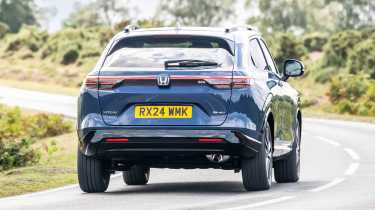
Family buyers probably won’t be exploring the limits of the HR-V’s handling, although you can make swifter progress because it’s all very settled and assured through the corners thanks to Honda working its engineering magic. Torsional rigidity has been increased by 15 per cent over the previous model, which helps give the HR-V a sportier feel than some of its rivals – especially the Hyundai Kona. The Honda has pleasingly accurate steering and plenty of grip, enabling you to confidently carry a bit of speed through the corners on twisty country roads.
We do find the ‘Road Departure Mitigation’ system to be a bit annoying at times, because it can occasionally nudge the wheel even though you aren’t near the white lines, which is a bit unnerving at speed. It can be switched off, but you have to remember to do so every time you restart the car. It can also be a distraction to do so while driving, because you have to dive into a sub-menu in the driver’s instrument cluster using the fiddly buttons and thumbwheel on the left-hand steering wheel spoke.
Motorway driving and long-distance comfort
Getting up to motorway speeds can be a noisy affair in the HR-V, because the engine is quite boomy when stretched. The revs can also remain high for a reasonable period after you lift off the accelerator once up to speed, as the system tries to keep the battery topped up with charge. Even when the engine has calmed down, there’s a general background hum of road noise (especially over rougher surfaces) and a little wind noise around its upright windscreen and chunky door mirrors.
It does feel very stable at motorway cruising speed, and the brakes provide plenty of stopping power should you need to scrub off some speed when approaching traffic. Again, the ‘Road Departure Mitigation’ system can be intrusive if you forget to indicate when returning to the inside lane after overtaking slower-moving vehicles.
“Switching the safety-assistance systems off can be a chore if you haven’t done it before starting every journey, and it’s potentially unsafe to do so while driving. So I leave them on and try to ignore the small audible interventions.” - Chris Rosamond, special contributor.
MPG & running costs
Pros |
|
Cons |
|
The self-charging hybrid set-up used by the HR-V means there is no need to plug in, but the combination of a 1.5-litre petrol engine and two electric motors delivers a WLTP-rated combined economy of 52.3mpg.
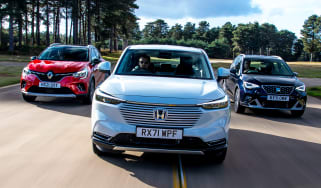
Our own test of the HR-V took in lots of less-efficient motorway driving, but with an average of 55.1mpg, we still managed to beat Honda’s claim comfortably. In comparison, the Renault Captur E-Tech Hybrid returned 54.3mpg following the same testing, while the SEAT Arona (with a standard 1.0-litre turbocharged petrol engine) managed 43.5mpg. We’re confident that the HR-V will easily exceed 60mpg on shorter in-town journeys where it can run on battery power much more often.
| Model | MPG | CO2 | Insurance group |
| HR-V 1.5 eHEV Elegance | 52.3mpg | 122g/km | 32 |
| HR-V 1.5 eHEV Advance | 52.3mpg | 122g/km | 33 |
| HR-V 1.5 eHEV Advance Style Plus | 52.3mpg | 122g/km | 33 |
Insurance groups
Arranging insurance cover for the HR-V may prove to be a little more expensive than for some of its close rivals. The HR-V falls into insurance groups 32 and 33 (out of 50), depending on the trim level you choose. That’s pretty high for a hybrid small SUV, especially when the equivalent Toyota C-HR goes from group 20 to 27.
For those who need a car with an even lower insurance group ranking, the SEAT Arona starts from as low as group 10, while the Ford Puma isn’t too bad, either, in group 12.
Tax
It’s not exactly a cheap car in this class, but the Honda HR-V does at least fall well below the £40,000 combustion luxury car tax bracket, when you remove the first year's VED and registration costs. Company car buyers will be far better off with an electric car, though, as these incur far lower Benefit-in-Kind (BiK) tax rates.
Following the demise of the Honda e:Ny1, you’ll now need to look towards other manufacturers of electric SUVs. The Hyundai Kona Electric, Kia EV3 and Skoda Elroq are three examples that we recommend.
Depreciation
The HR-V doesn't quite hold on to its value after three years or 36,000 miles as well as its rivals. Our market data shows that Honda’s SUV will retain between 44 and 48 per cent after this period, while the Hyundai Kona retains between 47 and 55 per cent after the same amount of time or mileage. The budget-friendly Dacia Duster wipes the floor with both of its rivals here, because it holds on to an impressive 56 to 61 per cent.
To get an accurate valuation on a specific model check out our free car valuation tool...
Interior, design & technology
Pros |
|
Cons |
|
The previous HR-V model majored on practicality, offering lots of interior space and a huge boot which wouldn’t have looked out of place in the class above. Although still a reasonably versatile family car, the third-generation HR-V is focused on delivering decent efficiency, improved on-board tech and a little extra style in an attempt to stand out in the ultra-competitive small SUV market.
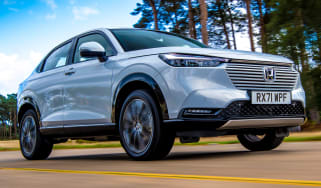
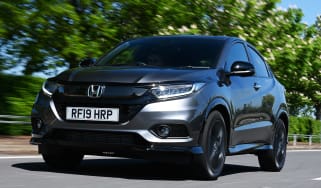
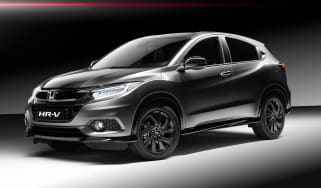
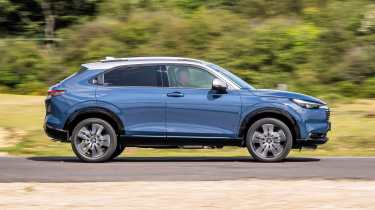
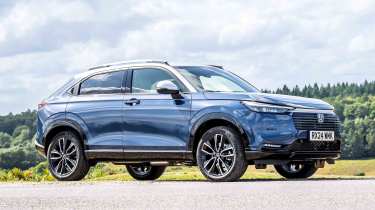
At first glance, the exterior design is certainly eye-catching, with cleaner lines than before and a sloping, coupe-like rear end – shown off particularly well if you go for the Premium Sunlight White Pearl paint option. Standard kit is generous, with all models featuring 18-inch alloy wheels, front and rear parking sensors, auto LED headlights, adaptive cruise control and a 9.0-inch touchscreen with integrated sat-nav, plus Android Auto and Apple CarPlay smartphone connectivity. Buyers also have the opportunity to personalise their HR-V by selecting one of two design packs (Sport or Patina bronze), with each offering different exterior trim options.
Interior and dashboard design
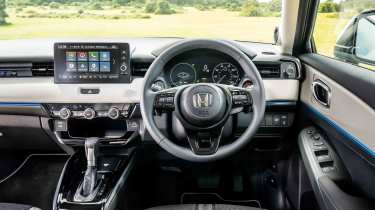
The interior is impressive, with a high level of perceived quality, and a design that, while you wouldn’t call it minimalist, is certainly simple, smart, and well organised. We would advise you to have a good look around a few HR-Vs at your local dealer, because some might find the sombre colour scheme of the Elegance and Advance trims less appealing to live with than the more colourful Advance Style and Advance Style Plus trims.
We approve of Honda having seen sense in keeping physical controls for frequently used features, such as the climate control, which has a set of chunky dials to adjust the fan speed and the separate temperature controls for the driver and front passenger zones. They’re even easier to use than the toggles in the Hyundai Kona and Toyota C-HR, and far less distracting than the touchscreen-only controls of the Ford Puma.
The HR-V gets a digital instrument cluster that can be configured to show lots of information, but it isn’t anywhere near as easy to use as the virtual cockpit in a Skoda Kamiq or Volkswagen T-Roc. Unlike its bigger Honda CR-V brother, the HR-V has a traditional and reassuringly purposeful gearlever rather than a slightly confusing array of buttons.
Materials and build quality
As we’ve often found with Honda cars, the HR-V feels impeccably well screwed together. All the buttons and switchgear have a consistent and high-quality feel, especially the dials for the climate control that provide a satisfying click when you turn them.
Most surfaces you come into contact with use soft-touch materials, although the top of the dash is made of hard plastic, which is a little unusual in a small SUV with premium pricing.
Infotainment, sat-nav and stereo
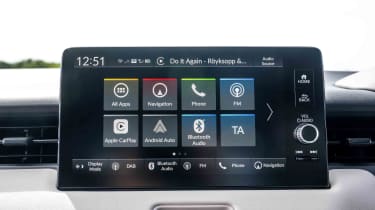
In essence, the HR-V’s infotainment system is closely related to the set-up used by the Honda Civic, featuring two displays. It’s a big improvement over the old car’s infotainment, but it isn’t the best system on the market.
The main menu page is arranged on a nine-inch screen with large, colour-coded tile icons for all of the major shortcuts, and there are physical home, back, track skip and volume controls to the side, too. The graphics aren’t quite as sharp as we’d like, nor are its loading times all that quick, putting it at a disadvantage against the improved OpenR Link infotainment system used by the Renault Captur that features Google built-in.
There is a My Honda+ app, which can operate as a digital key, using Geo Fence tech to create an alert if the car leaves a specified area, and locate it wherever it is parked.
"The lighter trim accents of Advance Style and Advance Style Plus trims do help to lift an otherwise dull and dark interior.” - Max Adams, online reviews editor.
Boot space & practicality
Pros |
|
Cons |
|
If you’re a family buyer looking for a small SUV that offers decent boot space, then the HR-V won’t be for you. Many of its rivals, such as the SEAT Arona and Peugeot 2008, provide more luggage room, although that’s not to say that the HR-V is completely lacking in practicality.
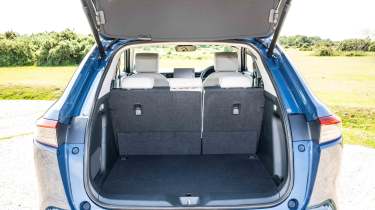
While its 335-litre boot is merely adequate, you’ll find Honda’s innovative ‘Magic Seats’ set-up in the rear of the cabin, which means not only will the seat backs fold flat, but the squab can also be pulled up into a vertical position - freeing up lots of useful space and allowing you to transport taller items.
The HR-V features a host of standard kit, including automatic wipers and LED headlights, adaptive cruise control and heated front seats. Honda has also designed a new ventilation system for the HR-V, creating air flow along the side window line to help cool or warm the car without generating a draught.
Dimensions and size
The HR-V is longer than the Ford Puma, Renault Captur, Peugeot 2008 and SEAT Arona, but Honda has done a good job of ensuring it doesn’t feel cumbersome from behind the wheel.
| Dimensions comparison | |||
| Model | Honda HR-V | Hyundai Kona | Renault Captur |
| Length | 4,355mm | 4,350mm (4,385mm N-Line & N-Line S) | 4,239mm |
| Width | 1,790mm | 1,825mm | 1,797mm |
| Height | 1,582mm | 1,585 | 1,576mm |
| Wheelbase | 2,610mm | 2,660mm | 2,640mm |
| Boot space |
319 litres 304 litres (Advance Style and Advance Style Plus) | 466 litres | 422 litres |
Seats & passenger space
There’s plenty of space on offer in the HR-V for both the driver and front passenger, and the driving position provides the sort of elevated seating position you’d expect of an SUV.
It is slightly disappointing that no version of the HR-V offers adjustable lumbar support, especially when cheaper alternatives such as the Toyota C-HR provide this as standard. You can’t get electric driver’s seat adjustment with memory settings, even as an option.
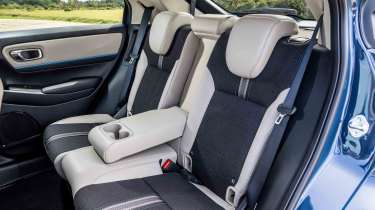
If you’ve drawn the short straw and find yourself in the narrow centre rear seat, things will feel a little cramped, but those in the outer positions should find things pretty comfortable, with plenty of leg and knee room for a 5ft 10in adult to sit behind a similarly sized person up front. There’s even lots of room for anyone with size 10 feet to fit their shoes under the seats ahead of them.
The slightly sloping roofline affects headroom: if you sit up straight, your hair will brush the headlining. Also, anyone in the middle seat will have to figure out how to clip in the three-point seatbelt, because it is stored in the roof when the seat isn’t being used.
Boot space
At 319 litres, the Honda HR-V’s boot is smaller than the Renault Captur’s 326-litre space, and comparatively tiny compared to the SEAT Arona’s 400 litres. There’s more bad news for those who opt for the fancier Advance Style and Advance Style Plus models, too, as these come with a 15-litre space penalty,
The HR-V’s boot lip is slightly stepped, but thanks to the clever Magic Seats folding mechanism, folding the rear seats reveals a completely flat load space of up to 1,289 litres. Not having an incline in the boot floor also makes it much easier to pack longer items.
The seats fold in a 60/40 split, which isn’t the most versatile layout, but that is typical for the small SUV class.
Towing
Unlike some other small SUVs, the Honda HR-V isn’t rated to tow. If you have a trailer or caravan standing by, we’d steer you towards the Volkswagen T-Roc 2.0-litre eTSI, because it can tow a very healthy 2,000kg braked trailer or caravan. If you’re not fussed about going with diesel power, the Skoda Karoq 2.0-litre TDI is even stronger at 2,100kg.
“Those ‘Magic Seats’ are a really clever feature, and also allow for the back seats to fold completely flat. That’s something we don’t often see in a car these days, including in estate cars where you’d expect maximising the available boot space to be a top priority.” - Max Adams, online reviews editor.
Reliability & safety
Pros |
|
Cons |
|
The third-generation HR-V underwent Euro NCAP's battery of crash safety tests in early 2022 and earned a four-star rating. That’s not unusual in this class, because the Ford Puma and Hyundai Kona also received four-star scores, but it is a little disappointing when alternatives such as the Toyota C-HR get the maximum five-star rating.
Euro NCAP penalised the HR-V’s child occupant score due to the seatbelt design slipping off the shoulder of the simulated child test dummy of a 10-year-old, and not providing enough head protection for children in the back in the side barrier crash test.
Despite its slightly disappointing safety score, the HR-V comes with a host of driver-assistance features, including Lane-keeping assist, Traffic Sign Recognition, and Collision Mitigation Braking. In true Honda style, it has also addressed some smaller tech details by introducing an improved HD camera and upgrading its processing hardware to enhance onboard pedestrian detection systems.
Honda’s approach to the ownership experience seems to be striking a chord with customers, because the brand finished in an admirable 10th out of 31 on the most recent Driver Power best manufacturer league table, with buyers praising their car's reliability, quality and running costs.
| Euro NCAP safety ratings | |
| Euro NCAP safety rating | Four stars (2024) |
| Adult occupant protection | 82% |
| Child occupant protection | 75% |
| Vulnerable road user protection | 72% |
| Safety assist | 78% |
Buying and owning
Best buy: Honda HR-V 1.5 eHEV Advance
While the entry-level Elegance comes very well-equipped, we’d recommend paying a little more for the Advance trim. It gives you several useful extras, such as an electric tailgate, a heated steering wheel, dual-zone climate control, blind-spot monitoring and adaptive headlights. The HR-V range only has one engine option, so that decision is taken care of for you. We’re hesitant to move higher on the trim level list because it increases the price and reduces the boot capacity.
Honda HR-V alternatives
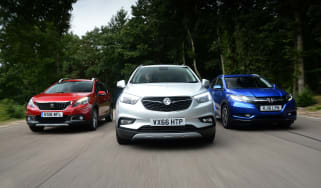
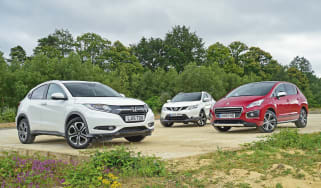
Talented rivals such as the Ford Puma, Peugeot 2008 and Renault Captur are firm favourites with family buyers (and our expert road testers), while the Volkswagen Group's trio of the SEAT Arona, Skoda Kamiq and Volkswagen T-Cross possess great all-round ability.
The Toyota C-HR is another capable contender, while those with slightly deeper pockets may be tempted by the style and extra space of the MINI Countryman.
Honda HR-V pictures
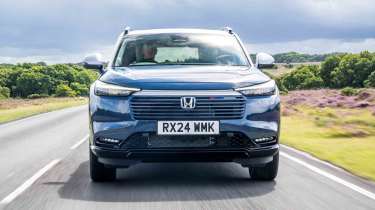
Key updates of the Honda HR-V review
9 June 2026: General update with the latest valuation information and to include the revised service activated warranty
14 April 2026: Updated to include the latest line-up and pricing information.
Frequently Asked Questions
A three-year/90,000-mile warranty is standard, but you can extend it by 12 months at a time with annual routine franchised dealer servicing, until the car is eight years old or has covered 100,000 miles, whichever comes first.
Deals on the HR-V and alternatives