Toyota Urban Cruiser review
Toyota has added a small EV to its line up with a little help from Suzuki, but it’s not the most compelling choice

Our opinion on the Toyota Urban Cruiser
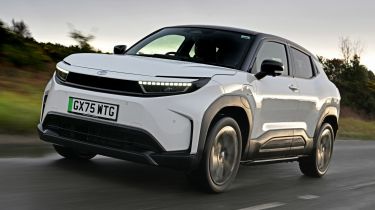
When it comes to an affordable electric crossover, we expected much more from Toyota. The new Urban Cruiser isn’t necessarily a bad car; it’s just unremarkable. We found it lacking personality, charm and a unique selling point that will allow it to triumph in the thunderdome that is the small electric SUV segment. Put simply, whatever it can do, most rivals can probably do better - including its Suzuki e Vitara sister car. We think the e Vitara has a bit more going for it with the option of a dual-motor 4x4 system, because the Urban Cruiser’s sole 2WD setup with average range and charging ability doesn’t help it stand out.
About the Toyota Urban Cruiser
These days, it feels like a new electric SUV is unveiled every five minutes, and just about every mainstream car maker either has one in its range or in the pipeline. Despite its rich history of hybrids, Toyota has been fairly slow on the uptake in the pure-EV market, but it's making up for lost time thanks to the recently updated Toyota bZ4X, the introduction of the Toyota C-HR+ and this, the Toyota Urban Cruiser.
It might be a global automotive giant, but Toyota looked to Suzuki to help develop the second-generation Urban Cruiser. A sibling to the e Vitara, the resulting vehicle sits on a brand-new, dedicated EV platform called Heartect-e that the two firms worked on together. The only real differences between the models are the front-end design and badges, plus the Suzuki offers the option of all-wheel drive.
Used - available now

2021 Skoda
Octavia
51,925 milesManualPetrol1.0L
Cash £10,600
2024 Citroen
e-Berlingo
57,511 milesAutomaticElectric
Cash £11,270
2022 Kia
e-Niro
32,354 milesAutomaticElectric
Cash £17,240
2017 BMW
X3
85,847 milesAutomaticDiesel2.0L
Cash £10,995While the Urban Cruiser is front-wheel drive only, it does at least get the same two battery options as the e Vitara - a 49kWh unit rated to do 214 miles between charges and a 61kWh unit with up to 265 miles of range. We've so far tried the Urban Cruiser in pre-production form during a drive in Spain, and in post-production 61kWh Excel form back in the UK.
Toyota Urban Cruiser prices and latest deals
Pricing for the Urban Cruiser has been made more attractive thanks to an 'Electrified Saving' of £1,500 from Toyota, so this car now starts at £28,500 in Icon trim with the small battery. The larger capacity battery arrives on the mid-range Design trim at £33,000, and finally, there’s the £35,000 Excel.
However, the e Vitara gets Suzuki’s more generous ‘Suzuki Granted’ discount of £3,750, which reduces prices to just over £26,000 for the entry-level Motion, and rises to £34,000 for the four-wheel drive Ultra. Neither the Suzuki nor the Toyota qualify for the government’s Electric Car Grant.
Now you can buy a car through our network of top dealers around the UK. Search for the latest deals…
Performance & driving experience
Pros |
|
Cons |
|
The Urban Cruiser drives identically to the e Vitara, so it isn’t particularly exciting behind the wheel. We’ve driven the e Vitara in its all-wheel drive dual-motor form, which we think gives the Suzuki a slight edge over the more one-dimensional Toyota.
Performance, 0-60mph acceleration and top speed
Those expecting the super quick 0-62mph sprint times of a Volvo EX30 are going to be disappointed with the Urban Cruiser. The entry-level 142bhp hits 62mph from rest in 9.6 seconds, while the 172bhp model with the higher capacity battery does the same sprint in 8.7 seconds.
That's more on par with a traditional petrol or diesel car, although we found that the acceleration still feels relatively nippy in the Urban Cruiser thanks to the instant torque you typically get from an electric motor and lack of any gear changes to interrupt the flow of power. It also has decent mid-range punch, because only gentle throttle inputs are needed to give quick bursts of acceleration from 0 to 30mph or 30 to 60mph. If you’re a bit heavy-footed, especially in the wet, the front wheels can scramble for grip. There’s enough poke for overtaking on a motorway as well, despite the relatively low 93mph top speed.
If you are considering an Urban Cruiser but want a little more performance, take a look at its sibling, the Suzuki e Vitara. With that car, you can get it in dual-motor AllGrip form with a little power at 181bhp and a swifter acceleration time of 7.4 seconds from 0-62mph.
| Model | Power | 0-62mph | Top speed |
| Toyota Urban Cruiser Icon 49kWh | 142bhp | 9.6 seconds | 93mph |
| Toyota Urban Cruiser Design 61kWh | 172bhp | 8.7 seconds | 93mph |
Town driving, visibility and parking
With a name like Urban Cruiser, you’d expect this car to be exceptional in town. The turning circle of 10.4 metres is pretty good, as is front and rear visibility, which is aided by a rather high driving position.
The light steering, paired with a responsive enough front end, means darting around parked cars and traffic is a breeze. We did find that at car park speeds on rough surfaces, the steering itself felt brittle - shaking as the front wheels dip into potholes.
There’s no one-pedal driving mode in the Urban Cruiser. Unlike the Renault 4 and Kia EV3, there are no paddles on the steering wheel to adjust the brake regeneration settings; the best that Toyota could come up with as a shortcut is a button on the centre control that simply turns the system on or off.
You adjust the strength of the regen via the touchscreen, and it’s a ridiculously convoluted process in the Urban Cruiser that involves trawling through settings menus. When you find the right one, you can opt for low, medium or high levels. You can’t change this while you’re driving, probably because Toyota knows drivers would be too distracted by the process. And even after all that, the strongest mode takes a long time (and distance) to slow the car to a crawl when you lift off the throttle.
Country road driving and handling
The country roads on our test route gave us an opportunity to try Toyota’s ‘active cornering control’. This is essentially torque vectoring by braking, so when cornering, the car uses the brakes on the inside wheel to tuck the car’s nose in and prevent understeer. The overall nimbleness of the Urban Cruiser is decent as a result, but an unsettling side effect of the system is that the car feels like it has no grip at the rear, which is the opposite of confidence-inspiring. If anything, the handling feels even more unnatural from the passenger seat.
With an upright body, a generous amount of give in the suspension and fairly skinny, efficiency-chasing tyres, the Urban Cruiser isn’t something you relish chucking around your favourite B-road. The ride settles down from the occasional jiggle you experience around town, though it’s still more floaty than we’d like - certainly compared to the best handling cars in the segment, such as the Ford Puma Gen-E.
We understand Toyota’s decision not to offer a dual-motor version of the Urban Cruiser as you'll find in the e Vitara (preserving the Vitara’s AllGrip history), but it’s still a shame as it limits choice compared to the Suzuki.
Motorway driving and long-distance comfort
At higher speed the Urban Cruiser’s steering feels stiffer, giving the feeling of a more stable car - though it’s still not the most connected you’ll feel to the driven wheels in a modern small SUV. The throttle and brake pedal calibration remain in a good operating window of not being hyper-responsive or too vague - even when you're switching the car between ‘Eco’, ‘Normal’ and ‘Sport’ modes.
The Urban Cruiser's suspension does a decent job of filtering out scarred surfaces, though undulations are felt through the overall wallowy nature of this crossover.
Toyota can’t take any of the blame or credit though, because we were told that Suzuki took care of tuning the chassis and suspension for the e Vitara/Urban Cruiser twins.
Compared to the similarly-sized Yaris Cross, which is Toyota’s combustion-engined B-segment SUV, the Urban Cruiser doesn’t feel as refined. Road noise creeps into the cabin, and during our test drive in heavy rain, the lack of sound deadening in the roof made the Urban Cruiser feel quite cheap.
“I’m baffled as to why Toyota and Suzuki have spent time trying to eliminate understeer in their new small SUVs that’ll mostly be used to potter around town, instead of developing a one-pedal driving function that this car’s buyers might actually appreciate.” - Ellis Hyde, news reporter
Range, charging & running costs
Pros |
|
Cons |
|
Suzuki says the battery cells for its e Vitara are sourced from BYD, and while Toyota hasn’t specifically said the same to us, it’s almost certain this is also the case with the Urban Cruiser. Typically, this would be a good thing because BYD makes some of the most energy-dense and competitive batteries in the automotive industry, though the Urban Cruiser’s range and efficiency are still only average for the class.
Electric range, battery life and charge time
While they have different faces (and consequently slightly different aerodynamics) the Urban Cruiser has the exact same range as its e Vitara cousin with the 49kWh battery, at 214 miles. The big capacity battery model in the Toyota squeezes out an extra mile over the equivalent Suzuki in either Design or Excel trim, at 265 miles.
In the real world, we averaged 3.7 miles per kWh in a near-production prototype when testing in Spain, or around 225 miles from the Toyota’s bigger 61kWh battery. On our test here in the UK in cold and soaking wet conditions, that figure dropped only slightly to 3.5 miles per kWh, which would return 213 miles of range.
A range of just over 200 miles is below average these days in the B-segment SUV market - especially at the price of the Urban Cruiser. Rivals like the Renault 4, Jeep Avenger, or base versions of the Kia EV3 and Skoda Elroq are all in the same ballpark as the Urban Cruiser 61kWh model’ s 264 miles. Crucially, you can get the Kia or Skoda with a larger battery that’ll cover more than 350 miles in one go.
The Urban Cruiser’s maximum charging speed - just 67kW for the large battery or 53kW for the small battery - is especially disappointing by today's standards. That means a 10 to 80 per cent top-up takes at least 45 minutes, no matter which battery capacity you have, and most other cars in this class can do the same job in about half an hour or less. Utilise a typical 7.4kW wallbox charger at home, and it'll take around 9.5 hours to fully recharge the 61kWh model, and just under 8 hours to do the same with the 49kWh version.
Toyota’s explanation for this is that the lower maximum speed helps ensure the longevity of the battery, which it will cover under warranty for up to 10 years or 650,000 miles (one million kilometres), so long as owners get the car serviced annually at an approved Toyota dealer. We can understand the thinking, but none of that is going to matter to anyone who’s leasing this car for just a couple of years, as a lot of people do with electric cars. They will have to sit plugged into a public rapid charger for nearly an hour, while other drivers with cars capable of faster speeds come and go.
| Model | Battery size | Range | Insurance group |
| Toyota Urban Cruiser Icon | 49kWh | 214 miles | 32 |
| Toyota Urban Cruiser Design | 61kWh | 265 miles | 34 |
Insurance groups
It isn't unusual for EVs to be in a higher insurance group than a traditional petrol or diesel car, but it is a bit odd that the Toyota Urban Cruiser is in a higher insurance group than the Suzuki e Vitrara, even though they are essentially the same car underneath. The Urban Cruiser starts in group 32 for the entry-level Icon trim, while the range-topping Excel is in group 35. Meanwhile, the e Vitara starts in group 20, and only goes up to group 28 for the four-wheel drive Ultra AllGrip model.
Tax
Low prices and all-electric drive mean that the Toyota Urban Cruiser will be attractive to business users, though the Suzuki e Vitara undercuts it on list price. Lower-rate taxpayers can expect bills of less than £250 a year, thanks to the four per cent BiK rating for the ‘26 to ’27 tax year. This will go up to five per cent from ‘27 to ‘28, and seven per cent for the ‘28 to ‘29 tax year.
The highest-trim Urban Cruiser sits well below £50,000 so there’s no worries about paying Luxury Car Tax. You will still have to pay the standard rate of annual vehicle excise duty (VED), as EVs are no longer exempt from it.
It is worth noting that EVs could be subject to an eVED pay-per-mile fee if that comes into force from April 2028 onwards.
Depreciation
Residual values for the Urban Cruisers are closer to the top of the class than many of its rivals. Our expert CDL valuation data suggests that after three years or 36,000 miles, it'll be worth between 47 and 49 per cent of its original value. Meanwhile, the mechanically similar Suzuki e Vitara will retain an average of 43 per cent.
In comparison, the Vauxhall Mokka Electric will only maintain 33 per cent of its value (the hot GSE is an outlier at 45 per cent), and the Jeep Avenger Electric hangs on to 39 to 41 per cent. However, the Renault 4 does better, and is expected to still be worth 51 to 53 per cent of its original value over the same period.
To get an accurate valuation for a Toyota Urban Cruiser, check out our valuation tool...
Interior, design & technology
Pros |
|
Cons |
|
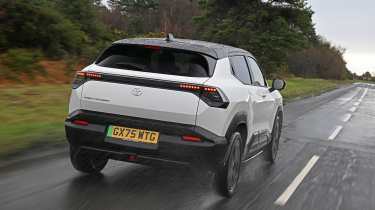
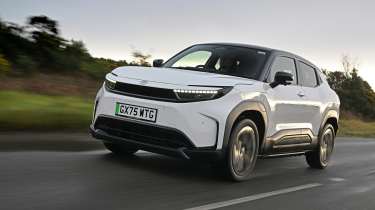
Toyota has made a slight effort to make the exterior of the Urban Cruiser look different to its Suzuki stablemate at the front by bringing the design in line with the larger bZ4X. Unfortunately, the rest of the car looks just like the Suzuki, and while it’s not necessarily a bad thing, we were hoping Toyota would inject more of its own design language and personality into the looks. The range of paint finishes on Icon and Design are pretty uninteresting, though Excel adds the choice of bi-tone paints and a splash of colour with red or green options that we like.
Entry-level Icon trim comes with 18-inch wheels, keyless entry, blind spot monitoring, adaptive cruise control, rear parking sensors, and second-row sliding seats.
Our preferred trim is the mid-range Design trim because it's the least expensive way of getting the 61kWh battery, but it does come with some nice features, such as:
- Heated front seats
- Heated steering wheel
- Heated door mirrors
- Front windscreen wiper de-icer
The range-topping Excel comes loaded with 19-inch alloys, a sunroof, a panoramic camera system, adaptive LED headlights, a JBL sound system, electric front seats, and a wireless phone charger.
Interior and dashboard design
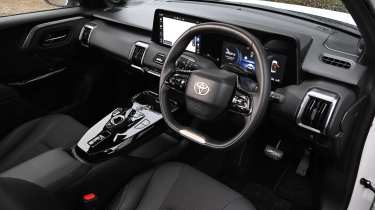
The Suzuki underpinnings are even more obvious inside. We thought Toyota should consider changing a few more things after our first drive in Madrid, because there’s a lack of similarity to other Toyota models in terms of switchgear, layout and materials in the Urban Cruiser. Sometimes this can work in a car’s favour, but that’s not the case here as the Urban Cruiser looks a little awkward in the Toyota range due to its obvious Suzuki roots.
Materials and build quality
The Urban Cruiser feels cheap, too, with almost all the surfaces made from varying textures of plastic. The dashboard has just a thin layer of soft-touch fabric to raise the tone.
The seats are incredibly hard and felt like they had no side bolstering; we slid around in them through corners. The headrests are also rock solid, which made us very grateful the Urban Cruiser doesn’t have enough torque to pin us back in the seats like some EVs can.
It’s a shame because quality and comfort are things that Toyota so regularly gets right, but it’s another example where outsourcing development has hurt the brand.
Infotainment, sat-nav and stereo
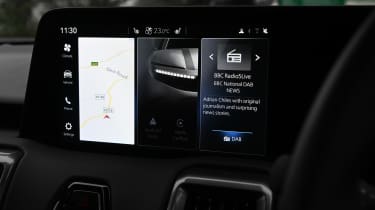
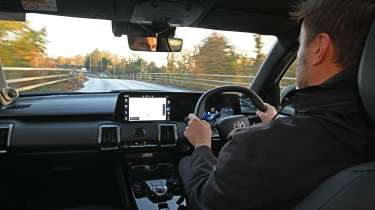
The infotainment system in our prototype test car was painfully slow, but the production car we tested later in 2025 was a bit sharper. We still had to wait for menus to load and a couple of times on our test the touchscreen needed a second prod to get it to do what we wanted.
Wireless Apple CarPlay and Android Auto do come as standard, so you don’t have to deal with the built-in software for media and navigation, at least. The driver’s display itself has an unsightly black bar at the top to make it merge into one uniform tablet with the central touchscreen.
The system is nowhere near as slick as the one you find in the latest Toyota bZ4X, though, with such a basic menu layout, it is at least easy to get your head around. The graphics are okay for this sector, but what we didn't like was the grainy rear-view camera quality and the annoying start-up sequence, which displayed the exterior 360-degree camera for far too long.
“Design-wise, the Toyota Urban Cruiser is an uninteresting car that doesn’t manage to look sleek or futuristic, can’t play off people’s nostalgia or even appeal to young buyers who want something really boxy. I imagine this is what a street sweeper in the Star Wars universe would look like.” - Ellis Hyde, news reporter.
Boot space & practicality
Pros |
|
Cons |
|
The Urban Cruiser doesn’t feel particularly spacious up front, and taller individuals may find the driving position quite cramped – our hands kept hitting our knees whenever we turned the steering wheel because we needed to set it low enough to see the driver’s display. The long rear windows help mitigate the blind spot created by the thick C-pillar, but we wish the rear windscreen or rear-view mirror were bigger to improve visibility.
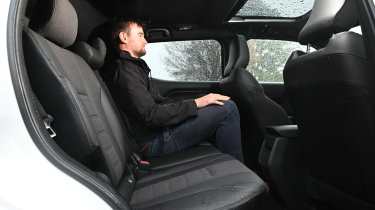
There’s an adequate amount of kneeroom in the back – plenty for six-foot-tall adults – and sufficient headroom, but the floor is high, and you don’t get much under-thigh support, so it won’t be terribly comfortable back there for adults on long journeys.
There are two sets of Isofix mounting points for child seats in the back, and the wide-opening rear doors help when loading up the car. The only creature comforts are a pair of USB charging ports, and if you fold down the middle seat, there’s a pair of cup-holders for the rear passengers, too.
Dimensions and size
You won’t be surprised to hear the Urban Cruiser is almost the exact same size as the e Vitara. That means it’s around the middle of the pack for overall dimensions in the B-segment SUV sector, but doesn’t mean it’s particularly competitive for interior space.
| Dimensions comparison | |||
| Model | Toyota Urban Cruiser | Ford Puma Gen-E | Renault 4 |
| Length | 4,285mm | 4,313mm | 4,144mm |
| Width | 1,800mm | 1,805mm | 1,808mm |
| Height | 1,635mm | 1,555mm | 1,552mm |
| Wheelbase | 2,700mm | 2,588mm | 2,440mm |
| Boot space | 216-566 litres | 556-1,283 litres | 420-1,405 litres |
Seats & passenger space
The instrument cluster could be better positioned, as the driver-attention sensor - located high on the steering column - can obstruct the lower part of the display for drivers who prefer a raised steering wheel.
We found the front seats offer good space and ample adjustment, but they’re quite firm and might not be the best on longer journeys. A high centre console incorporates an awkward-to-use tray underneath, which also houses two USB sockets.
The highlight of the Urban Cruiser’s interior is the sliding rear bench, a feature shared with the Suzuki e Vitara. When set to its rearmost position, all three rear seats offer generous legroom. However, the middle seat is narrow, and the center console extends back slightly, encroaching on kneeroom. With the rear bench slid forward, there’s simply no room for adults back there.
Boot space
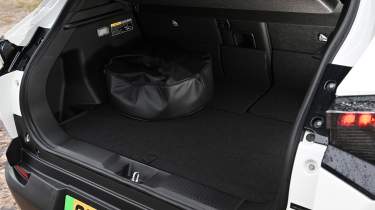
The Urban Cruiser’s 216-litre boot is only slightly bigger than a MINI Cooper, and far less practical than any rivals. The rear seats can be pulled forward by up to 16cm to expand the capacity, but even then, there’s still only 306 litres available.
For context, the Renault 4 boasts 420 litres, while the Elroq can haul 470 litres of stuff and its cabin feels far more spacious. Fold the 40:20:40-split rear bench down, and the Urban Cruiser offers 566 litres of cargo space, which is less than you get in the Skoda Enyaq with the rear seats up. The Toyota has barely enough underfloor storage for the charging cables and no extra stowage space under the bonnet.
"The maximum towing rate of the Toyota Urban Cruiser is only 750kg, so those wishing to tow a decent-sized trailer or caravan will need to look towards the Volvo EX30, which in dual-motor form can handle up to 1,600kg." - Max Adams, online reviews editor
Reliability & safety
Pros |
|
Cons |
|
The Toyota Urban Cruiser received a four-star Euro NCAP safety score - the same as its Suzuki sibling. Despite this, the full list of standard safety equipment is very solid. Every model comes with the brand’s ‘pre-collision system’ with vehicle, pedestrian and cyclist detection, adaptive cruise control, a driver monitoring camera, lane departure alert and lane-keep assist systems.
Similarly, while this car is based on a brand-new platform, Toyota is well known for making reliable cars and EVs are generally very reliable. The Japanese brand finished eighth (out of 32) in our 2024 car manufacturer rankings but slipped to a middling 14th in the 2025 Driver Power customer satisfaction survey.
| Euro NCAP safety ratings | |
| Euro NCAP safety rating | Four stars (out of five) |
| Adult occupant protection | 77% |
| Child occupant protection | 85% |
| Vulnerable road user protection | 79% |
| Safety assist | 72% |
Buying and owning
Best buy: Toyota Urban Cruiser Design
The mid-level Design model, which adds the bigger 61kWh battery, seems the best option. Equipment will be the same as in base cars that come with dual 10-inch displays, wireless Apple CarPlay and Android Auto, a sliding rear bench and an energy-saving heat pump.
Toyota Urban Cruiser alternatives
The Toyota Urban Cruiser is a small electric SUV, meaning there’s about two dozen alternatives you could (and probably should) choose instead. If it's style you want, there’s the Renault 4, MINI Aceman and even the Jeep Avenger.
Meanwhile, the larger and more sophisticated Kia EV3 and Skoda Elroq offer extra space inside and much larger range figures. If you want to save some money, the Citroen e-C3 Aircross and Vauxhall Frontera Electric because both cost less than £25,000 and come with much more space inside.
Key updates of the Toyota Urban Cruiser review
9 April 2026: Updated to include information about Toyota's electric car discounts and our latest valuation information.
Deals on the Toyota Urban Cruiser's rivals
Frequently Asked Questions
Toyota specifies that the Urban Cruiser needs to be serviced annually or every 10,000 miles. That's quite short for an EV when compared with, but it does allow you to maintain the brand's service-based extended warranty up to 10 years or 100,000 miles.