Kia Venga 2015 review
The facelifted Kia Venga covers many bases with lots of practicality, but it’s short on driving excitement

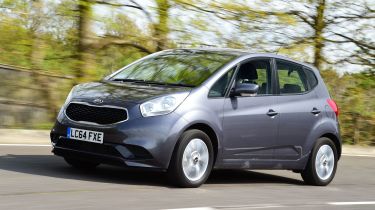

A roomy interior and a comfortable ride means this revised Kia Venga is even more usable than a conventional hatchback. However, it’s not that fun to drive, and with a dull cabin and inefficient 1.4-litre petrol engine tested here, there are more appealing mini-MPV alternatives out there.
Like the latest Picanto hatchback, you’d be hard pushed to tell this Kia Venga is new. However, the Korean brand has given its mini-MPV a mild facelift for 2015, including a few design tweaks and a revised, ‘more sophisticated’ interior.
The Venga now gets a bigger version of Kia’s trademark ‘tiger nose’ grille, as well as another new air inlet lower down incorporating the car’s fog and daytime running lights. On top of this there are some new alloy wheel designs while a range-topping ‘4’ trim level has been added to line-up, but the changes to the Venga are minimal, and in our test car’s metallic grey paint it isn’t the most head-turning car in its class.
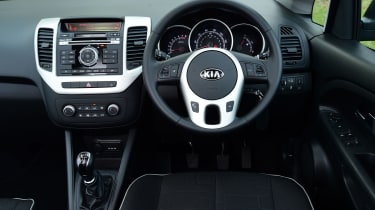
There are more changes inside, including brighter trim details to try and lift the atmosphere, as well as options including a heated steering wheel, a 7.0-inch sat-nav system and a rear-view camera – however, these neat gadgets only feature on higher trim levels and not on the ‘2’ spec version we’ve tested here. This car makes do with a conventional radio.
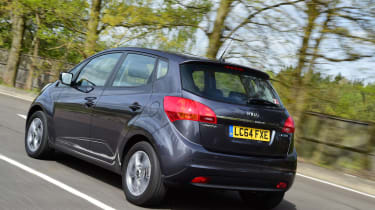
Even with a few more silver-coloured panels, it’s still not the most stylish cabin, but it is practical. The Venga rides slightly higher than a normal hatch, which means it’s easier to get in and out of. And there’s plenty of leg and headroom once you’re in there.
Used - available now

2024 Audi
A3 Saloon
25,119 milesManualPetrol1.0L
Cash £18,497
2022 Nissan
Qashqai
23,640 milesAutomaticPetrol1.5L
Cash £17,197
2024 BMW
2 Series Gran Coupe
59,459 milesAutomaticPetrol1.5L
Cash £16,697
2024 Volkswagen
Polo
34,462 milesAutomaticPetrol1.0L
Cash £15,900A 440-litre boot is seriously impressive, and there’s up to 1,486 litres available if you fold the rear seats down. You can slide the back bench forward or backward by 130mm as well depending on whether you need more luggage room or passenger space.
This comfortable, practical edge is reflected in how the Venga drives. That higher ride height means long-travel suspension, which allows the Venga to soak up serious bumps around town with a nice, rounded edge. However, throw it into a roundabout too fast and the Kia will roll over heavily. The steering isn’t that precise either, and if you push the Venga harder it feels mushy and indistinct.
It’s best to stick to a more relaxing pace instead, as the 89bhp 1.4-litre petrol engine isn’t particularly punchy. It lacks the mid-range go of some low-capacity turbocharged rivals, which means you have to rev it fairly hard if you need to make a quick getaway.
One major drawback of the Venga’s naturally aspirated engine is its efficiency. Kia claims 50.4mpg combined, but 130g/km CO2 for this stop-start equipped model means £110 per year road tax and elevated company car costs compared to the cleaner competition.
Kia’s five-speed manual gearbox is light and pleasant to use, but the Venga feels like it could do with a sixth gear on the motorway to improve refinement that little bit further. In general though, it’s quiet and composed in every-day driving.
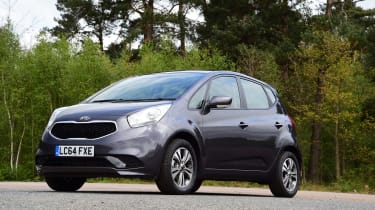
Around town, visibility is excellent, which makes the car surprisingly easy to manoeuvre – it’s quite a clever trick given how spacious the Kia is that the Venga’s footprint isn’t that much bigger than a regular supermini, and at £13,895 for this mid-grade ‘2’, it’s relatively well priced.
You get 16-inch alloy wheels, air conditioning, Bluetooth, USB connectivity, parking sensors and tinted windows, as well as Kia’s class-leading seven-year/100,000-mile warranty.
If it’s practicality and dependability you’re after, the new Kia Venga is a respectable candidate for the job, but Ford’s B-MAX mini-MPV is a more exciting car to drive, while the Nissan Note or Skoda Fabia Estate also offer lots of versatility without the Kia’s more dowdy image.