New Volkswagen ID.3 Neo 2026 review: EV puts VW back where it belongs
Has VW’s all-electric hatchback finally grown up? We get behind the wheel to find out

Verdict
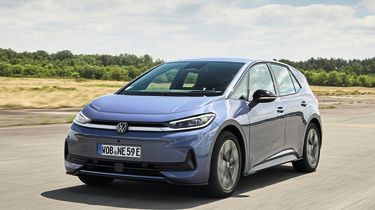
Let's just forget what used to be: the Volkswagen ID.3 Neo absolutely delivers, and it does so properly. It scores highly with its vastly improved technology and excellent versatility. Crucially, the new, more frugal electric motor makes the smaller battery packs far more attractive to buyers than they ever were before. Volkswagen is seemingly back where it belongs.
As a general rule, Volkswagen only really starts chasing automotive trends when they have almost lost their trendy status, and success has already been carved into permanent, reliable pathways – usually by other manufacturers.
However, with the ID.3, things were supposed to be different. The all-electric Golf equivalent arrived early, making its grand debut at the Frankfurt Motor Show back in September 2019. With this crucial model, VW wanted to escape its recent past, leave the diesel-scented depths of the emissions scandal firmly in the rear-view mirror, and lay down a serious marker against the early pioneers at Tesla.
The strategy was to make absolutely everything new. But in doing so, Volkswagen ran the immediate risk of alienating its fiercely loyal clientele. While VW drivers were historically accustomed to cars that were perhaps unfashionable but meticulously engineered and highly resolved, the original ID.3 operated more on the ‘banana principle’, meaning it essentially ripened while in the customer's possession. When it first arrived, the cabin quality, glitchy software and the frustrating ergonomics didn’t meet the high expectations VW buyers had long held, costing the company a lot of goodwill and trust.
Used - available now

2015 Mercedes
GLA
64,307 milesAutomaticDiesel2.1L
Cash £8,900
2015 Renault
Grand Scenic
139,735 milesManualDiesel1.6L
Cash £1,995
2021 Skoda
Octavia
51,925 milesManualPetrol1.0L
Cash £10,600
2024 Citroen
e-Berlingo
57,511 milesAutomaticElectric
Cash £11,270Which brings us to the here and now. Over the years, VW has made numerous tweaks and improvements to the ID.3, yet this new model is intended to be much more than just a mid-life facelift. To ensure absolutely nobody misses this fact, VW has even slapped the new ‘Neo’ surname directly onto the new, body-coloured tailgate. But just how much is genuinely new under the skin?
Interior, design and technology
If you ignore the minor exterior tucks and styling modernisations, such as the updated front bumper and the tweaked headlights, and dive straight into the Neo's interior, you will quickly find where the real money has been spent.
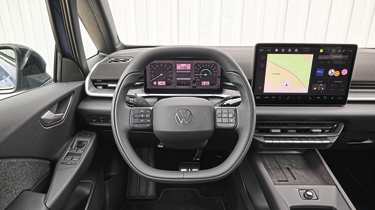
The widely criticised dashboard that plagued early cars is finally a thing of the past. You will now find pleasant fabric covers on the forward section of the cabin, which is nicely flanked by softer, more premium materials on the door panels. Inspect the surfaces around the rear doors too closely and you can still feel where the accountants wielded their red pens, but overall it’s a noticeable improvement.
The second major issue VW had to tackle was the ergonomics and user operation. To make everything a bit simpler and more intuitive again, VW has reintroduced physical buttons in several places.
On the driver's door, there are now four dedicated window switches, replacing the infuriating two-switch set-up in the old car. In the centre console, there is a proper volume knob that you can twist, which can also be nudged like a joystick to skip tracks back and forth. The inductive charging pad has also been repositioned and is now ventilated to keep your smartphone cool.
Directly in front of the driver, there is a brand-new steering wheel featuring tactile controls. While this might seem like a small step, it represents a giant leap forward for Wolfsburg; we found operating the cruise control had definitely improved as a result of these physical buttons.
The ID.3’s software had already been heavily revised recently, meaning it was no longer something to get angry about. Nevertheless, VW has added further improvements, treating the system to gently redesigned user interfaces and a few extra customisation options.
There is now a satellite map view, similar to what you get in an Audi, which can also be displayed on the screen directly in front of the driver. By pressing the ‘View’ button on the steering wheel, the instrument cluster – now much bigger than before – changes its layout.
Further updates include refreshed driver-assistance systems, notably a Travel Assist feature that confidently steers the ID.3 through tricky environments even when lane markings are poor. The car now also features traffic-light recognition.
Practicality and space
Now that your mood is no longer affected by interior quirks, the subjective strengths of the ID.3 carry much more weight. Chief among these is the car's excellent packaging and use of space. The VW completely ignores the trend for swooping, coupe-like rooflines, so its slightly tall, upright stance is actually reminiscent of the old Golf Plus.
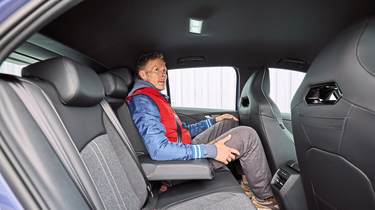
This translates to wonderfully generous cabin space. Especially in the rear, where some rivals force you into a foetal position, the ID.3 remains entirely uncomplicated. The large doors make getting in and out easy, and even without the optional panoramic glass roof, the interior ambience is bright and friendly. The optional 'ergoActive' seats offer fantastic support, side bolstering and even a massage function, while passengers approaching six-feet tall will fit comfortably in the back of this relatively short car.
You do have to make some minor compromises when it comes to luggage, however. The boot space is strictly average for the class, offering between 385 and 1,336 litres of capacity – identical to the pre-facelift car. Furthermore, the optional rear tow hook is designed exclusively for mounting bicycle carriers.
Up front, the bonnet is relatively short, and the ID.3 still does not offer a ‘frunk’ for storing charging cables. Cleverly, though, the rear-view reversing camera remains hidden away under the rear VW badge, keeping the lens clean from road grime.
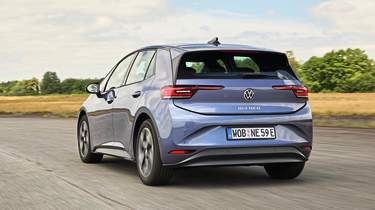
Performance and driving dynamics
On the move, the ID.3 once again demonstrates exactly what Volkswagen's engineers are capable of. Although it is certainly no lightweight, at around 1.9 tonnes, the adaptive suspension (DCC) and progressive steering set-up (likely to be a cost option) extract astonishing capability from the chassis.
The 4.27-metre-long EV reacts immediately to steering inputs. It feels remarkably agile, aided by a tight turning circle of just 10.4 metres. At the same time, it remains highly comfortable, thanks to 15 different selectable damping stages.
The rear-wheel-drive layout ensures the car always remains the master of the situation; the healthy 350Nm of torque is kept perfectly in check by an attentive stability and traction-control system. In terms of sheer polished refinement, almost no other car in this class can match it.
Under the skin, the Neo is the very first VW on the market to utilise the updated MEB+ electric platform. This means it benefits from a brand-new electric motor unit which, unlike its predecessor, runs much more efficiently to enable longer driving ranges.
During our testing, the 58kWh ID.3 Neo genuinely impressed by recording an efficiency figure of almost exactly four miles per kWh. This boost over its predecessor yielded an extra 31 miles of total range, achieving almost 254 miles on test – against an official maximum of 297 miles.
The Neo charges its LFP (Lithium-Iron-Phosphate) battery at a slightly reduced peak rate of 105 kW (down from 120 kW previously), getting from 10 to 80 percent in 26 minutes. On the flip-side, the ID.3 now comes with a true one-pedal driving mode, which can be adjusted across two strength levels. The car also now features Vehicle-to-Load (V2L) technology, meaning it can supply power to external electrical devices.
Volkswagen is yet to announce UK pricing, with first cars not expected here until October at the earliest. In Germany, Volkswagen is asking a minimum of 39,195 Euros (around £33,500) for the Neo equipped with the mid-size battery – although discounts are already being advertised on the company’s customer site. If you want a heat pump, however, you’ll have to pay an extra 1,090 Euros (£930) for the privilege.
Perhaps VW isn't actually too late in chasing trends. Perhaps it just spends a little too long developing its own ideas.
| Model: | Volkswagen ID.3 Neo 58kWh |
| Price: | £33,500 (est) |
| Powertrain: | 58kWh battery, 1x e-motor |
| Power/torque: | 187bhp/350Nm |
| Transmission: | Single-speed automatic, rear-wheel drive |
| 0-62mph/top speed: | 7.9 seconds/99mph |
| Range: | 297 miles |
| Charging: | 105kW (10-80% in 26 mins) |
| Size (L/W/H): | 4,295/1,809 /1,561mm |
| On sale: | October |
Get even more from Auto Express, follow our channels...
• Google
• Reddit
• Whatsapp