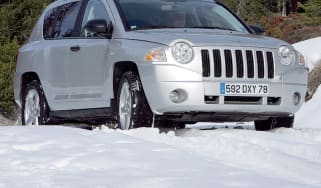
Jeep Compass review
Jeep Compass is a ruggedly styled family SUV with plenty to offer beyond its distinctive looks


Our opinion on the Jeep Compass
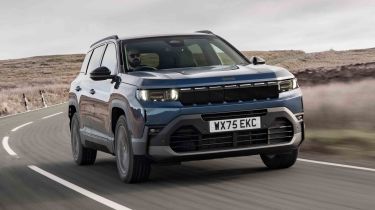
The latest Jeep Compass capitalises on the success of the smaller Avenger by offering a similar combination of ruggedly handsome looks, an interior that’s built to last, good tech, and a wide selection of powertrains that should suit everyone. Sure, the Compass isn’t as fun to drive as its baby brother, or the plushest mid-size SUV around, but it’s practical and respects Jeep’s off-road heritage – even if the most treacherous landscape it’ll ever see is a gravel car park.
About the Jeep Compass
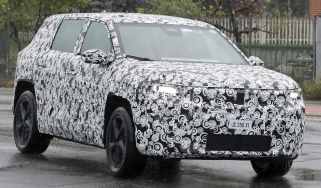
Since the baby Jeep Avenger arrived a few years ago, more than 200,000 have been snatched up, and the brand’s UK sales figures have tripled. So the decision to take this big seller’s winning formula and super-size it to create the new third-generation Compass is a no-brainer.
The Jeep Compass is a mid-size family SUV that uses the same STLA Medium platform as the latest Citroen C5 Aircross, Peugeot 3008 and Vauxhall Grandland. Eventually, it’ll be available with the same selection of hybrid, plug-in hybrid and pure-electric powertrains as its cousins, too.
Jeep Compass prices and latest deals
Once the Jeep Compass is available to order in entry-level Altitude trim, prices will start from just over £34,500 for the hybrid version in Altitude trim, and a little under £37,000 for the EV.
Used - available now

2022 Jeep
Compass
29,671 milesAutomaticPetrol1.3L
Cash £17,463
2019 Jeep
Compass
35,231 milesManualDiesel2.0L
Cash £13,000
2020 Jeep
Compass
45,337 milesManualDiesel1.6L
Cash £10,495
2018 Jeep
Compass
71,762 milesManualPetrol1.4L
Cash £8,495For context, the Peugeot 3008 starts from nearly £38k, while the E-3008 starts from more than £46k. Meanwhile, the Citroen C5 Aircross is available from £30,500 in hybrid form, while the base E-C5 Aircross costs about £34k, and it’s eligible for the Government’s £1,500 Electric Car Grant, which the Jeep isn’t.
Unfortunately, the new Jeep Compass isn’t available to order or lease through the Auto Express buy a car service just yet, but both its French cousins are. In fact, you can save more than £8,500 on the Citroen C5 Aircross.
Performance & driving experience
Pros |
|
Cons |
|
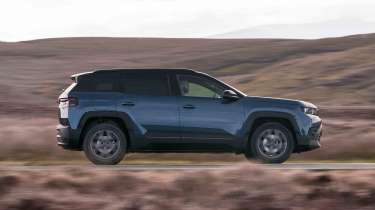
There will only be one all-wheel-drive version of the latest Compass, which isn’t arriving until 2026 and will be a dual-motor EV. The Vauxhall Grandland is now available with a similar set-up, but the Jeep gets a unique e-motor for the rear axle that can supposedly deliver up to 3,100Nm of torque at the wheels – the perfect amount, we’ve been told, for the car to conquer a 20-degree slope with absolutely no traction on the front wheels.
As well as extra traction, the four-wheel drive Compass 4xe will deliver a combined 370bhp and even greater off-road ability than other versions of the car, thanks to an extra 10mm of ground clearance. That’s still to come, as are the 191bhp plug-in hybrid, and a long-range variant of the Compass Electric with a 403-mile range.
For now, the Jeep Compass is available with a turbocharged 1.2-litre three-cylinder petrol engine and a six-speed dual-clutch automatic transmission that has a 21bhp electric motor built in. Or as an EV with a single 210bhp e-motor and 73kWh battery providing up to 310 miles of range. We tried both on the outskirts of Milan in Italy.
| Model | Power | 0-62mph | Top speed |
| Compass e-Hybrid | 142bhp | 10.3 seconds | 117mph |
| Compass Electric | 210bhp | 8.5 seconds | 112mph |
Performance, 0-60mph acceleration and top speed
In the hybrid, when you’re not driving on the e-motor (you can tell because the speedo turns blue), the three-pot engine hums away in the background. Put your foot down, and there’s a slight delay until the gearbox finally decides to kick down, then the engine emits a rather gruff drone as you very steadily gain speed. If you need to accelerate hard, such as when joining the motorway, we suggest using the paddles behind the steering wheel to force the gearbox into action.
The electric version provides much smoother acceleration and a generally more refined driving experience – but we did notice some whine from the e-motor when accelerating. The EV’s extra power and more immediate power delivery also chop nearly two seconds off the Compass’s 0-62mph time, although that’s still not enough to make it Tesla quick.
Town driving, visibility and parking
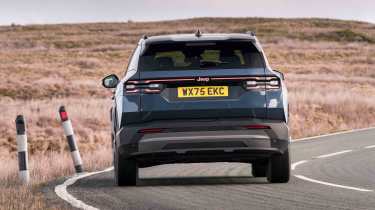
Visibility is decent, and the driving position is suitably lofty. The big, heavily sculpted bonnet not only makes you feel like you’re driving a much larger 4x4, but the squared edges actually help with placing the car on the road and judging how close you are to stuff, which is particularly helpful in tight situations around town.
This is a relatively easy car to drive around town, in fact, especially the EV with its one-pedal driving ability – something that its Vauxhall, Peugeot and Citroen siblings based on the same platform don’t offer. You do have to be somewhat delicate with the throttle in one-pedal mode to drive the Compass Electric smoothly, but it didn’t take us long to get the hang of it.
Country road driving and handling
The Compass was engineered to cope well with uneven terrain, rather than carving up windy country roads, so there’s quite a bit of body roll when you’re cornering. The steering is accurate and has some weight to it, the brakes offer a good amount of stopping power – as they should – and again, there’s no issue placing the car on the road. There is a Sport mode, if you ever fancy it, but we doubt the majority of drivers will.
Motorway driving and long-distance comfort
During our test we found that while the suspension does a decent job of absorbing the impacts from imperfections in the road, the ride feels slightly lumpy, and the car thumps when you drive over potholes and the like. It never fully settles down on the motorway either. We also noticed a fair amount of road noise coming into the cabin in both the hybrid and electric versions.
MPG & running costs
Pros |
|
Cons |
|
If you’re not ready to go electric, or just don’t want the hassle of charging a car, the Compass e-Hybrid is the one for you. Its 1.2-litre petrol engine is paired with a 0.9kWh battery that allows for short periods of pure-electric driving, and it’s charged using energy recuperated from the car slowing down.
According to Jeep, the Compass e-Hybrid can average up to 47.9mpg, and while we haven’t had a chance to cover hundreds of miles to say how accurate that figure is, we did achieve 44.7mpg, which isn’t too far off.
As encouraging as that is, the latest Nissan Qashqai e-Power offers up to 62.8mpg, and we achieved 52.5mpg during our testing. Meanwhile, the equivalent Kia Sportage Hybrid offers up to 50.4mpg, and we saw 43.8mpg when we tested it.
| Model | MPG | CO2 | Insurance group |
| Jeep Compass e-Hybrid | 49.6mpg | 128g//km | 23E |
Electric range, battery life and charge time
Coming shortly is the e-Hybrid Plug-In, which will pair a 1.6-litre four-cylinder petrol engine with a single e-motor and a 17.9kWh battery pack. This will offer more than 50 miles of pure-electric driving range and should return close to 100mpg. However, we haven’t tested this particular version yet and, as with all PHEVs, you’ll need to charge the battery frequently to get the best fuel economy.
The 73kWh battery in the standard Compass Electric offers up to 310 miles of range, which is about the same as the entry-level Tesla Model Y. With a peak charging speed of 160kW, refilling the battery from 10 to 80% should take just over half an hour, if you can find a charger capable of such speeds. Most will utilise a 7kWh home wall box charger, which should replenish your Compass in around 12 hours.
The long-range version, also coming in 2026, uses an even larger 97kWh battery to deliver up to 403 miles of range, which is further than any variant of the Tesla or Skoda Enyaq.
| Model | Battery size | Range | Insurance group |
| Compass e-Hybrid Plug-In | 17.9kWh | 50+ miles | TBC |
| Compass Electric 73kWh | 73kWh | 298 miles | 32E |
| Compass Electric 98kWh | 98kWh | 425 miles | TBC |
Insurance groups
Insurance for the Jeep Compass should be reasonable, starting a few groups lower than a Nissan X-Trail in group 23. However, the entry-level Skoda Kodiaq beats this by starting in group 17.
It’s a similar story with the Compass Electric, which starts a few groups lower than the equivalent Vauxhall Grandland electric in group 32, but can’t quite match the Citroen e-C5 Aircross, which drops down to group 27.
Tax
Company car drivers will find the Compass Electric the most appealing due to its low 4 per cent Benefit-in-Kind (BiK) company car tax rate (rising to 5 per cent for the ‘27 to ’28 tax year, and 7 per cent for the ‘28 to ‘29 tax year). The list price of the electric Compass also handily comes in below the raised £50,000 luxury car tax threshold for electric cars, even if you go a but nuts loading it up with factory optional extras. You’ll only need to pay the standard rate of vehicle excise duty (VED) for the electric model.
The e-Hybrid has a 33 per cent BiK rate, so company car drivers might be better off waiting for the plug-in hybrid if they don’t want to go all electric. Meanwhile for private buyers, both Altitude and First Edition versions of the e-Hybrid Compass cost less than £40,000, allowing them to avoid the luxury car tax surcharge for petrol, diesel, and hybrid cars. However, you can go beyond this with a few options on First Edition trim, so choose wisely, or you’ll need to pay over and above the standard rate of annual VED.
Depreciation
According to our most recent expert data, the e-Hybrid Jeep Compass should hold onto up to 43 per cent of its original value over a typical three-year/36,000-mile ownership period, with the electric versions performing better at between 50 and 52 per cent over the same period.
For comparison, the Kia Sportage is projected to retain between 48 and 51 per cent, while the Nissan X-Trail is expected to be worth around 47 per cent.
To get an accurate valuation for a specific model, check out our free car valuation tool...
Interior, design & technology
Pros |
|
Cons |
|
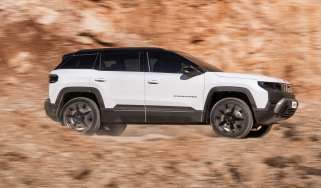
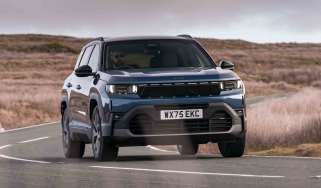
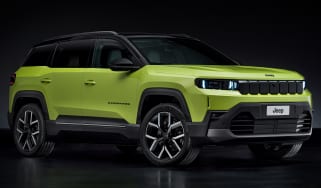
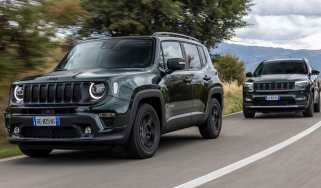
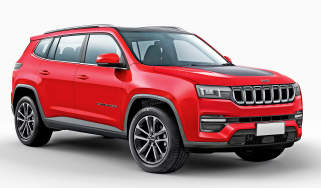
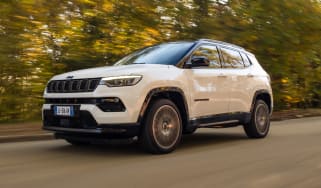
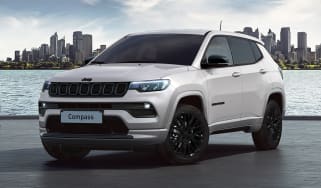
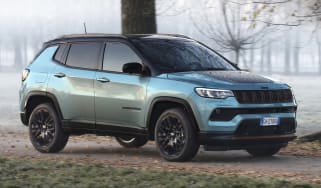
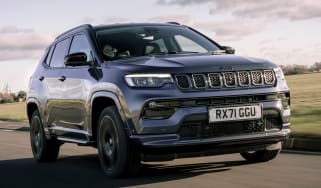
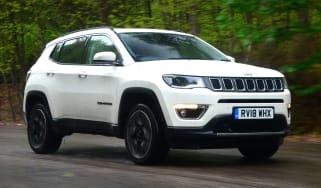
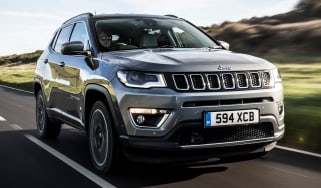
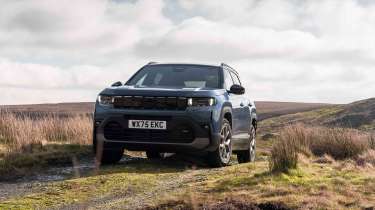
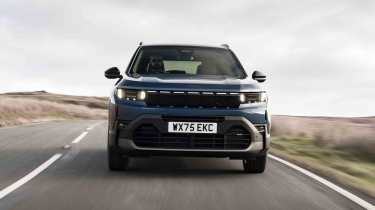
The key Jeep styling traits are present and correct here, including the squared-off wheelarches and the iconic seven-slot grille. It’s blanked off, like the Avenger’s grille, but certain Compass models feature an illuminated grille. The front camera is located in the grille, which should hopefully prevent it from being damaged by debris.
Eventually, the Compass will be available in Altitude and Summit trim, or Overland and Upland trim if you go for the all-wheel-drive version. The equipment list for our preferred Altitude trim is rather generous and includes:
- LED headlights
- 18-inch alloys
- Heated front seats, steering wheel and windscreen
- Front and rear parking sensors
- A 16-inch touchscreen infotainment system with sat-nav
- Adaptive cruise control
- A 10.25-inch digital instrument cluster
Above that (for now) is the First Edition model, which adds 20-inch alloy wheels, an illuminated grille, adaptive matrix LED headlights, an electric tailgate, a reversing camera, and a wireless charging pad.
Interior and dashboard design
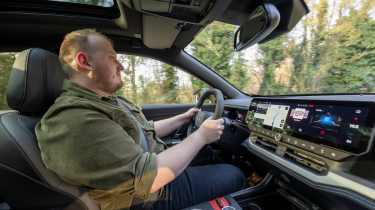
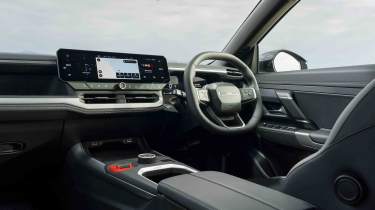
The third-generation Compass is a big step forward in interior design, quality and technology over the previous model. We like the two big clear displays that come in every model, plus the chunky physical buttons on the squared-off steering wheel. The tall centre console also gets a bright red toggle switch for the drive modes and a rotary gear selector that’s well damped, and surprisingly satisfying to use.
Materials and build quality
The leather on the dashboard is a nice touch, and we found everything in the cabin feels sturdy, but there is still a lot of plastic in here.
On one hand, the plastics, thick rubber floor mats and fabric seat upholstery suit this car’s persona, and there are some Jeep ‘easter eggs’ dotted around. However, we understand buyers may want a mid-size SUV that looks and feels of higher quality. If that’s you, the Hyundai Tucson, Nissan Qashqai and Volkswagen Tiguan spring immediately to mind.
There were also a few electrical gremlins in the two models we tested. It took several minutes for the head-up display (part of the ADAS pack) in the first test car to wake up, and the sunroof in the second refused to do anything. Luckily, it was (and remained) in the closed position.
Sat-nav, stereo and infotainment
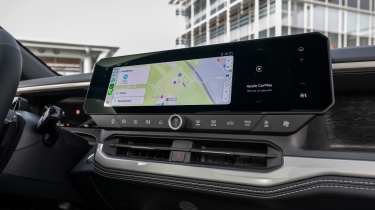
Every model features a 10-inch instrument panel with clear, simple graphics, and a whopping 16-inch touchscreen. Jeep’s latest infotainment system offers lots of functionality with three customisable widgets on the homepage, plus climate controls permanently displayed on either side – even if you connect to Apple CarPlay or Android Auto.
We found that the menus don’t always load instantly, and you do have to have to be quite precise about how you press or swipe on the homescreen to ensure you interact with the right widget block. Luckily, there is a row of shortcut buttons below the display, including one for the ADAS menu that will switch off selected safety systems if you press it long enough.
A wireless phone charger is available as part of the £1,200 convenience pack on Altitude trim, or comes fitted as standard to First Edition models. An upgraded 9-speaker Focal sound system is part of the Premium Pack.
Boot space & practicality
Pros |
|
Cons |
|
The Compass offers plenty of storage for the detritus that family life generates, with 34 litres worth offered by various trays and cubbies. That includes a handy shelf in front of the passenger, two huge bins in the centre console, and a spot to throw your phone into.
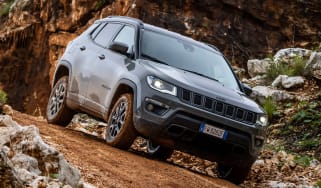
But this being a Jeep, a lot of time and effort has also gone into ensuring the Compass is capable of getting down and dirty. Extremely short overhangs at the front and rear create the best approach, departure and break-over angles of any SUV on this platform. The Jeep also has more than 200mm of ground clearance and a maximum wading depth of 470mm.
True, they’re not exactly key criteria for family SUV buyers, but it’s what people expect from a Jeep and will give them confidence if a festival car park turns into a total quagmire. As do the dedicated ‘Selec-Terrain’ modes for Snow and Sand/Mud, which alter the power delivery and traction control.
Dimensions and size
The third-generation Compass is about 150mm longer than the last model, and its wheelbase is about 130mm longer too, which has provided a big increase in boot space. The Compass is also about the same size as other mid-size SUVs like the Sportage and Qashqai.
| Dimensions Comparison | |||
| Model | Jeep Compass | Kia Sportage | Citroen C5 Aircross |
| Length | 4,552mm | 4,540mm | 4,652mm |
| Width | 1,928mm | 1,865mm | 1,936mm |
| Height | 1,675mm | 1,645mm | 1,688-1,691mm |
| Wheelbase | 2,795mm | 2,680mm | 2,784mm |
| Boot space | 550 litres | 526-591 litres | 565-650 litres |
Seats & passenger space
The back seats offer more than enough legroom for six-foot-tall adults, as well as adequate headroom – a benefit of the car’s boxy shape. The rear floor is a little higher than that of other mid-size SUVs, but we assume that’s in order to accommodate the battery pack in the EV, and passengers have space to stretch out, including room under the front seats to tuck their feet.
We think you could just about squeeze three people into the rear seats, or, if you have small children, there are two sets of Isofix mounting points on the outer seats, covered by zips.
Boot space
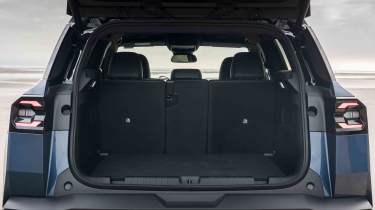
The Compass offers 550 litres of boot space, which is 45 litres more than the previous model and is competitive with mid-size SUV pack. The Nissan X-Trail offers up to 585 litres, while the Kia Sportage provides a couple of litres more, at 587 litres. The EV version of the Compass offers the same amount of cargo space, and there’s room under the boot floor for the charging cables.
Every version has a flexible 40/20/40 split folding rear seat design, much like premium brand SUVs like the BMW X1.
“The Jeep Compass (presently) isn’t a great tow vehicle, with the best version only being able to handle a braked caravan or trailer of 1,000 - 1,150kg. The electric Volvo EX30 manages 1,000 - 1,600kg, while the more traditionally powered VW Tiguan can handle 1,600 - 2,300kg.” - Max Adams, online reviews editor
Reliability & safety
Pros |
|
Cons |
|
The third-generation Jeep Compass received a four-star out of five crash safety score from Euro NCAP, the same result as the Citroen C5 Aircross, Peugeot 3008, and Vauxhall Grandland. That's hardly surprising because they’re all based on the same STLA Medium platform, but a little disappointing when a whole host of other SUVs like the Cupra Terramar, Ford Explorer, MGS5, MINI Countryman, Toyota C-HR, and Volkswagen Tiguan all get a higher five-star rating.
Every Compass is equipped with adaptive cruise control and lane-keeping assist, which means it offers Level 2 autonomous driving ability. Automatic Emergency Braking, plus front and rear parking sensors, but it is odd that a reversing camera isn’t.
Thankfully, you can add a 360-degree camera system, blind-spot detection, and extra parking sensors with the Convenience Pack (£700 or £1,200, depending upon which trim level you go for). There’s also a £1,500 ADAS pack, which bundles rear cross-traffic alert, blind-spot detection, a head-up display and other tech.
Jeep only managed to finish 26th (out of 31 brands) in the most recent Driver Power best car manufacturer rankings, putting it behind other members of the Stellantis family, including Fiat (21st), Citroen (16th), Peugeot (7th) and Vauxhall (4th). Thanks to a low number of responses, Alfa Romeo and DS weren’t included in the list.
| Euro NCAP safety ratings | |
| Euro NCAP safety rating | Four-stars (2025) |
| Adult occupant protection | 80% |
| Child occupant protection | 85% |
| Vulnerable road user protection | 74% |
| Safety assist | 66% |
Buying and owning
Best buy: Jeep Compass Electric Altitude
The zero-emission version of the Jeep Compass offers a more refined driving experience than the e-Hybrid, plus it’s just as practical and delivers a decent amount of range.
You’ll get all you need with the entry-level Altitude trim, but it might be worthwhile adding the convenience pack in order to get a 360-degree surround view camera system, blind spot monitoring, and lateral parking sensors to warn if you’re getting your precious alloy wheels too close to the kerb. We’d also recommend adding the £850 heat pump to help preserve your driving range in cold weather.
Jeep Compass alternatives
The Jeep Compass faces stiff competition from loads of mid-size SUVs, including those related to it, such as the Citroen C5 Aircross, which prioritises comfort and value. Its other cousins are the spacious Vauxhall Grandland and the stylish Peugeot 3008.
The Nissan X-Trail is a fine all-rounder that should be greatly improved when the revised version arrives with the updated e-Power hybrid powertrain that impressed us so much in the current Qashqai. The Kia Sportage is more practical, though, and it recently received a fresh new look, inside and out.
Meanwhile, the Hyundai Tucson offers refinement, space and hybrid technology in a head-turning package with a great-feeling interior. But if you want an even more sophisticated feel to your next family SUV, the Volkswagen Tiguan is the way to go.
Jeep Compass pictures
Key updates of the Jeep Compass review
6th May 2026: Updated with UK trim details and pictures
11 December 2025: update to include the released Euro NCAP crash test safety data.
Deals on the Compass and alternatives
Frequently Asked Questions
We achieved 44.7mpg when we tested the Jeep Compass e-Hybrid, which is respectably close to what Jeep says this hybrid version of the family SUV should be able to return.
More reviews
Which Is Best