New Volkswagen California eHybrid review: a taste of electric campervan life
Plug-in power is a welcome addition to the California line-up, but it does come with some drawbacks

Verdict
Whether the hybrid Volkswagen California suits your needs will depend wholly on how you intend to use it. The 19.7kWh battery and 52-mile range give us a taste of what electric-camper life might be like, without the inherent compromises that come with long trips in an EV. Yet if long trips are your thing, you’ll still be better served by the smooth and frugal diesel version. The Cali eHybrid is good, but it isnƒca’t quite perfect.
Diesel has long been the fuel of choice for light commercial vehicles and their associated spin-offs, including, for the most part, compact campers such as the Volkswagen California. But no part of the new-car market is completely immune from electrification, and VW’s latest home-from-home is proof.
Launched almost two years ago, the seventh-generation California built on its predecessor’s enviable legacy with handy new features like twin-sliding doors, better tech and more interior space. It even moved to the ubiquitous MQB platform (shared with the Golf, as well as larger models such as the Volkswagen Tiguan and Volkswagen Passat) for a more car-like driving experience. But with only petrol and diesel engines to choose from, forward thinking, eco-conscious van-lifers have been forced to wait in line.
Used - available now

2017 Mazda
3 Fastback
36,250 milesManualPetrol2.0L
Cash £10,449
2018 Volkswagen
Golf GTD
115,000 milesManualDiesel2.0L
Cash £9,499
2025 Hyundai
Tucson
24,464 milesAutomaticPetrol1.6L
Cash £22,984
2013 BMW
X5
110,374 milesAutomaticDiesel3.0L
Cash £6,995Now, however, the California is finally available with a plug-in hybrid powertrain that pairs VW’s familiar 1.5-litre, four-cylinder petrol engine with a 19.7kWh high-voltage battery and two electric motors for all-wheel drive. If you regularly traverse slippery pitches or muddy fields and 4Motion is non-negotiable, this is your only option.
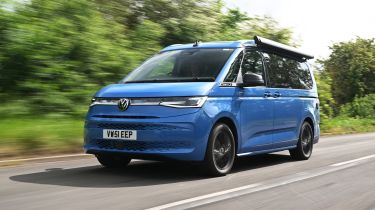
The only tell-tale signs from the outside that this camper runs on a mixture of petrol and electric, rather than diesel, are the additional fuel-filler cap on the front wing, plus a smattering of badges on the bootlid. Otherwise, it’s business as usual; based on the long-wheelbase Multivan, it’s available in Beach, Coast and Ocean trims.
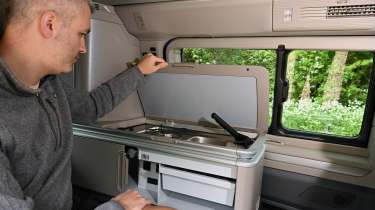
If you thought the outside was uneventful, there’s not much we can say about the interior to get the pulse racing. The cabin layout is identical, with our top-spec Ocean variant featuring the usual kitchen and cupboards down the left-hand side, plus a pull-out fridge to the front – big enough to feed the family for a weekend away, and easily accessed from both sides thanks to that extra door. There are a few bespoke menus within the infotainment system, and the digital instrument cluster shows both fuel and battery range. But that’s about it.

Yet while you might not notice the differences visually, you’ll feel them the moment you hit the starter button. Instead of a rattly diesel or droning petrol motor, you’re greeted – at least initially – by the sound of silence. Even with what the van deems an empty battery, the California eHybrid will perform most low-speed manoeuvres without the engine – perfect for setting up shop on a quiet campsite late at night.
It’ll come as no surprise, but like almost all PHEVs, the California is at its best when at least partly charged. It’ll mostly prioritise the front e-motor, but there’s enough pull for normal driving duties – even up to motorway speeds. It will default to E-mode as long as there’s enough juice in the cells, and switch to Hybrid as soon as they run dry; you can force it to combine the two should you wish, or ask the van to hold its remaining range if desired.
The maker claims a zero-emissions range of 52 miles, which isn’t far off what we experienced in real-world use – even with sustained high-speed running. Once the charge is depleted, you can expect around 38-40mpg at a steady cruise, or a little less in stop-start traffic. Charging is easy: the inclusion of a DC connector allows for rapid top-ups (10 to 80 per cent) in as little as 26 minutes. Using a 7kW home wallbox charger shouldn’t take more than three hours.
The transition between petrol and electric can be a bit clunky at low speeds, especially when asking for extra shove away from junctions or roundabouts. It doesn’t bog down as such, but the way the engine interrupts the peace and sends the revs skyward means this isn’t the most cultured PHEV we’ve experienced.
The California juggles its two power sources more effectively at a cruise, however, blending petrol and electric as required. If you watch the rev counter closely, you’ll see the engine disengage on steep descents, before firing up as you climb up the other side. Overall, it’ll represent a pretty effective solution for those looking to lower their carbon footprint on local journeys, without being restricted to campsites within a 50-mile radius.
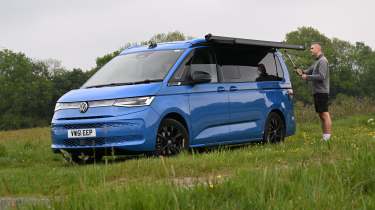
Otherwise though, the California eHybrid will feel familiar to anyone who’s driven other versions of the seventh-generation camper – or even the latest Volkswagen Multivan. You get a commanding view of the road ahead, and the large, armchair-like front seats are comfortable and supportive. The steering is well weighted and the handling is acceptable for a vehicle of this type – even if something as tall as this naturally promotes a gentler driving style.
The biggest issue – although not exclusive to the VW – is how susceptible the big, open shell is to bumps, potholes and small ridges in the road surface. The rattle from the rear cabin is ever present, and only made worse when you fill the cupboards with crockery and kitchen equipment. It’s not that the ride is unsettled, it just feels a bit brittle.
Functionally, the California is right up there with the very best manufacturer-backed campers and aftermarket conversions. From the chairs in the tailgate, to that new pull-out fridge and second sliding door, the Cali proudly displays its years of evolution. There’s only one hob nowadays, but VW does provide a pop-out table with a conveniently located three-pin plug that can hold an additional induction ring should you need it.
Of course, there’s plenty of space for odds and ends, although we did notice that with the rear seats pulled forward – either for convenience, comfort, or for a bit of extra boot space – the cup-holders at the base of the windows are inaccessible. Those seats do at least slide independently, and can be removed entirely if you need to carry big or bulky items. As ever, the front seats can rotate 180 degrees when stationary, creating a homely environment and somewhere to eat your dinner out of the cold.
The two beds – one in the lower cabin and another in the roof – are easy to assemble, and relatively comfortable. On Coast and Ocean variants, the top raises electrically at the touch of a button to reveal a sprung mattress, while the rear bedding folds in three and is stowed behind the rear seats when not in use. There’s space beneath for bags, or in the eHybrid’s case, the charging cables.
Ocean is the most expensive variant available, but throws in everything – including the kitchen sink. Beach versions get five seats but no hob or cupboards, while Coast represents the best value with the kitchen, three-zone climate control and electric roof. If you want matrix-LED lights, sat-nav and ambient lighting, you’ll need very deep pockets indeed.
Outright value is hard to determine; as with any PHEV, the California’s real-world use case will depend on how you intend to use it. Commanding a premium of around £5,000 versus the equivalent front-drive TSI petrol, at first glance the eHybrid looks pricey. But keep it charged and – particularly with petrol and diesel prices as they are – you could save a small fortune, while also protecting the planet.
| Model: | Volkswagen California Ocean 1.5 eHybrid 4Motion |
| Price: | £85,482 |
| Powertrain: | 1.5-litre 4cyl petrol PHEV |
| Power/torque: | 242bhp/250Nm |
| Transmission: | Six-speed automatic, four-wheel drive |
| 0-62mph: | 10 seconds (est) |
| Top speed: | 124mph |
| Economy/CO2: | 90.1mpg/70g/km |
| Size (L/W/H): | 5,173/2,252/1,972mm |