Volkswagen ID. Cross review
Likeable, clever, well built and efficient. Just like its smaller ID. Polo sibling, the ID. Cross represents VW back at its best


Our opinion on the Volkswagen ID. Cross
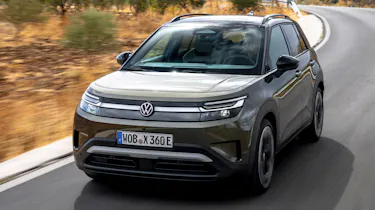
Volkswagen has played to its historic strengths by creating a high-quality, refined and desirable car, one that’s more capable than any B-segment crossover was even just a generation ago. Yet in contrast to its previous electric cars, VW has also nailed the driving experience, technology interfaces and cabin quality. Yes, it’s marginally more expensive than its rivals, but this is a VW at its best, so it feels worth every extra penny.
About the Volkswagen ID. Cross
The Volkswagen ID. Cross is a compact electric SUV that sits just above traditional B-segment superminis and the crossovers they spawn. It joins the VW range alongside the ICE-powered T-Cross and T-Roc, and splits the two in terms of space and price. It is also Volkswagen’s first BEV in this segment, and just like the new ID. Polo, is promising a more customer-centric and quality-led approach compared with the ID models that came before.
UK list prices will start at £26,985, but this doesn’t take into account the UK Government's Electric Car Grant (ECG). The ID. Cross is eligible for the lower grant of £1,500, which will bring the entry price down to £25,485, with the 52kWh version starting at £28,500. Prices will rise to somewhere around £35,000 for a fully loaded variant with the largest available battery, especially once the R-Line models join the range in 2027.
Performance & driving experience
Pros |
|
Cons |
|
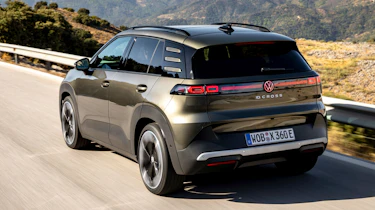
Volkswagen has been very clear about its ambition to return to its most authentic self in this new era of EV models. It intends to offer customers exactly what they need in this class, and the ID. Cross is clear evidence of this. As a result, anyone looking for startling straight-line speed or exotic powertrain layouts will need to look elsewhere. For everyone else, this is a very impressive package.
Performance, 0-60mph acceleration and top speed
Volkswagen will launch the ID. Cross with three powertrain options, starting with a 134bhp variant paired to a 37kWh battery, while a larger 52kWh unit can be mated to two specifications of e-motor with either 208bhp or 227bhp.
Used - available now

2022 Volvo
XC40
23,849 milesAutomaticPetrol1.5L
Cash £19,497
2024 BMW
2 Series Gran Coupe
31,937 milesAutomaticPetrol1.5L
Cash £18,876
2023 Ford
Kuga
17,226 milesAutomaticPetrol2.5L
Cash £18,497
2018 Renault
Clio
74,980 milesManualPetrol0.9L
Cash £6,597UK sales will kick off with the 208bhp 52kWh variant, which will sprint from 0-62mph in 7.1 seconds and go on to a 99mph top speed. In 2027 the entry-level 134bhp 37kWh variant will be available, and complete the same 0-62mph benchmark in 9.8 seconds. We’re yet to drive the top-spec model, which will arrive in the second quarter of 2027 alongside the R-Line design package.
Neither of these figures is particularly fiery, but in day-to-day driving there’s more than enough grunt to easily keep up with traffic. This is thanks to the instant torque and seamless delivery of the e-motors. If you’re used to a combustion powertrain in this class, or indeed the one above, the ID. Cross will feel completely effortless.
Town driving, visibility and parking
The ID. Cross feels primed for urban life. The high-ish driving position gives a great view out, and large windows all-round make it easy to place the car on the road. The large rear screen is bigger than we’ve become used to in modern cars, and if it’s still not enough, the on-screen camera system is clear and crisp.
Low-speed modulation of the throttle and brakes is excellent. VW doesn’t offer steering wheel-mounted paddles for the time being, but the regenerative braking system can be easily activated by pressing ‘B’ on the gear selector. When this is active, the car will seamlessly come to a stop without needing to touch the brake pedal – but when you do use it, there’s excellent modulation and feel.
We must also mention the assisted parking functions and all-round camera system. Both work extremely well, so if you’re not the most adept parker, they might be worthwhile options to choose.
Country road driving and handling
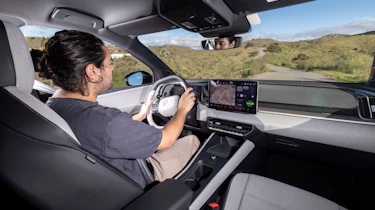
We found the ID. Cross inspired just as much confidence at high speeds as it did at low ones. VW has managed to instill a definite sense of solidity in the car. The steering always has a reassuring heft, and an accuracy just off centre that makes turning into tight bends feel natural and easy.
Compared with many electric SUV rivals of similar size and price, the ID. Cross feels designed to excel on a wide range of driving conditions. When the road gets twisty, the large wheels and low centre of gravity give it an excellent base to work from. Although the new MEB+ architecture it’s based on is simpler on paper than the underpinnings of the larger ID.3 and ID.4, the whole car feels more resolved than VW’s larger EVs.
We drove cars on the largest 20-inch wheel option, and this didn’t seem to negatively affect the ride quality. Our test cars were also fitted with optional Dynamic Chassis Control adaptive dampers, but despite having a lot of variability inside the touchscreen, we felt very little difference between the softest and stiffest modes. We’d suggest that the smaller 19-inch wheels would be a better bet if you’re after the best possible ride quality, but none are uncomfortable.
Motorway driving and long-distance comfort
While this is no motorway basher, it’s still perfectly comfortable at sustained high speeds. However, this is when road and wind noise can creep into the cabin, and this will be accentuated on rough UK roads. However, the general refinement of the powertrain means this is all there is to hear, and the VW still feels like a big step up on many existing B-segment ICE cars.
While adaptive cruise control is standard, you can also choose to drive the car in ‘normal’ cruise mode, which many prefer, and everything from the ease with which you can turn off the driver assistance aids or personalise the displays is a clear benefit. The ID. Cross doesn’t feel like it lacks any features, but it feels set up in a way that many rivals don’t.
Beyond just the measurable attributes, the ID. Cross feels like a product that’s been designed with a sense of clarity and focus. There’s very little that’s superfluous to the experience, yet you’re still given all the variation and configurability that many people expect of a modern hi-tech EV.
| Model | Power | 0-62mph | Top speed |
| Volkswagen ID. Cross 135PS 37kWh | 134bhp | 9.8 secs | 99mph |
| Volkswagen ID. Cross 211PS 52kWh | 208bhp | 7.1 secs | 99mph |
| Volkswagen ID. Cross 231PS 52kWh | 227bhp | TBC | TBC |
"The ID. Cross is a calm, confidence-inspiring, high-quality EV with more capability than is strictly required for buyers. This is a superb daily driver…" - Jordan Katsianis, News Editor
Range, charging & running costs
Pros |
|
Cons |
|
Anyone looking to lower their cost of ownership has to look at EVs, especially if they can charge cheaply at home. But even on a public network, the ID. Cross’ impressive efficiency means running costs will remain low – and unaffected by the instability of fuel prices.
Electric range, battery life and charge time
Volkswagen’s range figures for the ID. Cross are good, but not class-leading, thanks to a relentless march towards ultimate efficiency across all EVs of this size and price. The entry-level 37kWh model is quoted as reaching up to 190 miles on a charge, which is lower than many rivals. But the 52kWh option does much better, with up to 262 miles on a charge.
Better still, in our testing, we found these claimed figures to be reliable – we were close to the official claim despite a relatively demanding test route, reaching 4.6mi/kWh. This would translate to a range of 240 miles from a full charge. However, VW does not fit a heat pump as standard in the UK, which will help reduce the losses during cold weather. One can be fitted as an option, but it costs a hefty £965.
| Model | Battery size | Range | Insurance group |
| Volkswagen ID. Cross 135PS 37kWh | 37kWh | 190 miles | NA |
| Volkswagen ID. Cross 211PS 52kWh | 52kWh | 262 miles | NA |
| Volkswagen ID. Cross 231PS 52kWh | 52kWh | NA | NA |
Insurance groups
Insurance groups have yet to be set, but we expect a small increase on the groups set by the ID. Polo, which is between 12 and 21 depending on model.
Tax
All ID. Cross models dip under the luxury car threshold, meaning road tax will be locked in at £200 per year for the first five years on the road.
Depreciation
Depreciation rates for all BEVs are still lower than for a petrol equivalent, but they are stabilising. VW also generally has impressive resale rates across different models, and when combined with reasonable as-new prices, the ID. Cross should be more impressive than most BEVs.
Interior, design & technology
Pros |
|
Cons |
|
The way Volkswagen has developed its design and technology should be studied in car design textbooks of the future, because the transformation from the original ID models to the new ID. Cross is extraordinary. It’s not just tangible aspects that have been revolutionised, but also the philosophy behind them. This has made a huge impact on the experience customers will notice the moment they shut the door.
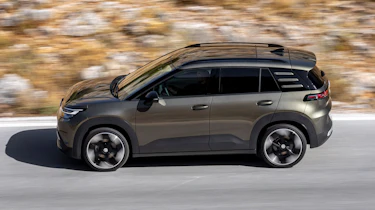
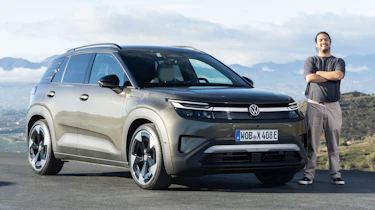
The ID. Cross has a contemporary exterior design with clever lighting and details that immediately catch the eye. It’s not retro, but it’s also somehow still deeply rooted in VW’s historic design philosophy. It looks robust and well-built, helped by generous wheel sizes and a pleasing lack of chrome; it’s a million miles away from the blobby IDs that came before.
Interior and dashboard design
The improvements in this VW’s cabin compared with ID models that came before begin the moment you sit in the seat. It no longer feels like you’re perched in a bare cabin, instead you’re surrounded by soft-touch materials and feel more cocooned within the space. The seats themselves are also wonderfully comfortable and offer lots of adjustment.
Where the ID. Cross surpasses its Polo sibling is with the design of the dash. A hoop of warm silver wraps itself around the padded dashtop, linking in with textured fabric that’s found on the doors, seats and centre console. Our test car was fitted with the optional light-coloured fabric, which only enhanced this feeling of calm and quality.
Materials and build quality
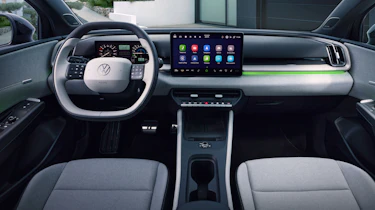
What’s really clever here is where VW has spent the money, and where it hasn’t. It’s not typical for B-segment cars in this class to feature a soft-touch dashboard or upper door cards, and that remains the case here.
Instead, VW has used fabric across key parts, which suggests high quality without needing to invest in a large soft-touch dashboard. Press the very top of the door cards or the dash by the windscreen and you’ll see what these elements are really made of. But does it matter? Not one little bit.
This same level of thoughtfulness is apparent across pretty much all of the car’s interior components. The buttons are solid and have a satisfying click, the volume knob is nicely weighted and the steering wheel feels wonderful – futuristic and yet still solid, if a touch big.
There’s also no gloss black material anywhere inside, so everything should age well after years of use.
Infotainment, sat-nav and stereo
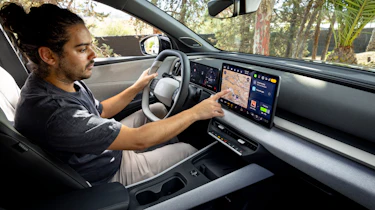
VW’s new-found quality also applies to its digital interfaces, because the new infotainment system – which is standard across the range – really does work brilliantly. Many of the key controls are accessible from the home screen, and there’s lots of customisation to prioritise the information you might use most often.
There is a strip of relatively small climate functions along the bottom, but key controls including the temperature, fan speed and demisters are also accessible by a run of physical controls. The navigation works very well in its latest iteration too, and rarely did we find ourselves endlessly prodding the screen in order to finely tune any settings. It all just worked.
Apple CarPlay and Android Auto are fitted as standard, and a nice bonus is that the display in front of the driver is now fully variable, and able to show fully detailed navigation maps, leaving the central screen free to be used for other functions.
If you so wish, there’s also a ‘Retro’ mode for the dials and centre screen, adding a bit of fun to an otherwise functional and well executed cabin.
"You’d be hard-pressed to want for anything more than the new ID. Cross offers inside. In terms of tech, materials and design, this is now the pinnacle in this class – a total revolution compared with its predecessors" – Jordan Katsianis, News Editor
Boot space & practicality
Pros |
|
Cons |
|
Where the ID. Cross doesn’t have a march on its key rivals is practicality, because the flexibility of its interior space isn’t quite up to the class best. The second row has just about enough space for adults, but this is compromised further by the optional panoramic roof.
Dimensions and size
VW has purposely kept a cap on the exterior dimensions. The ID. Cross is shorter than many European rivals such as the Ford Puma or Peugeot E-2008, and quite a bit smaller than many similarly priced Chinese rivals.
Dimensions comparison | |||
| Model | VW ID. Cross | Ford Puma Gen-e | BYD Atto 2 |
| Length | 4,153mm | 4,214mm | 4,310mm |
| Width | 1,794mm | 1,805mm | 1,830mm |
| Height | 1,581mm | 1,555mm | 1,675mm |
| Wheelbase | 2,601mm | 2,588mm | 2,620mm |
| Boot space | 475 litres | 523 litres | 400 litres |
Seats & passenger space
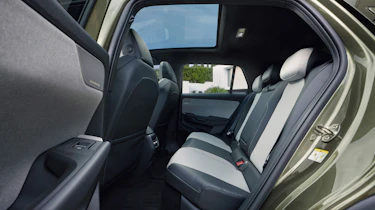
Space up front is excellent, and feels it, thanks to the large windows and low scuttle. The seats themselves are also very comfortable, and feel well sculpted to give you support in the bends without feeling too restrictive.
Yet the second row only has just about enough space for adults, and this is compromised further by the optional panoramic roof. Legroom is a little tight, and without the ability to slide or recline the second row, it doesn’t quite have the versatility of some rivals. So if ultimate practicality is a requirement, there are better options in the class.
Boot space
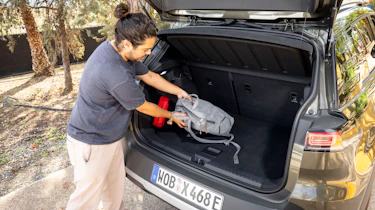
The boot is large and well shaped, and there’s almost no load lip to speak of, although this does mean it has a relatively high floor. However, under this space is a huge well that – together with the main space – adds up to 475 litres.
However, if you specify the optional upgraded stereo, this well also houses an extra speaker that just sits in the space, without any real housing or cover for it.
Towing
VW offers a factory towbar option on ID. Cross for £765 and the more powerful 52kWh model is rated to tow a braked trailer of up to 1,200 kg; the 37kWh models have a 750kg limit.
Reliability & safety
Pros |
|
Cons |
|
It’s always tough to comment on reliability on such a new car, but the context of the ID. Cross within its range serves to give us some insight. As part of VW’s new MEB+ program, this fundamentally revised platform should see many of the bugs of the original MEB system dealt with. Indeed, the MEB platform was constantly updated throughout its life, so this new MEB+ was already built on a solid foundation.
In terms of safety, the ID. Cross and the smaller ID. Polo have yet to be tested officially, but the Cupra Raval – another sister car – received a full five-star rating when fitted with the safety pack. These elements are fitted as standard on the ID. Cross, so we expect a similarly impressive showing.
It’s also worth noting that while the systems can be intrusive, they’re far less distracting than rival set-ups – especially those from Chinese brands. If you wish to switch them off, it’s a simple procedure.
| Euro NCAP safety ratings | |
| Euro NCAP safety rating | NA |
| Adult occupant protection | NA |
| Child occupant protection | NA |
| Vulnerable road user protection | NA |
| Safety assist | NA |
Buying, prices and deals
- Best buy: Volkswagen ID. Cross Style 52kWh
We’ll have to wait to drive all the variants for a definitive verdict, but in light of its capability and value, the 52kWh variant in either Life or Style trim is a brilliant buy, even though it’s slightly more expensive than some rivals. From an ownership perspective, there are very clear benefits to choosing the VW over many of its rivals.
It feels like a high-quality product, just as the best VWs typically have in the past. The small electric SUV class has been expanding rapidly, but pretty much the only one you need to consider right now has a glowing VW badge on the nose.
Volkswagen ID. Cross alternatives
Prices are slightly higher than those of many key rivals, but not by as much as you might expect. The similarly sized Jaecoo E5 is around £1,500 cheaper than the 52kWh ID. Cross, yet doesn’t match it for range. A BYD Atto 2, meanwhile, is considerably more expensive at close to £35,000 when specified to match the VW’s range figure.
Look at Ford’s popular Puma Gen-E and a full ECG grant keeps the starting price down to around £25,245 for a model with a longer claimed range. Skoda’s new Epiq could also be considered a rival, and does offer slightly more kit for your money, but we prefer the VW’s styling, cabin and driving experience. The Renault 4 is a more flamboyant option, but less competent.
Volkswagen ID. Cross pictures
Frequently Asked Questions
Yes, Volkswagen’s return to form is no more clear than in this exceptional SUV.