Porsche Cayenne Electric review
The Porsche Cayenne is arguably the most convincing electric SUV yet, but performance might have been prioritised too much in a world where efficiency matters


Our opinion on the Porsche Cayenne Electric
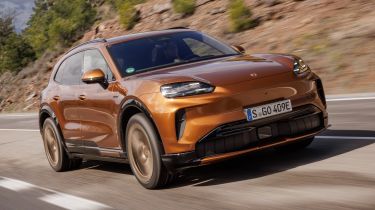
Porsche has done the unimaginable by making a 2.7-tonne electric SUV accelerate, steer and stop with real poise and precision. In day-to-day driving it makes for a superb companion, with lots of desirability packaged in. Its range and charging are competitive, especially considering this car’s size, but we wonder if some efficiency has been sacrificed for the sake of capability that a vast majority of owners won’t tap into.
About the Porsche Cayenne Electric
The Porsche Cayenne has defined the performance-oriented luxury SUV class since its introduction in 2002. The model has typically been available with a range of petrol and hybrid powertrains, but this is the first all-electric version, and it was initially designed to replace the ICE-powered model wholesale.
Unfortunately, the world hasn’t quite bought into the EV transition as much as Porsche, or many others for that matter, expected. So this all-new and completely distinct model will now sit alongside the previous model as a “technical flagship”. Available in three variants for the moment, the new Cayenne Electric – much like its combustion-powered sibling – must perform many roles: practical family car, luxury cruiser, high-performance sports car and even a rough-and-tumble off-roader.
To make that happen, Porsche has thrown the kitchen sink of technology at its new model, with the new Turbo model particularly laden with cutting-edge chassis and powertrain features. At every level this is a sophisticated, multi-talented machine that could even be considered over-complex – until you drive it.
Porsche Cayenne Electric prices and latest deals
Prices start at £83,200 for the base car, and in a nice twist for Porsche, there’s lots of standard equipment. This includes matrix LED headlights, heated, electric and part-leather seats, the statement curved touchscreen, dual-zone climate control – we could go on. The standard wheels are 20-inch designs, but these look positively tiny on the Cayenne’s bulbous body, so we wouldn’t blame you for upgrading to 21s or 22s.
Used - available now

2023 Porsche
Cayenne
3,455 milesAutomaticPetrol3.0L
Cash £65,999
2023 Porsche
Cayenne
45,273 milesAutomaticPetrol3.0L
Cash £31,722
2027 Porsche
Cayenne
21,694 milesAutomaticPetrol3.0L
Cash £62,000
2027 Porsche
Cayenne
15,000 milesAutomaticPetrol3.0L
Cash £72,990The Cayenne S Electric currently sits at £99,900, and the Turbo sits at a much more chunky £130,900. These have incremental additions of kit, but for the statement features such as heated interior surfaces, the passenger screen or HD headlights, you’ll need to tick some option boxes.
Did you know you can sell your car through Auto Express? We’ll help you get a great price and find a great deal on a new car, too.
Performance & driving experience
Pros |
|
Cons |
|
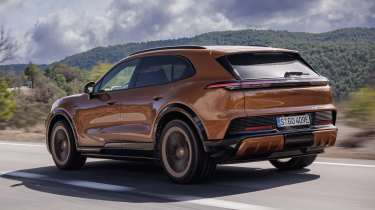
The Porsche Cayenne Electric’s most important, and arguably hardest task, only begins when the tyres start turning. All the Cayennes on our test featured optional rear-wheel steering, and while this system isn’t a first for Porsche, the angles capable from those rear wheels are new ground for the company.
As a result, the steering lacks that final measure of clarity we expect from all Porsches. It’s still well weighted and very accurate, but you can’t rely on its feedback in quite the same way as with the brand’s other models.
The ride, on the other hand, is excellent and seems to remain so regardless of any options fitted. All Cayennes will come as standard with a dual-chamber air suspension with dual-valve adaptive dampers, which deals with uneven roads and broken surfaces with real sophistication. You can still feel undulations, but the set-up removes unwanted harshness. Refinement is also top class, although you’ll need to shell out extra for the double glazing of our test cars.
Other driving characteristics, such as the powertrain response and calibration, are also first rate. There’s not a huge amount of excess shove given that 402bhp has to move nearly 2.7 tonnes, but there’s plenty of punch for overtaking. The variation between the drive modes also gives the car multiple settings to match your mood – or your passengers.
The brakes are generally excellent, because the majority of the Cayenne’s braking is handled by regeneration, thanks to the high-end 800V electrical architecture. This helps with brake feel at low speeds and puts energy back into the battery. However, we found that at very high speeds the integration of the friction brakes is a little clumsy – it’s a very niche issue, but with that Porsche badge comes this high level of scrutiny.
| Model | Power | 0-62mph | Top speed |
| Porsche Cayenne Electric | 402bhp (435bhp with overboost) | 4.8sec | 148mph |
Performance, 0-60mph acceleration and top speed
Key stats relate largely to the car’s electric powertrain, which combines a 113kWh battery pack and two electric motors. Power is rated at 402bhp, but with launch control activated a short 435bhp overboost will help the SUV get from 0-62mph in 4.8 seconds.
If this sounds a little tardy for an £80,000-plus Porsche SUV, it is worth remembering that the base petrol-powered Cayenne takes an extra 0.9 seconds over the same benchmark sprint. Also helping the Porsche feel more powerful than its numbers suggest is the torque figure. Not only is this all available from the moment you touch the throttle pedal, but at 835Nm, it’s also 335Nm up on the petrol-powered equivalent.
Town driving, visibility and parking
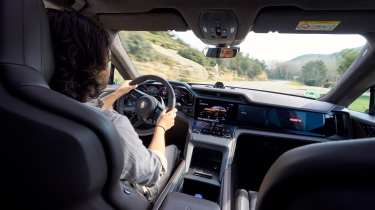
In town, the Cayenne is easy to navigate through tight roads, with accurate and nicely weighted steering, a compliant ride and a responsive throttle. The rear-wheel steering of our test cars only accentuated the tight turning circle.
Oddly, the brakes are a highlight, though, because the pedal has a smooth and consistent operation, even when juggling between friction and regen. Visibility is fine, and while the rear window is quite narrow, there’s plenty of camera views on the large, clear central screen to make most parking manoeuvres seamless.
Country road driving and handling
The general competence of the new Cayenne’s ride and handling package is most obvious on country roads. There’s excellent control to the chassis, which is essential when the car weighs 2.7 tonnes, but also a finely wrought sense of balance and poise to its suspension.
As with most comfort-oriented Porsches, you feel the ebb and flow of the road, but any harshness is filtered away.
At higher speeds you can still load up a rear corner and shoot out of a bend with complete control. The twin-motor layout is very rear-biased in its delivery, so there’s always a sense of dynamism often lacking in other large electric SUVs.
Motorway driving and long-distance comfort
The large tyres and sporting edge might give you the impression that comfortable long-distance driving isn’t one of the Cayenne’s strengths, but this isn’t the case. Porsche has done an excellent job of calibrating the suspension and steering so the Cayenne ‘feels’ like a Porsche, even when driving in a straight line. There’s a confidence to the way this car can stick to its line at high speed.
Wind noise and road noise are very well suppressed, although for the ultimate in-cabin calm, you’ll need to choose the laminated window option, because the frameless doors can cause a little bit of wind noise.
MPG & running costs
Pros |
|
Cons |
|
Electric range, battery life and charge time
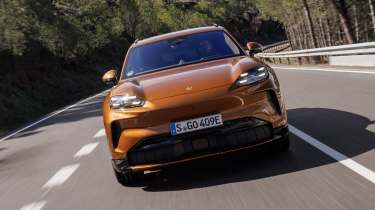
Range is a little more limited. Porsche quotes a maximum of 399 miles on the smallest wheel option. This is an objectively good figure, but in a world where a BMW iX3 can quote 500 miles of range for more than £20,000 less, big expensive EVs just have no choice but to strive for similar figures. Unless an even bigger battery finds its way under the cabin floor, 399 miles is theoretically as high as any Cayenne will go, and Porsche quotes around 358 miles with the optional 22-inch wheels and a Sport Design package fitted.
Porsche insists that this will be enough for even the most lengthy road trips, though. And with 400kW charging promising a 10-80 per cent refresh in just 16 minutes, this capability underpins this claim. However, the focus of this EV isn’t really efficiency, but its ability to demonstrate the sort of characteristics typical of a modern Porsche: an engaging driving experience, excellent performance and a tangible sense of quality.
One area that Porsche won’t be winning any awards for is electrical consumption. In temperate weather on medium-to-high-speed roads, we averaged around 2.8mi/kWh. This will be slightly worse than what we might see in ideal conditions, but is surely a result of Porsche’s chassis set-up. It’s clear that the large performance-orientated tyres, aggressive suspension geometry and instantly available power don’t go hand-in-hand with extreme efficiency.
| Model | Battery size | Range | Insurance group |
| Porsche Cayenne Electric | 113kWh | 399 miles | NA |
Insurance groups
The latest Cayenne has yet to be assigned car insurance groupings, but given that it’s a Porsche, an EV and one with lots of expensive radars and lights at its extremities, we suspect low-hanging models to be near to the top, and Turbos in the highest groups.
Tax
The standard road tax of £195 is increased by a £425 supplement because of the car’s high purchase price, totalling £620 per year. BiK is also on electric car rates, meaning three per cent this year, with a one per cent increase until 2027 and then a further two per cent for each of the 2028 and 2029 financial years.
Depreciation
This is where the low running costs of an EV come back to bite, because the depreciation isn't expected to be too bad. No values have been confirmed so far, but alongside its key competition, the Cayenne will be hit.
Due to the war in the Middle East, fears over fuel security and the price of oil mean that the values of second-hand EVs are stabilising, as people see the fiscal benefits of running an electric car, as opposed to just the environmental ones. This could see values remain stable, but it all depends on supply and demand.
Interior, design & technology
Pros |
|
Cons |
|
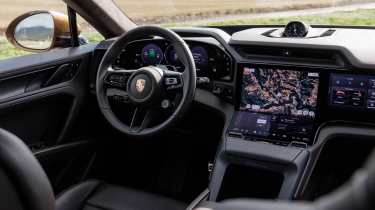
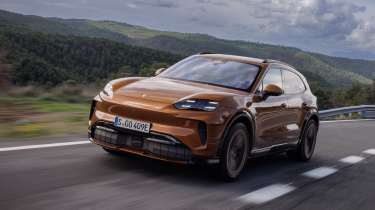
In the flesh, the new Cayenne looks quite different to high-riding ICE-powered models of the past. It has a lower stance, sleeker styling and a more overtly aerodynamic silhouette. However, open the frameless door and things are instantly more familiar. The cabin’s underlying quality is superb, with all models featuring a series of curved displays that look and feel expensive.
The driving position is nicely adjustable. Put the seat all the way down and shorter drivers will be peering over the steering wheel just as in a 911 Coupé, albeit a few feet further off the ground. Space in the back is also vast, because the brand has stretched the wheelbase on this Cayenne compared with the ICE model, resulting in a flat floor and far more rear legroom.
Porsche’s inclusion of high-end luxury features has also taken a considerable step up in this generation. The rear bench is now electrically adjustable, and as well as heated rear seats, Porsche offers heating on surfaces such as the armrests and the centre console’s lid up front. The opening panoramic roof is a nice touch, but for the first time in a road car it also features switchable transparency within the moving panes.
Interior and dashboard design
The cabin’s general architecture is quite different to that of former Cayenne models thanks to big open spaces under the main centre console and an excellent Magsafe charging pad keeping your iPhone in place. This uses magnets to keep Apple’s smartphones in place on the charging mat, but Android devices will work on it, too.
The design is quite screen-heavy, and without the passenger display fitted, there’s a big slab of dust-attracting glossy plastic. Key controls for the volume, air-conditioning and driver aids are present and feel great, and there’s a few bonus touch-sensitive controls around the digital dial pack for less used, but still important functions.
Materials and build quality
All the interior materials have a distinctly Porsche feel, which is to say they’re solid. However, if you want the more sumptuous materials that are available, you’ll need to pay extra for them.
Infotainment, sat-nav and stereo
It’s not often we say this, but the digital interfaces are excellent. The odd, curved touchscreen isn’t just a gimmick, but intelligently splits the display into two zones that you use quite differently. Critically, everything is very configurable, and quickly falls to hand after a little time setting things up. The best bit is that the physical controls for the main air-conditioning system, volume and demisters remain. There are also separate switches for the lights, camera view and a few other subsidiary functions up by the driver’s display.
Boot space & practicality
Pros |
|
Cons |
|
Through its generations, the Cayenne’s overall size has remained largely consistent. This makes it a relatively large SUV by European standards, yet it’s considered mid-size in markets such as the USA and Middle East. This new electric version keeps within these bounds, largely because we know a larger and even more luxurious new Porsche SUV is in development.
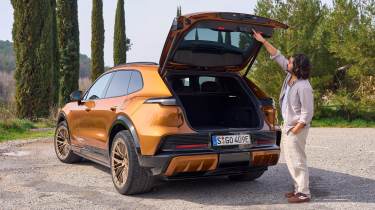
Boot space for the new Cayenne Electric is around 80 litres up on the ICE car (and far more than on the e-Hybrids), at 781 litres, and there’s a 90-litre ‘frunk’ for the charge cables, too.
Dimensions and size
The new Cayenne Electric is lower, longer and slightly narrower than its petrol-powered counterpart, but the general dimensions are very similar. Within those, though, there are some substantial differences driven largely by its new platform. The nose, for instance, is shorter and there’s a shorter front overhang to go with it. The rear wheels are also mounted further back, giving the car a shorter rear overhang and unlocking extra space for rear-seat passengers – and the massive battery pack.
Dimensions comparison | |||
| Model | Porsche Cayenne Electric | BMW iX | Mercedes EQS SUV |
| Length | 4,985mm | 4,965mm | 4,863mm |
| Width | 1,980mm | 1,970mm | 1,940mm |
| Height | 1,674mm | 1,695mm | 1,707mm |
| Wheelbase | 3,023mm | 3,000mm | 3,030mm |
| Boot space | 781 litres | 500 litres | 520 litres |
Seats & passenger space
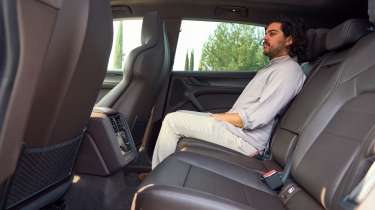
Porsche usually nails this sort of stuff, and the new Cayenne is no different. The seats up front are firm, but extremely comfortable and supportive over longer journeys. The high dash can feel a little intimidating at first, but it’s easy to find a great driving position.
Space in the back is far better than in any Cayenne that’s gone before, too, thanks to a flat floor and more legroom. The doors open nice and wide, but they’re quite thick, so opening them in tight parking spaces could be tricky.
Boot space
The boot is wide and square, with a flat floor and no load lip. There’s also some storage under the boot floor, but the roofline is lower than on the ICE variants and does limit ultimate cargo capacity. Outright capacity is 781 litres, which is about 50 litres up on the ICE Cayenne, and significantly up on the e-Hybrid models.
Towing
Porsche quotes a colossal 3.5-tonne towing capacity, and thanks to the high torque figure and standard four-wheel drive shouldn’t have any issues with those weights. This will have a detrimental effect on range, though, as per all electric SUVs.
Reliability & safety
Pros |
|
Cons |
|
This is a brand new model, so it’s tricky to comment on reliability, but we expect the safety rating to be at five stars, especially considering Porsche’s record of excellent systems’ calibration and passive safety. No official Euro NCAP rating has been recorded as the model is still too new.
There’s also a new parking assistant, which is capable of steering the car into tight spaces autonomously.
In terms of reliability, there’s a couple of things to note. This is a brand-new model for Porsche, and it introduces a new digital interface, which could throw up a few teething issues. However, the PPE platform and the electronic stack this car runs on have already been used on the Macan and a range of Audi models, so many of these could already be dealt with.
| Euro NCAP safety ratings | |
| Euro NCAP safety rating | NA |
| Adult occupant protection | NA |
| Child occupant protection | NA |
| Vulnerable road user protection | NA |
| Safety assist | NA |
Buying and owning
- Best buy: Porsche Cayenne Electric
As always with a Cayenne, the model you should buy always directly corresponds with how much performance you want. The base Cayenne is a high-quality, well finished family car with lots of technology and luxury. However, performance is adequate, but not thrilling. If extreme high performance is desired, the Turbo has far more of it, and uses technology such as Active Ride to lift capability to a higher level. The new Cayenne S Electric will act as the centre ground, and could be the pick of the range – but we’re yet to drive it.
Porsche Cayenne Electric alternatives
For now, not many rivals offer quite so much in one car. BMW’s iX does, but it’s now deep into its post-facelift model cycle, and will soon be replaced by the iX5. However, that won’t arrive in the UK until the end of 2026.
The Mercedes EQS SUV is more opulent, perhaps, but it’s also a far cry from a keen driver’s car, although it comes with about as much desirability as any mid-size people carrier. Audi’s Q6 e-tron, with which this Cayenne shares its fundamental platform, is smaller, cheaper and far less ambitious in its remit.
Looking further down the line, the Range Rover Sport Electric is on track, plus Bentley’s Urban EV and AMG’s own bespoke SUV, but these are coming in 2027 at the earliest.
Frequently Asked Questions
Yes, the Porsche Cayenne is well built, good to drive and practical, but it’s also expensive. If you want a high-end electric SUV, though, there are few better options.
More reviews
Car group tests
In-depth reviews
Road tests
Which Is Best