New Nissan Ariya 2026 facelift review: Leaf makes it a tough sell
The Nissan Ariya has been updated for 2026, but it hasn't moved the game on in terms of practicality, refinement or tech


Verdict
The Nissan Ariya remains a fine and capable choice in the family electric SUV class, with decent practicality, refinement, interior quality and tech. However, the updates for 2026 have done nothing to close the gap to the front of the pack, because rivals offer more range and faster charging, are more efficient and better to drive. Meanwhile, the new Nissan Leaf is nearly as practical but delivers much greater value-for-money, making its bigger brother look frankly redundant.
We were so impressed by the Nissan Ariya when it was launched in 2022 that we named it the Auto Express Car of the Year. Since then, however, alternative electric family SUVs have been arriving one after another. Among them was the all-new third-generation Nissan Leaf that, as with its sibling, has claimed the highest honour we can bestow.
So after being somewhat forgotten about in the rapidly evolving world of electric cars, it’s about time the Ariya received a couple of mid-life upgrades. Although ‘tweaks’ might be a better description of the changes, because this facelift wasn't as extensive or transformative as we’ve seen rivals such as the Tesla Model Y receive.
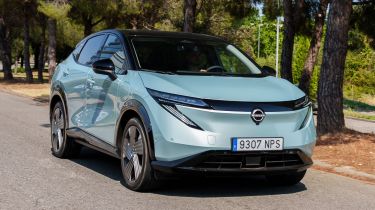
The light Leaf-inspired makeover the Ariya got removed the large black blanked-off grille-type panel that used to be on the car’s nose. Its daytime running lights and front bumper were also redesigned, fresh 19-inch alloy wheels were added and a new ‘Plasma Green’ paint colour.
Used - available now

2024 Nissan
Ariya
4,445 milesAutomaticElectric
Cash £25,990
2024 Nissan
Ariya
2,743 milesAutomaticElectric
Cash £19,665
2024 Nissan
Ariya
17,802 milesAutomaticElectric
Cash £20,149
2024 Nissan
Ariya
17,151 milesAutomaticElectric
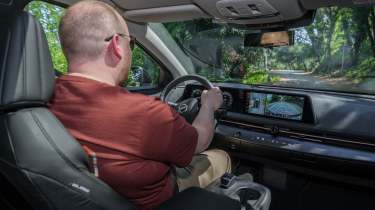
Cash £24,197The interior is almost exactly the same as before, too, including the dual 12.3-inch digital screens and the row of touch-sensitive controls on the dashboard, plus a few more on the centre console. Nissan has added the latest version of its infotainment system though, which has built-in Google Maps, plus Google Assistant and the ability to add more apps using the Google Play store.
We think all of those features are useful and welcome additions, and the brand’s onboard tech is simple and easy to use, if not as slick as many rivals’ systems. We also wish the graphics on both screens were sharper.
Wireless Apple CarPlay and Android Auto come as standard at least, along with a wireless smartphone charging pad that’s now in front of the centre console – not concealed under the armrest like before – and features MagSafe. The Ariya offers Vehicle-to-Load (V2L) charging now, too, so its big battery pack can be used to power small appliances should you get desperate on a family camping trip.
The interior doesn’t feel as upmarket as the Smart #5’s or as unique as a Cupra Tavascan’s, but the overall quality is still pretty nice. Our test car featured suede across the dash and doors, plus various squidgy surfaces, even if that is all interspersed with hard black plastic. The attention to detail doesn’t go unnoticed, whether that be the interesting wood-effect trim and copper detailing on the dash, or the geometric finish on the doors and in the footwell.
However, rather bizarrely, we struggled to find a comfortable driving position, because the seat felt very high and you can’t lower it much, so we felt like we were perched on top of the car.
As with the award-winning Leaf, the Ariya’s sloping roofline hinders practicality. Six-foot-tall adults have plenty of legroom to stretch out, but headroom is tight. Those with longer limbs may also notice they’ve not got much under-thigh support because the seat base is low. So it’s not ideal for adults on long road trips.
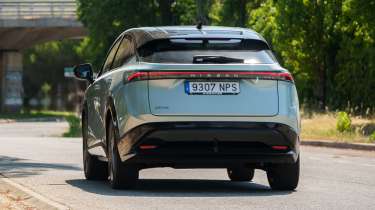
The 466 litres of boot space is a long way off the best in class, with the Tavascan, Renault Scenic and Skoda Enyaq all offering roughly 100 litres more. In fact, the smaller Leaf is nearly as practical, with its 437-litre luggage capacity. There’s no additional storage under the Ariya’s bonnet either, disappointingly.
Nissan says it made some changes to the Ariya’s chassis in an effort to improve ride comfort and refinement, however, we won’t know for sure if they’ve worked until we drive the updated car on UK roads.
We will say that on the smooth, almost pothole-free tarmac around Barcelona, Spain, the ride felt firm and rather bumpy around town, and could have settled down better on a motorway. The Ariya also feels its size on the road, and while very light steering helps to make parking and tackling tight city streets easier, it doesn’t provide any sense of feedback. So this is a decent and refined car to drive, but not an entertaining or fun one.
A couple more things: despite what its name suggests, the ‘e-Pedal Step’ system in the Ariya doesn’t provide one-pedal driving as with a Hyundai Ioniq 5 or Kia EV6. It only brings the car to a slow creep. Also, the quiet of the cabin is repeatedly shattered by Nissan’s annoying ADAS tech, particularly the speed-limit warning and driver-fatigue monitoring.
Finally, while the Ariya’s drivetrain is smooth and packs enough power for a mid-sized electric SUV, it’s still not very efficient. During our testing across a variety of roads in warm, sunny Spain, and a lot of time in stop-start traffic using the regenerative braking, we averaged an unremarkable 3.0 mi/kWh. That equates to 261 miles from the long-range model we tested with its sizeable 87kWh battery.
Admittedly, Nissan only claims it delivers 329 miles, but rivals can go much further, as can the new Leaf. That offers up to 375 miles of range for a little over £32,000 – around £11,000 less than the Ariya. Its younger brother charges quicker, too, and with the Ariya only capable of reaching 130kW, a typical 20 to 80 per cent top-up takes roughly 40 minutes.
The ‘new and improved’ Nissan Ariya was due to go on sale in June, however it’s still not available yet. It should be soon, we’ve been promised, and when orders do open there will be a simple choice of just two models: Engage+ and Advance.
Prices will start from £37,000 without the Government’s Electric Car Grant that the entry-level model should get. As before, that car will come with a 63kWh battery good for up to around 250 miles of range, plus those two big displays, Google services built-in, heated front seats, a wireless charging pad, a full suite of driver-assist systems and Nissan’s latest ProPilot adaptive cruise control tech.
The range-topping Advance version doesn’t get the grant, so it will cost from £43,425. On top of the bigger battery, it adds a head-up display, Bose sound system, digital rear-view mirror, a hands-free tailgate, heated steering wheel and 360-degree camera system.
Did you know you can sell your car through Auto Express? We’ll help you get a great price and find a great deal on a new car, too.
| Model: | Nissan Ariya Advance |
| Price: | £43,425 |
| Powertrain: | 87kWh battery, 1x e-motor |
| Power/torque: | 239bhp/300Nm |
| Transmission: | Single-speed automatic, front-wheel drive |
| 0-62mph: | 8.0 seconds |
| Top speed: | 100mph |
| Range: | 329 miles |
| Max. charging: | 130kW (20-80% in 40 minutes) |
| Size (L/W/H): | 4,595/1,850/1,660mm |
| On sale: | Summer |