Lexus RZ review
The Lexus RZ is a compelling alternative to its more mainstream electric SUV rivals

Our opinion on the Lexus RZ
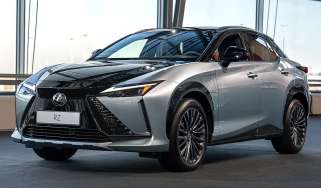
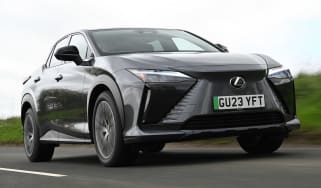
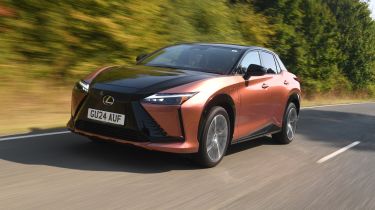
Given the facelifted Lexus RZ retains the same sharp lines and pointy details of its predecessor, you’d be forgiven for thinking that little has changed. However, lots of improvements have been brought in underneath as Lexus has moved to address initial concerns, namely by increasing its power, extending its range and cutting its charging times.
Along with various suspension and structural upgrades, this EV has improved as a package. However, choose the fancy steer-by-wire system carefully, because its bizarre steering ‘yoke’ is not for everyone. The 500e is a better all-rounder than the flagship 550e F Sport, too.
About the Lexus RZ
Following the UX300e, the RZ was only the second full-EV from Lexus when it launched in 2023. Early impressions of the RZ were largely positive, and negatives such as its relatively short range and comparatively slow charging times were addressed as part of the 2025 facelift.
Despite looking like a coupe-SUV, there’s a good amount of space inside the RZ thanks to its low-set floor. There are two or four-wheel drive versions on offer, with the front-wheel drive version badged RZ 350e, while four-wheel drive is reserved for the 500e and 550e.
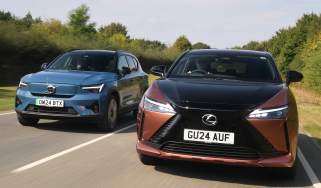
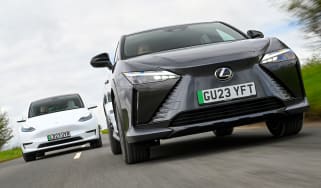
There are no shortage of competitors to the Lexus RZ, and before it’s facelift, we pitted it against the Volvo EX40 in a twin test, and then in 2026 we ran a premium electric SUV supertest where the updated RZ went up against the Audi Q6 e-tron, Tesla Model Y, BMW iX3 and Alpine A390.
Lexus RZ prices and latest deals
Having previously started at over £50,000, Lexus gave the RZ a huge price cut in 2026, so the range now kicks off at £44,615.
Used - available now


That’s for the base 350e Premium spec, while Premium Plus adds £1,250. The dual-motor 500e starts with Premium at £52,545, with an extra £1,500 needed for the Premium Plus or an extra £6,000 for the Takumi. At the top end, the 550e comes in either £64,045 F Sport or £67,345 F Sport Takumi spec.
You can build your perfect Lexus RZ through the Auto Express Buy a Car service. We also have a range of RZ leasing deals to choose from, as well as used RZ models in stock and waiting to hit the road.
Performance & driving experience
Pros |
|
Cons |
|
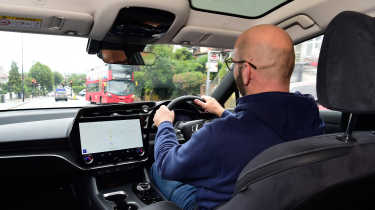
While the Lexus RZ looks sharp, the driving experience is geared towards comfort rather than sportiness, and that’s to the car’s benefit.
| Model | Power | 0-62mph | Top speed |
| RZ 350e Premium | 221bhp | 7.5 seconds | 99mph |
| RZ 500e Premium | 376bhp | 4.6 seconds | 112mph |
| RZ 550e F Sport | 402bhp | 4.4 seconds | 112mph |
Electric motors, 0-60mph acceleration and top speed
The power output of all RZ models swelled as part of its mid-life facelift, resulting in the old 300e and 450e being replaced by the 350e and 500e, respectively, while a range-topping 550e was also added to the line-up. Performance figures range between 221bhp for the 350e, 376bhp for the 500e, and 402bhp for the 550e. The latter’s power output is a serious improvement over the old 450e, which topped out at 309bhp.
The 350e has just about enough punch for most drivers’ needs, as its 7.5-second 0-62mph time will attest. With 269Nm of torque, it feels able to keep up with regular traffic flow without difficulty. However, the muscular 500e is the more fitting on-road performer for a premium brand like Lexus, and its 4.6-second 0-62mph time is now a match for the Tesla Model Y AWD.
Rather than its 4.4-second 0-62mph time, it’s the Interactive Manual Drive fitted to the 550e which makes this version stand out. This uses torque interruption from the motors and synthetic noises to simulate driving a combustion car with gears. Unfortunately, those ‘gears’ are ripped through way too quickly, and the RZ makes a truly peculiar digital noise – a bit like an industrial cement mixer overlaid with a jet engine – as it accelerates. It’s a noble effort at bringing added interactivity to the EV driving experience, but the Lexus set-up is nowhere near as successful as the system used by the Hyundai Ioniq 5 N. We reckon you’ll try it once or twice and then soon forget about it.
Town driving, visibility and parking
At low speeds the RZ is quiet, but the suspension can become a little restless on poorer road surfaces. Front and rear sensors and a reversing camera help with parking, which is handy, because there’s a relatively long bonnet that dips down ahead of you, and the rear windows are narrow.
Models with steer-by-wire, or more specifically the ‘yoke-style’ steering wheel, can be a little tricky to use during low-speed manoeuvring because this setup is far too keen to self-centre and lacks precision as a whole. Adding the indicator stalk on the wheel adds another, unnecessary level of complexity. We’d therefore stick with a round steering wheel and a proper mechanical link between the driver and the vehicle’s front wheels.
Country road driving and handling
Pleasingly, changes to the suspension, steering and structural rigidity of the RZ have markedly improved the car’s dynamic behaviour. Both the single-motor, front-wheel-drive 350e and the dual-motor, all-wheel-drive 500e are very pleasant to travel in, with excellent ride comfort and rolling refinement coupled to sharp, adept handling.
At higher speeds, the steer-by-wire of the 550e starts to feel a bit more organic, but on the whole, the 550e doesn’t feel appreciably quicker or more enjoyable to drive than the longer-legged and cheaper 500e.
Motorway driving and long-distance comfort
The RZ is very peaceful at motorway cruising speeds, where the brand’s soundproofing efforts really pay off. The fidgety ride that occurs at low speeds around town isn’t an issue at higher speeds, meaning you can sit back and relax while chewing up the miles.
“It seems odd for a front-wheel-drive car to have fatter rear tyres, but the RZ’s rear track is also wider by 15mm, and the difference is designed to boost the car’s handling.” – Dean Gibson, senior test editor.
Range, charging & running costs
Pros |
|
Cons |
|
The battery capacity for the RZ was increased from 71.4kWh to 77kWh when the car was facelifted, but this is still shy of a number of key rivals, as we found out during our premium electric SUV supertest.
The most efficient model in the range is the front-wheel-drive 350e, with up to 346 miles of range – provided you stick with the smaller 18-inch wheels. Opt for the 20-inch alternatives, and you’ll see your range decrease to 315 miles.
In mid-range 500e spec, the RZ gets four-wheel drive as standard, and the weight penalty of that means its range drops to 306 miles on 18-inch wheels, or 286 miles with 20-inch wheels. The range-topping 550e is only offered on 20-inch rims and is restricted to a 287-mile maximum. All versions of the RZ feature a heat pump that takes the load off the battery when warming the car in cold weather, helping to maintain your driving range.
When we tested the range-topping Lexus RZ 550e F Sport Takumi as part of our premium electric SUV group test, this car only returned a rather meagre 2.7 miles per kilowatt-hour. This translates to a real-world range of only 194 miles, which isn’t only a long way off of Lexus’s claims, but it was also painfully far behind the Tesla Model Y’s 3.5mi/kWh average which equated to around 284 miles from its 84.7kWh battery. The BMW iX3 wasn’t the most efficient, but its massive battery allowed for the best real-world range of our group at around 300 miles.
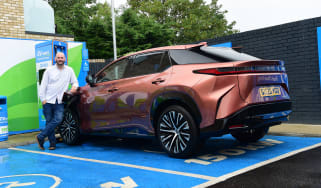
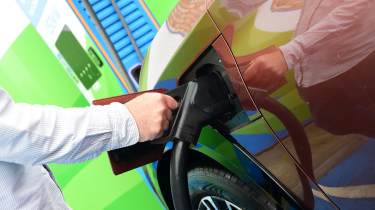
Charging speeds were also increased during the revamp, but only for AC charging rather than DC rapid charging. The RZ is capable of accepting a three-phase feed of up to 22kW rather than the 11kW of the pre-facelift car. That sees charging times from zero to 100 per cent reduced to around three and a half hours rather than the seven hours it previously took.
However, since three-phase electricity is only really found on commercial premises or in the public network, most home charging will be done on a typical 7.4kWh wallbox home charger, and this should take around 10 and a half hours.
If you plug into a rapid charger capable of delivering the maximum rate of 150kW that the RZ can accept, you’ll be able to perform a 10 to 80 per cent top up charge in around half an hour.
| Model | Battery size | Range | Insurance group |
| RZ 350e Premium (18-inch wheels) | 77kWh | 347 miles | 40 |
| RZ 500e Premium (18-inch wheels) | 77kWh | 306 miles | 43 |
| RZ 550e F Sport (20-inch wheels) | 77kWh | 287 miles | 45 |
Insurance groups
It may come as little shock that the upmarket Lexus will be quite costly to cover, as the revised line-up sits between insurance groups 40 and 45 (out of 50). This is considerably higher than the Volvo EX40, which resides in groups 33 and 40, while the Tesla Model Y finds itself somewhere in the middle in groups 34 to 42.
Tax
Every Lexus RZ is liable for the standard rate of VED road tax, and this car’s pricing structure means a large proportion of the line-up sits above the £50,000 electric luxury car tax threshold. Go higher than this number, and you’ll be adding an extra £440 to your annual bill between the second and sixth years after the car is registered.
Company car drivers will see the typically low Benefit-in-Kind (BiK) tax rates that are associated with fully electric cars.
Depreciation
Despite its upmarket, left-field status, the Lexus RZ struggles in the fight against depreciation. Our market data indicates that this electric SUV only manages to retain between 37 and 42 per cent of its original value after a period of three years or 36,000 miles. The Volvo EX40 suffers a similar fate at 37 to 41 per cent, while the Tesla Model Y emerges at a much stronger 48 to 64 per cent.
To get an accurate valuation for a specific model, check out our free car valuation tool...
Interior, design & technology
Pros |
|
Cons |
|
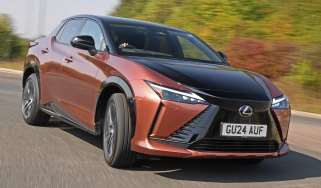
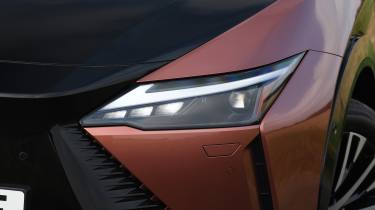
To help your RZ stand out, there are six paint colours to choose from. The complementary colours are Graphite Black or a rather smart-looking Aether Blue – although the fetching Sonic Copper is a mere £250 extra.
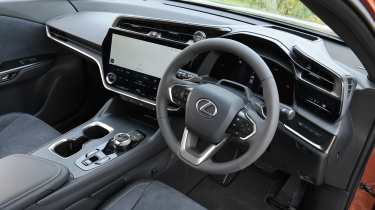
Inside, you can pick between three interior colours: black, grey, or hazel. There’s a driver-focused cockpit that is easy to navigate, although there are a few too many controls on the touchscreen.
As we’ve already mentioned in the driving section, higher-spec models are available with a steer-by-wire system, which was said by the manufacturer to be the first implementation of this system in the European market. But we reckon it’s a gimmick, rather than a meaningful advancement in the EV story.
The oblong yoke which controls the steering is, literally, reinventing the wheel when there’s no need to do so. It looks and feels odd in your hands, and the ergonomics of its strangely stunted paddle shifts for the ‘gearbox’, the unusual placement of key controls on its face, and its stalks which aren’t column-mounted (they rotate with the yoke) are somewhat counterintuitive at first sampling.
Interior and dashboard design
A large 14-inch display controls most of the functions in the Lexus via the Lexus Link Pro software. However, the screen is integrated with a pair of touch-sensitive climate controls beneath – the rotary temperature dials are easy to use when on the move. Still, the buttons on the smooth display are less responsive, which is a shame because the voice control alternative is quite poor, often struggling to understand your commands, and its functionality is limited compared with rival systems.
The main screen is easy to navigate, with shortcuts stacked vertically to the right of the screen. Another button below the main screen takes you to a custom menu where you can add frequently used functions and quickly access the driver-assistance tech. If you want to utilise your phone instead of the on-board software, both Android Auto and wireless Apple CarPlay smartphone connectivity (as well as wireless charging) are provided as standard.
However, you may still want to use the on-board sat-nav system because it includes dedicated route planning with charging stops based on the car's current state of charge. It’s also now possible to precondition the battery of the RZ (either automatically or manually via a setting in the infotainment system) ahead of rapid charging stops to help speed up charging times.
Materials and build quality
The materials used throughout the interior are befitting of a premium model, with lots of soft leather, grained plastics and metal switchgear on display. Takumi and F Sport trim models include a material called Ultrasuede on the door cards that’s 30 per cent plant based, and features graphics that are applied to the surface with a laser.
One novelty that can also be found on the Lexus NX and Lexus LBX SUVs is the e-Latch electronic door release. Rather than having pull handles, the RZ has a button release on the back of the handle that opens the doors from the outside, while a similar push-button arrangement is fitted inside.
From on-board, simply grab the interior handle, press the button with your thumb and push the door open at the same time. It takes a bit of getting used to, but soon becomes second nature. This also has safety benefits, because the system uses sensors to detect if you’re opening the door into approaching traffic.
Infotainment, sat-nav and stereo
A large 14-inch display controls most of the functions in the Lexus via the Lexus Link Pro software. However, the screen is integrated with a pair of touch-sensitive climate controls beneath – the rotary temperature dials are easy to use when on the move. Still, the buttons on the smooth display are less responsive.
The main screen is easy to navigate, with shortcuts stacked vertically to the right of the screen. Another button below the main screen takes you to a custom menu where you can add frequently used functions and quickly access the driver-assistance tech. If you want to utilise your phone instead of the on-board software, both Android Auto and wireless Apple CarPlay smartphone connectivity (as well as wireless charging) are provided as standard.
However, you may still want to use the on-board sat-nav system because it includes dedicated route planning with charging stops based on the car's current state of charge. It’s also now possible to precondition the battery of the RZ (either automatically or manually via a setting in the infotainment system) ahead of rapid charging stops to help speed up charging times.
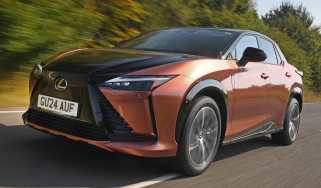
“The distinctive Sonic Copper metallic paint is a surprisingly affordable option that costs only £250, and is worth paying for just to have something that stands out in a monochrome new-car market.” – Dean Gibson, senior test editor.
Boot space & practicality

Pros |
|
Cons |
|
The Lexus RZ looks like a coupe-SUV from the outside, but clever EV packaging means that interior space isn’t compromised. The five-door body gives good access, with a powered tailgate fitted as standard on all variants.
One glaring problem is that rear visibility could be better, especially because there’s no rear windscreen wiper to clean the screen. There are, of course, reversing cameras (Premium Plus trim and above introduce a 360-deg system) and parking sensors, which do help when reversing, but they’re no substitute for being able to look through a clear section of the rear window.
Dimensions and size
The sporty profile of the Lexus RZ means it has a longer, lower appearance than the upright Volvo EX40. The roofline is 1,635mm tall and blends into a steeply raked tailgate, so while it looks sporty, it’s actually set quite high.
| Dimensions comparison | |||
| Model | Lexus RZ | Volvo EX40 | Tesla Model Y |
| Length | 4,805mm | 4,440mm | 4,797mm |
| Width | 1,895mm | 1,873mm | 1,982mm |
| Height | 1,635mm | 1,647mm | 1,624mm |
| Wheelbase | 2,850mm | 2,702mm | 2,890mm |
| Boot space | 522 litres | 410 litres | 845 litres (measured to roof) |
Seats & passenger space
A flat floor boosts cabin space in the rear, while the seat is wide, so fitting three across it is simple enough. Legroom is good, but foot space is limited under the front seats. Two Isofix points are provided on the outer positions.
You might expect the RZ’s coupe-like profile to compromise headroom, but it’s actually fine – especially with Premium trim models and above that feature a panoramic roof with electrochromatic glass that eliminates the need for a retractable sunshade. This means headroom is fine.
Storage is poor in the back, though, with only small bottle-shaped door bins and no other pockets, but there are USB-C connections and a three-pin plug socket on the back of the central armrest for connecting devices.
Boot space
There’s a slightly high load lip on the RZ, but the floor is level with it, so loading heavier items is simple enough. The RZ has a false boot floor, though, and it lifts to reveal a deep well below that can take charging cables and other items, while lashing eyes and cargo hooks are set in the sides of the boot. While there’s space under the boot floor, there’s no room for anything under the bonnet, which is a shame when you consider rivals like the new Mercedes GLC Electric come with a 128-litre ‘frunk’.
The back seats fold in a 60/40 split to leave a completely flat load area, and a maximum capacity of 1,451 litres is decent. The tonneau cover has been altered, going from the flimsy, cheap-feeling bit of fabric in earlier RZ models to a more substantial design that incorporates a layer of felt to further reduce interior noise.
Towing
The low 750kg maximum braked towing limit of the RZ 350e means that any EV driver wishing to tow a decent-sized caravan will need to consider the pricier four-wheel drive 500e and 550e models with their greater 1,500kg capacities.
If you need something with a bit more capacity, try the Hyundai Ioniq 5 with its 1,600kg maximum braking capacity, or the Kia EV6 with up to 1,800kg.
‘I found it annoying that there aren’t any quick-release buttons to drop the rear seats from the boot. Instead, you have to run around and reach through the rear passenger doors to fold down the seats, which isn’t great when loading longer items.’ – Darren Wilson, creative director.
Reliability & safety
Pros |
|
Cons |
|
With the might of Toyota behind it, and a certain weight of expectation around the Japanese giant’s first dedicated electric platform, you can be sure that the Lexus RZ has been developed to be as reliable and trouble-free as possible.
If you do need to visit a Lexus dealer, you can expect some top class customer service, according to owners who have fed back to the Driver Power ownership survey. The brand finished in 3rd out of 31 manufacturers in the most recent survey, with Lexus drivers praising value for money, infotainment ease of use, the interior, build quality, and reliability of their cars. They were less pleased with ride and handling, but since these areas have been improved with the revised RZ, the Lexus brand might yet return to the top spot next year.
Every version of RZ has lots of standard safety tech, including adaptive cruise control, lane-keeping assist, front and rear cross-traffic alert (it warns you of vehicles that’ll cross your path when reversing out onto a road), and traffic-sign recognition. Like the Subaru Soltera and Toyota bZ4X, the RZ has a driver monitor system to ensure you’re paying attention to the road. If it thinks you are falling asleep or your attention wanders, it’ll ping up a warning.
Our creative director, Darren Wilson, ran an RZ as a long-term test car and was a fan of most of the safety systems, especially the safe exit system that will pick up cyclists approaching when you’re parallel parked on a road, and prevent you opening the door on them as they pass by. He was less pleased with the rear auto brake that in tight carparks would slam the brakes on if it thought you were going to hit something, and then take ages to let you move the car again.
| Euro NCAP safety ratings | |
| Euro NCAP safety rating | Five stars (2023) |
| Adult occupant protection | 87% |
| Child occupant protection | 87% |
| Vulnerable road user protection | 84% |
| Safety assist | 81% |
Buying and owning
- Best buy: Lexus RZ 500e Premium
Even though the revised 350e comes with a little more power, we still think the mid-range 500e is the pick of the range, and feels a much better fit for the RZ and its premium aspirations. We’re more than happy with the level of specification the entry-level Premium has, which gets all the safety technology you could want along with plenty of gadgets to keep you occupied.
Lexus RZ alternatives
There are plenty of premium compact SUVs that rival the Lexus RZ. The lower starting price places it in competition with the Audi Q4 e-tron, BMW iX1, BMW iX2, Mercedes EQA, Genesis GV60 and Volvo EX40, while the Tesla Model Y is a big-selling alternative. You could save money by choosing the Toyota bZ4X, Subaru Solterra, Volkswagen ID.4, or Volkswagen ID.5, but none of these have the premium appeal of the Lexus. At the higher end of the price range, the RZ rivals the likes of the Audi Q6 e-tron and Porsche Macan Electric, although it’s not as spacious as any of these models.
Lexus RZ 450e Takumi long-term test
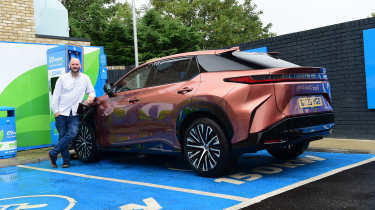
Our creative director, Darren Wilson, ran a pre-facelift Lexus RZ 450e Takumi as part of our long-term test fleet. Although the price of this range-topper was rather steep at £74,000, Darren felt that the RZ’s quality definitely reflects the price.
This all-electric luxury SUV performed well in wintery conditions, with the real-world battery range decreasing by only 19 miles, down from the 205 miles achieved in fairer and warmer weather. It’s important to note, though, that this was still 66 miles below the RZ’s WLTP combined range. You can read more about Darren’s experience with the RZ here…
Key updates of the Lexus RZ review
24 April 2026: Updated to include the latest line-up information and our recent driving impressions.
Frequently Asked Questions
The standard Lexus warranty is three years or 60,000 miles, whichever comes first, which is similar to the sort of cover offered by the company’s premium rivals. There’s roadside assistance for the same period, too.
However, where Lexus pulls out an advantage is with its extended warranty. If you book a service at a Lexus franchise, then the company will cover your car for an additional 12 months or 10,000 miles, up to a maximum of 10 years or 100,000 miles, whichever comes first. Even better, if a regular service is missed or work is done on the car outside of the network, that won’t affect its eligibility; it’s just the time and mileage limits that apply.
The RZ’s battery warranty of eight years/100,000 miles can be extended to ten years or 600,000 miles, which is unmatched in the EV world.
Deals on the RZ and alternatives