New Mitsubishi Outlander PHEV 2026 review: plug-in SUV is back and better than ever
The Mitsubishi Outlander PHEV is a plug-hybrid pioneer, and now there's an all-new version coming to the UK


Verdict
Mitsubishi is offering the right car at the right time in the shape of the Outlander PHEV. The clever hybrid system is super-smooth, it delivers a long all-electric range, there’s plenty of space on board, the ride is comfortable and the car is well equipped for the price. New Chinese models are flooding the market, but the return of Mitsubishi should offer some familiarity to buyers looking for their next family SUV.
Did anyone miss the Mitsubishi Outlander while it wasn’t available for five years? It certainly didn’t have a negative impact on its sales figures. One of the more interesting slides that was presented at the car’s UK launch featured a graph showing sales of plug-in hybrid family SUVs from 2014-2024. Despite being on hiatus for some of that period, nearly 55,000 Outlanders had found homes, which was more than double the number of the next car on the list, the Volvo XC60 PHEV, which was available for the whole decade.
With that in mind, as well as increased consumer demand for PHEVs, it seemed obvious for Mitsubishi to relaunch in the UK with the car that all but single-handedly set the template for the plug-in hybrid family SUV.
Used - available now

2021 Skoda
Octavia
51,925 milesManualPetrol1.0L
Cash £10,600
2024 Citroen
e-Berlingo
57,511 milesAutomaticElectric
Cash £11,270
2022 Kia
e-Niro
32,354 milesAutomaticElectric
Cash £17,240
2017 BMW
X3
85,847 milesAutomaticDiesel2.0L
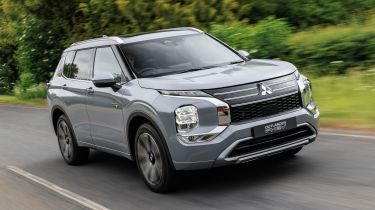
Cash £10,995The Outlander is only new in the sense that it’s new to the UK, because this fourth-generation car followed the Mk3 in 2021. Overall the shape is fairly generic for a family SUV, but the larger grille and C-shaped details on the nose give it a look that’s familiar from past Mitsubishi concept cars.
Inside, the layout has a typically Japanese feel, with plenty of buttons (including separate climate controls) and acronyms dotted around the cabin, while the large central touchscreen and smaller driver’s display are loaded with information. The cabin layout is a little fussy, though, with a real mix of materials used, including gloss-black plastic on the centre console, carbon-look plastic on the doors and stitched leather on the dashboard.
Under the skin, the Outlander features the same Common Module Family (CMF) platform as the Nissan Qashqai and Renault Austral (Mitsubishi has been part of the Renault-Nissan Alliance since 2016), although the plug-in powertrain is Mitsubishi’s own design.
It’s similar in execution to the original Outlander PHEV, but Mitsubishi has improved on the set-up in every department. As before, petrol power comes from a naturally aspirated 2.4-litre engine, while two electric motors (one up front, one for the back axle) mean the Outlander PHEV is four-wheel drive, but without any physical propshaft connecting the front and rear axles. The power of the electric motors has been increased by 41 and 43 per cent respectively, and there’s a total combined output of 295bhp on offer from the powertrain.
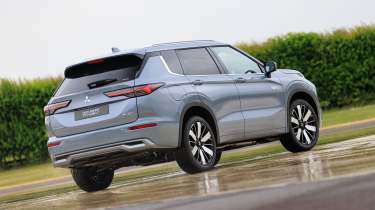
Drive for the two motors comes from a 22.7kWh battery, which is 8.9kWh larger than the pack in the last Outlander PHEV. It offers a WLTP-tested all-electric, zero-emissions range of 53 miles.
Since this is a second-generation PHEV, and the original set-up benefitted from a number of refinements during its life, the powertrain offers smart use of its power sources. For the most part it will default to electric drive as long as there’s enough charge in the battery. There are series and parallel hybrid modes on offer, too, with the former offering electric drive that’s assisted by the petrol engine acting as a generator. Parallel mode engages when the drive battery is running low, with the engine taking over as the prime power source, with the electric motors cutting in as needed.
As ever, there are different power modes on offer, including the ability to charge the battery on the move (and drain the fuel tank by doing so), and a save function so that you can make use of zero-emissions driving if needed later in a trip.
There are six levels of regenerative braking, too, which are selectable via paddles behind the steering wheel or with the drive selector on the centre console. This allows you to adjust the intensity of the energy recovery from freewheeling to strong, although there isn’t a one-pedal setting.
A rotary selector behind the gearlever is used to pick between three drive modes for acceleration and another four that set up the car’s dynamics depending on surface (tarmac, gravel, snow or mud).
On our drive, the Outlander PHEV was a quiet and refined performer in all conditions. On the road, a comfortable ride is appealing, while there’s very little noise in the cabin. Since the car runs on electric drive most of the time, it’s serenely quiet, and you’ll barely notice when the engine cuts in – you’re more likely to see that it’s running via the energy flow display than actually be able to hear it.
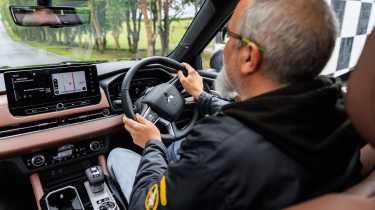
The response of the powertrain is good, too, while light controls and good visibility will make the Outlander a doddle to manoeuvre around town. It’s not the most engaging car to drive on a faster road, but it holds its own, helped in part by the S-AWC system that includes torque vectoring to boost the car’s ability in corners.
We also had the opportunity to sample the Outlander off road, and the drive modes helped it to deliver a good performance. Aside from four-wheel drive, there’s also hill descent control, and this proved to be effective in limiting the car’s speed on a slippery downward slope. The system works at speeds up to 12mph, while uniquely it can be used when driving forward or in reverse.
Overall the Outlander PHEV is a decent driving package, but it’s the rest of the car that is sure to appeal to private buyers and company-car users alike. There are two models offered at launch, the Nativa and Diamond. Both are very well equipped, with 20-inch wheels, four-wheel drive, a 12.3-inch infotainment screen and a head-up display all included on both trim levels.
One new introduction is a seven-seat layout for the Nativa model. We say seven seats, but even Mitsubishi calls it a 5+2 configuration, because the rearmost row is pretty small and will only be good for short trips. But at least it now has the option.
The Diamond model only has five seats, but it lays on the luxury, with diamond stitched leather (the tan finish is a no-cost option), panoramic glass, LED ambient lighting, a powered tailgate, ventilated and massage front seats, heated rear seats and a 12-speaker stereo from Yamaha. The latter is especially impressive with its tech, because it’s a 1,500-watt system (usually only seen on high-end premium models), while the surround system offers noise cancellation against exterior sounds, including rain, and even compensates for the sound of the air-conditioning.
The Mitsubishi Outlander PHEV has plenty going for it, and it comes at a competitive price, too, with the Nativa available for £46,995 and the Diamond only £3,000 more than that - the sole cost option is metallic paint. While Mitsubishi makes its return selling new cars, it had 106 service centres across the UK to help maintain existing models. It’s planning to expand that to 120 over time, while around 50 new-car dealerships will be opened to fulfill the company’s sales ambitions. And to help convince buyers that Mitsubishi’s return is a positive step, there’s an eight-year, 100,000-mile warranty offered as standard.
Did you know you can sell your car through Auto Express? We’ll help you get a great price and find a great deal on a new car, too.
| Model: | Mitsubishi Outlander 2.4 PHEV Diamond |
| Price: | £49,980 |
| Powertrain: | 2.4-litre petrol, 22.7kWh battery, 2x electric motors |
| Combined power/torque: | 295bhp/199Nm |
| Transmission: | Single-speed auto, 4WD |
| 0-62mph: | 7.9 seconds |
| Top speed: | 106mph |
| Economy/CO2: | 313.2mpg/20g/km |
| EV range/max. charging: | 53 miles/39kW |
| Size (L/W/H): | 4,720/1,862/1,751mm |
| On sale: | Now |