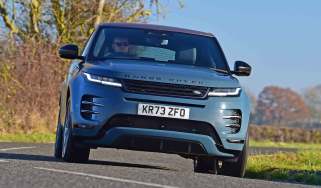
Kia Niro Plug-in Hybrid vs Mitsubishi Outlander PHEV
We see if the Kia Niro Plug-in Hybrid SUV can topple the latest version of the Mitsubishi Outlander PHEV

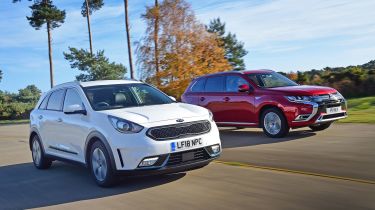
Chances are, you or someone you know will soon be considering a car that is electrified to some extent.
As manufacturers ramp up their production of this new generation of transport tech, and governments and private companies add more charging infrastructure, it’s becoming easier and more attractive to own one. But a pure-electric car isn’t for everyone just yet, because many people live in areas still poorly served by charge points, or need the flexibility a petrol car provides when it comes to range.
We’ve lined up two new models – the Kia Niro Plug-in Hybrid and the latest Mitsubishi Outlander PHEV – to find out which is the better frugal family plug-in SUV.
Head-to-head
| Model: | Kia Niro Plug-in Hybrid 3 1.6 GDi | Mitsubishi Outlander PHEV 2.4 Juro |
| Price: | £30,845 | £36,755 |
| Engine: | 1.6-litre 4cyl petrol plus e-motor | 2.4-litre 4cyl petrol plus twin e-motors |
| Power: | 139bhp (combined) | 221bhp (combined) |
| Transmission: | Six-speed dual-clutch automatic, front-wheel drive | CVT automatic, four-wheel drive |
| 0-60mph: | 9.6 seconds | 8.9 seconds |
| Top speed: | 107mph | 106mph |
| Test economy: | 73.7mpg/16.2mpl | 58.2mpg/12.8mpl |
| CO2/tax: | 29g/km/£130 | 40g/km/£130 |
| Options: | Premium paint (£565) | Metallic paint (£550) |
Kia Niro Plug-in Hybrid
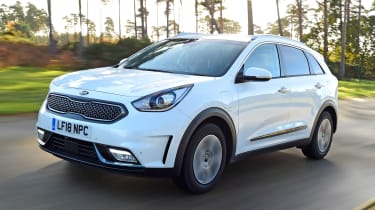
For: Top infotainment system, cheaper than its rival here, build quality is strong.Against: Less practical than the Outlander, dull to drive, performance is disappointing.
Kia launched the Niro in 2016 as a hybrid, but the range has been expanded to include plug-in hybrid and pure-electric variants. That means the Korean firm joins sister brand Hyundai in offering a model range with three types of electrification (Hyundai does the same with its Ioniq hatchback).
In the Niro Plug-in Hybrid a 1.6-litre petrol engine and one electric motor serve up a combined 139bhp, and an all-electric range of 36 miles. The Kia is aimed at those who can charge at home and work, and spend most of their time driving on battery power alone. However, the petrol unit is there to give the Kia more flexibility and work alongside the e-motor to balance this with efficiency.
Used - available now


Power is delivered via a dual-clutch automatic gearbox, in contrast to the CVT transmission fitted to its rival here. The main benefits of this are that the Niro drives much like a normal car and there’s no unpleasant drone from the engine should you request extra performance, as is the case with its CVT-equipped Japanese competitor.
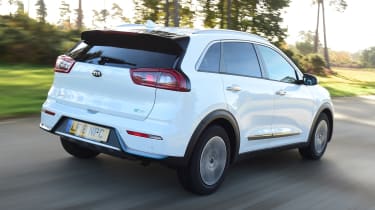
However, the Outlander was the faster car on test, partly due to its gearbox. It took 8.9 seconds to sprint from 0-60mph and 7.9 seconds to go from 30-70mph, while the Niro completed these benchmark tests in 9.6 and 9.2 seconds respectively. It’s clear, then, that while you’re on the move the Outlander’s 221bhp output trumps the Niro’s comparatively weedy 139bhp.
But the Kia isn’t so far behind as the numbers make it seem, because at 50mph you can always drop down an extra gear; and since the Niro weighs 286kg less than its opponent, it’s more agile as well. While neither car is particularly fun to drive, the Niro feels much more composed on a country road, with more grip and less body roll in corners.
It’s also slightly more comfortable, because the big Outlander PHEV feels unsettled on rough roads. However, the Niro isn’t a stand-out performer in this area, because it can crash into potholes as well.
Further, its numb steering and economy tyres mean keen drivers won’t find much enjoyment in pushing the Niro, or the Outlander, hard. Both cars were clearly designed as relaxed commuter vehicles, and while they’re not the last word in comfort, both SUVs deliver on that brief, because they’re at their best nipping around town.
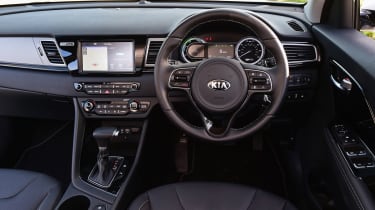
The Niro PHEV is well equipped and comes with an eight-inch touchscreen infotainment system that features sat-nav, plus Android Auto and Apple CarPlay functionality. There’s also adaptive cruise control, heated leather seats, 16-inch alloys and dual-zone climate control included in the spec.
Testers’ notes
- • Infotainment: Niro’s sat-nav is easy to use and features info on nearby charging stations. Both Android Auto and Apple CarPlay work well here.
- • Gearbox: Dual-clutch auto is okay when you’re driving slowly, but it doesn’t shift as quickly as you might expect for a DCT.
- • Materials: Hard plastics are present in both cars, but they’re better hidden in the Kia. The dash design is bit dull, though.
Mitsubishi Outlander PHEV
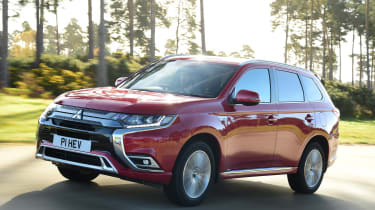
For: Spacious interior, potentially low running costs for a car of this size.Against: Unsettled ride, more expensive to buy than its test rival, interior is ugly.
While this new version of the Mitsubishi Outlander PHEV looks quite similar to the model that went before, under the skin there have been several changes. The powertrain and battery have been revised (with a greater all-electric range of up to 33 miles), while a new 2.4-litre petrol engine replaces the previous 2.0-litre unit.
Alterations to the chassis set-up have improved the Mitsubishi’s road manners and made it more comfortable than its predecessor. While it still tends to jostle about on bumpy surfaces, it doesn’t shake and shudder as much as it used to over bigger bumps. Yet the Niro is still the more comfortable car, because it settles down better when cruising.
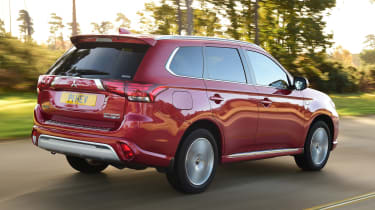
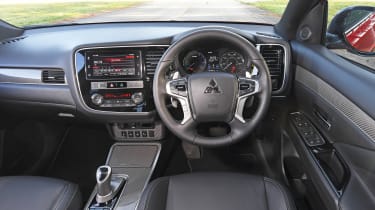
Build quality is solid in both models, but the Outlander’s interior design isn’t as modern-looking as the Niro’s, although there is a lot more space inside. While the Mitsubishi’s infotainment system has been updated, it’s much more confusing to use than the Kia’s set-up and doesn’t come with sat-nav.
Still, the Outlander is reasonably well equipped even in entry-level Juro spec as tested (although our pictures show a 4H model). Its infotainment does feature Apple CarPlay and Android Auto, which makes up for the lack of navigation, plus there’s also dual-zone climate control, 18-inch rims, a heated windscreen and keyless entry and go.
However, while the Japanese PHEV can’t travel as far as the Niro on electric power alone, it integrates its two power sources similarly well. And because it has two electric motors with a greater total combined power output, the Outlander is a bit more relaxing to drive, because you can rely on the motors to get you up to speed easily.
Still, even though the CVT gearbox is smooth when driving gently, the transmission dents the model’s refinement when you need to speed up quickly. Press the throttle hard and the engine revs rise to optimise power delivery, and the subsequent droning is at odds with the usually quiet character of the PHEV model.
Despite its bigger bulk, the more powerful Outlander was quicker than the Niro, accelerating from 0-60mph in 8.9 seconds (the Kia took 9.6 seconds). Four-wheel-drive traction helped here, just as it assists on loose surfaces if you go off road.
The 113bhp 2.4-litre engine is joined by an 80bhp front electric motor and a 94bhp rear motor to create the 4x4 set-up, but because the Outlander is heavy (it weighs 1,880kg), performance is nothing more than okay, and neither of these two models is engaging from a driver’s perspective. Both are refined at low speed, though, and are efficient.
Testers’ notes
- • Touchscreen: Cluttered menu screens mean the Mitsubishi’s infotainment system takes longer to get used to than the intuitive set-up in the Kia.
- • EV modes: You can tell the Outlander to hold its battery charge or even charge up the battery using the petrol engine.
- • Specification: Leather seats are available on higher-spec cars like the 4H in our pictures, but Juro models use a cheaper upholstery called ‘C-Tec’.
Verdict
First place: Kia Niro Plug-in Hybrid
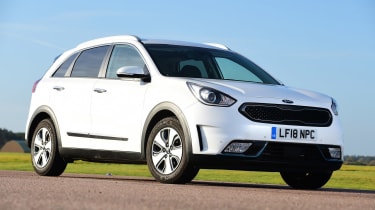
Impressive fuel economy and affordability mean the Niro makes more sense for more buyers than the Outlander PHEV. If you really need the extra space then consider the Mitsubishi, but for anyone else the Kia’s lower running costs and better infotainment will hold more appeal.
Second place: Mitsubishi Outlander PHEV
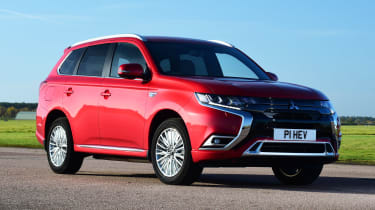
There’s only one main reason to choose the Outlander over the Niro, and that’s if you need the extra practicality, whether that’s the bigger boot, the extra legroom or the 4x4 off-road ability. Otherwise, stick with the Kia, because the Mitsubishi is more expensive to run and less comfortable.