Mercedes GLB review
Latest Mercedes GLB seven-seat premium SUV merges petrol and electric ranges into one

Our opinion on the Mercedes GLB
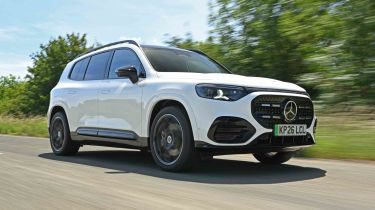
The second-generation Mercedes GLB is a big upgrade on its predecessor, and not just because it combines the petrol GLB and electric EQB line-ups into a single model range. The seven-seat arrangement is unique in the premium SUV sector, and while space in the rearmost row isn't vast, the inclusion of four sets of Isofix child-seat mounts and a sliding middle row adds versatility.
The tech on board is hard to fault, and although we do wonder about the merits of the third dashboard display, the high-resolution screens are easy to navigate. The driving experience in the all-electric model is quiet, refined and plush, and while prices are steep at the top of the range, there is no other model with similar dimensions that offers the GLB’s mix of practicality, luxury, tech and comfort.
About the Mercedes GLB
In the cut and thrust of the small premium SUV market, the Mercedes GLB has largely flown under the radar. Sitting between the Mercedes GLA and Mercedes GLC in Merc’s line-up, the GLB has offered the premium quality we have come to expect from the company, while delivering more space and the versatility of seven seats.
Two versions of the GLB Electric are available: the GLB 250+ and GLB 350. There are two differences between them, with the 250+ featuring a lower power output and rear-drive, while the GLB 350 has 4MATIC four-wheel drive courtesy of two electric motors. The petrol GLB line-up consists of front-wheel drive with the GLB 180 and GLB 200 models, or 4MATIC four-wheel drive with the GLB 220, but we’ll have to wait until later in the year to experience these models.
Used - available now


There are five trim levels: Sport, Sport Executive, AMG Line Executive, AMG Line Premium, and AMG Line Premium Plus.
We’ve tested the Mercedes GLB 250+ AMG Line Premium on the international launch, and we’ve also tested the 250+ and 350 4MATIC GLB Electric models in the UK.
Performance & driving experience
Pros |
|
Cons |
|
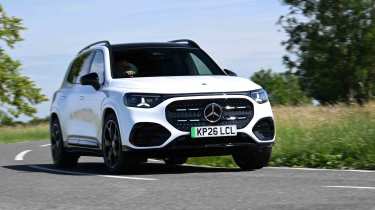
There’s an overriding sensation of comfort when driving the Mercedes GLB, with the suspension set-up favouring a soft ride over cornering poise. Higher-spec cars come with adaptive dampers that offer a greater breadth of ability, while the electric model offers decent pace and quick responses.
The GLB features the same Mercedes Modular Architecture (MMA) platform that’s used by the excellent Mercedes CLA executive car, and here it delivers a similar level of power and response.
Performance, 0-60mph acceleration and top speed
The GLB 250+ has a single electric motor that drives the rear wheels and makes 268bhp and 335Nm of torque. This is good for a 0-62mph time of 7.4 seconds, and the car feels reasonably sprightly, even though there’s the small matter of its 2.2-tonne kerbweight to get off the line.
Upgrading to the GLB 350 4MATIC adds another 80kg to the car’s kerbweight, but its twin-motor set-up with 349bhp and 515Nm of torque easily compensates for that. Although the GLB 250+ already feels quick enough, the 350 has a 0-62mph time of 5.5 seconds, which is enough to frighten hot hatchbacks, and is sure to amuse your passengers at the traffic light grand prix. Both the GLB 250+ and GLB 350 max out at 130mph.
We’re yet to try the petrol GLB, but it’s fair to say that either version of the GLB Electric will be sprightlier in terms of performance. The entry-level 134bhp GLB 180 will crack 0-62mph in 9.7 seconds, which is slower than the entry-level Audi Q3 and BMW X1. The 161bhp GLB 200 manages the same sprint in a more respectable 8.7 seconds, while the four-wheel drive 187bhp GLB 220 gets from 0-62mph in 7.5 seconds.
| Model | Power | 0-62mph | Top speed |
| GLB 250+ Sport | 268bhp | 7.4 seconds | 130mph |
| GLB 350 4MATIC AMG Line Executive | 349bhp | 5.5 seconds | 130mph |
| GLB 180 Sport | 134bhp | 9.7 seconds | 120mph |
Town driving, visibility and parking
There’s plenty of tech on board the GLB to help you with town driving, and Mercedes makes it pretty straightforward to set the features up how you like them.
Front and rear parking sensors and a reversing camera are standard fit across the range, while the top-spec AMG Line Premium Plus model has a 360-degree camera and sensor system with advanced self-parking that can manoeuvre the car into parallel or multi-storey bays without any input from the driver. We found the self-parking feature quite straightforward to start, and it did a fine job at bay parking, although we did fear it was getting too close to the car beside us during the manoeuvre.
There’s more than enough power in the electric version to cope with urban driving, while the GLB remains quiet and refined; the 85dB noise figure we recorded at 30mph is one of the lowest we’ve seen. The ride is comfortable, with thumps and bumps being well isolated from the cabin.
In the GLB Electric, there are four levels of regenerative braking, adjustable via steering-wheel paddles. The strongest mode allows for one-pedal driving – which is great in town – while an adaptive setting adjusts the car’s speed to prevailing speed limits and traffic conditions. It’s a pretty smooth system and helps to take the strain out of stop-start driving.
Getting up to speed is straightforward, while the shifts of the two-speed transmission in electric models are only ever felt if you demand more acceleration than second gear can provide and the system kicks down.
Country road driving and handling
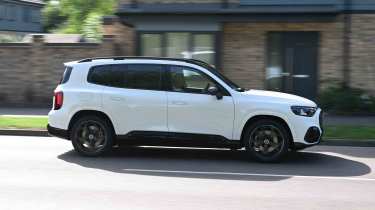
All versions of the GLB come with a multi-link rear suspension to improve the car’s handling. The set-up is soft, and the car’s hefty kerbweight can be felt in corners, too. As a result, it’s best to take things easy; although the GLB handles well, its suspension creates plenty of body roll if you drive the car hard. There’s plenty of grip, although the suspension has a tendency to float up and down over mid-corner bumps.
Higher-spec AMG Line Premium and AMG Line Premium Plus cars improve on the standard set-up with adjustable damping, so when you select the Sport drive mode, the dampers firm up and are better able to cope with the car’s weight, with less bounce and better poise in corners.
Motorway driving and long-distance comfort
The GLB’s refinement is maintained at higher speeds, and the car is a relaxing cruiser without much in the way of wind or road noise in the cabin. It soaks up bumps well, though hitting a series of undulations can make the car feel floaty, although that can be lessened in cars with adjustable damping by putting the suspension in sport mode.
MPG, & running costs
Pros |
|
Cons |
|
The entry-level GLB 180 is the most efficient petrol in the GLB range, with a WLTP figure of 47.9mpg, while the GLB 200 is only slightly short of this at 47.1mpg. The extra weight of the 4MATIC four-wheel drive system fitted to the GLB 220 means the fuel economy drops to 44.8mpg. While the GLB isn’t quite as efficient as the petrol BMW X1, it is a lot better than the diesel Land Rover Discovery Sport.
Speaking of diesel, the GLB can’t be ordered with a diesel engine, which may lead some people to consider alternatives like the X1 or Audi Q3. Another point worth mentioning is that both the GLB 180 and GLB 200 have a 52-litre petrol tank, while the four-wheel-drive GLB 220 gets a larger 60-litre tank to help maintain its overall driving range compared with its more efficient siblings.
Electric range, battery life and charge time
As with the Mercedes CLA, the GLB features an efficient electric powertrain with a two-speed transmission that helps to boost the car’s range when travelling at higher speeds.
All versions of the electric GLB sold in the UK are equipped with an 85kWh battery that’s located beneath the passenger compartment floor. The GLB 250+ has a claimed maximum range of 379 miles in entry-level Sport form, while the AMG Line offers 367 miles of range in its most basic guise. In comparison, the more powerful GLB 350 with four-wheel drive has a maximum claimed range of 360 miles, with larger wheels and extra kit reducing the range for higher-spec versions of both powertrains.
When we tested the GLB 250+ on UK roads in warm weather, we saw an estimated range of 315 miles from a fully charged battery, although based on our efficiency figure of 3.6 miles per kWh, we suggest you'll get 306 miles between top-ups in the real world. That figure was based on mostly motorway work, so we’d expect that could be improved with more town driving where you can use regen braking. We saw a return of 3.5 miles per kWh from the GLB 350 version in similarly warm weather, or around 298 miles between charges, which suggests you shouldn't suffer a big efficiency penalty for going with the four-wheel-drive version.
One area where the GLB matches the CLA is with its advanced on-board charging tech. It’s fitted with an 800-volt system, so if you can find a DC source that can pump out 320kW of power, then the battery can be topped up from 10 to 80 per cent in just 22 minutes. Utilise a typical 7kW home wallbox charger, and it’ll take around 14 hours to fully recharge the battery.
It's worth noting that some older public chargers in the UK aren’t compatible with the GLB’s 800V system, so Mercedes offers an £850 option that supports 400-volt charging as well. It’s worth noting that this system limits maximum charging to 100kW, which isn’t as fast as some rival set-ups.
| Model | Battery size | Range | Insurance group |
| GLB 250+ | 85kWh | 379 miles | 45 |
| GLB 350 4MATIC | 85kWh | 360 miles | 47 |
Insurance groups
With hi-tech charging systems on board, as well as a raft of touchscreen tech, group ratings for the Mercedes GLB are on the high side. They start at 45 for the GLB 250+ in Sport guise, while the more powerful GLB 350 starts in group 47. The top-spec model in Premium Plus trim is in group 48 out of 50.
For cheaper insurance, the petrol GLB is likely to be a better bet. The entry-level GLB 180 Sport starts in group 28, with the slightly quicker GLB 200 Sport in group 32, and the four-wheel drive GLB 220 4MATIC Sport in group 36.
Tax
Having zero emissions works in the electric GLB’s favour, with company-car costs ranging from £368 to £487 for lower-rate taxpayers. In comparison, the GLB hybrid costs a whopping £2,650 - £3,989 per year for 2026/27.
While the Government raised the luxury-car VED threshold for electric vehicles from £40,000 to £50,000, this still means that only the Sport and Sport Executive versions of the GLB avoid the additional road-tax charge between years two to six. The rest of the electric range faces annual bills of £640, while petrol GLBs face a similar annual VED surcharge due to all versions costing more than the £40,000 luxury car tax threshold for petrol and hybrid powered cars.
Depreciation
If you want to lose the least amount of cash on a GLB, then the electric version is the model to choose. It currently has residual values of around 55 per cent, which is far better than the outgoing EQB. The petrol GLB has values in the 48-53 per cent range, which is similar to the previous generation.
Interior, design & technology
Pros |
|
Cons |
|
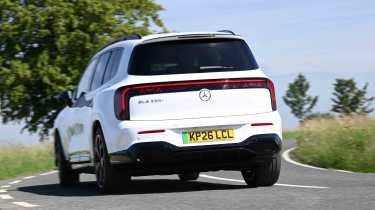
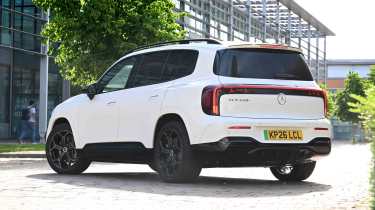
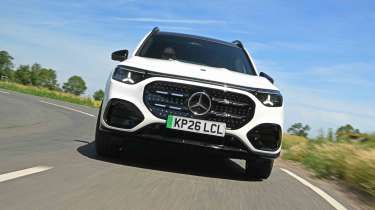
On the outside, the GLB has evolved into a larger and boxier shape than the first generation, and to our eyes has some similarities with the Smart #5. The squared-off rear is designed to create more usable space in the back of the car, and the cabin has been optimised to deliver a mix of tech, premium quality and convenience.
Entry-level Sport comes well-equipped with 18-inch alloys, front and rear parking sensors with a reversing camera, an electric tailgate, panoramic glass roof, a 14-inch infotainment screen with in-built sat-nav and full smartphone connectivity, heated front seats and a 10.25-inch digital instrument cluster. Stepping up to Sport Executive means you get larger 19-inch alloys, keyless entry and start, wireless phone charging, and ambient interior lighting.
Our preferred trim is AMG Line Executive because it has sportier interior and exterior styling and more supportive sports seats.
AMG Line Premium adds the passenger superscreen, 20-inch wheels, electric front seat adjustment with memory settings, dual-zone climate control, and adaptive suspension. Meanwhile, the fully-loaded AMG Line Premium Plus has adaptive Multibeam headlights, an upgraded Burmester sound system, a heated steering wheel, and a head-up display.
Interior and dashboard design
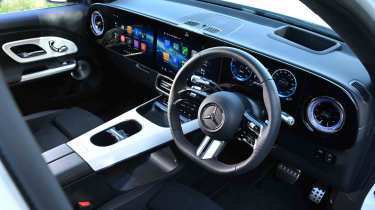
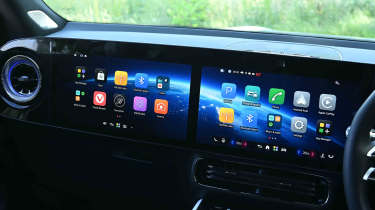
Digital displays play a major role in Mercedes’ current interior design trends, and the GLB doesn’t disappoint in that regard. All cars come with a high-resolution 14-inch screen that takes centre stage, while Premium and Premium Plus models add a second touchscreen of the same size for passengers.
There’s a 10.25-inch driver’s display, too, and the screens are all housed in an upright dashboard with shiny black plastic surrounds, while at either end there are stylised air vents with LED illumination. There’s additional lighting throughout the cabin, with different themes on offer that can be adjusted in terms of colour and brightness.
If there's one detail we would criticise, it's Mercedes' decision to follow Volkswagen and cheap out on offering four individual window switches. The combined switch with a button to select between the front and rear windows adds an extra step and complication where there need not be any, all for the sake of saving on two switches.
Materials and build quality
While there are some harder plastics lower down in the cabin, the quality of the fit and finish in the GLB is very good. Most cars come with Artico man-made leather, with the base model adding fabric upholstery, while real leather is available as an option. There are different trim finishers on the centre console and doors depending on which model you choose, with the matt white natural finish of AMG Line Premium Plus cars being a particular highlight.
Infotainment, sat-nav and stereo
Mercedes packs all its cars with cutting-edge tech, and its MBUX interface lets you use voice commands to control functions – including asking for your current efficiency reading in whatever units you prefer. However, as with some rival systems, it can automatically activate if it ‘hears’ the trigger phrase within a conversation you might be having with passengers, which can be irritating. You can deactivate voice control or set it to work only when you press the microphone button below the central air vents. This is positioned next to the hazard-warning switch, while a few other shortcuts also help navigate to the home screen, climate menu and drive settings. But while there’s a button to activate windscreen defrosting, the heated rear screen is only accessible via the main display.
The vast 14-inch touchscreen has high-resolution graphics and is backed up by Mercedes’ so-called Supercomputer MB.OS system. This incorporates plenty of cutting-edge tech, including the usual navigation, radio, and phone functions, as well as a built-in video camera for taking pictures and recording footage in the cabin.
Another feature of the operating system is the ability to add what Mercedes calls Digital Extras. Access the Shop via the screen, and you can set up subscriptions over 12, 24 or 36 months to add features such as 360-degree cameras, park assist, adaptive headlights, and a massage function for the seats.
AMG Line Premium and AMG Line Premium Plus come with a second ‘Superscreen’ ahead of the front-seat passenger. It has the same resolution and most of the same functions as the main screen, but also adds the ability to watch TV and play games. Built-in safety features mean the screen can’t be used if the front passenger seat is unoccupied, while the system can detect if the driver is being distracted by the secondary display and will stop working.
“The biggest external difference between the petrol and electric GLBs is up front, where the EV benefits from a star-studded illuminated grille, while the petrol hybrid features an LED strip around the perimeter of the grille.” - Dean Gibson, senior test editor
Boot space & practicality
Pros |
|
Cons |
|
One advantage that the Mercedes GLB has over many similarly sized and priced rivals is the inclusion of a seven-seat layout – neither BMW nor Audi offer a similar configuration. The car’s upright shape helps with overall space, too, but the added versatility doesn’t come at the expense of the car’s premium feel.
Dimensions and size
At 4.7 metres long and nearly 1.9 metres wide, the GLB is marginally larger than the outgoing car. It’s also edging closer in size to the original ML-Class SUV of the early noughties. As you can see from the figures, the GLB is larger than a BMW X1, but a Smart #5 is marginally bigger again, although this car doesn’t offer a seven-seat option.
| Dimensions comparison | |||
| Model | Mercedes GLB | BMW X1 | Smart #5 |
| Length | 4,728mm | 4,500mm | 4,695mm |
| Width | 1,860mm | 1,845mm | 1,920mm |
| Height | 1,689mm | 1,642mm | 1,705mm |
| Wheelbase | 2,889mm | 2,692mm | 2,900mm |
| Boot space | 540-1,715 litres | 500-1,545 litres | 630-1,530 litres |
Seats & passenger space
Sport models feature regular pull door handles, but the rest of the range gets pop-out handles. These are designed to boost aerodynamic efficiency, but are more likely to confuse passengers unless the car is unlocked.
Once inside, there’s plenty of space to get comfortable, and in the front the seats offer a wide range of electric adjustment (via Mercedes’ traditional door-mounted controls) while higher-spec Premium cars feature sports seats with a memory function.
The upright dashboard is set at a comfortable distance from the front seats, although we found that in some positions the steering wheel obscured the lower right portion of the screen, so we had to lean slightly to see that we were pressing the correct part of the display.
Storage is good, with decent door bins and a reasonable glovebox, too. The high-set centre console features an upper tray with a wireless phone charging pad, while a pair of illuminated USB sockets are located on the shelf below. There’s also a handy porthole in the front of the armrest bin, so you can trail a charging lead from the sockets into the bin without having it untidily poking through the armrest lids. The view out of the GLB is good, with clear visibility all round.
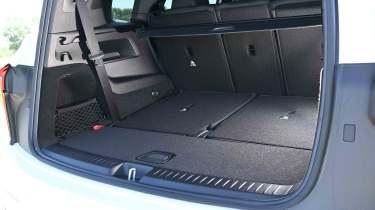
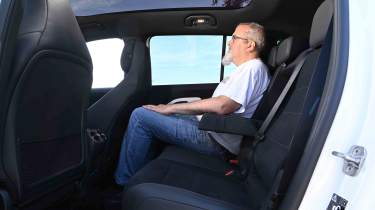
In the back, the GLB has a sliding bench so you can optimise passenger or boot space, and there’s a flat floor that offers clear foot room for all three back-seat passengers. Set the front seat as far back as possible and slide the rear bench all the way forward, and there’s no legroom at all, but you can move the seats around so that all three rows have some legroom to work with.
All versions of the GLB come with standard-fit panoramic glass. This helps to brighten an otherwise black interior and doesn’t compromise headroom in the back. The glass is fixed, and there’s no sun shade, but the tinted glass has a reflective coating that helps mitigate cabin heating. On the hot, sunny days when we drove the car, back-seat passengers didn’t complain about overheating.
There are no other mod cons (air vents, USB sockets) for third-row passengers, just a couple of small cup-holders. Access to the rearmost seats is a little tricky, because while the middle row slides forward, the backrests don’t fold very far to make room. This makes it awkward to climb aboard, and only the most nimble passengers will be able to get in easily. Once there, legroom is at a premium.
One highlight in the back is the inclusion of two Isofix child-seat mounts, although trying to manhandle a child seat into position might be tricky unless you fold the middle-row chairs completely flat first. There are a total of four child seat mounting points in the GLB, and all are straightforward to access behind easily removable plastic covers.
Boot space
There’s 540 litres of boot space in five-seat mode, which expands to 1,715 litres with all of the seats folded flat. As well as being able to slide the middle row back and forth, the three seat backs fold individually, offering more versatility.
If you’re using all seven seats or want the maximum boot space, you’ll need to remove the roll-top load cover. Thankfully, Mercedes has created space beneath the boot floor behind the rear wheelarches to store the cover when it’s not in use. Unlike the outgoing EQB, the electric GLB has storage under the bonnet, with a 127-litre capacity that’s more than enough for a couple of sets of charging cables.
Towing
Towing weights are useful, with a 1,500kg braked limit for the GLB 250+, while the GLB 350 can tow up to two tonnes of weight. That’s the same maximum for the GLB 220 hybrid, while the GLB 180 and GLB 200 can tow up to 1,600kg and 1,800kg respectively.
“The two rearmost seats lift out of the boot floor via pull cords, but you have to make sure the middle row is slid forward a little to ensure the rear headrests lift clear of the seat backs.” - Dean Gibson, senior test editor
Reliability & safety
Pros |
|
Cons |
|
The latest Mercedes GLB has yet to be tested by Euro NCAP, but with a full suite of safety features on board, it’s certain to be a good performer. The safety-assistance tech isn’t too intrusive, with subtle bongs from the speed-limit warning (you can deactivate it with a long press of the mute button on the steering wheel) and Mercedes’ familiar buzz through the rim when you slip out of lane.
The GLB is too new to have appeared in our 2026 Driver Power ownership survey, but Mercedes as a brand ranked first in our poll of 30 car manufacturers. Owners like the user-friendliness of the touchscreen systems, the quality of the interiors and the comfort that’s offered, while powertrains, steering, suspension and brakes all came in for much praise, too. High running costs are a downside, although owners appreciate that you’re paying more for a high-quality product.
Buying, prices and deals
Best buy: Mercedes GLB 250+ AMG Line Executive
Prices start at just over £42,000 for the petrol version of the GLB 180 in Sport trim, while the all-electric range kicks off at around £46,000 with the GLB 250+ Sport. The Sport Executive trim starts at £44,000 for petrol and £48,000 for electric, while the AMG Line Executive costs around £47,000 for petrol and £51,000 for electric. AMG Line Premium starts at around £50,000 for petrol or £54,000 as an electric. Meanwhile, the AMG Line Premium Plus costs £53,000 for petrol or £57,000 for the electric.
The GLB 350 4MATIC isn’t available in Sport trim, and instead starts in AMG Line Executive spec at just over £55,000. The highest-spec GLB 350 4MATIC AMG Line Premium Plus is nearly £61,000 before adding options.
We think the GLB 250+ has more than enough performance and range, while the AMG Line Executive model offers a sharper look than the Sport trim and a bit more kit, too.
If you want to save some money on your next new car, you can save by building your ideal Mercedes GLB via the Auto Express Buy a Car service. We also have a range of Mercedes GLB leasing deals.
Mercedes GLB alternatives
If you’re looking for a seven-seater, then there aren’t many direct rivals to the GLB – especially if you're going electric. Most other premium electric seven-seaters are far more expensive (Volvo EX90, for example), while Audi and BMW don’t build anything that’s similar. If five seats are fine, then the BMW iX1 and Audi Q4 e-tron are worth considering, but the closest rival to the GLB is the Smart #5. While Smart is a subsidiary of Mercedes, the #5 doesn’t share anything with the GLB, but it’s slightly larger and offers a premium interior with its own unique layout.
If you cast your net a little wider, the Hyundai Ioniq 9, Kia EV9, Peugeot E-5008, and the upcoming Skoda Peaq all offer seating for seven and all-electric propulsion. The Long Range version of the E-5008 has a longer WLTP driving range than the GLB Electric and is significantly cheaper. The 390-mile Peaq can't quite undercut the entry-level GLB EV, but it is a much bigger car. Both the Ioniq 9 and EV9 are noticeably bigger again and offer similarly quick rapid charging thanks to similarly state-of-the-art 800v charging architecture.
The petrol GLB also has few premium seven-seat SUV alternatives because, once again, Audi and BMW don't offer seven-seat models in this size or price range. If you're looking for something similarly-sized, then you'll have to consider more mainstream brands like the Peugeot 5008, Skoda Kodiaq, or Volkswagen Tayron.
Mercedes GLB pictures
Deals on the Mercedes GLB and alternatives
Frequently Asked Questions
Mercedes offers a standard three-year warranty, but it has no upper mileage limit, so this could be useful for high-mileage drivers. Extended warranty cover is available at extra cost for cars up to nine years old that have covered less than 120,000 miles.