Range Rover Sport Electric review
The Range Rover Sport takes on a whole new dimension in electric form, and is even more impressive

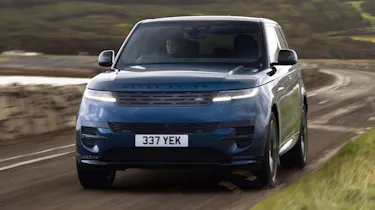

Our opinion on the Range Rover Sport Electric
There probably isn’t another car on sale that is as unstoppable off-road, yet as refined, poised and capable on it as the Range Rover Sport Electric. The EV is the best car in the range for the majority of buyers - at least until the tech and configurations developed for it are rolled out to the ICE versions.
About the Range Rover Sport Electric
The Range Rover Sport is more than a coupe-SUV version of the Range Rover, and the plan is for it to assume an even stronger identity of its own in the years ahead. The Range Rover Sport Electric is the first step on that road, basically a new EV powertrain for the SUV launched in 2022.
This new electric tech is accompanied by a host of other modifications designed to sharpen the driving experience, and they are expected to be rolled out to the Sport’s petrol, diesel and plug-in hybrid variants in the near future.
This is not an SUV on bespoke electric-car underpinnings; Land Rover has engineered its platform to accommodate the full range of power sources and claims compromises are minimal compared to purpose-designed and built electric cars. The flexibility this approach brings is hugely valuable to the company, however, cutting costs and allowing it to more easily adapt production to demand.
Used - available now

2022 Land Rover
Range Rover Sport
70,485 milesAutomaticPetrol2.0L
Cash £26,649
2027 Land Rover
Range Rover Sport
24,526 milesAutomaticPetrol3.0L
Cash £68,150
2027 Land Rover
Range Rover Sport
12,293 milesAutomaticPetrol3.0L
Cash £69,320
2027 Land Rover
Range Rover Sport
20,851 milesAutomaticPetrol3.0L
Cash £65,349The Range Rover Sport Electric holds the joint title of being Range Rover’s first EV, its launch synchronised with that of the full-size Range Rover Electric. The two cars share the same twin-motor EV powertrain but the Sport costs £44,000 less, at just under £110,000 in Dynamic SE trim, or £31,000 less if you compare the Autobiography trim level that’s the entry point for the Range Rover Electric.
Performance & driving experience
Pros |
|
Cons |
|
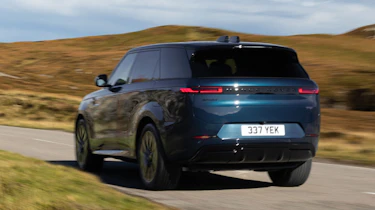
Range Rover is intent on putting more distance between the Range Rover Sport and the full-blown Range Rover in terms of the way they drive. The Range Rover Sport Electric is the embodiment of this, gaining revised suspension and quicker steering to deliver a noticeably more dynamic experience than you get in the comfort-focused Range Rover Electric.
The addition of Range Rover’s self-designed and built electric powertrain under the floor actually increases the rigidity of the chassis and has allowed the engineers to tune the standard air suspension for a feeling of greater athleticism. The dampers, upgraded brakes and faster steering ratio give sharper responses and an enhanced impression of control in the EV version, even compared to the other models in the Sport range. Yet, it will still wade through 900mm-deep water and rumble over terrain that precious few owners would consider risking their lovely 21 or 22-inch wheels on.
The Range Rover Sport Electric launched in EV550 form with 542bhp, but it’s likely that the lesser EV450 version with 444bhp will soon follow it to the UK market. In the flagship version, each motor can produce up to 349bhp in isolation but the combined total is never actually delivered. The electronics shuffle the power around the wheels for optimum traction on any given surface but no more than 542bhp is ever available simultaneously.
Performance, 0-60mph acceleration and top speed
Range Rover has developed its twin-motor EV powertrain to excel on- and off-road.
Instant torque is a characteristic of EVs generally, but the Range Rover Sport Electric EV550 offers up its massive 850Nm with even more immediacy to make short work of daunting obstacles. On the road, the power delivery can be sudden if you want but the calibration of the throttle pedal means the torque and 542bhp power output are easy to use in a controlled manner.
Make no mistake, the electric Range Rover Sport is fast. The spring from standstill to 62mph takes 4.5 seconds, and the surge of acceleration available from low speeds would be even more intoxicating than in the models equipped with the 4.4-litre BMW V8 were it not for the lack of a stirring soundtrack. The Range Rover Sport Electric does have a range of ‘sound design’ options to generate some artificial powertrain noise, but even the strongest setting is far from intrusive. You suspect that most owners will try the booming howl from the speakers once, and then turn it off.
Town driving, visibility and parking
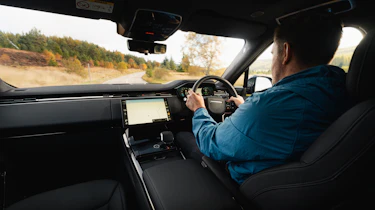
The Range Rover Sport’s thick pillars and slimmer glass area make visibility to the rear and sides a little tricky at times when manoeuvring or parking. It’s more like the view out of so many other luxury SUVs than the full-blown Range Rover with its ‘command driving position’. What you do get is four-wheel steering that tightens the turning circle by a metre and a half to 10.95 metres kerb-to-kerb. It makes the chunky SUV feel surprisingly nimble at low speeds while improving stability when going faster.
One-pedal-driving mode brings the car to an impressively gentle stop, but the strength of the braking effect is less than in a lot of cars so it does need a bit of space to slow right down. It can be easily activated with the driving mode selector, and you find yourself flicking it on when you come into town or hit a traffic jam.
Country road driving and handling
The laws of physics present huge challenges to SUVs trying to deliver a sporty drive on twisty, badly surfaced British B-roads, and a hefty 118.5kWh battery doesn’t help matters. Yet the Range Rover Sport Electric makes a remarkable fist of it and is right up with the best-handling electric large SUVs on sale despite its 2,770kg kerb weight.
The often floaty ride of the regular Range Rover is banished in favour of a far more planted and confidence-inspiring feel. The air-suspension resists bounce over humps and bumps, soaking up the initial hit and then settling quickly, ready for the next one. In corners, the weight transfer is controlled and gradual, helped no doubt by that floor-mounted battery lowering the centre of gravity.
In Dynamic mode, if anything, things get a little too firm and focused for normal driving. The Sport Electric is great being driven swiftly around corners in its Comfort setting, whereas Dynamic transmits a lot more back from the surface that less keen drivers would be quite happy not knowing about. The steering is delicate and responsive in any mode, with only tiny inputs needed to keep the car on the desired course and a pleasant weighting when you wind on more lock.
Motorway driving and long-distance comfort
Range Rover Sports tend to be fantastic motorway cars, and swapping the combustion engine for an electric drivetrain only enhances the serenity of the experience. It’s beautifully quiet and, while beaten for outright ride comfort by the floaty Range Rover, the Sport is still a top-class option to sit out a long journey in.
| Model | Power | 0-62mph | Top speed |
| Range Rover Sport Electric EV550 | 542bhp | 4.5s | 124mph |
Range, charging & running costs
Pros |
|
Cons |
|
We don’t have predicted residual values for the Range Rover Sport Electric, but Range Rover has an excellent record for building and marketing cars that hang on to their value, with a knock-on positive effect on running costs. The EV version is also going to be the cheapest in the range to fuel, assuming you can charge at home or use anything but the most exorbitantly priced public chargers. On the downside, insurance is in group 50.
Electric range, battery life and charge time
The Range Rover Sport Electric’s official combined cycle efficiency is measured at 2.8 miles per KWh. This is nothing to write home about but it’s competitive against the Porsche Cayenne Electric – and our test drives suggest you can get close to matching it in the real world.
The official electric range is 374 miles and, again, our testing on a mix of UK roads suggests real-world returns of around 330 miles are perfectly possible. You’d struggle to go any farther without refuelling the V8 model.
At a time when the best mid-size premium SUVs are peppering the 500-mile mark with their official electric ranges, there is still a question over whether this is enough in a model with a £110k price tag, albeit one that’s significantly larger and heavier.
On the charging front, the 118.5kWh of usable battery capacity can be charged at up to 350kW, so you could recharge from 10 to 80 per cent in as little as 22 minutes. On a 7kW home charger, a complete zero to 100 per cent charge will take 19 hours.
| Model | Battery size | Range | Insurance group |
| Range Rover Sport Electric EV550 | 118.5kWh | 374 miles | 50 |
Interior, design & technology
Pros |
|
Cons |
|
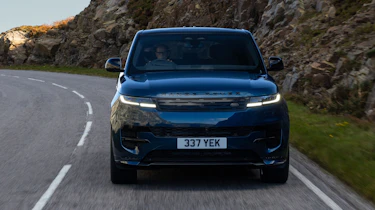
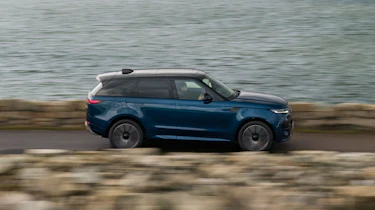
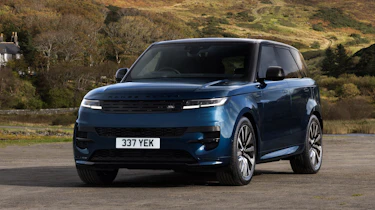
Identifying a Range Rover Sport Electric isn’t easy. The missing exhausts are the obvious clue but from the front you need to notice the subtly blanked-off grille or the ‘EV’ badges on the centre caps of the specially designed aero wheels. Of course, if the owner has specified their car with one of the other wheel options, that avenue is closed off.
EV or not, the Range Rover Sport is a handsome beast, although it doesn’t reach the design icon status its big brother enjoys. It blends more easily in with the throng of other luxury SUVs on the road but is still unmistakably a Range Rover.
Interior and dashboard design
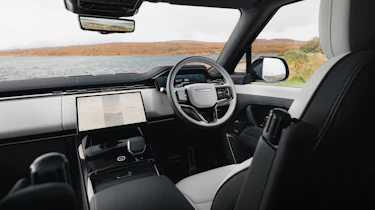
The interior that first saw the light of day in 2022 when the car launched still stands up to scrutiny today, and it’s carried over wholesale to the electric model. The high, wide centre console slopes down to the rear, mimicking the line of the roof outside and making front-seat occupants feel more enclosed than in the Range Rover.
Materials and build quality
The quality of the materials is well up to scratch and there are loads of options for personalisation, although they do get expensive. The leather is soft while the metallic and plastic finishes are all very high quality. There are a few harder plastics on show but none are obviously low-rent.
Infotainment, sat-nav and stereo
The 13.1-inch central display is angled to match the centre console and definitely on the small side compared to the giant touchscreens found in so many premium SUVs launched more recently. Lots of buyers will prefer the Range Rover Sport’s approach, though. With a separate and equally compact digital instrument display ahead of the driver, it’s far less overwhelming.
Buttons are kept to a minimum, with basics such as the climate control and the Terrain Response driving modes all inside the screen menus. There are steering-wheel mounted buttons for essential driving functions, including one that lets you activate or disable the driver assist warnings. Rear-seat occupants still get rotary dials for their climate controls.
As for Range Rover’s in-house Pivi Pro infotainment software, it’s not the slickest system on the market, with its unusual vertical column layout and complex menus for the myriad controls available in this complex vehicle. You do get Android Auto and Apple CarPlay, and these are well integrated, filling the screen. All Sport Electric models get a Meridian stereo that sounds great.
Boot space & practicality
Pros |
|
Cons |
|
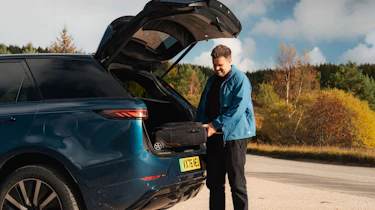
In terms of practicality, very little is lost in the Range Rover Sport’s transformation to EV. There’s a marginal decline in boot space compared to the petrol models, but passenger space is unaffected. Otherwise, this big SUV is only slightly shorter than the Range Rover, despite what its Sport billing might lead you to expect, and it’s impressively practical overall.
Dimensions and size
At 4,946mm long, the Range Rover Sport is around 100mm shorter than the Range Rover. It’s the same width but 48mm lower. Despite not being quite as tall as its big brother, it’s still a lofty car in the luxury SUV class, even before the air suspension is jacked up into its higher off-road settings.
Dimensions comparison | |||
| Model | Range Rover Sport Electric | Porsche Cayenne Electric | BMW iX |
| Length | 4,946mm | 4,985mm | 4,965mm |
| Width | 2,047mm | 1,980mm | 1,970mm |
| Height | 1,819mm | 1,674mm | 1,695mm |
| Wheelbase | 2,997mm | 3,023mm | 3,000mm |
| Boot space | 627 litres | 781 litres | 500 litres |
Seats & passenger space
Front occupants are cocooned by the higher centre console, but there will be few complaints about the spaciousness of the seats. The driving position is more laid back than in the Range Rover but, while there’s plenty of scope to position the seats as required, reach adjustment on the steering wheel is quite limited for those who like to sit farther back and stretch their legs.
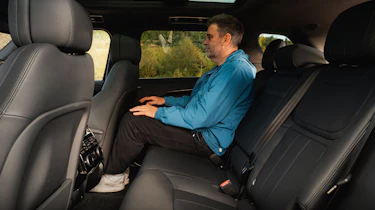
Space in the back of the Range Rover Sport Electric is a little disappointing considering the car’s prodigious size, but a six-foot-tall passenger can still get comfortable behind a driver of the same dimensions. There’s space under the seat to put your feet, but your knees are quite close to the seat back.
Boot space
The boot holds 627 litres with the rear seats in use. It’s 20 litres less than you get in a petrol Range Rover Sport, and when you fold the seats – which can be done using switches inside the load area – you’ve got 1,471 litres to play with. However, Porsche’s Cayenne Electric has more space in the rear. You might find the loading lip a little high for heavy items but the floor is flat for sliding them inside, and the space as a whole is usefully square.
Towing
The Range Rover Sport Electric can tow 2,500kg, which is good for an EV but down on the prodigious 3,500kg of braked trailer that the diesel and petrol versions can pull.
Reliability & safety
Pros |
|
Cons |
|
It’s likely that the Range Rover Sport Electric will gain the five-star Euro NCAP safety rating that the non-EV cars were awarded in 2022, but the tests have grown more demanding since. All models get the excellent 3D surround-view camera system with its specialist settings for off-roading, plus blind-spot assist, lane-keeping assist, rear-traffic monitoring, four-wheel steering and adaptive cruise control. There’s also a 12-month subscription to the Secure Tracker Pro anti-theft system.
Range Rover is well aware of the questionable reputation for reliability it has had in the past but it’s making strides in putting that right, and scores in our Driver Power customer satisfaction survey have improved recently. In the 2026 survey, the Land Rover brand placed 10th out of 31 manufacturers, and it was actually fifth overall in 2025.
| Euro NCAP safety ratings | |
| Euro NCAP safety rating | Five stars (2022) |
| Adult occupant protection | 85% |
| Child occupant protection | 85% |
| Vulnerable road user protection | 69% |
| Safety assist | 82% |
Buying, prices and deals
- Best buy: Range Rover Sport Electric Dynamic SE
The Range Rover Sport Electric kicks off in Dynamic SE trim for a shade under £110,000. The Autobiography model costs around £122,000 and the fully loaded First Edition is £126,000. Then you have the sporty SV Ultimate with styling enhancements.
Given that all models get air suspension, rear-wheel steering and the same EV550 electric powertrain – until the lesser EV450 arrives – the Dynamic SE model that serves as the entry point in the EV range makes the most sense. You miss out on some of the desirable features such as the heated, ventilated and massaging seats, but the important stuff is included, performance is the same and it helps to keep the price under control. If you want a more luxurious spec, the First Edition looks like good value.
Range Rover Sport Electric alternatives
The Range Rover Sport competes for buyers’ interest in the heartland of the luxury SUV market with its sportier take on the Range Rover formula. In Electric form, it’s an alternative to the Porsche Cayenne Electric, Lotus Eletre, Audi Q8 e-tron and the new BMW iX5.
Range Rover Sport Electric pictures
More reviews
Car group tests
In-depth reviews
Long-term tests
Which Is Best