New Range Rover Sport Electric prototype review: a new sense of serenity
We get an early taste of the new Range Rover Sport Electric, but it's too early to tell if it's the complete package

Verdict
An electric powertrain fundamentally suits the nature of the Range Rover Sport, giving it a new sense of serenity, speed and composure. We loved our first taste, but wonder whether there’s enough capability in the car’s projected range to be as versatile as its owners expect. Until we know for certain how far it’ll go and how quickly it’ll charge, the Range Rover Sport Electric remains an unknown quantity.
‘This is not an electric Range Rover, it’s a Range Rover that happens to be electric.’ We’re emphatically told this during a short presentation by MD Martin Limpert ahead of our first drive of the new Range Rover Sport Electric.
While we’ve known for some time this project was on the cards, after a lengthy delay this is our first chance to get a taste of it, as well as officially confirm for the first time that the Range Rover Sport Electric will be launched alongside.
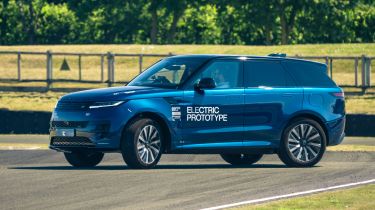
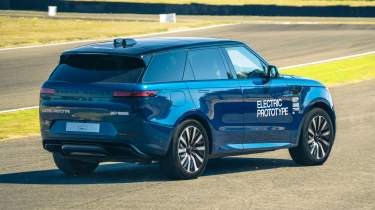
There’s no camouflage on the pre-production test cars we’re driving, and this is by design because the new Range Rover Sport Electric looks almost identical to existing ICE-powered models. The only changes are a new design of 22-inch wheel, a marginally more closed-in upper grille and some tweaks to the lower rear bumper; there’s little sense this is anything new.
Used - available now

2023 Land Rover
Range Rover Sport
22,753 milesAutomaticPetrol3.0L
Cash £54,650
2022 Land Rover
Range Rover Sport
40,000 milesAutomaticDiesel3.0L
Cash £39,980
2023 Land Rover
Range Rover Sport
70,173 milesAutomaticPetrol3.0L
Cash £45,037
2020 Land Rover
Range Rover Sport
47,317 milesAutomaticDiesel3.0L
Cash £23,531But this familiarity isn’t to undermine the work that engineers have put into the development of this new model, because under the skin there are some big changes that have gone into ensuring these all-electric variants live up to the standard of those with a combustion engine under the bonnet.
Fundamentally, this isn’t a half-baked conversion to electric, because the MLA architecture that forms the basis of the Range Rover and Range Rover Sport models was designed from the outset to accept a battery-electric powertrain. In the space where the propshaft, fuel tank and batteries sit in normal Range Rovers (the last element of that related specifically to the PHEV) is now a big bank of lithium ion batteries that are assembled in Wolverhampton.
The tall stature of the Range Rover Sport’s overall body has allowed these batteries to be stacked in two layers totalling around 118kWh. This is a generous capacity for the class of 2026, but next year’s new BMW iX5 is capable of packing 140kWh in a similar footprint – a model that will be sure to raise the stakes, just as its smaller iX3 sibling did 18 months before in the class below.
In the space left by the combustion engine up front and the rear differential out back, Land Rover has fitted its own electric motors which together are capable of producing up to 542bhp combined. Inside the transmission tunnel you’ll find more of the batteries’ subsidiary hardware, and there’s charging points on both sides, but there are no further changes to the general layout, much to the credit of the MLA package’s flexibility.
In fact, while both e-motors are the same, they are mounted in different orientations. The front motor is mounted upright to allow for more interior space in a position similar to that of the existing inline six-cylinder engine, with the rearmost unit placed on its side so it doesn’t intrude into the boot floor. No additional space has been carved out of the chassis though, because there’s no under-bonnet storage or any more storage under the boot floor – there is still enough room under there for the charge cables though.
The e-motors are identical, so there’s a true 50/50 split in terms of power delivery, but being electric there’s no need for bulky transfer cases or locking differentials to achieve the same goals off-road. There will be one caveat, though, in that there will no longer be a seven-seat option for the full-sized Range Rover long-wheelbase – so we expect the Volvo EX90 will retain its luxury electric family barge supremacy for now.
Performance and range figures are still to be confirmed, but even if Land Rover’s electric motors and batteries hit miraculous efficiency numbers, the Range Rover Sport Electric will struggle to match the new iX5’s 4.4-second 0-62mph time, let alone its incredible WLTP range of around 525 miles. Realistically, we’d expect a range figure around 200 miles less than the new BMW.
But in much the same way we make allowances for a diesel or PHEV Range Rover Sport on these metrics due to its real off-roading capability, the same is worth considering here. There’s been no compromise to any metric of off-roading so we’re told, and it’s one that we’ll get to test out today – albiet in a very controlled environment.
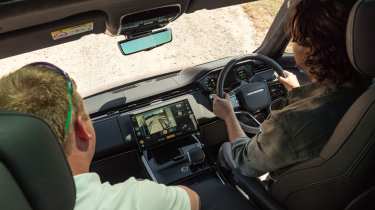
From the moment you enter the cabin, there’s no sense whatsoever that you’re in anything new. Pull away and the car will effortlessly sail forwards, but the calibration of its throttle feels even more resolved than the already-impressive PHEV. We quickly make a turn off onto some fairly rough gravel roads and the serenity that’s unique to a Range Rover only feels more impressive.
The ride is exceptional, so too is overall powertrain refinement, and thanks to a responsive and consistent brake pedal it’s easier than modulating controls to make smooth progress at low speeds. All new Range Rover Sport Electric models feature one-pedal driving, with a high-regenerative braking mode taking the place of the ICE car’s ‘Sport’ gearbox mode. The braking action is incredibly smooth, and it will bring the car to a complete stop without any form of judder. While this is very impressive, though, the system isn’t quite as good as the one found in BMW’s latest iX3, but it’s not far off and this is still a prototype.
We then reach our first off-road test, a quick fiddle with the existing drive modes puts us into the rock-crawl setting. Here, rather than a low-range transfer case and locking differential, the RRS is capable of using its software to change the car’s throttle mapping, in effect mimicking the action of the traditional hardware, gently using its prodigious torque to climb what feels like a 45-degree slope while barely breaking a sweat. Coming back down the hill, regen is capable of absorbing a majority of the momentum, but we still need to hold the brakes so as not to repel too quickly.
It’s an impressive capability, even more so when you realise there’s no clunky, efficiency-sapping hardware that needs to snap into place in order to achieve it. It feels like electric motors, with their instant torque and fine control, were made for the job.
Further down our testing route we switch over to a more road-focused mode and experience the car’s on-road dynamics. It’s obvious this is a heavy car, but it feels even more composed and controlled than the plug-in hybrid version. Beyond the fact it has a lower centre of gravity, it’s also hinted that it doesn’t weigh much, if anything, more than the existing PHEV.
Just as was the case off-road, it’s clear that big progressive steps have been made in perfecting the Range Rover Sport’s control interfaces on-road. Even at high speeds brake feel is very good, with no noticeable transition between regenerative to friction braking. A Range Rover’s often hesitant transmission is also a thing of the past, and without needing to wait for a turbo to start spinning, acceleration is instant and the amount of power feels generous, without being obnoxiously rapid.
In fact, the electric powertrain feels so well suited to the Range Rover package that you begin to ask yourself if a combustion engine was ever really suitable. After all, if you were to consider the metrics of what makes a good luxury and/or off-roader, the inherent qualities of a BEV powertrain tick all the right boxes.
When the Range Rover Sport Electric and its bigger Range Rover Electric brother arrive, there will be questions about range, performance and charging speeds to consider, but even now an electric Range Rover feels about as natural as changing from a gas to an electric oven – in 10 years’ time we’ll no doubt be wondering why it took us so long to switch.
Did you know you can sell your car through Auto Express? We’ll help you get a great price and find a great deal on a new car, too.