Kia PV5 Passenger review
Van-derived Kia PV5 MPV offers lots of space in a great-value package that’s good to drive

Our opinion on the Kia PV5 Passenger
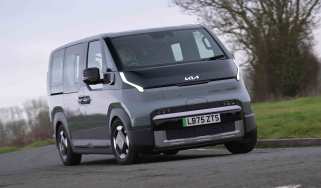
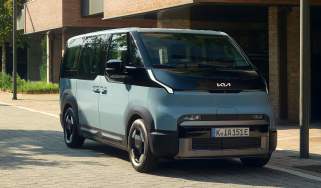
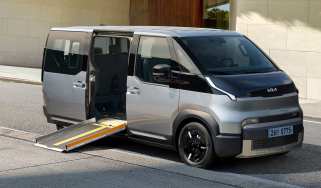
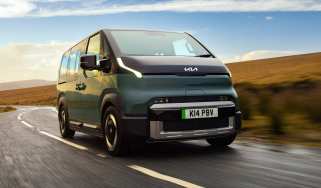
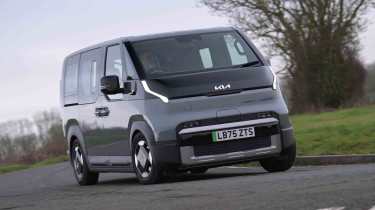
While the Kia PV5 Passenger has roots in the commercial vehicle sector, Kia’s clean-sheet design has also been turned into an impressive electric family car with futuristic looks, acres of space, and a driving experience that’s more car-like than any other van-derived MPV.
The PV5 is more affordably priced than the similarly sized Volkswagen ID. Buzz, while it offers more space than many family-focused SUVs. The boxy Kia is efficient, although a relatively small battery means its official range isn’t amazing. But if you can live with that, this is a very versatile and well-priced family car.
About the Kia PV5 Passenger
While Kia has plenty of SUVs to choose from, it has diversified its line-up with the arrival of the PV5 Passenger. It uses Kia’s E-GMP.S platform, which has a couple of intricacies that may be of benefit in the real world. The first is its Cell-to-Pack (CTP) technology, which, with increased battery density, should offer tangible efficiency gains. The second is its front-driven layout; with all the hardware mounted low and ahead of the driver, this MPV can do what MPVs do best – concentrate on functionality above all else.
Measuring 4,695mm long, the PV5 is 17mm shorter than the base ID. Buzz, and while a choice of five and seven-seat layouts will be available (the latter arriving by mid-2026), there’s no long-wheelbase version, as offered on the VW. In addition to being a little more compact, the Kia is also down on power, range and charging speed when compared with the VW, but is ahead of the larger Vauxhall Vivaro Life and the other Stellantis mid-sized van-based MPVs.
Used - available now

2021 Skoda
Octavia
51,925 milesManualPetrol1.0L
Cash £10,600
2024 Citroen
e-Berlingo
57,511 milesAutomaticElectric
Cash £11,270
2022 Kia
e-Niro
32,354 milesAutomaticElectric
Cash £17,240
2017 BMW
X3
85,847 milesAutomaticDiesel2.0L
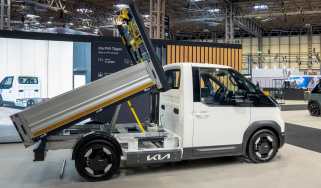
Cash £10,995Speaking of the Vivaro Life, we’ve tested the Kia PV5 against it in a twin test. We have also driven the PV5 in South Korea on the international launch, and in the UK as part of the national launch. We have also tested the Kia PV5 Cargo van, which you can read about in a separate review.
Kia PV5 prices and latest deals
The Kia PV5 is priced from around £33,000 in standard range, five-seater Essential form, rising to nearly £42,000 for the long range model in the top Elite trim with seven seats. That’s a lot more affordable than the VW ID. Buzz, and the five-seat PV5 Passenger also qualifies for the Government’s £1,500 Band 2 Electric Car Grant (ECG), helping to make it even better value. The seven-seater doesn't qualify for this grant at the moment, but the brand has stated that it "will announce any future ECG applicable to the Passenger 7-seat in due course."
If you're interested in purchasing a Kia PV5 Passenger, we can help. Configure your ideal Kia PV5 now to get top offers from local dealers, and check out the latest Kia PV5 leasing deals with our Find A Car service. You can even sell your existing car for a great price with Auto Express Sell My Car.
Performance & driving experience
| Pros |
|
| Cons |
|
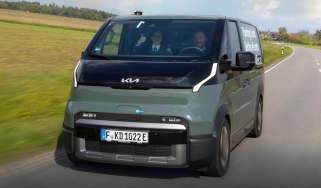
Given how strong the PV5 is for practicality, the way it drives is virtually inconsequential. However, it delivers a decent experience overall, with a responsive electric powertrain, a comfortable ride and useful manoeuvrability. It feels remarkably car-like for something that shares its platform and body with a panel van.
You could reasonably expect the 161bhp e-motor to struggle on the open road, yet the PV5 has enough low-down torque to keep pace with other traffic, even in its energy-efficient Eco mode.
The steering is light, and the suspension does a great job of soaking up lumps and bumps, whether we tried it on countless sections of rough or rutted highway west of Seoul in Korea or on the deeply potholed country lanes around Bedford back in the UK. We think refinement is excellent for something so bluff-fronted, too, with just a little wind noise around the door mirrors.
The brakes are also worth mentioning. While the pedal feels smooth and progressive, Kia’s intuitive multi-stage regenerative braking set-up is so good that you’ll soon find yourself barely using the pedal at all. The system is easily adjusted via paddles on the steering wheel and can switch from friction-free coasting to forceful one-pedal driving at the flick of a switch.
Electric motors, 0-60mph acceleration and top speed
Even though the Standard Range PV5 has only a 120bhp motor, it does a better job of getting up to speed than its 12.8-second 0-62mph time would suggest, and can even handle the odd cross-country dash without holding up traffic. It's a great option for those doing mostly urban journeys who don't need the extra battery capacity of the pricier Long Range model.
However, the Long Range is the one we’d choose. Its more powerful 160bhp motor is responsive, and its 0-62mph sprint time of 10.7 seconds is considerably faster than the 14.3 seconds it takes the equivalent 75kWh version of the Vauxhall Vivaro Life Electric. Acceleration for both cars is linear and consistent all the way up to the national limit.
The top speed of both versions of the PV5 is pegged at 84mph.
| Model | Power | 0-62mph | Top speed |
| Kia PV5 Standard Range | 120bhp | 12.8s | 84mph |
| Kia PV5 Long Range | 161bhp | 10.7s | 84mph |
Town driving, visibility and parking
A short front end, high driving position and large door mirrors help when driving in town and when parking, although with very little bonnet ahead of you, it takes a little while to adjust to where exactly the front of the PV5 is in relation to your seating position. Thankfully, there are front parking sensors fitted as standard, although we found that they didn’t necessarily activate when moving forwards into a parking space at low speed – a quick flick of the drive selector from park and into reverse woke them up, though.
While you sit tall in the PV5, the dashboard is set quite high, plus the thick A-pillars, especially on the driver’s side, create large blind spots that mean you have to crane your neck when approaching a roundabout or T junction. A flat rear end, large window and standard reversing camera and parking sensors make it fairly easy to back the PV5 into a space – a grid on the reversing camera display helps you leave extra room to open the huge tailgate.
Country road driving and handling
The PV5 handles neatly for a boxy MPV. All of the car’s weight is set low in the chassis, so body lean isn't as great as you might imagine for something so tall, and overall, the PV5 feels more like a car to drive than a commercial vehicle. The heavy battery also helps the suspension to smooth out the ride on bumpy roads. Bigger potholes thump through the car’s frame, but it’s far less of an issue here than in rival van-derived MPVs.
The Long Range model has quick responses that help you to keep pace with faster-moving traffic, although the light steering can feel a little wayward if you send full power to the front wheels on an uneven surface. The steering itself is light but accurate, which means you’re always confident in knowing where the front wheels are pointing.
Motorway driving and long-distance comfort
We found the PV5 to be decent on the motorway, despite its bluff shape. There’s very little road noise, plus the electric motor is well insulated and far quieter than the grumbly diesel typically found in a vehicle such as this.
You might hear a small amount of wind noise around the chunky door mirrors, but that can easily be drowned out by turning the radio volume up. Its car-like ride and handling mean it's no chore to drive the PV5 over long distances.
It’s not all plain sailing, though. The Kia’s flat sides mean crosswinds can have an impact (the electronic stability control can mitigate against this), while the relatively small 16-inch wheels combined with the quick steering rack mean it feels as if you need to apply constant small corrections to the wheel to keep the PV5 in its lane when travelling at the national limit.
“The PV5 is a car that looks bigger than it actually is. While it’s taller than a Vauxhall Vivaro, it’s narrower and shorter, and since you’re seated almost directly above the front wheels, it feels as if you have a super-tight turning circle to work with. At 10.8 metres, it is pretty small, matching the Kia K4 hatchback, among others.” – Dean Gibson, senior test editor
Range, charging & running costs
| Pros |
|
| Cons |
|
Electric range, battery life and charge time
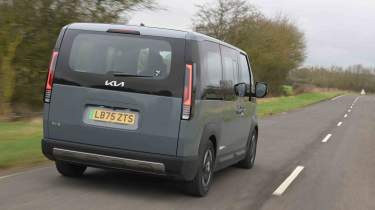
The Standard Range has 51.5kWh of usable capacity and can cover a WLTP-tested distance of 183 miles, but for not much more, you can upgrade to the Long Range version. This has 67kWh of usable capacity and has an official range that tops out at a much more usable 256 miles. Range figures for the seven-seater, which only uses the higher-capacity battery pack, are yet to be confirmed, but it is suggested that it should be over 240 miles to a charge.
On our first encounter with the PV5 in Korea, we averaged around 4.1 miles per kWh over 120 miles on a mix of roads that included plenty of motorway and stop-start urban work, and with temperatures around 22 degrees Celsius.
Back in the UK, in 10 degrees Celsius weather, the Standard Range returned 3.3mi/kWh, which equates to 170 miles on a full charge, while the larger battery delivered an economy of 2.7mi/kWh in the freezing cold of winter. This isn’t helped by the fact that a heat pump isn’t fitted to the entry-level Essential trim (it’s only offered on Plus trim and above), but it’s worth noting that the Vauxhall Vivaro Life managed an even poorer return of 2.0mi/kWh in the same conditions on a similar mix of roads.
While Kia adds 800-volt electrical architecture to its premium EVs, the PV5 makes do with the more affordable 400V set-up. That means a maximum charging speed of 150kW is on offer, which is slower than the 200kW available with the ID. Buzz, but better than the 100kW offered on the Vauxhall Vivaro Life.
The PV5’s charge port is located on the nose, so you might have to do a bit of planning around some connectors, but once plugged in, the battery can go from 10-80 per cent capacity in around half an hour.
Charge at home using a standard 7.4kW wallbox, and it’ll take around seven hours to fully recharge the Standard Range battery, while the Long Range model will take around 10 hours. And if you need to charge items from the PV5’s battery, the higher-spec Plus and Elite models come with vehicle-to-load capability and a three-pin plug socket between the front seats.
| Model | Battery size | Range | Insurance group |
| Kia PV5 Standard Range | 51.5kWh | 183 miles | 25 |
| Kia PV5 Long Range | 71.2kWh | 256 miles | 29 |
Insurance groups
Car insurance groups for the Kia PV5 are decent when compared with its rivals. The Kia starts in group 25, whereas the Vauxhall Vivaro Life is in Group 33 and the VW ID. Buzz starts in group 37. The PV5 Long Range Plus is in group 30, while the top-spec ID. Buzz GTX tops out in group 42.
Tax
The most expensive PV5 is priced at £38,295, so the whole range avoids the revised £50,000 expensive car supplement (or luxury car tax). That’s in contrast with the VW ID. Buzz that starts at over £60,000. Owners of the PV5 will only have to pay the standard rate of vehicle excise duty (VED), which is presently £200 per year.
Having zero tailpipe emissions means the PV5 has a very low Benefit-in-Kind (BiK) company car tax bill. It’s currently at three per cent, but it will rise to four per cent for the 2026/27 tax year, and five per cent for 2027/28.
One thing to keep in mind is that EVs might be subject to an eVED pay-per-mile fee if that comes into force from April 2028 onwards.
Depreciation
While depreciation, in percentage terms, is poorer than the equivalent ID. Buzz, the fact that the PV5 costs so much less at the point of purchase means you could save in the long run. Our data specialists suggest the PV5 will retain around 49 per cent of its value after three years and 36,000 miles, with the strongest RVs apparently for the mid-range PV5 Essential fitted with the bigger of the two batteries. The ID. Buzz is expected to retain around 52 to 54 per cent of its original value over the same period.
Interior, design & technology
| Pros |
|
| Cons |
|
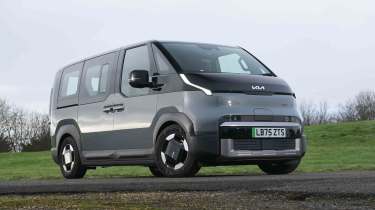
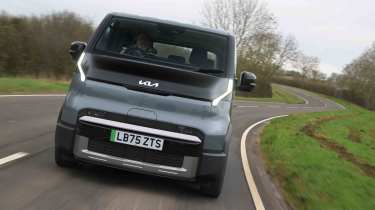
There are three trims to choose from on the PV5: Essential, Plus and Elite. There’s little to differentiate between the versions from the outside, because all models feature the same futuristic look, with clean lines and vertical daytime running lights up front - the biggest visual clue is that the Essential car has 16-inch wheels with plastic trims featuring a three-spoke design, while Plus and Elite trims have alloys with four spokes and square centre caps.
Entry-level Essential models are decently equipped, with a large central infotainment screen and a smaller driver’s display, and standard kit that includes a built-in reversing camera, wireless Apple CarPlay and Android Auto, as well as a six-speaker stereo, automatic climate control and LED headlights.
We think it’s worth upgrading to Plus trim because it adds:
- A powered tailgate
- Four heated seats
- A heated steering wheel
- Wireless phone charging
- Blind-spot monitoring
- Adaptive cruise control
- Heat Pump
The range-topping Elite trim adds electric sliding side doors, ventilated front seats, a 360-degree surround view monitor, a blind spot view monitor, and side parking sensors. It also comes with premium paint and two-tone upholstery.
Interior and dashboard design
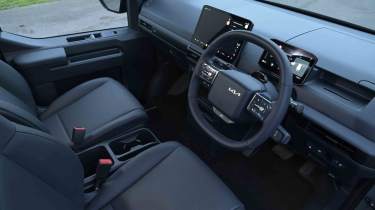
The PV5’s interior is best described as functional, but that doesn’t mean it’s totally devoid of design flair. The dash comprises a large 12.9-inch touchscreen and a 7.5-inch driver’s display – the latter nestled behind a quirky two-spoke steering wheel with familiar buttons, a drive-mode control in the centre and the drive selector on a stalk on the right of the steering column.
The front seats give a commanding view of the road, but only feature a fold-down armrest for the driver, so it can feel as if you’re sitting a little lopsided at times. The seats themselves are mounted closer into the centre of the car than you’ll find in most van-derived MPVs (The Kia PV5 Cargo van is a two-seater) so Kia has added a padded extension to the door card to give an elbow rest that’s closer than the window sill.
Materials and build quality
The PV5 doesn’t feel as if it’s built to a price, but it won’t be winning any awards for its luxury materials or high-end features. The areas you’re in constant contact with, such as the steering wheel and seats, are covered in plush materials that feel soft to the touch and add a bit of upmarket quality, while the blue tint to the plastics gives a different look to the usual relentless black plastic found in rivals.
Ultimately, the Kia PV5 is a people mover designed to withstand the abuse of family life, and it should be up to the task. However, we did find that the plastics lower down in the cabin were very prone to scuff marks from your feet, and started to look rather scruffy even after a few hundred miles of use.
Infotainment, sat-nav and stereo
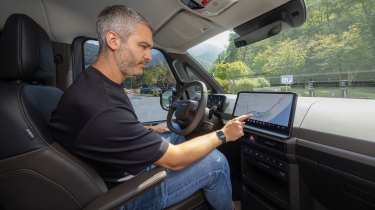
The infotainment system in the PV5 is completely different to the set-up found in its passenger cars. The rectangular screen is nice and large for ease of use, though, and features crisp graphics with easy-to-read fonts.
A lack of physical controls might be frustrating, but the menu system isn’t quite as complicated as the one found in the Kia Sportage, with the six last-used functions remaining as shortcuts across the bottom of the display. But the home button in the bottom right corner might be obscured by the steering wheel for some drivers.
A modest 7.5-inch readout puts vital information in front of the driver, and this is controlled via buttons on the left-hand steering wheel spoke. Wireless Apple CarPlay and Android Auto are included, although you’ll need to step up to the Plus trim for wireless phone charging.
There’s no physical volume knob on the PV5’s dashboard. The only button for that is the scroll wheel on the steering wheel, so if a passenger wants to adjust the volume, they must swipe down on the touchscreen and select one of three volume bars - the other two are for nav instructions and phone call volume.
“I found that when using Apple CarPlay, the system locks out all of the functions of the native touchscreen bar the climate controls, so you can’t sweep down and change the volume via the screen at all.” – Dean Gibson, senior test editor
Boot space & practicality
| Pros |
|
| Cons |
|
The PV5 Passenger is unashamedly based on the van with the same name, so it’s no surprise it gets full marks for practicality. It’s massive inside, whether you’re looking to carry people, luggage or both.
One small annoyance is that the front windows don’t lower completely, while the sliding doors only feature porthole windows that are fiddly to use and only come with mid-range Plus trim.
Dimensions and size
At just under 4.7 metres long, the PV5 isn’t as cumbersome as you might expect. It’s a similar size to the Volkswagen ID. Buzz, which means it’s larger than small van-derived people carriers such as the Citroen Berlingo and Ford Tourneo Connect, but smaller than medium-sized models such as the Vauxhall Vivaro Life. The PV5 is a very tall vehicle, but model year 2027 PV5s come with a flat antenna compared with earlier models to make it a little easier to fit this MPV in multi-storey car parks.
| Dimensions comparison | |||
| Model | Kia PV5 Passenger | Volkswagen ID. Buzz | Vauxhall Vivaro Life |
| Length | 4,695mm | 4,712-4,962mm | 4,980-5,331mm |
| Width | 1,895mm | 1,985mm | 1,920mm |
| Height | 1,923mm | 1,927mm | 1,890mm |
| Wheelbase | 2,995mm | 2,989-3,239mm | 3,275mm |
| Boot space | 1,320-2,300 litres | 1,121-2,205 litres (5 seater) | 1,624-2,700 litres |
Seats and passenger space
Those up front sit slightly higher than those in the back, and the seats are positioned higher than in most SUVs for a great view out. The side windows are lower than the base of the windscreen, so you can see the kerb more easily when parallel parking, although those thick A-pillars do limit your view slightly. Aside from that, you get plenty of seat and steering wheel adjustment, while Plus trim and above include electric front seat adjustment with adjustable lumbar support.
Storage up front is great, with a lidded cubby featuring a USB socket above the driver’s display, an open tray between the front seats, multiple bins in the doors and a large drawer at the base of the centre console. There are two more USB sockets just above the storage drawer, and a wireless charging tray on Plus and Elite trims.
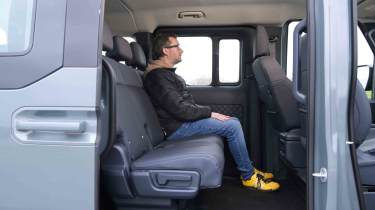
There is more leg and headroom in the back than a six-foot adult will know what to do with, although those with longer legs might like a bit more cushion to sit on. A flat floor means even those in the middle will be happy with the amount of foot room on offer. There’s a lack of storage in the back, though, with just a pair of air vents and USB sockets set into the backs of the front seats, but no cup holders. Kia has fitted a slot to the rear of the centre console that can be used to mount accessories. Ahead of this is a three-pin plug socket that can power accessories directly from the drive battery.
Unlike most van-derived MPVs that have three individual chairs in the back that slide and can be removed independently of each other, the PV5 has a fixed bench. The rear seat backs can be moved from upright to reclined in multiple stages to boost comfort for passengers, though. The seats fold in a 60:40 split in one motion, with the seat base dropping as the back tumbles forward. It’s worth noting that there are only two sets of Isofix child seat mounts in the PV5, because some rivals offer more options for baby carriers.
The updated PV5 can be ordered with seven seats, although the seat arrangement of the seven-seater is slightly different from the ID. Buzz. There are only two seating positions in the middle row, with a gap left on one side to aid access to the three positions in the third row and eliminate the need for an expensive seat-folding mechanism.
Boot space
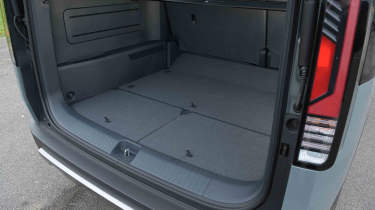
The vast tailgate offers clear access to the load area, although the electrically operated door fitted to Plus trim is rather slow to operate. The space inside is huge and square, while a low lip makes loading heavy items a cinch. Load volume for the five-seat PV5 is 1,320 litres to the parcel shelf, while the back seats fold to create 2,300 litres of space, albeit with a kerb-style step in the floor where the seats are located. Capacity numbers for the seven-seater haven't been revealed yet, but expect them to be reduced slightly due to the third-row seats taking up space.
The sides of the load area are uniform in shape with a couple of smaller storage compartments, while the floorboards lift to reveal hidden storage areas under the floor that are big enough to fit charging cables and a tyre repair kit.
Towing
The Kia PV5 is officially rated to tow up to 750kg for the Standard Range and 1,500kg for the Long Range model. That's better than rear-wheel-drive versions of the ID. Buzz, but a little less than the 1,800kg capacity of a four-wheel-drive ID. Buzz GTX manages.
“I appreciate that Kia has added pieces of fabric trim to the seatbelt buckles so they don’t rattle against the plastic interior when they’re not in use” – Dean Gibson, senior test editor
Reliability & safety
| Pros |
|
| Cons |
|
The Kia PV5 was awarded a four-star out of five rating by safety experts Euro NCAP. That’s on par with the likes of the Peugeot E-5008, but the Hyundai Ioniq 9, Kia EV9, and Volkswagen ID. Buzz managed to get the maximum five-star rating.
Every model gets forward-collision-avoidance assist, highway-driving assist, intelligent-speed-limit assist and smart cruise control with stop/go. You’ll need to step up to the Plus trim to add rear cross-traffic collision avoidance assist and safe-exit warning, while Elite has side parking sensors to let you know if you're getting close to the kerb, a 360-degree camera system, and the same blind spot view monitor as used on high-end versions of the Santa Fe, EV6 and EV9 models to display a live camera feed of what's alongside you when you indicate to change lanes.
Due to the PV5 being so new, we don’t yet have any data on the vehicle’s reliability, but it is backed up by the same seven-year, 100,000-mile warranty as the brand's regular passenger cars. However, the brand only finished 18th (out of 31 brands) in our 2025 Driver Power owner satisfaction survey.
Overall, the PV5 feels like it’s built to last and should stand the test of time, while its simple electric drivetrain, with fewer moving parts than a combustion engine, will help reduce running costs.
| Euro NCAP safety ratings | |
| Euro NCAP safety rating | Four stars out of five (2025) |
| Adult occupant protection | 84% |
| Child occupant protection | 85% |
| Vulnerable road user protection | 70% |
| Safety assist | 73% |
Buying and owning
Best buy: Kia PV5 Long Range Plus
Given the great value that the PV5 offers, we’d recommend stepping up to the best-equipped model you can afford. Given the Long Range version in flashier Plus trim is still very affordable compared with its rivals, we'd recommend spending a little bit more for it.
Kia PV5 Passenger alternatives
The Kia PV5’s main rivals include van-based MPVs such as the Peugeot Traveller, Citroen SpaceTourer, and Vauxhall Vivaro Life Electric, as well as the altogether more expensive Volkswagen ID. Buzz. Buyers could quite reasonably be cross-shopping with seven-seat SUVs such as the Peugeot E-5008, or even the Hyundai Ioniq 9, too.
Key updates of the Kia PV5 Passenger review
8 June 2026: Added pricing and some details of the seven-seat PV5.
13 March 2026: Added impressions from our Kia PV5 versus Vauxhall Vivaro Life twin-test.
20 January 2026: Review updated to include the £1,500 Band 1 Electric Car Grant discount for five-seat versions of the PV5, UK driving impressions, and the latest Euro NCAP crash test results.
Deals on the Kia PV5 and alternatives
Kia PV5 Passenger pictures
Frequently Asked Questions
You get the same seven-year/100,000-mile warranty on the PV5 as you do on the rest of the Kia line-up. Considering it’s a brand-new model from the ground up in a sector that is new to Kia, it’s impressive that the company is confident enough to keep the warranty as it is.