Peugeot E-5008 review
All-electric Peugeot E-5008 seven-seat SUV is a more compelling option than its E-3008 sibling and it's main rivals
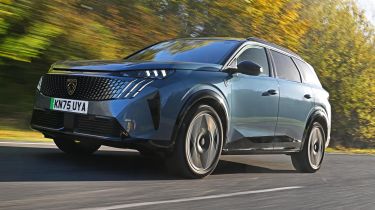

Our opinion on the Peugeot E-5008
While the all-electric Peugeot E-5008 shares many qualities with the smaller Peugeot E-3008, this seven-seat SUV is a better all-round proposition. Its longer body and more upright rear end deliver far greater space than its five-seat sibling. It’s not the most spacious in the rearmost row, but then the E-5008’s list price is a chunk lower than it is for most rival seven-seat electric SUVs, so if you only need seven seats occasionally, it might be worth checking out.
About the Peugeot E-5008
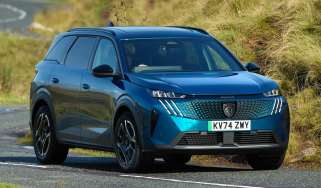
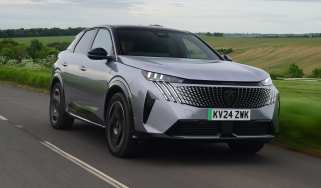
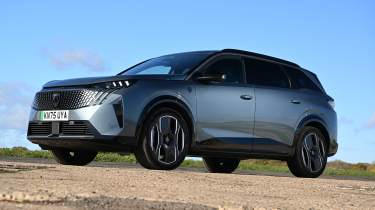
If style is high up your priorities for a seven-seat EV, it’s hard to ignore the Peugeot E-5008. It flaunts eye-catching design both inside and out, but that’s meaningless if there isn’t the ability to back things up.
Fortunately, there’s a lot to like here; by the standards of the class, it’s great to drive, reasonably efficient, and backed up with plenty of standard kit. We’d recommend the higher-capacity 97kWh battery model because the overall range is a little underwhelming in 73kWh models. Front-wheel drive is standard with either battery size, but there is a Dual Motor four-wheel-drive variant that uses the smaller-capacity 73kWh battery. The latter is only available in GT and GT Premium grades.
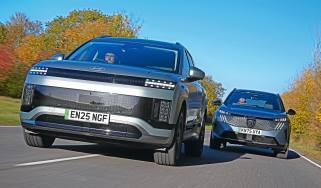
We've tested the Peugeot E-5008 against the Hyundai Ioniq 9 to find out which is the better electric seven-seat SUV. While the Ioniq 9 is the more practical car, we found that the E-5008 would still suit most families' needs and is much more affordable to buy. It also has a more premium feeling and stylish interior, and provides a great balance between decent handling and a comfortable ride.
Performance & driving experience
Pros |
|
Cons |
|
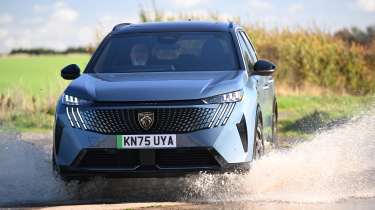
As with its petrol and hybrid siblings, the Peugeot E-5008 is lighter than much of its competition, so overall it’s better to drive than its closest rivals.
| Model | Power | 0-62mph | Top speed |
| E-5008 73kWh | 207bhp | 9.7 seconds | 105mph |
| E-5008 73kWh Dual Motor | 321bhp | 6.5 seconds | 112mph |
| E-5008 97kWh | 227bhp | 9.6 seconds | 106mph |
Electric motors, 0-60mph acceleration and top speed
Peugeot offers three powertrain options across its trim levels – a line-up that is shared with the smaller E-3008. Things start with a single-motor option that offers up 207bhp and 343Nm of torque, while those on the hunt for a little more urgency will want the much more lively dual-motor option. Here, there’s 321bhp on offer and an additional 166Nm of torque from the rear-mounted motor.
Used - available now

2026 Peugeot
5008
4,226 milesAutomaticElectric
Cash £39,990For those who value range more than performance, Peugeot also offers the E-5008 with a 97kWh battery. This is mated to a single motor making 227bhp, while the torque figure is identical to the 73kWh car’s, at 343Nm.
Power delivery from the 207bhp car is smooth and much more progressive than in some EVs. It doesn’t have the rapid acceleration some have come to expect of EVs, even if you have the Sport driving mode selected. In the dual-motor model, we found that when hard acceleration is needed, there’s a little lag between pressing the accelerator and getting full power. Other than that, the system is smooth and quiet.
Town driving, visibility and parking
The E-5008 is fairly easy to drive at low speeds, certainly by seven-seater standards. A tight 11.2-metre turning circle and light steering play their part here, enabling Peugeot’s largest car to feel barely any more stressful to thread around urban areas than the brand’s 308 hatchback.
While there’s a little fidget at low speeds, the E-5008’s ride is well judged over larger bumps; it’s soft enough to cushion the blow nicely, but not so soft that the car wallows around. The transition between regenerative and mechanical braking isn’t the most seamless we’ve tried, but it’s only when stopping more suddenly that this transition is noticeable.
Country road driving and handling
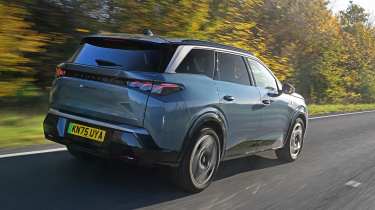
Even though it’s lighter than the likes of the Hyundai Ioniq 9 and Kia EV9, the E-5008 still weighs more than 2.3 tonnes. However, it’s rare that it feels overly hefty on the move; that light steering masks the overall mass for the most part. It’s not a fun car to drive, but it feels noticeably more agile than most other seven-seat EVs. Body control is better than the Ioniq 9’s, with the chassis less fazed by potholes and mid-corner bumps than in its Korean rival. Grip is reasonable enough, and the car has a neutral balance.
We can forgive the traction and stability control systems feeling a little heavy-handed; the power is noticeably restricted while any steering lock is applied, which, if we’re nitpicking, can sometimes hamper smooth progress on a twisty road.
Motorway driving and long-distance comfort
That composed ride quality works especially well at speed, where the E-5008 successfully blends control and comfort. Indeed, much of that low-speed fidget eases off as the speeds increase.
When we first tested the E-5008’s smaller rangemate, the E-3008, we were left disappointed by a very firm ride that felt out of place in a practical family SUV. However, the E-5008 is significantly more comfortable over both big compressions and smaller, higher-frequency bumps. It’s so much better, in fact, that we hope that Peugeot sees some sense and applies this chassis set-up to the smaller car. - Alex Ingram, special contributor
Range, charging & running costs
Pros |
|
Cons |
|
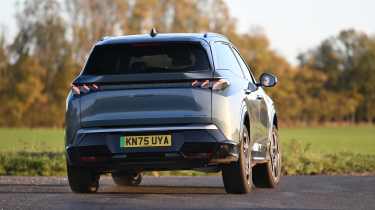
Efficiency figures take a hit at motorway speeds, but overall prices are keen compared with those of the electric seven-seat competition, and really help the Peugeot’s case.
Electric range, battery life and charge time
At 3.1 miles/kWh, efficiency in temperatures of around 15 degrees is okay, if not outstanding, for the Dual Motor model. The E-5008’s efficiency struggles at motorway speeds the most, where on test it would drop below three miles per kilowatt-hour. That’s still a better return than the likes of the Hyundai Ioniq 9 and Kia EV9, but those cars offer bigger batteries, too. With the 73kWh pack, that efficiency translates into a range of 226 miles, but with more motorway use, that can drop below 200 miles. That's why our pick is the 97kWh model; that extra 24kWh of capacity should enable closer to 300 miles of real-world range, and it costs £300 less than the Dual Motor model.
Officially, the E-5008 can charge at a rate of 160kW. The maximum speed we noted when charging the E-5008 at a 350kW charger, without any facility to implement battery conditioning to optimise speeds, was 111kW at 42 per cent charge. A typical 7.4kW home wallbox will fully replenish the 73kWh unit in just under 12 hours, and 15.5 hours in the 97kWh version.
Disappointingly, a heat pump is a £700 option on most versions of the E-5008 (standard only on the range-topping GT-Line Premium). This is a more energy-efficient way of heating the car’s interior in colder weather, helping to maintain your overall range and boost efficiency. It’s a worthwhile option for those who have to tackle a long commute, because you shouldn’t lose too much of your range in winter compared with warmer weather.
| Model | Battery size | Range | Insurance group |
| E-5008 73kWh | 73kWh | 309 miles | 33 |
| E-5008 73kWh Dual Motor | 73kWh | 293 miles | 42 |
| E-5008 97kWh | 97kWh | 413 miles | 35 |
Insurance groups
Single-motor versions of the E-5008 with the 73kWh battery sit in insurance groups 33 to 35, depending on trim level. The 97kWh battery models are in groups 35 and 36, while the quickest Dual Motor model sits in group 42.
Tax
Thanks to its fully electric powertrain, the E-5008 is the go-to choice of the 5008 line-up for company car users. Even higher-rate income tax payers will face annual deductions of around £700 in the 2025/26 financial year – vastly less than petrol or diesel SUVs of the same size or value. Benefit-in-Kind (BiK) rates are rising from three per cent to four per cent for the ‘26 to ’27 tax year, and five per cent from ‘27 to ‘28.
You will have to pay an annual vehicle excise duty (VED) fee because EVs are no longer exempt, and as long as you steer clear of too many options on higher-spec versions of the E-5008, you can avoid paying an additional surcharge for EVs that cost over £50,000 when new.
EVs could be subject to an eVED pay-per-mile fee if that comes into force from April 2028 onwards.
Depreciation
Depending on trim level, the E-5008 is predicted to maintain between 46 and 50 per cent of its original value after three years or 36,000 miles. Of course, those figures will stand up even better if you’re able to take advantage of the up-front discounts available through the Auto Express Buy a Car services.
For comparison, the Ioniq 9 is likely to retain between 49 and 51 per cent over the same period, while the Kia EV9 is predicted to maintain around 50 per cent of its original value. Both are a lot more to buy in the first place, though.
To get an accurate valuation on a specific model check out our free car valuation tool...
Interior, design & technology
Pros |
|
Cons |
|
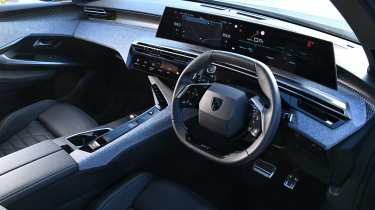
In terms of design and quality, the E-5008 is at the top of its class. Even if the touchscreen tech is merely okay and short on physical controls, few rival manufacturers can offer a sense of occasion like this.
Whichever version of the E-5008 you choose, equipment is in plentiful supply. The range kicks off with the Allure, which gets LED headlights, 18-inch alloy wheels, dual-zone climate control, wireless smartphone charging, and a reversing camera with rear parking sensors. Allure Premium is better specced with adaptive cruise control, blind spot monitoring, a 360-degree camera system, front parking sensors, high-beam assistance, electric driver's seat adjustment, and heated front seats and steering wheel.
Our recommended trim is GT, which has:
- 19-inch alloy wheels
- Adaptive LED headlights
- An electric tailgate
- Three-zone climate control
- Ambient interior lighting
- Uziris leather-effect seat trim
- Retractable sunblinds for the second-row passengers
For some odd reason, it missed out on some of the driver assistance technology fitted to Allure Premium, such as blind spot monitoring and a 360-degree camera system, but these can be added as part of the £600 360 Vision and Drive Assist pack.
The GT Premium adds the semi-autonomous Drive Assist Pack, a 360-degree parking camera system, a driver monitoring system, front seat massage, 20-inch alloys, Alcantara trim, and a heat pump.
Interior and dashboard design
Peugeot’s interior designs have been a cut above those of mainstream rivals for some years, and the E-5008 is no different. The swoopy surfaces and driver-centric dash look like nothing else in the class, with a heavily curved 21-inch HD display; a spine that connects the dashboard and centre console cocoons the driver, but the cabin still feels spacious.
Materials and build quality
Large expenses of fabric across the dashboard and doors – not to mention the soft Nappa leather upholstery on the seats if fitted – make the E-5008 feel as luxurious as it looks.
Infotainment, sat-nav and stereo
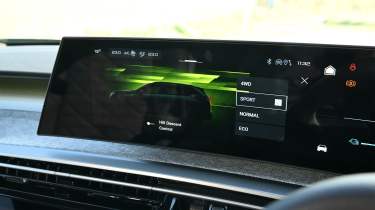
The E-5008’s gently curving panel neatly integrates both the digital driver’s display and the main touchscreen. That touchscreen is one of two; below the primary infotainment display is a secondary screen that houses menu shortcuts, which can be tailored to the driver’s taste. It works fine, but frustrations such as touchscreen-only climate controls and the fact that the heated seats and wheel operation are buried in sub-menus can soon become a pain. Wireless phone connectivity and charging are provided as standard.
"Peugeot is gradually building a reputation for interior poshness to rival the big German brands, and with the Mercedes EQB, Mercedes offers a direct alternative to the E-5008. And as long as you can ignore the lure of that three-pointed star, we think the Peugeot is the one to have." - Alex Ingram, special contributor
Boot space & practicality
Pros |
|
Cons |
|
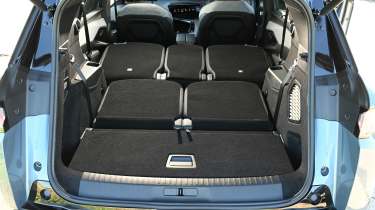
Regard the third row of seats as for temporary use or kids only, and the E-5008 can be a usefully practical seven-seat option. However, the full EV isn’t quite as spacious as the equivalent hybrid 5008.
Dimensions and size
Compared with the 3008, you can see where the 5008 has grown, with a longer wheelbase and overall length. Irrespective of the seven-seat layout, this helps to deliver greater practicality, although a Hyundai Ioniq 9 is roomier for passengers.
| Dimensions comparison | |||
| Model | Peugeot E-5008 | Kia EV9 | Hyundai Ioniq 9 |
| Length | 4,791mm | 5,010mm | 5,060mm |
| Width | 1,895mm | 1,980mm | 1,980mm |
| Height | 1,694mm | 1,755mm | 1,790mm |
| Wheelbase | 2,901mm | 3,100mm | 3,130mm |
| Boot space 7/5/2 seats | 348/916/2,232 litres | 333/828/2,318 litres | 338/908/2,419 litres |
Seats & passenger space
For some time, Peugeot’s range has been one which, more than other brands’ offerings, we’ve encouraged buyers to try for themselves before making a decision. That’s because of what Peugeot calls its i-Cockpit interior design. While the interior looks spectacular, the layout involves positioning the digital dials in a way that makes you look at them over the top of the steering wheel. To allow for this, the steering wheel itself is small, and its maker intends for the driver to position it quite low. Some testers struggled with this arrangement, with the wheel obscuring the dials.
We’ve run a hybrid version of the 5008 on our long-term test fleet, covering the best part of 10,000 miles in one. We’ve been impressed with its practicality and space, and while on the face of things, the fully electric versions look identical, there’s one key difference. In order to accommodate the large battery pack beneath the cabin, the floor level has been raised inside to avoid compromising the car’s ground clearance.
Sit in the middle row, and that is noticeable; the footwells aren’t quite as deep as they are in the internal-combustion models, which lifts occupants’ legs off the seat cushions. Although interior space is still generous – headroom is excellent – taller passengers will be a little short of under-thigh support.
Fortunately, even a third passenger is fairly well catered for in the middle row; while the seat is a little narrower and the backrest a little harder than the places to either side, the seat base itself isn’t raised as you’ll find on many traditional middle seats.
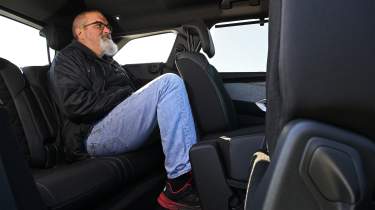
All three seats slide forward and backwards; this both allows the third row a little more space when six and seven occupants are on board and, combined with a backrest that drops flat, improves access into that third row. It’s still a bit of a squeeze getting there, though. Once inside, as long as those middle-row passengers are willing to give up just a little knee room, the third row is just about okay for shorter adults on quick trips. Children should feel like they have more than enough space.
Boot space
At 259 litres to the window line, the E-5008 has reasonable storage even when all seven seats are being used. The seats are easy to fold down but leave a slightly awkward step at their bases, although they do drop flat. In five-seat mode, the total capacity increases to 748 litres. In two-seat mode, that figure grows to 1,815 litres, well behind the 2,419 litres of the Ioniq 9, but that’s to be expected when the Peugeot is a physically smaller car.
Towing
The electric E-5008 has a maximum braked towing weight of 1,000kg, which is the same as the 5008 Hybrid when it has a factory-fitted towbar. The plug-in hybrid is slightly better, with a maximum weight of 1,300kg on offer.
Reliability & safety
Pros |
|
Cons |
|
A four-star rating in the 2025 Euro NCAP safety testing isn’t up to the five-star standards of many of the E-5008’s rivals, but it’s worth noting that this has nothing to do with the Peugeot’s ability to meet standards in the event of a collision. Instead, it’s down to its safety-assistance technology. Euro NCAP marked the E-5008 down in this category because its driver-monitoring system can’t detect whether a driver is distracted, while the second- and third-row seats do not come with occupant detection.
Owners were a little mixed about the latest 5008 in our latest 2026 Driver Power customer satisfaction survey, which covers both the electric E-5008 and petrol and hybrid 5008. In the survey, the 5008 managed to come in 35th place out of the best 50 cars to own list, with owners loving their car's practicality, boot space, rear seat leg room, child-friendly features, seating versatility, and ride comfort. However, they weren't so keen on the infotainment system and the balance of physical and touch-sensitive controls. Owners also told us it wasn't much fun behind the wheel, which is somewhat to be expected of a large SUV primarily designed for safe, predictable handling.
| Euro NCAP safety ratings | |
| Euro NCAP safety rating | Four stars (2025) |
| Adult occupant protection | 80 per cent |
| Child occupant protection | 85 per cent |
| Vulnerable road user protection | 79 per cent |
| Safety assist | 62 per cent |
Buying and owning
Best buy: Peugeot E-5008 97kWh GT
Thanks to some recent price cutting, the entry-level Allure trim Peugeot E-5008 with the smaller 73kWh battery starts at around £40,500. The longer-range 97kWh model starts at £43,500 (also in Allure trim).
We'd recommend GT trim because it has a premium feel that is worth paying extra for. It starts at around £44,000 with the 73kWh battery, but our preferred larger battery with a more useful driving range comes in at just under £47,000.
The range-topping GT Premium trim comes in at £46,500 for the smaller battery, rising to £49,500 for the dual-motor four-wheel drive model.
Check the Auto Express Buy A Car service, and you’ll find monthly payments from around £250, which is considerably cheaper than for many rival seven-seat SUVs.
Peugeot E-5008 alternatives
The Peugeot E-5008 will be ideal for anyone with a keen sense of style who needs a large SUV that can seat seven people or just offers a huge amount of space. It does this while being priced at a similar level to five-seat models such as the Skoda Enyaq, Ford Explorer and Hyundai Ioniq 5.
If you need seven seats, then the E-5008 is a great-value alternative to other electric models such as the Volkswagen ID. Buzz LWB, Mercedes EQB, Hyundai Ioniq 9 and Kia EV9.
If you’re not yet ready to make the switch to EV, then the mild-hybrid and plug-in hybrid versions of the 5008 are also available for less money. Or if you just want a very capable, practical family SUV, the Skoda Kodiaq is a top choice.
Key updates of the Peugeot E-5008 review
22 June 2026: Update to include the recently announced price reduction of the E-5008 range, and our most recent Driver Power customer satisfaction survey results.
13 March 2026: General update with the latest depreciation data, trim level information, and revised EV luxury car tax threshold.
Peugeot E-5008 pictures
Deals on the Peugeot E-5008 and alternatives
Frequently Asked Questions
As standard, the E-5008 comes with a three-year warranty, but this can be extended to up to eight years and 100,000 miles through the Peugeot Care programme. In order to be covered by this extended package, the car needs to be serviced on schedule at an approved dealer.
More reviews
Car group tests
In-depth reviews
Which Is Best