Stunning new Ferrari F80 arrives to resume hypercar head-to-head with McLaren
The new Ferrari F80 follows the Italian brand’s hypercar icons, and showcases a hi-tech future

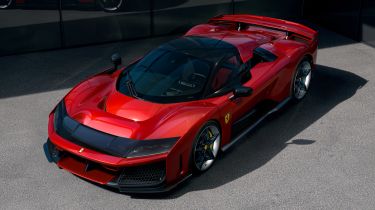
Ferrari has unveiled its next ‘once-in-a-decade’ hypercar; a looking glass into the future of the brand’s technical and design ambitions. Joining an illustrious group of iconic predecessors that includes the F40, F50, Enzo and LaFerrari, the next in line will be called the Ferrari F80 and it leads the brand into a complex new world of competition-derived hybrid powertrains and next-generation aerodynamics.
Priced from around £3.1m including local taxes, the Ferrari F80 will be limited to 799 units, all of which are already spoken for, with deliveries due to commence in the fourth quarter of 2025.

Not to be confused with Ferrari’s rare V12-powered Icona models, nor indeed any of its bespoke one-off creations, the all-new hypercar is a technical showcase for the next generation of series production models. As a result, its carbon fibre structure is brand new and completely bespoke, as is its mid-engined hybrid powertrain.
With regard to the powertrain, Ferrari claims a peak combined power figure of 1,183bhp derived from a 120-degree 3.0-litre V6 engine, aided by two turbos and no fewer than five electric motors.
Of that figure, 887bhp is derived from the V6 engine, which is inspired, if not entirely derived, from the units found in Ferrari’s F1 and 499P endurance racers. It will redline at 9,200rpm, and specific attention has been paid to the soundtrack, with the intake and exhaust manifold tailored to create an emotional ‘baby V12’ engine note.
Bolted to the top of the engine are two electrically-assisted turbos, which fit small electric motors between the turbine and compressor wheel. These improve response and allow Ferrari’s engineers to run extremely high boost pressures – a similar principle to what you’ll find on the latest Porsche 911 GTS or Mercedes-AMG C 63 S E Performance, only on this occasion there are two fitted to the one engine for the first time.
In addition to this, there’s another small electric motor that acts as a starter generator and has a small torque-fill at low revs. This is mounted to the underside of the engine and together with the V6 is connected to an eight-speed dual-clutch transmission mounted on the rear axle.
The final two 139bhp e-motors are mounted on the front axle, making the F80 all-wheel drive, and directly drive a front wheel each, allowing for active torque-vectoring. Energy for all the e-motors comes from a compact and extremely lightweight 2.28kWh battery pack mounted behind the seats, fed by both regeneration from the brakes and the engine. There is no ability to plug in. All of the electrical components are brand new and developed in-house, and represent big gains in efficiency, while reducing weight.
Enrico Galliera, Ferrari’s chief marketing and communications officer explained: “Any element that we think can provide a competitive advantage, we want to develop in-house. If we buy components from the market, we need to adapt it, but if we do it, we can make it exactly as we want it.” Despite all this new electrical hardware in comparison to the LaFerrari, it weighs around 40kg less, coming in at 1,525kg dry.
Performance figures are typically immense, with the F80 dispatching 0-62mph in 2.15 seconds, hitting 124mph in 5.75 seconds and topping out at a limited 217mph.
It’s impossible not to compare these figures with those of McLaren’s new W1, which itself has only just been revealed. The British car packs even more power, with 1,284bhp from a 4.0-litre V8 engine paired to its own complex hybrid system.
However, the W1 trails on acceleration, taking 2.7 seconds to hit 62mph, due largely to the fact it has just two driven wheels. The 124mph sprint is completed in 5.8 seconds, though, suggesting that the McLaren claws back time when up and running.
But the F80’s new powertrain is only part of the story, as the chassis and aero technology is equally transformative. Underpinning the whole car is a mixed material structure made up from a carbon fibre cell around the cockpit and upper part of the engine compartment, with aluminium subframes carrying most of the front and rear suspension.
The suspension itself is in a pushrod set-up on stunning 3D-printed suspension arms, and features a cutting-edge fully active roll control system from Multimatic. This works by using four more electric motors mounted on the suspension arms to cancel out lateral body movement, as well as control dive and pitch. This is especially useful for the F80, as its aero package is capable of producing a huge 1,050kg of downforce at 124mph, changing the load requirements at each corner depending on speed.
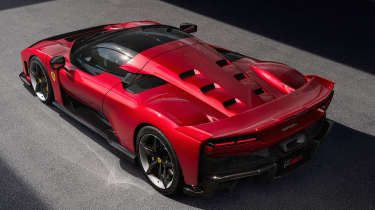
This is generated through a sophisticated combination of underfloor aero management and a huge active rear wing. As in a modern F1 car or endurance racer, the driver’s feet are elevated slightly, allowing for engineers to create a more aggressive aero duct at the front. This is helped further by a narrowed cockpit, made possible by slightly staggering the driver and passenger seats, bringing them further inboard.
The brakes are all-new, and feature a new CCM-R composite gripped by massive Brembo six-piston calipers on the front axle, while the 20-inch and 21-inch wheels are bespoke carbon-fibre units with five spokes – another first for Ferrari.
Of course, a game-changing Ferrari hypercar is nothing if it doesn’t look like a step forward and here chief designer Flavio Manzoni and his team have created a car that unapologetically references the sci-fi world for inspiration. The blocky design language is new for Ferrari, and features lots of elements that build a bridge between the past and future.
The nose, with its black facia and hidden headlights, was designed to give the F80 a new face, paired to a large aero opening at the centre and two outer intakes. The flat front wheelarches reference the F40’s rear wing section, while also helping separate the air from the side and top surfaces of the car. Manzoni’s team have also re-interpreted the aeronautical NACA duct that’s been found on various Ferrari sports and competition cars since the 1950s, which sits on either side of the cabin behind the two butterfly doors.
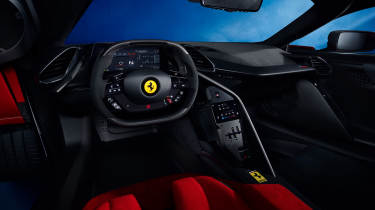
The cabin’s unique packaging is highlighted with an asymmetrical dash layout that separates the driver and passenger, and is accentuated by the coloured driver seat. There’s no main display, but instead a driver’s information display mounted directly to the steering column, with a passenger display mounted on to the passenger side dash. The steering wheel is also new, and features physical buttons, in contrast to the haptic buttons of current Ferrari models.
Like all of its once-in-a-decade hypercars, the F80 takes performance and technology onto a higher plane. All of the electrical components are lighter, more compact and more energy dense than before, and they will feed into the next generation of Ferrari models that you’ll see on the road in the coming years.
Click here for our list of the best hypercars...