Are car headlights too bright? How hi-tech LED lights prioritise the driver but risk dazzling everyone else
LED headlamps on cars may improve visibility at night, but some people say they’re too bright. We investigate the issue and what can be done

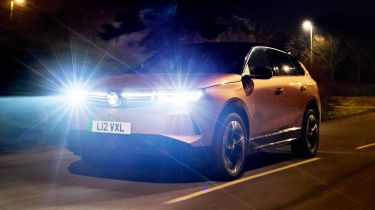
Trundling through the darkness on a country road in Oxfordshire, the light of our car’s adaptive LED headlights pick out a pothole lurking amid the undulations of the tarmac. Seeing this, we’re given enough time to swerve out of the way, saving ourselves a potential popped tyre or kerbed wheel.
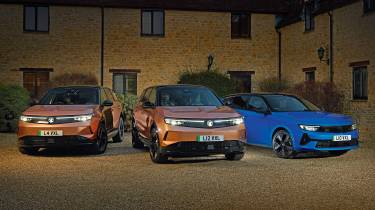
We’re taking part in a new Vauxhall study to probe the tangible benefits of LED headlights, specifically those with adaptive matrix tech. In view of the debate over the negative impact of LED car lamps, primarily the dazzling of other road users, the brand is keen to showcase how its Intelli-Lux HD headlights not only make driving at night safer, but also less stressful.
According to a survey conducted by Vauxhall itself, one in 10 motorists are afraid of driving in the dark, with the majority of respondents admitting they often struggle to see road signs or even pedestrians when driving at night.
The trial we’re taking part in is being headed up by Vauxhall and a member of the board of trustees at The Road Safety Trust, Dr Neale Kinnear. It aims to quantify how adaptive matrix technology can actively reduce driver stress and potentially even change habits.
Are LED headlights better for drivers?
Along with five members of the public who were known to experience anxiety when driving in the dark, we have been recruited to drive two cars back-to-back: a Vauxhall Astra with standard auto-dipping LED headlights and a Grandland with the Intelli-Lux HD lamps. A post-drive survey, plus telemetry and heart-rate readings, would determine how we responded differently to each type of headlight technology.
Aside from us, none of the other trial volunteers was informed of the study’s nature, to prevent the results being skewed. The order in which we drove the cars was also randomised to avoid the issue of primacy bias.
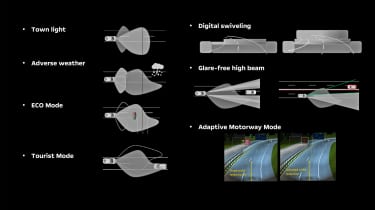
We quickly find that the Grandland’s more advanced headlights provide a much more comprehensive view of the road; the swivelling beams maintain vision through corners, while the LEDs dim slightly in order to improve the legibility of road signs by reducing reflections. But the researchers struggle to find any difference for us in terms of our heart rate or any changes in driver behaviour via the vehicle telemetry. This is put down to our breadth of night-driving experience. Yet while filling in the survey back at base, we note that we felt noticeably more relaxed behind the wheel of the Grandland, which required us to squint less to pick out hazards.
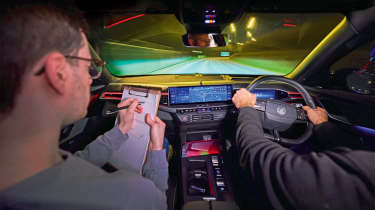
It’s not just us who feel this way; our fellow participants unanimously report that Vauxhall’s more advanced headlights provide greater visibility and require less mental effort. “The second car (with Intelli-Lux HD) helps you to see the road and signs,” says one driver. “It’s not as easy as driving in daylight, but not far off!” Even Dr Kinnear admits: “The results are more overwhelming than I originally anticipated.”
Overall, those participating in the trial said they were 43 per cent more likely to drive at night with matrix LEDs as opposed to a standard LED headlight system. “Taken together, the findings suggest that lighting technology can meaningfully change how night-time driving feels, and for people who find driving after dark uncomfortable or stressful, that has real potential to support confidence and everyday mobility,” concludes Kinnear.
The dazzling cost of LED headlights
But while the improvements in visibility for the driver are evident, it’s difficult not to wonder whether we’re placing too much emphasis on the benefits to the individual and neglecting the impact on other road users. Following a study into headlight glare commissioned by the Department for Transport, Dr Shaun Helman of the Transport Research Laboratory (TRL) points out: “Brighter lights do help drivers see further, but safety must balance visibility for one driver with comfort and safety for everyone else.”
If you’ve driven at night recently, you’ll be aware of how LED headlights are much brighter than their halogen counterparts – on average the difference in lumens can be between 150 and 300 per cent. While this certainly helps the person behind the wheel, it can have a negative impact on oncoming drivers.
Denise Voon from the College of Optometrists says: “The current UK lighting regulations, which are based on laboratory measurements of luminous intensity [the amount of light emitted by a source] rather than the luminance [the amount of light hitting a surface or structure] experienced by drivers, are no longer sufficient with modern headlight technology.”
It’s not just the brightness either; Voon says today’s drivers typically experience more glare because “the colour temperature of LED lights is much bluer and whiter and mimics natural daylight much more closely than the warmer yellow/orange of halogens.” But Vauxhall points out how cooler headlight hues typically offer greater contrast, thus providing the driver with a clearer picture of obstacles ahead.
Since LED daytime running lights became mandatory for all new cars in 2011, full-LED headlights have slowly become the industry standard on account of not only their inherent brightness, but also their energy efficiency. Yet there is a growing feeling that headlight dazzling is getting worse; earlier this year, an RAC survey of 1,745 drivers found 57 per cent feel the issue has deteriorated in the past 12 months alone.
“Dazzle from headlights is now a perennial problem for drivers and it’s clearer than ever that they want to see something done,” says the RAC’s senior policy officer, Rod Dennis. “For some it’s just a mild annoyance, but for others it’s tangibly affecting their lives.”
Some studies have drawn direct comparisons between road collisions and headlight glare, yet the overall data is inconclusive. DfT statistics suggest that headlight glare contributed to just 216 of the more than 66,000 collisions recorded in 2023. But the TRL’s findings show how the fear of being dazzled can deter some people from driving at night, and that while it can be difficult to squarely link bright headlights to crashes, greater visibility is preferable from a safety perspective.
There’s also the question of the reliability of adaptive tech, which doesn’t have a human driver’s intuition. Thus a car suddenly appearing from around a corner may be dazzled because the system doesn’t have the capacity to approach certain situations tentatively and scan for clues that another vehicle is approaching.
Are bright headlights a road safety issue?
During our 30-minute drive in the Grandland with its Intelli-Lux headlights, we were flashed by three oncoming drivers who were dazzled by the beam not shutting down correctly. This is despite the system boasting up to 50,000 individual elements that can be shut off to prevent dazzling cars coming in the other direction.
But Stellantis’s global head of lighting and vision, Philipp Röckl, says: “I can only speak from my own experience, but I’ve been driving the Grandland for one and a half years now and I have never got a flash from other drivers. There are some minor situations where the car appears very fast and there needs to be some connection between the camera and headlamps; this time is below 50 milliseconds. For sure we can’t say that this will never happen, but let me say that in 99 per cent of these cases we’re fast enough to react properly to oncoming traffic.”
Is there some disconnect between car makers and the reality on the ground then? The UK’s Society of Motor Manufacturers and Traders (SMMT) describes the issue of glare as “a very subjective issue that affects different people to greater or lesser extents”.
A spokesperson for the SMMT says: “Safety remains every vehicle maker’s highest priority, and ensuring drivers can see clearly at night without causing discomfort or risk to others, is central to that. All headlights must meet strict international regulations governing beam pattern and intensity, ensuring they provide good visibility while minimising glare.”
The TRL has called on the Government to consult on legislation changes that would alter headlight design in order to reduce glare, something Number 10 promised to investigate as part of its recent Road Safety Strategy.
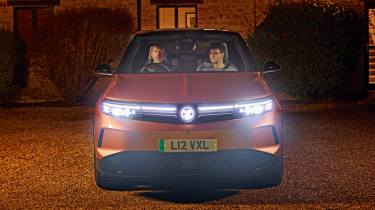
Features such as automatic headlight self-levelling – something the Grandland’s Intelli-Lux HD units have – are due to be mandatory in 2027 as per United Nations regulations. But further rules surrounding design such as restrictions on the volume of blue light emitted could result from the Government’s investigation.
Vauxhall is partnering with universities to take advantage of AI to fill in the shortcomings of current adaptive headlights, Röckl says. As for the UK’s existing cars, tougher regulations surrounding MoT tests to wheedle out poorly calibrated or illegally retrofitted LEDs will also help curb the problem. Nevertheless, the answer – as it is with most motoring-related issues – is far from straightforward. However, we know that ‘brighter’ doesn’t always mean ‘better’.
Did you know you can sell your car through Auto Express? We’ll help you get a great price and find a great deal on a new car, too.