BMW X5 (2018 - 2026) review
The BMW X5 remains an outstanding choice in the large SUV class, delivering superb performance, practicality and technology

Our opinion on the BMW X5
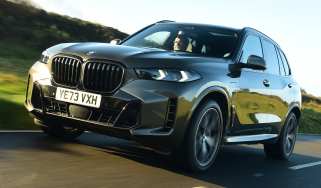
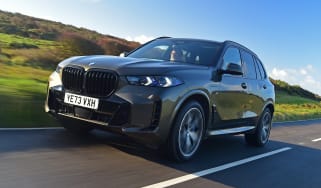
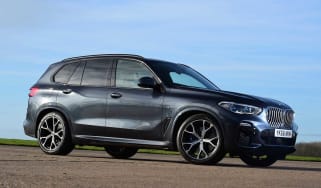
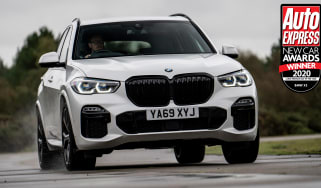
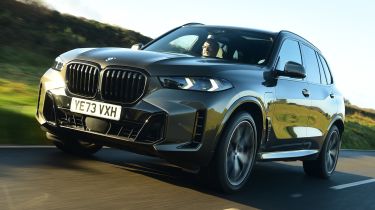
The latest edition of the BMW X5 builds on the success of its predecessors with improvements in practicality and design enhancements, as well as upgrades to the infotainment and safety tech. The exterior looks bullish and modern, while the inside is highly luxurious.
There are some solid engines to choose from, and each returns a commendable amount of performance without trampling over fuel efficiency. At the same time, the hybrid continues to be the most cost-effective option for company car drivers. The X5 is not the most exciting car in the large SUV market and it’s expensive to buy, but if you prioritise comfort, refinement and interior quality, then it is an excellent choice.
About the BMW X5
Currently in its fourth generation, the evolution of the BMW X5 has been typically smooth. The original came along in 1999 and set the template for the brand’s SUVs with four-wheel drive, prioritising on-road driving enjoyment ahead of off-road ability.
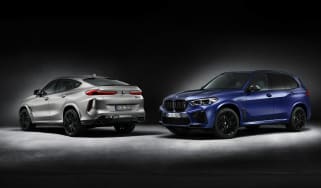
The X5 now sits between the smaller X3 and larger X7, and it also has a coupe-shaped sister car known as the BMW X6. Both cars share a vast amount of components, but the X5 is the more practical model of the two due to its more traditional SUV shape.
Used - available now

2024 BMW
1 Series
50,138 milesAutomaticDiesel2.0L
Cash £21,151
2026 BMW
4 Series Gran Coupe
17,682 milesAutomaticPetrol2.0L
Cash £29,360
2026 BMW
X1
32,346 milesAutomaticPetrol1.5L
Cash £27,597
2024 BMW
1 Series
12,634 milesAutomaticPetrol1.5L
Cash £22,741Premium SUV buyers are a discerning bunch, so we’ve been sure to put the BMW X5 to the test alongside some equally fancy rivals. When we put this car against a Porsche Cayenne in a twin test, the Porsche won due to its ever so slightly superior driving experience, refinement and efficiency, but it was a very close battle.
BMW X5 prices and latest deals
The core BMW X5 line-up is a pretty straightforward one, with a petrol, two diesels or a plug-in hybrid powertrain to choose from, along with xLine or M Sport trim. Pricing for the regular X5 starts from around £76,000 for a base xLine model with the less-powerful xDrive30 diesel under the bonnet. At the top end of the core X5 range sits the hotter M60 i xDrive, which just about passes the £100,000 mark.
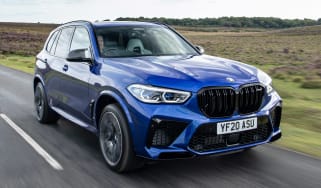
If you want maximum performance to go with your BMW, though, you’ll want the full-fat X5 M. You’ll need to brace for the price as well as the power with this one, as it’ll cost you at least £137,000.
Whichever BMW X5 floats your boat, you can save with the Auto Express Buy a Car service. As well as being able to build your dream BMW X5, you can also take a look at the very best X5 leasing deals, and find plenty of used X5 models in stock. You can also sell your car with us.
Performance & driving experience
Pros |
|
Cons |
|
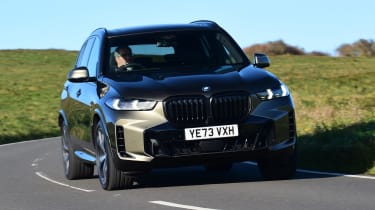
If you want a large SUV that handles like a saloon car, the X5 is one of your best options. Using the highly-modular CLAR platform, it belies its size and weight in bends while also providing superb cruising ability. There’s also a wide range of excellent powertrains to suit almost every need.
| Model | Power | 0-62mph | Top speed |
| BMW X5 xDrive30d | 298bhp | 6.1 seconds | 145mph |
| BMW X5 M Competition | 626bhp | 3.6 seconds | 155mph |
| BMW X5 xDrive50e | 483bhp | 4.8 seconds | 155mph |
Performance, 0-60mph acceleration and top speed
The xDrive30d and the xDrive40d diesel options in the X5 range are based on the same 3.0-litre, twin-turbocharged six-cylinder units. The power outputs are decent, but it’s the torque on offer – the xDrive30d has 650Nm and the xDrive40d 700Nm – that is really impressive. As a result, we don’t feel like there's a huge amount of difference between the two diesel engines.
They’re responsive enough, thanks in part to their mild-hybrid set-up (added to X5 petrols and diesels during the 2023 facelift). They can be noisy under hard acceleration, and don’t expect electric-only running from the 48-volt hybrid system, but it assists in making smooth shifts from the eight-speed automatic transmission (the only gearbox available in the X5). It’s great as an auto and while using the manual shifts gives you a bit more engagement, the shifts themselves aren’t especially snappy.
The plug-in hybrid xDrive50e uses a 3.0-litre straight-six petrol which is paired with a 25.7kWh battery and electric motor. The total output of 483bhp is far higher than the old xDrive45e’s 389bhp – although the PHEV version of the X5 is the heaviest at 2,420kg.
Before the mid-life facelift, you could get an xDrive40i version with a pure-petrol straight-six, but now the ‘entry-level’ petrol is the hot M60i version. This comes with a 4.4-litre, twin-turbocharged V8 with mild-hybrid tech, putting out 523bhp and 750Nm of torque. It’s not the most potent X5 – that honour goes to the full-fat, 626bhp X5 M Competition – but the M60i serves up more power than anyone could need, even in a big, heavy SUV.
Town driving, visibility and parking
There’s no getting around the fact the X5 is a big car, so you will have to take a little more care on tighter roads in urban areas – especially if you’ve fitted the largest 22-inch rims. Visibility is good, however, thanks to the high driving position. We found the steering to be nice and light at low speeds, too, and the turning circle of 12 metres isn’t bad for a big SUV such as this. We relied on the rear view camera a lot when parking the X5, so it’s good that the clarity of the picture is excellent on the large central screen.
The additional weight of the xDrive50e’s battery pack and its larger 20-inch wheels means it doesn’t cope as well with speed bumps and potholes at lower urban speeds, but things do smooth out once the pace increases thanks to standard-fit air suspension.
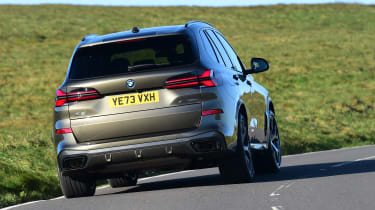
Country road driving and handling
The X5 is well known for its road-focused driving manners, and that remains the case with the latest generation. However, BMW has included an optional xOffroad package with xDrive30d and xDrive40d diesel models.
It has four specific loose-surface driving modes, some underbody armour to deflect rocks and bumps and a mechanical locking differential to maximise traction in slippery conditions. You will also have to add optional adjustable suspension that will enable you to alter the ride height (making this a near £5,000 outlay). And in the end, the X5 still won’t be as good off-road as a Range Rover Sport – although it should be sufficiently capable for most owners.
All versions of X5 feature the same super-smooth eight-speed automatic gearbox and a 4x4 xDrive drivetrain, although it does send more torque to the rear wheels to emphasise the sporty driving feel. It’s a more rewarding driving experience than SUV rivals such as the Mercedes GLE or Volvo XC90, but a Porsche Cayenne is sharper still.
The Integral Active Steering option pack adds four-wheel steering to make the X5 feel more alert at higher speeds and easier to manoeuvre when parking. It’s standard on the M60i, but we found it to be a little inconsistent in its responses, which reduced our confidence in the X5’s handling. In its standard set-up, there’s very little delay on the steering and there’s not a tremendous amount of body roll in bends, either.
Motorway driving and long-distance comfort
On the road, models equipped with adjustable suspension (only standard on the M Sport xDrive50e and an option on the rest of the range) have a serene, luxury-car ride, especially when travelling at motorway speeds, where the X5 is a relaxing mode of transport because it suppresses unwanted wind, road and engine noise impeccably. There’s also a £4,000 Comfort Plus pack which adds acoustic glass, plus other items such as heated and cooled cup-holders and heated rear seats.
Of course, the plug-in hybrid xDrive50e is even quieter when running on electric power only, and it can do so for up to 65 miles. We found the switch between petrol and electric to be almost imperceptible in Hybrid mode, with the engine being a little more vocal in Sport. The only time we caught the system out was when pulling out of a junction with urgency, where we thought it delivered a little too much performance instead of metering its power out to maintain composure.
“While some lighter X5s are more agile, the plug-in hybrid 50e still does a good job on a twisty road, gripping well and turning in positively thanks to good steering responses – thanks in part to the batteries being mounted low down. It rides well too, feeling more like a luxury saloon than an SUV.” - Richard Ingram, deputy editor.
MPG & running costs
Pros |
|
Cons |
|
Although having mild-hybrid assistance, the lack of electric-only running means the diesels are still quite thirsty. The xDrive30d will return an average consumption of 39.8mpg, roughly the same as a 300d Mercedes GLE and a little better than a D300 Range Rover Sport. The diesel X5’s 194g/km emissions put it into the top 37 per cent Benefit-in-Kind (BiK) company car tax bracket, so it’s not cheap from a company car perspective. The other diesel option is the 335bhp xDrive40d, which offers greater performance, yet still returns 38.2mpg and 195g/km of CO2.
The petrol-engined M60i is strictly for those with deep pockets, as the 4.4-litre V8 only manages 24.3mpg, with CO2 emissions of 270g/km. The M Competition model is even less efficient, with fuel economy of 23.7mpg and emitting 304g/km of CO2.
| Model | MPG | CO2 | Insurance group |
| BMW X5 xDrive50e | 313.9mpg | 20g/km | 48 |
| BMW X5 M Competition | 23.7mpg | 304g/km | 50 |
| BMW X5 xDrive40d | 38.2mpg | 195g/km | 43 |
Electric range, battery life and charge time
If you want to minimise running costs, go for the plug-in hybrid xDrive50e. It has a 3.0-litre six-cylinder petrol engine and electric motor powered by a lithium-ion battery with a 25.7kWh usable capacity. The impressive all-electric range of up to 65 miles helps deliver an official fuel consumption figure of 313.9mpg under WLTP testing. You’d need to regularly charge the battery to get anywhere near that figure, though. On a long 450-mile drive, our average on both petrol and electricity was 43.5mpg. That’s still better than the older xDrive45e, which we ran for a year and saw an average of 40.1mpg.
While the xDrive50e doesn’t have rapid charge capability like the plug-in hybrid Range Rover Sport, the charging speed has been increased from the rather slow 3kW of earlier xDrive45e cars up to 7.4kW. That reduces recharge times from nine hours to four and a half when using a suitably quick wallbox charger.
| Model | Battery size | Range | Insurance group |
| BMW X5 xDrive50e | 25.7kWh | 65 miles | 48 |
Insurance groups
As expected of a powerful, premium SUV, insurance will be costly. The xDrive30d is included in group 43, while this rises to 47 for the xDrive40d, 48 for the xDrive50e, all the way up to group 50 for the M60i and X5 M Competition.
Those are on par with the equivalent Mercedes GLE and Range Rover Sport. However, the Audi Q7 starts from group 42, making it cheaper to insure. The smaller BMW X3 is way cheaper to insure on average, with groups starting from 32.
Tax
While the plug-in hybrid xDrive50e will look reasonably tempting to company car drivers, PHEVs aren’t able to offer the very lowest Benefit-in-Kind (BiK) rates. If you want to enjoy this particular discount, you’ll need to look towards a fully electric car. You might not necessarily need to look far, though, as the zero-emission BMW iX is similar in size to the X5.
Depreciation
The undoubted cachet of the BMW badge, the novelty value of the latest-generation X5 and the model’s sheer desirability should mean residual values remain strong. Our market data suggests that it should hold onto between 49 and 53 per cent of its original value after three years and 36,000 miles of motoring, with M Sport models generally performing best.
However, those wanting the greatest return on their investment should look towards the Range Rover Sport, because this returns between 54 and 60 percent after the same amount of time or miles.
Interior, design & technology
Pros |
|
Cons |
|
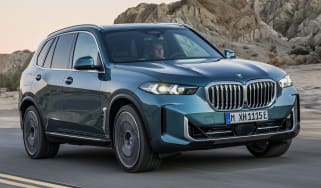
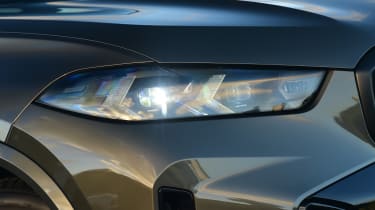
The BMW X5 was facelifted in 2023, but it’s still instantly recognisable. Exterior revisions brought it more in line with the brand’s current design themes, so there are thinner headlamps to match the BMW X6, plus you can choose an illuminated kidney grille to match that car and the pricier BMW XM. Overall, it’s one of BMW’s more conservative designs currently – especially when you compare it to the similarly-sized BMW iX.
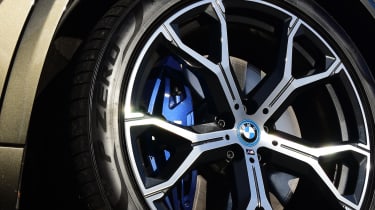
There is scope for customisation, with a range of alloy wheels (20 inches up to 22 inches), xLine or M Sport bodykits and BMW’s extensive ‘Individual’ paint finishes – although the latter cost more than £5,000.
Interior and dashboard design
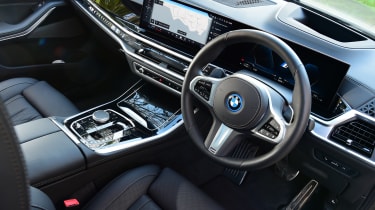
Inside, the X5 features a curved digital dashboard comprising a 12.3-inch driver display and a 14.9-inch central touchscreen display lifted from the all-electric BMW iX. Overall it looks tidy and modern enough, although it doesn’t have the concept-like cabin of the iX – which distinguishes itself with physical controls made from crystal and a minimalist dash.
There are no physical buttons for the climate controls, and while the temperature and menu icon are permanently on display, we didn’t find it as easy to adjust on the move compared with the toggle controls found in the Mercedes GLE. Also, the digital driver display doesn’t have the level of customisation you’ll find from Audi’s Virtual Cockpit as featured in the Audi Q7.
Materials and build quality
The interior quality is excellent, with fine materials, classy finishes and an overall sense that it’s all screwed together very convincingly. You can specify real leather upholstery on the seats and dashboard to replace the standard artificial leather material called Sensafin, along with polished glass for the start/stop button, gear lever and iDrive controller. There’s also the latest version of BMW’s iDrive control system, which works well, although it’s getting increasingly complicated to navigate.
Interesting options for the X5 include a panoramic sunroof with a starlight night-time illumination mode. You can also have laser headlamps that pierce the gloom with a 500-metre maximum range. Meanwhile, the aforementioned Offroad pack brings four loose-surface driving modes – sand, rock, gravel and snow – and adds underbody protection for X5 users who want to see a bit more of the countryside.
Infotainment, sat-nav and stereo
The infotainment set-up features wireless Apple CarPlay connectivity, while Android Auto is provided through a wired connection. The main interface is the iDrive controller situated next to the gear lever, which controls the 14.9-inch screen, although you can also interact with it via touch. The screen's graphics are crisp, and it responds swiftly to inputs. The driver’s screen isn’t as configurable as Audi’s Virtual Cockpit.
As you’d expect, the X5 comes with sat-nav and an excellent standard audio system, but if you’re an audiophile, there’s also a 16-speaker, 415-watt Harman Kardon sound system. Or if you’re really demanding, a 1,500-watt, 20-speaker Bowers & Wilkins diamond surround sound system for even crisper sound quality.
Boot space & practicality

Pros |
|
Cons |
|
The BMW X5 is available as a five-seater as standard or with an optional third row of seats for around £1,700. That said, this rearmost row is best suited to children, so if you want to carry lots of adults on a regular basis, then the bigger BMW X7 might be a better choice.
We found the driving position of the X5 to be excellent, with the usual great BMW ergonomics and a vast range of adjustment, particularly from the standard sports seats with electrically adjustable lumbar support, plus a memory function. As part of the Comfort Pack, the optional front comfort seats add additional electric adjustment, such as extendable thigh support. You get a commanding view of the road ahead, too, thanks to the X5’s height, although you’ll be relying on the front and rear parking sensors and rear view camera when parking. You’ll need to add the Technology Plus Pack to get a top-view, 360-degree camera system, which is a bit of a shame when a similar system comes as standard on the Range Rover Sport. If you want a panoramic sunroof, rear window blinds and additional boot dividers, there’s a Travel Pack which costs almost £2,500.
The interior of the X5 provides plenty of storage, with a large lidded bin between the front seats, a good-sized glovebox and spacious door bins. The front cup-holders can even be heated or cooled to either keep your coffee warm or your bottle of water cool, if you add the aforementioned Comfort Pack.
Dimensions and size
The latest-generation X5 is a little bigger than the previous BMW X5 and is usefully boxy in its outline, but it’s not quite as big as the Range Rover Sport.
| Dimensions comparison | |||
| Model | BMW X5 | Range Rover Sport | Porsche Cayenne |
| Length | 4,922mm | 4,946mm | 4,918mm |
| Width | 2,004mm | 2,047mm | 1,983mm |
| Height | 1,745mm | 1,820mm | 1,696mm |
| Wheelbase | 2,975mm | 2,997mm | 2,895mm |
| Boot space | 650-1,870 litres | 647-1,491 litres | 698-1,708 litres |
Seats & passenger space
Legroom and headroom are excellent all around in the BMW X5, and the small transmission tunnel is especially impressive, meaning a third central passenger can sit comfortably on the rear bench seat without too many compromises. There’s also plenty of shoulder and hip room.
A worthwhile option is electric adjustment for the second row of seats; this brings a control panel in the boot, allowing you to slide the bench forward or fold the seatbacks to maximise space as you’re loading.
Boot space
The X5’s boxy proportions mean it’s decently spacious – although it’s beaten by some rivals. The Mercedes GLE provides 690 litres for instance, while the plug-in hybrid X5 xDrive50e reduces boot space to 500 litres, whereas a Range Rover Sport P460e maintains its capacity at 647 litres. The rear bench in the X5 splits 40:20:40, which is great for fitting long luggage items between the two rear passengers with just the centre section folded.
BMW’s Comfort Access option provides hands-free control of the upper and lower tailgate sections and the retractable load cover. Equally useful is the split tailgate; the lower section provides somewhere to rest your shopping before arranging it in the boot, or somewhere to sit when changing into walking boots or cycling shoes, for example.
Towing
With its powerful range of engines, most versions of the X5 offer more than enough towing ability for most buyers. The xDrive30d is a tad disappointing for an SUV of this size with just 1,700kg of braked towing capacity, but the xDrive40d ups this to a healthy 2,500kg. The plug-in hybrid xDrive50e and M60i can pull even more at 2,700kg. The tow bar is an option, and an expensive one at £1,150.
We’d suggest you consider the Range Rover Sport if you need even greater capacity because the P460e can tow 3,000kg, while the rest of the range can pull up to 3,500kg.
“It’s odd that the less-powered diesel only tows up to 1,700kg when it has almost the same torque as the other diesel. The X5 has been popular with tow-car drivers for decades and it’s obvious why thanks in part to the comfortable ride and good visibility.” - Alastair Crooks, senior news reporter.
Reliability & safety
Pros |
|
Cons |
|
As one of the flagship SUV models in BMW’s range, the latest X5 unsurprisingly comes packed with advanced safety tech. The most impressive kit is part of the BMW Driving Assistant Professional system, which offers autonomous features like intelligent cruise control with lane-keeping assist and the ability to keep pace with flowing traffic – including making allowances for vehicles merging into your lane. Other innovations include autonomous emergency braking and an aid that steers into clear space if the system senses an imminent collision with a car or pedestrian.
As part of the Technology Pack, you also get Parking Assistant Professional which can save up to 10 manoeuvres (mainly for parking) which lets the X5 automatically steer, brake and accelerate. This works alongside the Reversing Assistant Professional, which works up to a distance of up to 200m.
The seven-seater option, meanwhile, might be meant for kids in the third row, but there are no Isofix points back there – you’ll only find them on the outer seats in the middle row.
Other safety measures include plenty of airbags around the cabin, and all X5s have a crash sensor that activates the central locking release, hazard lights and fuel cut-off. You also get piercing LED headlights, a speed limiter and the usual safety systems like Electronic Brake-Force Distribution, Stability Control and ABS.
It’s a comprehensive safety package, as you would expect, and Euro NCAP awarded the BMW X5 a five-star safety rating when tested in 2018, although this has now expired. The Mercedes GLE also received five stars and was tested under the same regime as the X5, but this car scored better in all areas. It’s worth noting that the newer Range Rover Sport, tested in 2022, also received a five-star rating, but it was rated under Euro NCAP’s latest and more stringent regime.
BMW finished an impressive eighth (out of 31 brands) in our best car manufacturer rankings, which is based on owners' feedback from the latest Driver Power customer satisfaction survey. That put it ahead of Audi and Volvo, but behind Porsche and Land Rover.
| Euro NCAP safety ratings | |
| Euro NCAP safety rating | Five stars (2018/expired) |
| Adult occupant protection | 89% |
| Child occupant protection | 86% |
| Vulnerable road user protection | 75% |
| Safety assist | 75% |
Buying and owning
- Best buy: BMW X5 xDrive50e M Sport
The diesel options within the BMW X5 range are excellent, but the plug-in hybrid system on the xDrive50e gives the big SUV the broadest appeal. You lose a bit of boot space (it’s still more than practical for most), but gain efficiency and a smooth-running electric powertrain. The M Sport trim will fare better for depreciation and give you some handy kit to go with the sportier looks.
BMW X5 alternatives
The Audi Q7 and Mercedes GLE provide the X5 with stiff competition, although there’s also the Porsche Cayenne and Range Rover Sport to deal with too. All these SUVs offer diesel, petrol and plug-in hybrid units and all feel like premium products, too.
There are now even more alternatives in the shape of all-electric SUVs as well. BMW’s own iX is a great option as is the Polestar 3 and Kia EV9 – even without the same badge cachet. The Volvo EX90 is another premium option, but it’s quite expensive.
Frequently Asked Questions
While expensive to buy outright, the BMW X5 retains its value fairly well so it’s a sensible option in the large SUV class.
Deals on the X5 and alternatives