New BYD Atto 2 DM-i 2026 review: clever PHEV is super-cheap but feels it
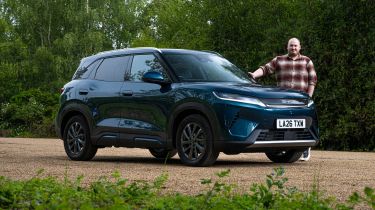
The new BYD Atto 2 DM-i is a plug-in hybrid SUV that covers all the basics, but rivals are better to drive


Verdict
Your bank account will be a big fan of the new BYD Atto 2 DM-i thanks to its highly efficient plug-in hybrid powertrain, fairly generous amount of standard kit and competitive pricing. However you might not be, because we found the driving experience to be genuinely unpleasant at times and quite tiring, largely due to poor ride quality and refinement. Hopefully some chassis tweaks can improve things, but even so the interior is boring and doesn’t feel spacious, the tech could be better, and the base model offers a puny electric range.
Most people will know BYD as a maker of electric cars, because they were the primary focus of the Chinese colossus when it arrived in the UK back in 2023; plus last year it sold more EVs worldwide than Tesla. However, the company is now going big on plug-in hybrids, almost overnight shifting from having just one in its line-up to five, and there are more on the horizon.
The big addition is a Ford Fiesta-sized hatchback called the BYD Dolphin G that will be the first model designed by BYD specifically for Europe and is guaranteed to be the most affordable plug-in hybrid in the UK. Meanwhile, the new, very boxy seven-seat BYD Ti7 4x4 will capitalise on Brits’ love for the Land Rover Defender, and should cost a lot less, too.
Used - available now

2025 BYD
Atto 2
1,895 milesAutomaticElectric
Cash £21,990Those are still to come though. The latest addition to BYD’s family of PHEVs is the new Atto 2 DM-i, which has arrived nearly a year after the pure-electric version of the compact family SUV that, it’s fair to say, failed to leave much of an impression on us.
Let's start with the positives: firstly, the hybrid is more affordable than the EV. While the electric Atto 2 starts from just under £31,000, the plug-in hybrid is available from £26,995 – or £269 per month on a zero per cent APR PCP finance deal with £1,999 down.
Even the higher-spec Boost model squeaks in under the £30,000 mark – or is available for £299 per month on the same finance deal – which is a good thing, because this is one we think the majority of buyers will go for.
Every Atto 2 DM-i features a 1.5-litre four-cylinder petrol engine paired with two electric motors, but the size of the battery and the power output depend on the model. The base Active version features a tiny 7.8kWh battery pack that offers a similarly small electric range of just 24 miles, which probably won’t cover many people’s commute to work. And with only 162bhp on tap, 0-62mph takes a rather leisurely 9.1 seconds.

Meanwhile, thanks to its larger 18kWh power pack, the Boost model that we’ve driven offers a much more useful 55-mile EV range and a combined range of 621 miles – enough to get from London to Inverness without refuelling. It also delivers 209bhp, which cuts the car’s sprint time down to 7.5 seconds, although it still doesn’t feel quick.
BYD’s rather slick plug-in hybrid system prioritises its electric motors over petrol power, in a bid to provide a smoother driving experience and boost fuel efficiency. It’s also set up to try and keep about 25 per cent charge in the battery, or there’s a ‘Save’ mode that ensures there’s even more energy ready for when you need it later in your journey.
As a result, its maker claims the Atto 2 DM-i will return up to 55mpg, which isn’t the type of fantastical and unachievable fuel economy figures we’re used to seeing from a plug-in hybrid. This is far more realistic, as we found during our testing when we covered about 150 miles on a variety of roads, including motorways, and averaged more than 62mpg.
It’s possible you could see even higher returns if the car was charged up as often as possible and its EV range does cover your commute. Mind you, we got around 54mpg in a Hyundai Kona Hybrid and saw nearly 65mpg from the Toyota Yaris Cross when we lived with one, and neither of those ever need to be plugged in. As with all plug-in hybrids, you have to carefully consider whether or not you can deal with having to charge the BYD regularly to get the most out of it.
When the battery starts running low on juice, as we experienced during our test, the hybrid system continues to seamlessly switch between the electric motor and petrol engine. We found the e-motor provides a short burst of power – getting you up from 60mph to 70mph, for instance – before the engine then has to chime in. The four-cylinder unit sounds quite strained when being worked hard, but once you ease off the throttle, it quickly goes back to running quietly in the background.
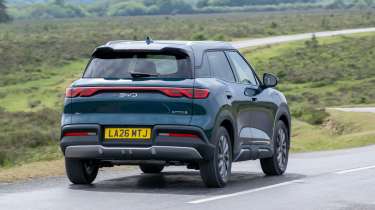
However, while the powertrain is undeniably impressive, on the whole we found driving the Atto 2 to be an unsatisfactory and rather tiring experience. The main problem is the overly firm and lumpy ride that sends all of the impacts from potholes, bumps and even small cracks in the road into the cabin, along with a noticeable thump.
The poorly tuned suspension and chassis are likely also responsible for the excessive amount of vibrations that we felt whilst driving the Atto 2. The car was shuddering so much at points that the rear-view mirror began shaking and we couldn’t tell what type of car was behind us; it just looked like a blurry blob with headlights.
On the motorway, the car bobs about, never settling down, and the nearly constant road noise is joined by a noticeable amount of wind noise generated by the side mirrors.
Then there’s the brakes that apply sharply and suddenly if you press the incredibly sensitive pedal just a little bit too much, as we learned for the first time while doing about 60mph leaving a busy motorway, which was alarming to say the least. The regenerative braking system doesn’t help much, because even in the strongest setting the car still very gently and gradually slows down, and only for a couple of seconds after you lift off the throttle.
The steering is relatively heavy too, even in Comfort mode, and incredibly eager to self-centre. But more disconcerting was the way we could feel the driver-assistance systems moving the wheel as we drove along, as if the car knew better than us where it needed to be in the lane. That was until it seemed to panic mid-way through a corner and turned sharply towards a hedge.
Perhaps the only good thing about how this car handles is that it doesn’t lean too much through corners. But that’s cold comfort really and needless to say, based on our first drive, this is not a car we’d want to cover more than 600 miles in. At least not in its current state, but considering the speed at which firms like BYD can update their products, perhaps it’ll be much better in a few months time after some fettling.
Meanwhile, the interior does the job, but overall feels like a rather dull place to be, especially if you go for the all-black colour scheme our test car had. We highly recommend opting for the beige interior, which is thankfully a no-cost option, because this will make the cabin feel slightly more inviting, if not any more spacious.
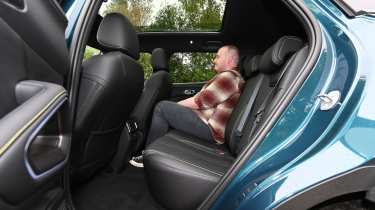
Even though there’s plenty of headroom throughout the Atto 2’s cabin due to its tall roofline, and Boost models come with a panoramic sunroof, it feels narrow and compact inside. Particularly up front because of the rather wide and tall centre console.
There is enough legroom for six-foot-tall adults to sit in the back, but trying to get three onto the rear bench would be a real squeeze. If you have small children, there are also two sets of Isofix mounting points in the back. The 425-litre boot is a useful space but it's not the biggest in the class, with the Ford Puma, Vauxhall Frontera and Hyundai Kona, among others, able to carry more.
In terms of quality, it’s generally solid, but more than once during our drive some piece of trim started rattling so much that it sounded like a distress signal in Morse Code. You don’t have to search very hard to find cheap-feeling plastics, and while we can forgive that for the lower parts of the centre console and doors, in the back BYD has moulded the top parts of the doors to look like stitched leather but is actually just more hard black plastic.
Both of the screens in the Atto 2 are sharp, although the small, thin font and the sheer amount of information on the driver’s display can make it hard to read at a glance. Similarly, while the 12.8-inch touchscreen features Google Maps and other Google tech built-in, the rest of the infotainment system is BYD’s, so there’s a lot of menus and even more sub-menus that you can easily get lost in and can be distracting to use on the go.
Wireless Apple CarPlay and Android Auto are standard-fit, along with LED headlights, rain-sensing wipers, rear parking sensors and a reversing camera. Active models get 16-inch alloy wheels, but the extra £3,000 you pay for the Boost version adds larger 17-inch rims, that sunroof, heated front seats, a heated steering wheel, synthetic leather upholstery rather than fabric, and a 360-degree camera system.
| Model: | BYD Atto 2 DM-i Boost |
| Price: | £29,995 |
| On sale: | Now |
| Engine: | 1.5-litre 4cyl petrol PHEV |
| Power/torque: | 209bhp/300Nm |
| Transmission: | Single-speed automatic, front-wheel drive |
| 0-62mph: | 7.5 seconds |
| Top speed: | 111mph |
| Economy: | 55.4mpg |
| CO2: | 13g/km |
| EV range: | 55 miles |
| Size (L/W/H): | 4,330/1,830/1,675mm |