Leapmotor C10 review
The Leapmotor C10 offers genuine value for money, but infuriating driver-assistance tech and sub-par range limit its appeal


Our opinion on the Leapmotor C10
The Leapmotor C10 is a promising entry into the electric family SUV segment, and there’s no arguing with the sheer value on offer. This is a spacious car with a premium-feeling interior and an extensive list of equipment at an appealing price. But as an EV, it’s little more than mediocre; the range is average at best, and the charging speeds are woeful.
The range-extender hybrid version gets around the problems of the EV version, and given it’s the same price, it’s our pick of the range. It’ll even go 90 miles on a charge, so you’ll end up using it like an electric car anyway, just with the added safety net of petrol power when you happen to go further afield.
About the Leapmotor C10
Leapmotor isn’t the first Chinese car maker to come to the UK with dreams of making it big, and it definitely won’t be the last, but there are some things that set this brand apart from the rest. The most significant is that it’s backed by the globe-striding colossus that is Stellantis, which also owns household names such as Alfa Romeo, Citroen, DS, Fiat, Jeep, Peugeot, and Vauxhall.
The Leapmotor C10 is an electric family SUV that competes against the likes of the Skoda Enyaq, Renault Scenic, Vauxhall Grandland and Tesla Model Y. We’ve found it to be a promising entry in a jam-packed class, but among its shortcomings are a 263-mile range from the 69.9kWh battery and slow 84kW rapid-charging capabilities.
Leapmotor has responded, not by shoving a bigger battery into the car, but by adding a range-extender powertrain that has increased the theoretical range to more than 600 miles, and broadened the car’s appeal considerably in the process.
The C10 REEV uses a smaller 28.4kWh battery that’s good for 90 miles of zero-emissions driving, plus a 1.5-litre four-cylinder petrol engine. The company claims it emits only 10g/km of CO2, but, more importantly, the engine never drives the wheels. Instead, its sole purpose is to generate energy for the electric motor and battery. That means the car still feels like an EV from behind the wheel.
As well as testing the standard Leapmotor C10, we’ve also tested the hotter C10 Irmscher to find out if Leapmotor is also a convincing player in the performance car world. While the Irmcher certainly makes this EV more attractive, we found the driving experience to be pretty underwhelming. This car isn’t currently planned to arrive on our shores.
Leapmotor C10 prices and latest deals
Competitive pricing is the key to the Leapmotor C10, which is priced at £36,500 whether you go for the electric or range extender hybrid version. There is a smattering of paint colours available, though, which cost £700 a pop.
Of course, you can save money by building your new Leapmotor C10 through the Auto Express Buy a Car service. We also have a range of C10 leasing deals to choose from, and can help you to sell your car.
Performance & driving experience
Pros |
|
Cons |
|
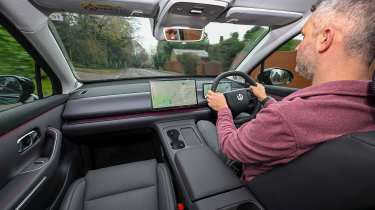
There are some shortcomings to the Leapmotor C10’s driving experience, but those are small gripes compared with the car’s maddening driver-assistance technology, which the company itself admits still needs a lot of work.
The adaptive cruise control, for instance, is jerky when slowing the car down and feels as if the driver is sporadically tapping on the brakes. The driver-monitoring system told us to take a break about five minutes after getting behind the wheel – and continued to do this until we shut it off.
The absolute worst is the ‘emergency lane-keep assist’ that requires you to be stationary to deactivate. Forget to do so, and it constantly reprimands you for being too close to any white lines, even when you’re definitely not, and it is particularly infuriating on narrow country roads. You end up driving along having a constant argument with the steering wheel because the car thinks it knows better, until the system suddenly disengages without warning when you turn the wheel to adjust your position in the lane, leading to a worrying moment of overcorrection.
| Model | Power | 0-62mph | Top speed |
| Leapmotor C10 EV | 215bhp | 7.5 seconds | 105mph |
| Leapmotor C10 REEV | 212bhp | 8.5 seconds | 112mph |
Electric motors, 0-60mph acceleration and top speed
There’s a Comfort drive mode that’s supposed to offer what the company calls ‘stable’ acceleration, while Sport is for when you want ‘robust’ pace – whatever that means. You have to go into the car’s overwhelming settings menu to toggle between all these different modes, which can be distracting on the go.
Regardless of the mode you’re in, the C10 won’t set your pants on fire. The pure-electric version uses a rear-mounted electric motor that produces 215bhp and 320 Nm of torque, so 0-62mph takes 7.5 seconds. Bizarrely, the e-motor in the range-extender version delivers just 3bhp less at 212bhp and has the same torque figure, but the claimed 0-62mph time increases to 8.5 seconds with no clear explanation why.
The e-motor responds immediately when you put your foot down, but the power available is barely enough to propel the nearly two-tonne SUV at even a leisurely pace, and overtaking on the motorway takes a long time.

Town driving, visibility and parking
Considering the size and heft of the C10, you might think that it would be a struggle in tight urban areas, but it’s easily capable of being threaded down a narrow street and slotted into parking spaces.
The kerbweight is disguised at low speeds by incredibly light steering and a fairly tight turning circle, plus there’s terrific visibility all around thanks to a traditional boxy shape, proper rear three-quarter windows, and a relatively low window line. The feed from the rear-view camera could be better, though.
Country road driving and handling
We’ve been told that engineers from Maserati – another member of the Stellantis family – helped tune the C10’s chassis for European roads. But exactly what input they had is unclear, because the car rolls in corners and dives under heavy braking, while that ultra-light steering lacks any feel.
Mind you, it didn’t help matters that the steering wheel on one test car we drove wasn't fitted straight. Elsewhere, the brakes offer pretty good stopping power, although we found the pedal to be very springy, and the initial bite is quite abrupt.
Motorway driving and long-distance comfort
Of course, most family SUV buyers will prioritise comfort over dynamics, and the ride in the C10 is pretty acceptable, although the car is fidgety on the motorway, and a lot of vibrations come up through the seats and steering wheel. A noticeable amount of road noise and wind noise from around the side mirrors permeate the cabin too, and there’s a constant whine from the electric motor.
The REEV’s 1.5-litre petrol engine only emits a low, distant hum when it does eventually clock in for work. The noise never goes beyond a faint drone, even when you’ve put your foot down and the battery is running low on juice.
Range, charging & running costs
Pros |
|
Cons |
|
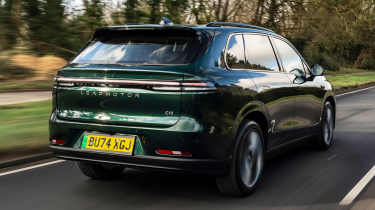
There are four different modes for the C10 REEV’s powertrain that determine when the engine awakens from its slumber. For instance, EV+ mode prioritises pure-electric running, and the generator doesn’t come on until there’s less than nine per cent charge left in the battery. EV mode is similar, but the threshold for the engine starting up is set to 25 per cent.
With Fuel mode, you can select exactly how much charge needs to be left before the engine starts generating more. Finally, Power+ fires up the engine immediately to keep the battery topped up, ready for when you want to maximise the EV modes later in a journey.
We flicked between them when we tested the C10 REEV over two days and nearly 250 miles on a mixture of roads. By the end, we managed to average 3.7 miles per kWh from the battery, and 42mpg from the engine, which are both impressive figures in their own right. But if you do the maths, it also means we could cover 567 miles in one go – enough to drive non-stop from London to Inverness in the Scottish Highlands.
The C10 REEV has a maximum charging speed of 65kW, which is a lot faster than most of the plug-in hybrid SUVs it competes against. However, you’d need to use a public DC rapid charger to reach that speed, and those can be pretty pricey. We expect most people will replenish the car’s 28.4kWh battery at home overnight, which should take about four hours from a standard 7kW home wallbox.
| Model | MPG | CO2 | Insurance group |
| Leapmotor C10 REEV | 706.2mpg | 10g/km | 41 |
Electric range, battery life and charge time
Range and charging are two more areas where the pure-electric C10 isn’t particularly competitive, because its 69.9kWh battery is good for 263 miles on a single charge. For comparison, an entry-level Skoda Enyaq makes do with a smaller 59kWh battery, yet matches the Leapmotor for range, while a bigger-battery variant can cover up to 359 miles in one go. The C10 does at least get an energy-saving heat pump as standard, which provides a more efficient way of heating the interior in colder weather and helps preserve the electric driving range.
Leapmotor doesn’t quote a peak charge speed for the C10 EV, but online data suggests the electric SUV tops out at just 84kW. The company does say a 30 to 80 per cent charge will take half an hour. However, that same Skoda, in its most basic form, has a peak of 165kW – almost twice as fast – and can be recharged from 10 to 80 per cent in just 24 minutes.
If you’ve got a standard 7kW home wallbox, fully recharging the 69.9kWh battery should take around 10 hours. The C10 EV is also equipped with an 11kW on-board charger, allowing for faster speeds at public or workplace AC chargers.
| Model | Battery size | Range | Insurance group |
| Leapmotor C10 EV | 69.9kWh | 263 miles | 41 |
Insurance groups
The Leapmotor C10 sits in insurance group 41 (out of 50) in both REEV and EV form, which is very high for an electric family SUV, probably due to the brand having only just arrived in the UK and being something of an unknown quantity. As a result, the C10 will be more expensive to insure than a Skoda Enyaq, which falls into groups 27 to 37, or the Renault Scenic that attracts ratings between 28 and 32, depending on the exact model.
Tax
The Leapmotor C10 avoids the luxury car tax regardless of your chosen powertrain or paint colour, so this additional charge won’t be a problem. The standard rate of VED road tax does apply, though.
Electric cars are the best choice for company car drivers because they attract the very lowest Benefit-in-Kind (BiK) tax rates.
Depreciation
Our market data shows that the Leamotor C10 EV should retain 47 per cent of its initial value after three years or 36,000 miles. The REEV is a slightly better performer at 51 per cent after the same length of time.
This is a reasonable outcome for both models when you consider that the Skoda Enyaq retains 45 to 49 per cent. The Renault Scenic is even better, though, at a steady 55 per cent.
Interior, design & technology
Pros |
|
Cons |
|
The design of the Leapmotor C10 is a bit generic, but it’s also quite handsome to our eyes. There are whiffs of Hyundai at the front and if you squint, perhaps some Porsche Cayenne at the rear.
Proportionally, it looks quite European, and the colour palette isn’t as wacky as some of the stuff currently en route from China (we’re looking at you, MG and BYD). The 20-inch gunmetal wheels look smart, too, while a tall side profile shows off the C10’s rather low-lying ground clearance of 180mm. To the rear, there is another light bar.
Interior and dashboard design
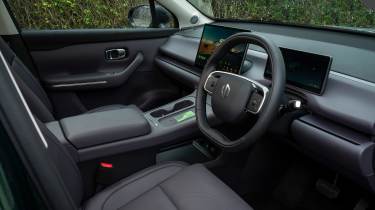
It’s equally pleasing inside, at least on first glance. The interior layout is incredibly minimalist – possibly inspired by the Tesla Model Y – with the big 14.6-inch touchscreen taking centre stage, complemented by a 10.25-inch digital instrument cluster. It’s all very responsive, but it’s a shame Leapmotor can’t offer customers Apple CarPlay or Android Auto at this stage.
There are almost no physical buttons anywhere. The few buttons Leapmotor has fitted are on the ceiling, including one for the sunroof blind and one for the hazard lights. There’s also an SOS button in case of an emergency, but there’s no cover or cage on it, so you’re very likely to hit it by accident.
Materials and build quality
Despite Leapmotor’s brand status as a newbie, the C10’s build quality has felt consistently stellar on the test cars that we’ve driven, especially given the list price. The dashboard and doors are covered in squidgy materials, and you have to go searching to find harder, cheaper-feeling plastic, such as on the door bins, for example.
It’s worth noting, however, that the cars we have driven so far have been quite literally factory-fresh. One was even registered just three days prior to us taking it for a spin, so it’s currently difficult to know how the fit and finish might fare after three years or 30,000 miles. The only chargeable option is for the various shades of black, white or grey paint (£700 each); green is standard, and would be our preferred choice.
Infotainment, sat-nav and stereo
Given that the 14.6-inch central touchscreen handles nearly every interior function, it has to work well. The Leapmotor C10 uses a similar yet far more detailed system to that of the Leapmotor T03 city car, running on a Qualcomm Snapdragon chip. It’s not the easiest system to get to grips with, but once you do, it’s supremely responsive, as we experienced no delays when switching between screens or asking the car to perform multiple tasks in quick succession.
The mapping is a nice design that feels pretty similar to Google’s offering, and there’s an app store that lets you add Spotify, for instance, but this still isn’t enough to make up for the lack of Apple CarPlay or Android Auto connectivity here.
Also similar to a smartphone is the pull-down menu with about a dozen shortcut buttons, which you can customise. However, we didn’t particularly enjoy using the climate control functions within the screen; physical buttons would be preferable.
Leapmotor says it will roll out over-the-air updates for life on the C10, and we hope that one item high up in its list is a fix for the night mode setting. On too many occasions, the screen switches to dark, then back to light, depending on external factors (going under a tree can upset it, for example).
The 10.25-inch driver’s screen is configurable, but only for three different small readouts on one side, and the small font can make it hard to read things at a glance. The resolution of all screens is great, however.
Boot space & practicality
Pros |
|
Cons |
|
When it comes to family cars, it’s not solely about the amount of space on offer. We like to see the little touches that will make everyday life easier for you and your loved ones, such as the umbrella that Skoda hides in the driver’s door of the Enyaq and Elroq, or the rather aptly named ‘ingenious rear armrest’ with built-in smartphone and tablet holders that you get in the Renault Scenic. But aside from ‘silicone leather’ seat upholstery, which should be easier to clean, the Leapmotor C10 lacks clever, practical features.
Dimensions and size
The Leapmotor C10 measures 4,739mm long, with a wheelbase of 2,825mm, and it’s 1,900mm wide and 1,680mm high. That means it’s larger than the already sizable Skoda Enyaq, and is almost the same as the Tesla Model Y, yet it offers significantly less boot space than either, or even some small SUVs.
| Dimensions comparison | |||
| Model | Leapmotor C10 | Skoda Enyaq | Renault Scenic |
| Length | 4,739mm | 4,658mm | 4,470mm |
| Width | 1,900mm | 1,879mm | 1,864mm |
| Height | 1,680mm | 1,622mm | 1,572mm |
| Wheelbase | 2,825mm | 2,766mm | 2,785mm |
| Boot space |
435 litres (EV) 400 litres (REEV) | 585 litres | 545 litres |
Seats & passenger space
There’s a good amount of adjustment in the driver’s seat and the steering wheel, but for some reason, you cannot lower the front passenger seat. It’s not the biggest problem in the world, because your passenger simply gets a lofty view of the road ahead.
The floating centre console features two cup-holders and a wireless charging pad, but the latter doesn’t have much of a lip, and the surface isn’t especially grippy, so your smartphone can easily fly out when going around corners. There are additional charging ports and storage space underneath, though they can be difficult to access.
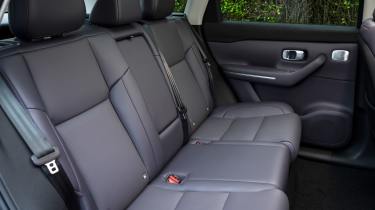
Even when the front seats are slid back for tall adults, there’s space in the rear for someone of a similar size. There’s no intrusive hump in the floor, and that glass roof floods the cabin with light, even on a grey day. There are also two sets of Isofix mounting points for child seats across the back row, but just a single air vent and two USB charging ports to keep passengers happy.
Boot space
Luggage capacity in the C10 differs depending on which powertrain you opt for. The pure-electric version has a 435-litre boot, which expands to 1,410 litres when the 60:40-split rear bench is folded flat. There’s also an extra 34 litres of storage under the bonnet, which is big enough for the charging cables at least.
The C10 REEV, meanwhile, only gets a 400-litre boot – the same size as the Alfa Romeo Junior baby SUV. Capacity increases to 1,375 litres when the back seats are down, but there is no ‘frunk’ due to the engine under the bonnet. It’s a perfectly usable size and shape, though, and should suit most families.
Even so, we’d expect a car of this size to be able to haul much more stuff. For instance, the Skoda Enyaq’s 585-litre boot space dwarfs either version, as does the 545 litres in the Renault Scenic. Even the more compact Kia EV3 manages to lug 460 litres worth of stuff around, and comes with a storage area for the charging cables under its bonnet.
Towing
The Leapmotor C10 isn’t rated to tow, so you’ll need to look elsewhere if you need to lug a trailer or caravan with your zero-emission SUV. The Volvo EX30 Extended Range is one of the better options in this regard, as it can take on up to 1,600kg braked.
Reliability & safety
Pros |
|
Cons |
|
The C10 is covered by Leapmotor’s four-year/60,000-mile warranty, plus an eight-year/100,000-mile warranty for the battery, which should be sufficient, as the company claims the car’s battery pack has an expected lifespan of more than 372,000 miles.
The C10 has also received the full five-star safety rating from industry expert Euro NCAP, including an 89 per cent score for adult-occupancy protection. It also earned 76 per cent in the safety-assist category thanks in part to its 17 different ADAS features, including a 360-degree camera system, blind spot detection, advanced emergency braking and rear cross traffic alert, plus many others.
However, as reassuring as it is to know these systems will be looking out for you on the road, as we’ve already mentioned, some of the myriad driver-assistance features are a little overactive – and there are still too many intrusive chimes from the speed-limit warning and lane-keep systems.
Leapmotor is aware of these complaints about its driver assistance technology, and is working hard to improve it. Better still, updates to these systems can be delivered over the air, so customers aren’t inconvenienced by repeat trips to the dealership for software tweaks.
Reliability is a bit of an unknown because Leapmotor’s cars have only just started arriving in the UK, and they don’t share a platform or any parts with the Citroen, Fiat, Peugeot, or Vauxhall models they’re sold alongside.
Leapmotor has previously reassured us that it’s working hard to ensure parts can be delivered quickly to those Stellantis brand dealerships when needed, plus servicing and maintenance can take place there, too.
| Euro NCAP safety ratings | |
| Euro NCAP safety rating | Five stars (2024) |
| Adult occupant protection | 89% |
| Child occupant protection | 85% |
| Vulnerable road user protection | 77% |
| Safety assist | 76% |
Buying and owning
- Best buy: Leapmotor C10 REEV
Unfortunately, the full-EV C10 isn’t quite where it needs to be in order to be truly competitive in this sector, so we’d currently opt for the REEV in order to quash any concerns about its lacklustre battery range and slow charging speeds. Besides, a 90-mile battery range means you’ll more than likely end up doing the vast majority of your driving on electric alone, and only need the engine for longer trips.
Leapmotor C10 alternatives
Rivals for the Leapmotor C10 include some highly-rated electric family SUVs, such as the Skoda Enyaq, Tesla Model Y and Renault Scenic. But this is an incredibly crowded segment of the market, and it is growing all the time. This car’s key selling point is value for money, because the Chinese newcomer offers ample cabin space and an incredibly generous equipment list for under £40,000.
However, smaller electric SUVs like the Skoda Elroq and Kia EV3 are available for similar money, and are more practical. The introduction of the range-extender version with a petrol engine will also expand its pool of rivals to include value-focused hybrid SUVs, such as the MG HS and Jaecoo 7.
Key updates of the Leapmotor C10 review
14 April 2026: Updated to include additional information about the Leapmotor C10 REEV.
Deals on the C10 and alternatives