Audi RS and performance mega test: historic Audi sports cars head-to-head
We drive some of the greatest Audis of all time to see how the brand has developed over the years

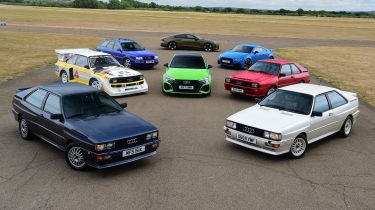
The saying goes that three is a magic number – yet for Audi, it’s five that holds a special place. This year marks 45 years of the German brand’s iconic five-cylinder engine configuration – and as a celebration to round off the year, we’ve gathered together some of the most famous models to be powered by the legendary five-pot motor.
But 2022 also sees another milestone, because earlier this year the company’s latest and greatest RS 3 landed in the UK. It became the final model in the brand’s history to feature five-cylinder power, but the story started with the Audi 100 C2. The second generation of the brand’s family saloon was the first to get a five-pot motor, producing a grand total of 134bhp from its 2.1-litre fuel-injected engine.

However, it wasn’t until a few years later, in 1980, when Audi’s five-cylinder story became really interesting, with a greater focus on performance.
The start of a new decade that brought with it shoulder pads, synth music and the ‘greed is good’ attitude was reflected in the automotive world, and nothing screams ‘eighties’ more than the original Audi Quattro. Often referred to as the 10-valve – or 10v – this is where turbocharging took off, force-feeding the car’s five cylinders with fresh air to unleash extra power.
Used - available now

2023 MG
ZS
11,062 milesManualPetrol1.5L
Cash £13,150
2022 Kia
XCeed
28,438 milesAutomaticPetrol1.5L
Cash £14,870
2023 MINI
Cooper Electric
33,691 milesAutomaticElectric
Cash £12,400
2024 Audi
A3 Saloon
25,119 milesManualPetrol1.0L
Cash £18,497A little over 40 years ago, this additional muscle amounted to 197bhp; by today’s standards, a sporty supermini pumps out this level of oomph, but in 1980 this sat very much in the high-performance category.
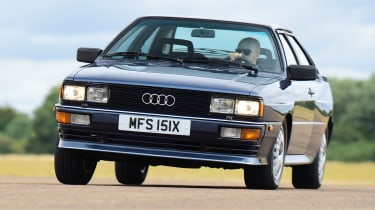
In the Quattro, the power was accompanied by 285Nm of torque, produced relatively high up at 3,500rpm – if you’re judging it compared with lag-free, modern, sophisticated turbochargers anyway.
With the Quattro fully wound up, a 0-62mph sprint took 7.1 seconds. No doubt the performance was helped by a relatively skinny 1,300kg kerbweight, with the car also free from the 21st-century safety aids and driver-assistance tech that make the 10v’s current-day successors that bit heavier.
Climb aboard and you’re reminded what an eighties car feels like, and how things have moved on in four decades. It’s not only the lack of systems that makes the Quattro light, but also the relatively slight structure. The car’s windscreen pillars are spindly by modern standards, yet they give a great view out as a result.
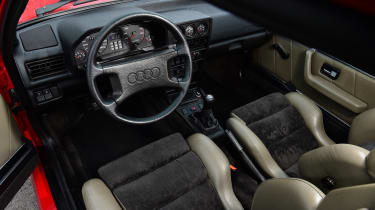
Pull the delightfully trimmed door to, and you are ensconced in a world of hard plastic and patterned velour trim. There’s nothing digital in sight, with all the instruments fully analogue. It’s delightful.
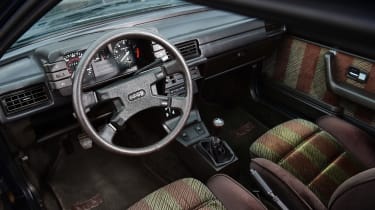
The contrasts continue when you insert the thin blade of a key into the ignition barrel and turn it to awaken the engine. The five cylinders catch and settle to a surprisingly muted idle, reminding you it’s only recently that performance cars have moved towards the peacocking flaring of engine revs with a crescendo of pops on start-up. Contrary to the points outlined above, in some ways things were more subtle in the eighties.
It’s very obviously a classic-car experience. Although the seats were probably the height of comfort and support around 40 years ago, they don’t offer much in the way of body frame-restraining sculpting. They also feel as though the seat frames themselves might not be quite as rigid as the day the Quattro left the factory; as you drop down into the admittedly low-set driving position, the backrest moves. There’s a fair level of adjustment, however, and despite the risk of skinning your knuckles or nicking a finger when reaching for some of the seat-adjustment levers, you can manipulate the Quattro’s seat to find a comfortable position that puts you in the prime place to really drive the Audi.
Maybe somewhat surprisingly for a car of this age, the gearchange continues this air of confidence. The shift action is not as baggy as you might expect, and while a little finesse is needed to make sure you find the right ratio, given the length of the throw, the mechanical interaction is pure, as is the meaty, hydraulically assisted steering that gives you a solid connection with the Quattro’s front end. Once you get used to the controls and their rate of response, you quickly learn to work with the car.

Audi UK’s example is looked after by NGM Services, and as with every heritage car in our line-up, the 10v is in fantastic condition. It is surprisingly quick, too – once you learn that the engine needs revs to deliver its best.
It’s swift below around 3,500rpm, but no more so than a downsized, turbocharged family hatchback. Maybe that’s doing the Quattro a disservice – or maybe it feels that way only because the relative climb in power and torque as the turbocharger begins to feed cool, compressed air to each of the five cylinders is so marked. Either way, once the Audi’s engine is on boost, it romps forward with a deep growl that has just a hint of underlying off-beat character to remind you this is a very special unit.
It pulls hard, and in the early eighties (Audi’s UK example is produced to original launch spec, but it is a 1981 car acquired before RHD development had begun) that 7.1-second 0-62mph time must have seemed as though it was approaching supercar levels of pace. Yet although around £26,000 was on the pricier side, the Quattro didn’t command a supercar tag. Also, with four- wheel drive allowing you to use all of the motor’s power on twisty roads, the Audi would have kept up with the best that Ferrari or Lamborghini was producing at the time.
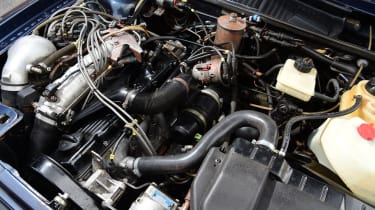
There’s no denying it does feel very nose-led – and that’s putting it kindly. This sensation is explained once you lift the Quattro’s expansive, square bonnet, because it’s immediately obvious just how far the longitudinally mounted engine protrudes beyond the front-axle line.
It means you always have to be mindful of the weight distribution, and it feels key to almost over-slowing the car into a corner, letting the front wheels find their line, and then getting on the power early to build through the turbo lag and deploy that motive force as effectively as possible.
Of course, this Audi is a cherished icon, so these sensations are subtle, and we’re driving with mechanical sympathy and the car’s age in mind. Yet you just know that, in its day, the Quattro would have stood up to punishment given the kind of reliability and mechanical solidity the brand became known for in the forests, on the asphalt and along the car-killing gravel roads of the World Rally Championship’s competitive stages.
Although the Audi was given a round of updates in 1983, moving to sleeker, one-piece headlight clusters and boasting some plusher trim inside, it wasn’t until the end of the decade that its 2.1-litre powerplant received any kind of meaningful mechanical improvements. They were significant, with Audi equipping the motor with four valves per cylinder compared with the original’s two-valve design – and so the 20-valve Quattro was born.
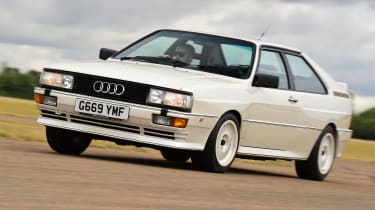
The engine’s displacement had also previously been increased from 2,144cc to 2,226cc – albeit initially still as a 10-valve set-up. Combined with the extra cubic centimetres of the larger 2.2-litre unit, the improved breathing from the extra valves per cylinder and crossflow-design cylinder head helped push power to 217bhp and upped torque significantly, to 309Nm. This new-found muscle was also available earlier in the rev range, dramatically boosting flexibility.
These improvements dropped the 0-62mph time by a considerable margin, to 6.3 seconds – a time we would consider relatively rapid in a compact hot hatch even today, so it would have been seriously impressive in a late-eighties performance coupé.
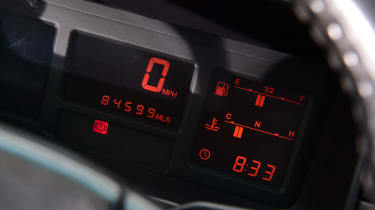
Inside, the trim updates were evolutionary, but they certainly modernised the Audi’s cabin. The velour trim remained, as did the controls for the lights mounted on the sides of the instrument binnacle, yet sitting between them was a much more modern dash layout, featuring digital readouts behind a sportier, three-spoke steering wheel wearing the Audi Sport badge. Even the vital readouts at the bottom of the centre console changed to digital bar graphs, while the heating and ventilation controls became more sophisticated compared with the original car’s horizontal sliders.
However, it was the mechanical tweaks that were key, and alongside the engine changes, Audi fitted a new Torsen centre differential. Whereas the original 10v featured a fixed 50:50 front-rear torque split, this 20v model benefitted from a more intelligent transmission. It might still be rudimentary compared with the standards set by ultra-variable all-wheel drive systems today, but allowing for as little as 25 per cent of the engine’s drive to be sent to the front wheels – or as much as 75 per cent – means you get a sense of the 20v Quattro offering just that little bit more adjustability on the move.
There is also the tangible feeling that Audi evolved the breed, retaining the car’s strengths while trying to tune out its weaknesses with the technology available at the time. The general dynamics and sensations are similar between the first and second iterations of the famous model line, but although you can sense the changes even today, they’re not night and day compared with the special machine that separated the 10v and 20v models in terms of the Quattro’s chronology.
That moment came in 1984, with the short- wheelbase Sport Quattro. A true homologation special, the newcomer was built in order for Audi to keep pace with rivals in the Group B category of the World Rally Championship. FIA rules stated that just 200 examples of these special machines had to be produced by each manufacturer to qualify it for competition (Audi actually built 214 Sport Quattros). Despite the low-volume production, the German brand went to town on the changes, chopping 320mm from the standard car’s wheelbase to improve agility and optimise weight distribution – even if the majority of the 2.1-litre motor was still slung out front ahead of the axle line.
In a bid to further alleviate the weight-distribution issues, the engine block and 20-valve cylinder head (actually the first four-valve, five-cylinder configuration for the brand) were constructed from aluminium, and along with extensive use of Kevlar, carbon fibre and fibreglass for the super-swollen bodywork that gives the Sport Quattro its characteristic square-set, wide-shouldered look, the car tipped the scales in road-going trim at a relatively lightweight 1,270kg.
The Audi was tuned significantly, with the engine receiving a larger turbo and a rally-spec intercooler to further chill the air compressed by the bigger blower. Power stood at a claimed 301bhp, while torque was said to be 350Nm at 4,500rpm – which meant a 0-62mph sprint time of a mere 4.8 seconds and a top speed of 155mph.
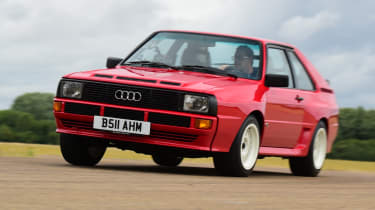
The Sport Quattro feels every bit good for those figures today. Off boost, the engine is still more urgent and eager than its simpler ‘civilian’ stablemates, but once the revs rise and the car climbs on boost, it’s explosively fast. Really, genuinely, modern kind of quick.
The classic five-cylinder warble is more apparent, too, while the then-new five-speed manual gearbox’s shift serves up a much shorter, more accurate throw compared with that of the 10v. It’s a pleasure to use, and you can rifle through the changes quickly to try to avoid the engine revs dropping and any consequent turbo lag. That is still very much present if you get caught off boost, so you find yourself beginning to chase corner speed in the Sport Quattro – especially given the reassuringly solid brakes – pumping the throttle in bends in an effort to keep the turbo spinning and access the performance as quickly as you possibly can.
Sometimes it’s in vain, sometimes it works – but in doing so, the changes Audi Sport made to the car’s chassis are also distinctly apparent. In its historical bumpf, the brand says that the Sport Quattro’s suspension set-up was so close to the rally car’s specification that it required exhaustive tuning for it to be used on the road.
Even today the system feels very different. It is taut and reluctant to yield, until the car is carrying significant momentum and the energy being forced into the suspension is beyond a certain level. Of course, by 2022’s standards it could still be classed as being on the soft side, with noticeable roll coming through as you push the pace. Yet by the yardstick of the time, the Sport Quattro was an uncompromising and focused car.
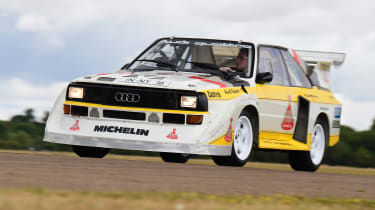
However, it was nothing compared with the Group B monster it spawned. The S1 E2 is the ultimate expression of the Quattro, and just being in its presence is enough to raise your pulse and excite your adrenal glands. Automotive aerodynamics have come a long way in the intervening years, even in rallying, but the S1 E2’s deep chin spoiler, huge box arches and simple, stubby rear wing (which also doubles as an air intake for the relocated radiators mounted in the boot) mean its shape couldn’t be mistaken for anything else.
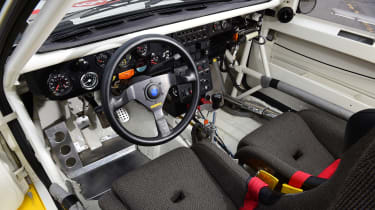
The doors are incredibly lightweight and made from Kevlar. They swing open without a stay, so you have to be careful in even a light breeze. Once you’ve threaded yourself through the chunky roll cage and unceremoniously plonked your backside into the one-piece seat, you’re immediately aware of just how old-school the car is. It has a manual boost controller, every dial is analogue and there are banks of fuses and switches, all labelled in German. It’s a relatively simple starting procedure, though.
Flick the first battery master switch on. Turn the second through the same 90-degree arc, and the fuel pump starts to whirr. We’re told not to touch the throttle at the risk of flooding the engine, so we simply push a nondescript black button to initiate the starter motor, which churns over slowly before the 2.1-litre engine catches into life with a near-deafening bassy rumble inside the cabin – and that’s with this car’s small exhaust silencer.
Everything buzzes and fizzes with menace, even at idle. We dip the seriously weighty clutch, and some of the percussive rattling stops before we select first gear. The shift is superb – ultra-precise, mechanical and loaded with feel. But now comes the hard part...
The paddle clutch is not only heavy, but like a hair trigger. It doesn’t appreciate being slipped, and the S1 E2 doesn’t suffer fools gladly, so we give it a flare of revs and
try to stop our thigh from shaking as we lift the left pedal to its biting point. Once there, you can get the car rolling (or sometimes kangarooing) before letting the clutch out fully a few moments later once the machine has built up some momentum. From there on in, all you need to do is kick the clutch as fast as you can for every change, up or down.
Variable boost meant that the Audi Sport works rally team could choose the power output for the surface and conditions in period – but we’re told the car is pushing out around 500bhp today, which seems plenty.
The motor’s characteristics off boost are similar to those of its road-going stablemates, and not that much happens here until between 4,500rpm and 5,000rpm. However, once the delicate yellow tacho needle sweeps through this point, you’d better hold on, because the power and torque ramp up so quickly and the car pulls with such explosive aggression that you’ll be seriously alarmed the first time it happens. And the second time, too. In fact, in our short exposure to this wonderful machine, we never quite got used to the ballistic delivery as the boost hit.
Dip the clutch, and forcefully – but still delicately – slice a new ratio home with the straight-cut gearbox, and the onslaught starts again. Only this time, there’s much less waiting as the turbo recovers from its brief pause.
The sensations are incredible: the noise, the vibrations, the physicality of the steering and how you have to work the brakes to get the car to shed speed – plus the S1 E2’s suspension hopping around on the bumpy surface as the rear pitches down under load and the nose seemingly points towards the sky. It all means you really have to drive the car, and reinforces to us that the ladies and gentlemen who drove these cars professionally in period were nothing less than super-human.
It’s a visceral, animalistic experience that’s a real privilege to sample, and once we’ve settled into it with a few laps under our belt, we start to notice a few more of the S1 E2’s delicate, nuanced qualities. The car responds well to being turned in on the brakes – and even though the weight distribution is what a modern engineer might call ‘sub-optimal’, once you can tuck the front end in with some extra weight on the nose the car starts to behave with a more neutral balance. Charge in too fast and the old fast-Audi understeer cliché will very much be apparent.
However, it’s the less subtle, more brutal personality traits that leave a lasting impression on us – primarily the speed, and how hard the boost hits, and the noise. Standing on the solid brake pedal and heel-and-toeing downshifts, you can hear the exhaust popping and cracking from beneath the floor. Our colleagues tell us the car was spitting sheets of evocative yellowy-red flames.
Moving from the rally car to the RS 2 Avant could have felt like going from a speed boat to a supertanker, but it really doesn’t. The Avant-only model really kicked off Audi’s fast-estate bloodline in the modern era and was, of course, powered by a five-cylinder engine. The 2.2-litre unit kicked out 310bhp and 409Nm of torque, which in an all-wheel-drive estate car weighing 1,595kg was enough for a 5.4-second 0-62mph time.
Released in 1994, the RS 2 was even claimed to accelerate from 0-30mph faster than a McLaren F1, while carrying a Maclaren pushchair in its boot.
For the Audi RS 2, the German brand teamed up with Porsche for some extra engineering know-how, resulting in that boosted engine output from a bigger turbo, new intercooler and uprated fuel injectors, plus ventilated four-piston brakes taken from the Porsche 968 Club Sport sitting behind 17-inch wheels from the 911 Carrera. On top of all that, the RS 2 benefitted from re-engineered suspension dampers, new anti-roll bars and an electronically locking rear differential as part of the four-wheel drive system, which could also be activated manually by a switch.
Even today, you can still feel these benefits that carved out this machine so distinctly as Audi’s first RS model. It’s easy to see why, nearly two decades ago, and as with the Quattro before it, the RS 2 brought something new to the automotive world. Whereas Audi’s counterparts from BMW M and Mercedes-AMG went for pure rear-wheel-drive layouts, by the brand staying true to its roots and sticking with all-wheel drive, it gave the RS 2 an unburstable character – with some magic from Porsche sprinkled on top of the package to elevate the model’s dynamic ability to new heights for the time.
There’s something inherently appealing about fast estate cars, and none more so than the RS 2, which pretty much coined the class. Its Nogaro Blue paint finish is iconic, and from behind the wheel it feels fast, pulling smoothly and with more linearity than you might imagine – certainly compared with its older counterparts.
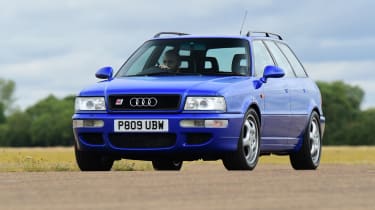
It’s far sharper than you might expect as well, and while it might not have been a true M3 competitor, it represented a different proposition. Today, it’s deeply cool. The eighties boxiness made way for softer nineties styling, with slightly more curvature to the RS 2’s body quite literally rounding the edge off its estate profile.
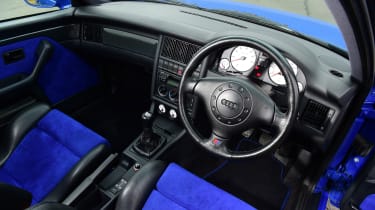
It feels special inside, too. The seats are superb – proper, figure-hugging sports items in a genuine family car – while the flashes of blue Alcantara and the white dials (including a row of three at the bottom of the centre console) mean the model’s cabin makeover matched its subtly pumped-up exterior.
From the mid-nineties, there’s a fairly large jump until Audi’s five-cylinder motor appeared again in a pukka performance car – first in the RS version of the second-generation TT in 2009, and then in the RS 3 of 2011. While further iterations of these models have come and gone, the configuration still powers the latest versions of Audi’s hardcore compact coupé and hot hatchback, with both cars likely to be the last that receive the famous five-cylinder unit before it bows out. But what a way to sign off.
The formula of a big, powerful engine in a compact car has long held appeal, and the current TT RS typifies this with a glorious soundtrack, huge performance and all-weather ability, thanks to its Haldex four-wheel-drive system – different from the old-school, traditional quattro set-up, because the engine is mounted transversely in the nose of both the TT RS and RS 3.
While the TT’s precise steering, rock-solid body control (although it gives a slightly fidgety ride) and explosive powertrain mean it still offers something unique going up against 2022’s four-cylinder Alpines and six-cylinder BMWs and Porsches, it’s actually the RS 3 that represents the most technologically advanced fast five-cylinder Audi. The motor plays a big part in that, serving up 395bhp and 500Nm of torque, but the clever RS Torque Splitter clutch pack does just as much for the car’s dynamic ability. Maybe even more.
The common theme running through all of these cars bar for this RS 3 is that, given where those five cylinders were often located within the body, Audi’s engineers often fought physics hard when it came to extracting agility from the brand’s machines.
However, the RS 3’s clever clutch pack can divert all of the available torque sent to the rear axle to just the outside back wheel, creating a much more rear-biased set-up that makes the car near on the most playful fast Audi we’ve ever sampled. Until now, true adjustability hadn’t been part of the playbook, but combined with a clever multi-link rear suspension layout, and much more controlled and forgiving suspension than even an S3, the RS 3 is dynamite. It’s precise and predictable, but it can also be a bit of a hooligan when you want it.
It’s pretty much the perfect car for Britain: small enough to work on our typically narrow roads; supple yet controlled enough to work with – not against – our often torn, broken Tarmac; fast and punchy enough to deliver a serious thrill without needing to achieve stupid speeds to do so; and, now, it has the agility to deliver a quality that’s becoming harder to find in increasingly complicated performance cars – fun.
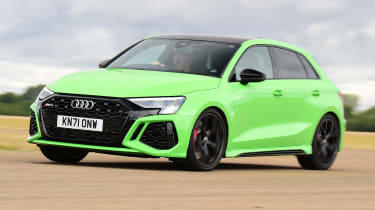
Make no mistake, the RS 3 still delivers on every five-cylinder check box from the past – noise, pace, visual attitude (especially in our car’s Kyalami Green finish) and a unique approach to performance being just a few – but it adds to this qualities that few Audis before it have possessed. Every single fast machine that follows from the brand won’t possess one facet the RS 3 does, however; the common link between all of the models we’ve lined up here – bar for one – is the engine configuration.
Sadly, the RS 3 is set to be the last car to feature this brilliant motor, and with Audi already embarking on its fully electric future, rapid RS models will be battery-powered and the five-cylinder unit will cease to exist.
Yet it would be remiss not to investigate this future here, and while we’ll mourn the loss of noise and the unique delivery of that turbocharged unit, there are many positives – as the company’s RS e-tron GT shows.
There’s another link to the brand’s past with this most modern of fast Audis; it has been developed in conjunction with Porsche. As with the RS 2, the RS e-tron GT borrows components and engineering expertise from its sister manufacturer. This time, it’s the J1 platform, battery and electric motors that are shared with Porsche, and the Taycan model in particular – and the similarities are obvious from behind the steering wheel, which is very much a positive thing.
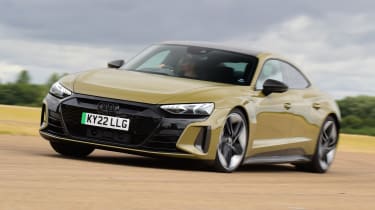
With up to 637bhp on overboost from its two electric motors, and a total of 830Nm of torque, the RS e-tron GT’s performance is of the explosive kind. Only the Group B car gets close to the level of clout this 2,276kg luxury electric four-door can deliver, and even then you have to wait for it in the S1 E2. In the 21st century Audi, it’s instant. This is what the electric age offers – and while we do lose in some places, we’ll gain in others.
But even in those areas in which we lose, it might not be by as big a margin as we think, because brands such as Audi are working hard on supporting elements of future packages to still deliver the experience enthusiasts want.
A futuristic five-cylinder soundtrack could well feature in forthcoming hot Audi EVs as a nod to the brand’s heritage, just as elements such as the box wheelarches on the RS 3 reference the original Quattro 40 years later.
What we should celebrate is how Audi has pioneered, nurtured and embraced its unusual five-cylinder engine over the years, and given us four decades of driving fun characterised by a superb soundtrack and stunning performance manifested in some very, very special cars.
Now read our list of the greatest German modern classics...