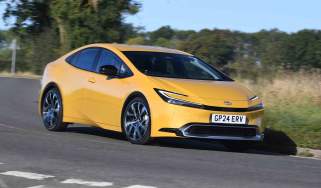
Long-term test: Toyota Prius Excel
Second report: Our PHEV’s safety tech is nagging a little too often – it’s time to reach for the ‘off’ switch

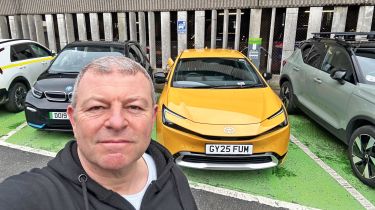

Verdict
While some of the Toyota Prius’s advanced driver-assistance systems have annoyed, the rest of the car is proving to be a seriously impressive package, with suspension that’s perfectly tuned for UK roads and average fuel economy that continues to improve.
- Mileage: 6,770 miles
- Efficiency: 78.2mpg
Although I wouldn’t yet say the honeymoon period is over, a couple of things about the Prius have started to irritate me of late, by far the most irksome of which is its over-zealous ADAS package.
Most of the features that help keep it on the road, and me out of harm’s way, work pretty well to be fair. And some of them are excellent, such as the rear cross traffic alert system that works a treat when you’re manoeuvring in tight spaces. Even the lane departure system – which in itself is too aggressive for me – is easy enough to switch off. Unlike the speed limit warning chimes, which are there every time you start driving.
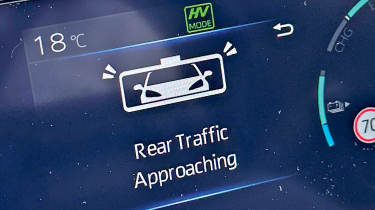
Most of the ADAS features I put up with, and shut up about, because, mostly, they are well enough integrated and don’t feel too intrusive from day to day. What I absolutely cannot be doing with, though, is the car’s Rear Vehicle Approaching Indication (RVAI) system.
Used - available now

2020 Toyota
Prius
61,896 milesAutomaticPetrol1.8L
Cash £19,600
2018 Toyota
Prius
52,000 milesAutomaticPetrol1.8L
Cash £12,990
2020 Toyota
Prius
72,650 milesAutomaticPetrol1.8L
Cash £14,995
2026 Toyota
Prius
10,480 milesAutomaticPetrol2.0L
Cash £26,195As far as I can deduce, this particular element of the ADAS package is unique to the UK market, because if you ask any AI search engine what it is and how to switch it off, they can’t identify it. Not until you add ‘on a UK-market Prius’ into the search, at which point it will tell you all about RVAI.
The defined purpose is apparently to “help monitor rear traffic to prevent tailgating incidents”. It does this by sensing vehicles that are approaching from the rear, then alerting the driver with a visual warning within the instrument display “alerting the driver to check their mirrors for safer lane changes and to prevent rear-end collisions”.
The first time I experienced RVAI was on the M23 when a bloke in a quick Audi came howling up behind me, quite clearly in a bit of a rush. I’d spotted him coming from a long way back but had nowhere to go; the M23 was busy that day and there was a train of cars both in front and to the side of me.
So the last thing I needed was a great big message within the instrument display warning me there was a “rear vehicle approaching”. All the message did was add (considerably) to both the stress and anger I was already feeling about being tailgated.
On reflection, however, it was the shock of the warning itself that was most perplexing – because my natural reaction on seeing it was firstly to come off the accelerator, and then brake. Which is surely what most folks will do – especially on a motorway – when they see a new, visually dramatic warning message light up half the dashboard. As such, I’d say RVAI is an entirely counter-intuitive safety feature, one that may well cause more accidents than it prevents.
Fortunately, and after much investigation, I’ve worked out how to deactivate it. Permanently. So it now stays off all the time, and I continue to be quietly blown away by how excellent the rest of this car is. I love how easy it is just to climb into and go, and the ride quality on our rubbish town roads is also a constant source of delight.
As is the 75mpg+ fuel economy, the light directness of the steering, the inherent smoothness of the superb hybrid powertrain, the general quality of the interior and its numerous toys, and most of all the fine comfort of its seats and the fundamental correctness of its driving position.
In short, I just really like climbing into the Prius and going for a drive in it, anywhere. I honestly wasn’t expecting that kind of satisfaction from a car like this – so long as the RVAI system is switched well and truly off.
Toyota Prius Excel: first fleetwatch report

Excellent efficiency and a usable electric-only range make the Prius a convincing antidote to ever-rising fuel bills
It’s easy to become quietly obsessed with your energy consumption when you’re a Toyota Prius driver. Journeys become missions to see how little fuel and/or electricity you can use, and you can easily forget how good the rest of the car is as a consequence. My personal best so far is 82.7mpg on a trip from Hove in East Sussex to Twickenham, south-west London, and back – a figure that I find frankly astonishing.
And since the price of fuel has started to sky-rocket, I mostly use EV mode to get about town, in which the Prius will do 40-45 miles for less than a fiver at my nearest public charging point. As a combination, and in this day and age, I’m finding the Prius more relevant – and just more excellent to live with – as each mile passes beneath its 19-inch wheels. It is, as they say, mustard.
Toyota Prius Excel: first report
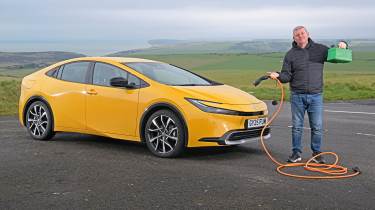
Surprises galore as Mk5 version of hybrid pioneer joins fleet
- Mileage: 5,350 miles
- Efficiency: 68.3mpg
I never thought I’d say this, but I’m already a huge fan of the new Toyota Prius that has just joined our fleet. It looks great, drives miles better than I expected, is way more refined than I thought it might be – and it returns a genuine 65mpg+ in everyday driving. As such, it’s an extremely easy car to like, and a difficult one to find fault with.

Ours is the top-spec Excel model, which comes on 19-inch wheels and has just one option, which is hard to miss because it comes in the form of Mustard Yellow metallic paint that costs an extra £655. This brings the total-as-tested price to £40,545, in return for which you get what is, I believe, one of the smartest, most relevant cars £40k can buy right now.
The powertrain is a plug-in hybrid set-up, as before, but Toyota has increased the outputs – and therefore the performance – substantially for this latest version. You now get 220bhp from the combined efforts of a 2.0-litre, four-cylinder petrol engine mated to a 13.6kWh lithium-ion battery with an electric motor and a CVT transmission.
That’s enough to propel the 1,610kg Prius to 62mph in a claimed 6.8 seconds and to a top speed of 110mph, with official CO2 emissions of just 17g/km. At my test average (so far) of 68.3mpg, that gives a theoretical range of over 600 miles from the 40-litre fuel tank, while in EV mode the claimed range is 53 miles. In reality, that figure is around 40 miles, while the on-board computer suggests a fill is required after not much beyond 450 miles because it doesn’t want to let you get anywhere near running out.
Even so, 500 miles or so is pretty tidy when the tank costs little more than £30 to fill at non-motorway petrol stations. To top up with electricity takes around five hours and costs me £6 at my nearest public charging point. The Prius doesn’t offer rapid charging, so it needs an overnight stop ideally. Which is fine if there’s a charge point on your driveway or nearby, not so fine if not.
The elements that have surprised and delighted me most so far – apart from the incredible fuel consumption, which is this car’s USP – are the ride and the quality of the cabin. I’m not sure why, but I didn’t expect the damping to be anything like as good as it is. It’s proved to be a super-refined car to drive on the increasingly poor road surfaces of Brighton and Hove, and it’s almost eerily calm and quiet on the motorway.
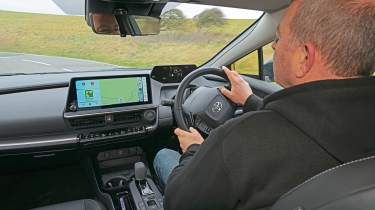
As for the cabin, I’m similarly amazed by how well made and high in quality the Prius feels. Equivalent-priced cars from VW, Ford and even Mercedes do not seem as top end as this. In many ways the Prius feels like a Lexus, with great seats, a lovely precision to all of its controls, plus a high level of equipment on offer, all of which comes as standard.
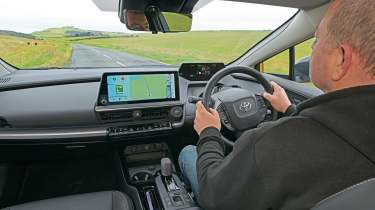
I’m learning to like the small instrument display, but suspect I will always wish it was a bit bigger, and a bit nearer. The 12.3-inch main central touchscreen is just fine, on the other hand, and appears to offer all the functionality you could want from a vehicle that contains this much technology. I haven’t yet been bamboozled by what’s on offer, which is a result considering how complex the Toyota’s features are.
Bottom line, I’m quietly blown away by how good this latest Prius is – not just as a car to drive, but as a machine to simply climb into, understand, and use each day. It appears to offer a unique combination of technology, economy, ecological awareness and good old-fashioned driver appeal, albeit in a contemporary kind of way. In short, I love it to bits so am struggling to find serious fault with anything. So far...
| Rating: | 4.5 stars |
| Model: | Toyota Prius Excel |
| On fleet since: | February 2026 |
| Price new: | £40,545 |
| Engine: | 2.0-litre 4cyl petrol PHEV |
| Power: | 220bhp |
| CO2/tax: | 17g/km/9% |
| Options: | Mustard Yellow metallic paint (£655) |
| Insurance*: | Group: 31 Quote: £1,300 |
| Mileage/mpg: | 6,770/78.2mpg |
| Any problems? | None so far |
*Insurance quote for a 42-year-old in Banbury, Oxon, with three points.
Buy a car with Auto Express. Our nationwide dealer network has some fantastic cars on offer right now with new, used and leasing car deals to choose from...