Toyota 4Runner review: thirsty, impractical US SUV is full of charm
Toyota’s rugged 4x4 is an excellent off-roader, but it doesn’t stack up as a family SUV


Verdict
The 4Runner’s utilitarian nature is both its biggest attribute and flaw. There’s so much character, charm and versatility here, you’ll be treating it more like a Swiss Army knife than a car. However, it’s supremely thirsty, with the hybrid not faring much better than the plain petrol, and a shortage of rear passenger space makes it a tough sell for family SUV buyers.
If you want a seriously capable off-road SUV from Toyota in the UK then the Land Cruiser has you covered, as it has done for many decades. But in the US, there are a few more options available, including the Toyota 4Runner, which is now in its sixth generation.
The 4Runner sits above the Toyota RAV4 in the US market and beneath the Land Cruiser starting from 42,270 dollars (around £31,000). That may sound very cheap for a large SUV, but bear in mind that the Land Cruiser costs from $58,080 in the US (around £43,000), while in the UK that same flagship SUV costs £80,945. If Toyota decided to bring the 4Runner here, we’d bet it would sit around the £60,000 mark.
The previous 4Runner lasted 15 years, selling almost 1.5 million units in that time. But when the current one arrived in 2024, it maintained that popularity with almost 100,000 sales in its first year. As it’s one of America’s most popular 4x4s, we couldn’t resist trying one in the States to see if we’re missing out.
Used - available now

2027 Genesis
Electrified GV70
3,081 milesAutomaticElectric
Cash £45,550
2024 Land Rover
Defender 90
24,403 milesAutomaticDiesel3.0L
Cash £52,636
2022 Nissan
Qashqai
15,186 milesAutomaticPetrol1.3L
Cash £20,499
2019 Volkswagen
Tiguan
85,300 milesAutomaticDiesel2.0L
Cash £15,495The latest version underwent significant changes with a new platform (although still a body-on-frame layout), exterior, engine, gearbox, interior technology and design – the latter heavily influenced by the Tacoma pick-up truck (America’s alternative to the Toyota Hilux).
The old, naturally-aspirated V6 options went out with the new model, so now there’s just a four-cylinder, available with or without hybrid assistance. The turbocharged 2.4-litre gets a tiny 1.87kWh battery with a 48bhp electric motor linked to the eight-speed automatic transmission for 326bhp and 630Nm of torque. The one we’re driving is the non-hybrid, essentially doing without the electrical side with a total power output of 278bhp and 429Nm of torque. Despite the power difference it’s only half a second off the hybrid from 0-60mph with a time of 7.5 seconds.
The hybrid system is pretty heavy too. Base versions of 4Runner weigh in from 2,021kg, but the higher-spec versions (when the hybrid becomes available) weigh up to 2,495kg. The non-hybrid is also better for towing, topping out at 2,721kg while the hybrid can haul 2,630kg.

With a bluff front end, a platform derived from a pick-up truck and four-wheel drive (although we had it in two-wheel drive mode most of the time), the 4Runner is not what you’d call economical. The good news during our drive across highways, mountain roads and around town was that we matched Toyota’s claimed economy figure, the bad news is that figure is just 21mpg under the US’ EPA testing cycle. Switching to the hybrid only raises that claimed figure to 23mpg, which is hardly worth it when you factor in the price premium of the electrified version to start with.
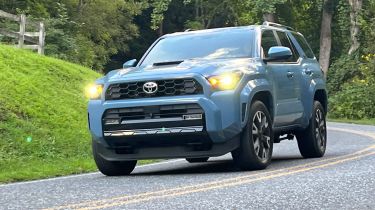
While it might look like an SUV, on the move the 4Runner can’t hide its truck-based underpinnings. Those more vertically challenged might need a running start to jump into the driver’s seat of the 4Runner because you do sit very high up – an early nod as to what this car is all about, if the blistered wheelarches, off-road tyres and various grab handles don’t already give it away.
Initially, you feel the driveline clunk into gear and there’s an obvious shimmy to the body in the immediate aftermath. At slow speeds and around town, the body control is a slightly odd mix of small, imperfect sections of road disturbing the peace and then large potholes and speedbumps being dispatched with ease. One thing that surprised us most was how intuitive and well calibrated the steering felt – Toyota has absolutely nailed the weight and response.
Visibility is a bit of a mixed bag. The air duct on the bonnet is fairly prominent and the exterior camera is mostly alright – apart from the terribly off-putting warped edges for a wider field of view. But if the 4Runner did make its way over to the UK, it would be no more difficult to thread through a village than a Land Cruiser or Land Rover Defender.
It’s a little less refined than either of those cars though. We’d hazard a guess that not as much sound deadening is used in the 4Runner compared with the Land Cruiser (and especially the Defender) with a slightly gruff engine note audible unless you’ve got a very light right foot. The ride settles far better at speed and while this might be a high-riding SUV, it’s surprisingly capable on a long motorway (or interstate) jaunt.
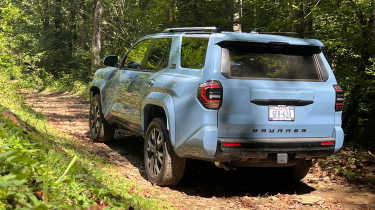
During our time with the 4Runner we managed some very light off-roading, or at least that’s how it felt behind the wheel, a RAV4 would’ve certainly been flummoxed by some of the terrain we comfortably cleared. The transfer case can be specified between high and low ranges with selectable two or four-wheel drive, the latter really only suitable on low-grip terrain, otherwise you’ll either overwork the tyres or damage the driveline. The slightly ponderous power delivery suits off-roading because you never feel like you’ll lose traction with a heavy right foot.
On the road the 4Runner feels slower than its 0-62mph time suggests with ‘Eco’, ‘Normal’ and ‘Sport’ drive modes having an effect on how long the big Toyota holds on to gears. On occasion we found ourselves looking to switch to manual mode to upshift.
Even though the cabin uses a different steering wheel, centre console layout and dash design to the Land Cruiser, it feels familiar inside. There’s a reassuring tactility to the switchgear and touchpoints, and while the 14-inch touchscreen (1.7 inches larger than the unit in the Land Cruiser) sits awkwardly on top, we had no issues with the responsiveness of the software, although switching between radio stations was a real pain because it forces you back to the favourites menu. Another slight gripe was that even in our mid-spec TRD Sport Premium car we counted nine very visible blanked-off switches.
As for practicality, the 4Runner isn’t as spacious inside as its size would suggest. There’s plenty of space to stretch out up front, but for rear passengers the raised floor makes legroom a little tight and the backrests are fairly upright, too. Clawing back some points is the boot, which in the five-seater, non-hybrid model has a capacity of 1,370 litres (measured to the roof). The rear seats have Toyota's ‘tumble-fold system’, which essentially means you can roll them forward with one hand to maximise boot space further.
Another practical side of the 4Runner we really enjoyed was the sliding back window. Unlike the Land Cruiser, which can pop up the back window on some struts, the 4Runner’s can slide down into the bootlid at the touch of a button - either on the boot itself or on the ceiling above the driver.
| Model: | Toyota 4Runner TRD Sport Premium |
| Price: | $56,180 (roughly £42,000) |
| Engine: | 2.4-litre turbocharged four-cylinder petrol |
| Power/torque: | 278bhp/429Nm |
| Transmission: | Eight-speed automatic |
| 0-60mph: | 7.5 seconds |
| Top speed: | 115mph |
| Economy: | 21mpg (US EPA) |
| CO2: | 282g/km |
| Size (L/W/H): | 4,950/1,981/1,844mm |
| On sale: | Now (in the US) |
Don't miss the best of Auto Express on Google! Make us a preferred source. Click here...