Car insurance scams: how to avoid them and what to do if you’re a victim
Well over 50,000 motor insurance scams were detected in 2024; we provide our top tips to help you avoid being the victim of one


Car insurance scammers are becoming more and more creative and devious. According to the Association of British Insurers, over 51,700 motor insurance scams were reported in 2024, worth over £576 million.
Whether it be ‘crash for cash’, spoof insurance ads or AI-powered ‘shallowfaked’ damage claims, insurance fraud can vary wildly, with many placing consumers right in the firing line.
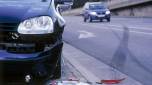
Head of intelligence, investigations and data services at the Insurance Fraud Bureau (IFB), Jon Radford, recently said: "Insurance fraudsters are relentless, and their tactics are evolving fast. Insurance scams can put people in danger and drive up costs for honest consumers, at a time when many are already under financial pressure.”
With all of this in mind, we sat down with Nicola Smith, Intelligence & Investigations Manager at the IFB, for an up-to-date appraisal of the current risks. We’ve also included some top tips on how to avoid being the victim of any of these scams.
Scams to avoid
Ghost broking
Ghost broking is one of the most prolific types of insurance scams, with cases rising by 52 per cent between 2022 and 2024. It involves an individual purporting to be an insurance broker, but secretly not being authorised by the Financial Conduct Authority to be one. These criminals will draw up a policy with a major provider for the consumer, only to manipulate the details in order to bring the cost down. Doing so renders the policy invalid, with the perpetrator often pocketing any savings.
“They usually sort of operate on social media or Facebook or Instagram, and they often target younger individuals whose legitimate insurance policies would probably cost a fair amount,” says Smith.
In other cases, she says, ghost brokers won’t initiate a policy at all, and are simply extorting money from victims. Regardless, drivers with concerns can check any insurance details via the Motor Insurance Bureau’s ‘Navigate’ web service (mib.org.uk), although not all insurers provide make and model info, meaning it’s not always possible to check that correct information has been provided.
Consumers should also avoid purchasing insurance through social media, something almost half of drivers aged between 17 and 25 admit to having done. Also keep an eye out for anyone asking for payment in cash/bank transfer, while it’s also worth questioning whether a quote looks too good to be true, as it often is.
Crash for cash
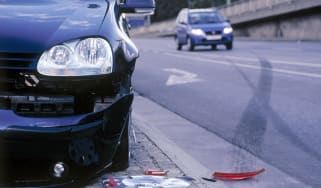
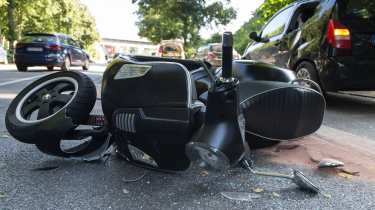
Crash for cash is becoming one of the most prevalent insurance scams, especially in major cities with perpetrators acting on mopeds or modified cars with disengaged brake lights. This effectively involves forcing an accident with another vehicle, only to claim against the innocent party’s insurance for excessive amounts for repairs or even for personal injury.
“We've seen all sorts of different types of crash for cash,” says Smith. “The classic induced incident will involve someone slamming on the brakes suddenly in front of you, often at a roundabout or a slip road – areas that might be quite successful in inducing an accident.”
The moped scams mentioned above are a newer development, and currently the most prolific.
“Essentially, moped drivers will linger at the end of public roads, or sometimes behind parked cars, and once a victim starts to drive towards them they will intentionally drive head first into your car or collide with it in some way, then submit claims as a result,” Smith says.
The main advice for this type of scam is to avoid being pressured to admit fault – scammers can often be intimidating – and look out for any shady signs, including pre-written insurance details and, as mentioned, disabled brake lights.
If anyone thinks they’ve been targeted by a ‘crash for cash’ scam, they should also report it via the IFB’s confidential Cheatline service.
Spoof car insurance adverts
One common tactic of scammers is to utilise paid search engine adverts to mimic legitimate insurance businesses online. This will boost their phoney site’s visibility, misleading people to think they are logging onto their actual insurer’s website. Through this, criminals will steal your data to either sell or forge fake insurance claims.
“If you're roadside, and you've just been involved in a crash and are quickly looking for your insurer's details online, you can click inadvertently on a fake link to report your incident,” says Smith. “Actually, at the other end is someone collecting data for illegitimate gain. You’ll think you’ve told your insurer about the claim, but you haven't - you’ve told a fraudster who's looking to gain financially from that situation and the information you’ve shared.”
The best way to avoid falling prey to spoof adverts is to keep your insurer’s phone number in your phone. It's also worth downloading your insurer’s official app if it has one or, if both fail, triple-check the website’s authenticity. Once again, if you come across misleading ads, report them to Cheatline.
Job listings/driving test identity theft
There are several other insurance scams out there online, mainly surrounding stealing personal information via fake job listings for delivery drivers and driving test pass certificates.
In the former scenario, scammers set up fake job listings for delivery drivers which, in legitimate circumstances, usually ask for diving licence details. However, in the case of scams, no real job exists and fraudsters instead steal applicants’ details to either sell or use in fake insurance claims. If you are applying for these jobs, do your research and ensure the place you’re applying to is legitimate by Googling their details or even visiting the establishment in-person and handing in an application there.
Details can also be stolen through driving test certificates; this documentation holds several personal details, which can be stolen if images are shared widely online. If you wish to celebrate passing your test, consider blurring out your personal details or just avoid picturing the certificate altogether.
Other insurance scams to be aware of
Fronting
This is a form of insurance scam where a driver becomes the fraudster, and it’s an application fraud rather than a claim fraud.
“When applying for insurance, someone might be tempted to mislead the insurer as to who will be the main driver of the vehicle in order to reduce the premium,” says Smith. “Typically this might be a teenager deciding that putting a parent as the main driver is a good idea in order to keep the premium down.
“However, this is insurance fraud,” she says. “It's illegal, and if you're stopped by the police and it's quite clear that you're the main driver of that particular vehicle, you face the same kind of consequences as if you are uninsured. You could have your car seized, you could have it crushed.”
Every week, three people are caught ‘fronting’ and placed on the IFB’s Insurance Fraud Register, with the ongoing consequence that it can become much harder and more expensive to find cover in future.
Shallowfaked claims
One of the newer developments in insurance fraud employs a phenomenon known as ‘shallowfaking’, which involves doctoring an image using AI – in this case, to make it look like a car is damaged when it isn’t. Fraudsters will do this to claim money via their insurance. However, firms such as Liverpool Victoria (LV=) are already implementing ways to combat this, including partnering with tech firms to detect AI-altered images, or even the voice patterns of serial scammers.
Have you been caught out by a car insurance scam? Let us know in the comments below...