Tesla Superchargers: who can use Tesla's charging stations and how do they work?
Unlike most electric car brands, Tesla has its own charging network, but who can use these Superchargers and how do they work?

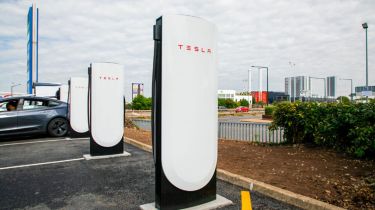
The Tesla Supercharger network has grown into one of the largest groups of electric car charging locations both in the UK and globally. While this service was originally reserved for Tesla drivers, the brand has now opened up a number of its sites to EVs from other manufacturers, too.
Tesla Superchargers, also known as ‘stalls’ can be found at Tesla Centres across the country, as well as at a large number of motorway service stations. These chargers can also be found at a number of businesses and tourist-heavy locations, so they can be a very convenient service to have at your disposal when you need to charge your car.
So what are the pros and cons of the Tesla Supercharger network and how does it work? Read on to find answers to all of these questions and more below.
What is the Tesla Supercharger network?
There are a variety of rapid charging providers in the UK, such as BP Pulse, Gridserve, Ionity and Shell Recharge, just to name a few. However, what makes the Tesla Supercharger network somewhat unique is that it belongs to an electric car manufacturer, rather than an energy company.
Tesla has continued to invest a huge amount of money and resources into expanding its UK infrastructure since it first arrived way back in 2014. Today, it’s now one of the larger networks in the country with thousands of units dotted around England, Wales, Scotland and Northern Ireland.
Tesla operates two different types of electric car chargers: Destination and Supercharger. As their name suggests, Destination chargers are typically installed at locations where people are most likely to spend a longer period of time, such as hotels or venues. The Supercharger network, meanwhile, is designed with rapid charging in mind, so these are typically found at motorway service stations and Tesla sales centres where drivers might stop on route somewhere. However, some Superchargers can also be found at locations such as hotels.
Can I charge my car using a Tesla Supercharger?
Originally, the Tesla Supercharger network was exclusively available to Tesla owners. However, May 2022 saw one of the biggest changes come into effect in the UK’s rapid charging network when Tesla opened its network up to non-Tesla drivers.
While some Supercharging sites are reserved exclusively for Tesla drivers, there are still plenty that are open for any electric car driver to use. This has provided a welcome expansion to the UK’s overall public charging network, and you can find details of which sites are open to non-Teslas by visiting the Tesla website. Some Destination chargers are also open to other compatible makes and models.
Only electric cars fitted with a CCS-type plug can use a Tesla Supercharger, while Destination chargers use a standard Type 2 connector, which should be compatible with most electric cars. A CCS plug is a standard Euro-spec connector that combines two DC pins arranged below the Type 2 connector, allowing for fast charging. The majority of electric cars should be compatible, but there are exceptions with older models such as the original Nissan Leaf, some Lexus models and early versions of the Renault Zoe.
How fast are Tesla Superchargers?
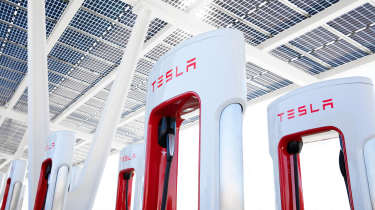
Tesla Superchargers operate two different power ratings of chargers in the UK with the V2 and V3 units providing power outputs of 150kW and 250kW respectively. The newer V4 chargers can supply power up to 250kW.
When the very latest V5 chargers arrive in the UK, they are set to provide a whopping 500kW. However, you’d need a compatible car if you wanted to see this sort of speed.
Destination chargers aren’t as quick as Superchargers, typically between 7 and 22kW. This is because they are intended to charge cars over a number of hours as opposed to the high powered Superchargers.
How do I find a Tesla Supercharger?
If you drive a Tesla, the built-in sat-nav will be able to guide you to the nearest Supercharger when you need to top-up. If you have a different make of car, you’ll have to do a little bit of research.
Firstly, you’ll need to download the Tesla app, as the older V2 and V3 Supercharger units don’t accept card or contactless payments (or even have screens), so all charging and payments will have to be done via the app.

The newer V4 Superchargers, however, feature a digital screen which allows for contactless payments, as well as providing a QR code for digital receipts. The V4 chargers can also be used through the Tesla app, and we’d still recommend downloading this as it’s the more convenient option.
Once you’ve downloaded the app, entered your vehicle and payment details (you’ll only need to do this once) and are ready to charge, choose the ‘find a charger’ button and locate the site where you are located. The app will then be able to give you more information about the location such as facilities, prices and number of available ‘stalls’.
How do I charge my car?
When you arrive at a Supercharger, simply reverse into the bay and plug the connector into your car. Once connected, the charging session will start automatically if you have a Tesla because the charger will be able to detect and communicate with the car straight away. However, if you don’t have a Tesla, things are a little more complicated.
- Plug the connector into the car. This may be a little trickier for some cars than for others, as Tesla chargers are designed for use with cars that have charging ports at the back on the passenger side - you may have to park a little creatively should your charging port be in a different location.
- Select your charger number on the app. This number and letter should be written on your chosen Supercharger and is usually found at the bottom. Once selected, press ‘start charging’ in the app. If you haven’t already entered your payment details, you will be directed to do this. Once completed, the charging session will begin.
- Keep an eye on the app. Should there be any issues with the charging session it will tell you, but connecting could take up to two minutes.
- To finish the charge, press ‘stop charge’. The session will end, so return the connector to the unit and you’re all done.
How much do Tesla Superchargers cost?
Tesla owners will automatically have access to the lowest Supercharging prices per kWh (kilowatt hour) and seamless car and charge post integration.
Non-Tesla owners who want to access the ‘open’ Supercharger stations frequently can sign up to a membership scheme for a monthly fee. This offers access to lower charging prices per kWh.
Drivers of other makes of electric vehicles can also charge without this subscription, but it’ll incur a higher rate per kWh. Prices can vary from site to site, too.
Typically, non-membership rates vary between £0.31 and £0.63 per kWh, depending on the time and location. Be careful, though, as Tesla also charges an additional ‘congestion fee’ if you occupy a charger with a charge of over 80 per cent during a busy period.
Tempted by a Tesla? Our dealers have plenty to choose from! Search for the latest deals…