Rivian CEO: I’ve learned from Elon Musk’s mistakes at Tesla
Rivian is seen by some as ‘the next Tesla’ - here’s why that’s both right and wrong

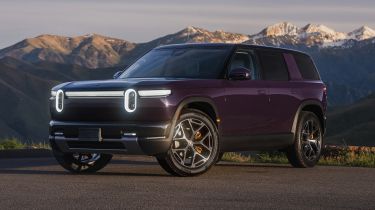
Rivian is the disruptive force that could make the world forget about Tesla. Just five years after launching its first model, the start-up behind the first-ever electric pick-up truck has taken America by storm, formed billion-dollar partnerships and is playing a key role in shaping the future of Volkswagen, Audi and even Porsche.
However, most Europeans have never heard about Rivian, and any discussion of the company inevitably involves mention of Tesla. In fact, it’s very easy for anyone unfamiliar with Rivian to see it simply as ‘the next Tesla’.
The two start-ups do have some things in common: both were born in California; both have high hopes for autonomous vehicles, neither allows Apple CarPlay in its cars, both utilise a direct-to-consumer sales model, and they each launched a groundbreaking flagship product before creating a more affordable, mass-market offering.
But while comparisons are appropriate (and logical, even), Rivian founder and CEO RJ Scaringe emphasises: “We're very different. Very different as a brand and very different in how we make product decisions.”
Perhaps the most important differentiator is that Scaringe is nothing like Elon Musk, whose association with the far-right in US politics and controversial antics have contributed to the noticeable drop in Tesla sales recently.
In contrast, the Rivian boss avoids the political spotlight, almost certainly to the benefit of his company. “I think Tesla becoming more political has certainly had the effect of certain people deciding that they don't want to be part of that,” Scaringe agrees.
“I think it's important not to be political because we really want to be able to sell vehicles to everybody. There’s a classic Michael Jordan line, ‘Republicans buy sneakers, too’, and it's the same with Rivian.
“There's a perception often that if you buy an EV, you have to be left-leaning, and that's actually not correct. We've done surveys of this and with the R1 it's about a 50-50 split [between Republicans and Democrats].
“So Rivian is like this unifier that tries to not be political, tries to embrace the essence of what it means to be human, which is the idea of exploring and the idea of curiosity driving exploring.”
But for all his controversies, Scaringe still acknowledges that Musk has done some good and the Tesla Model S laid the groundwork for the modern electric car landscape that Rivian is capitalising on. “Were it not for the Model S, I think the world would look different. It was a super-impactful vehicle,” he adds. In case you’re wondering, Scaringe informed us that he and Musk don’t talk often.
The story of Rivian, so far

For the many unfamiliar with the company, Rivian is a brand based upon functional yet approachable design, innovation and sustainability, and its mission is “enabling adventures, whatever form that is” says its creator who, as we chat, looks very much the picture of a charismatic entrepreneur; rolled-up jeans, box-fresh hiking books, an Apple Watch on one wrist and a Whoop fitness band on the other. It all conveys the ‘Silicon Valley meets Sierra Nevada’ image Rivian is going for.
Scaringe swears that from the age of 10 he wanted to build his very own car company, after being inspired by the story of Porsche, rather than a dream of being the next Henry Ford.
Admittedly, for a long time he had a somewhat romantic vision of what this could be like, explaining: “To me, it was just about building cars inside of a brick building.” But even after discovering the realities of what this journey would entail, in 2009 – just one day after graduating from MIT (Massachusetts Institute of Technology) – he established what would become Rivian.
Its first endeavour was going to be an electric sports car, Scaringe revealed to us, mirroring rival Tesla and the Roadster it launched just a few years prior. However, the team quickly abandoned that and eventually set about creating the world’s first zero-emissions pick-up truck, the Rivian R1T. It and its twin R1S SUV were revealed as concepts in 2018, long before anyone heard the word Cybertruck.
Things kicked into overdrive soon after. Ford and Amazon began investing big money in the start-up, and before Rivian’s IPO (Initial Public Offering) on the Nasdaq stock exchange in 2021 it was valued at $66.5 billion (£49bn at today’s exchange rate). But by the end of that year, Rivian was estimated to be worth roughly $150bn (£110bn) – more than BMW or Ford.
While its valuation has since slumped to around $22bn (about £16bn), Rivian has gone from a few people in a “pretty crummy” old warehouse to a 17,000-employee strong, ever-growing machine that Volkswagen has teamed up with as part of a £4.5bn (up to $5.8billion) joint venture. Uber also recently committed to investing up to £930million (up to $1.25billion) to help create as many as 50,000 autonomous robotaxis.
Rivian has also sold nearly 200,000 vehicles in the past five years, all in North America. For comparison, it took Tesla about nine years to achieve the same feat, and it was selling cars worldwide by then. What’s more, the brand has reported a year-on-year increase of deliveries in 2026, despite shaky interest in EVs in the US.
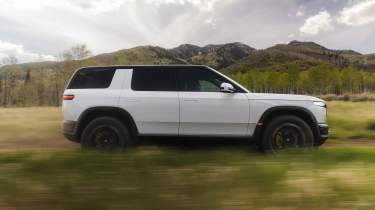
In fact, the Rivian R1S – a 5.1-metre long seven-seat SUV with a starting price of nearly $84k (circa £62,000) – is currently the biggest-selling luxury electric SUV in America, trumping rival offerings from Audi, BMW, Mercedes, Volvo and, of course, Tesla.
The brand recently launched the new Rivian R2 – a smaller, more affordable mid-size SUV that targets the Tesla Model Y – in America, with prices starting from under $45k (about £33,000). This will be the first model it sells in Europe and the UK, and was designed with European customers in mind, the Scaringe told us. The brand should arrive on our side of the Atlantic before the end of the decade.
Did you know you can sell your car through Auto Express? We’ll help you get a great price and find a great deal on a new car, too.