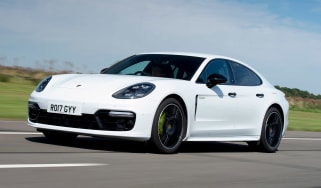
Porsche Panamera review
Effortless cruiser proves equally at home in town and on twisty country roads


Is the Porsche Panamera a good car?
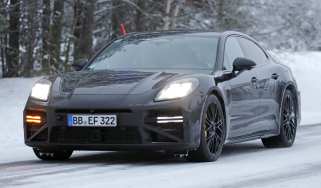
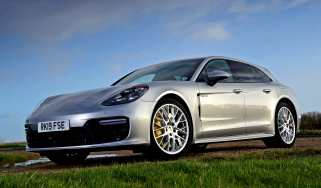
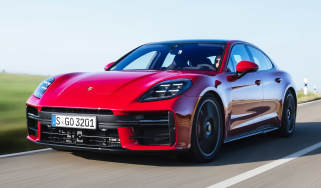
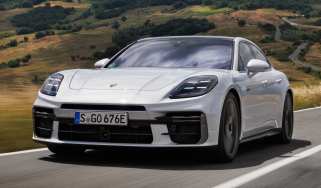
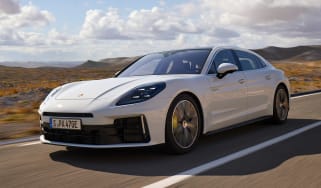
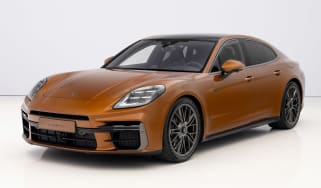
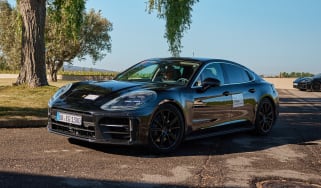
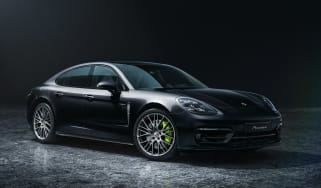
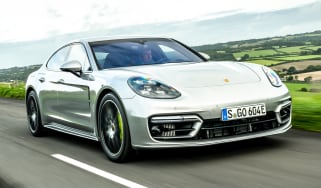
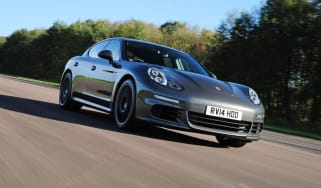
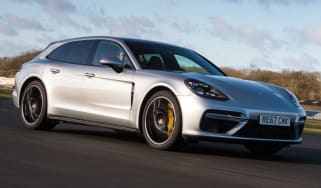
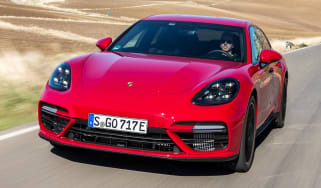
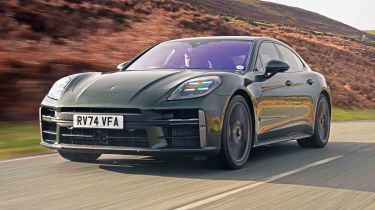
Revisions to the Porsche Panamera are subtle, but they have made a great executive car even better. The base model delivers more comfort and a sharper drive – albeit not at the same time – while moving up the range boosts performance into the realms of supercars. Unless you’re craving that extra sportiness, the base Panamera ticks all the right boxes, while the GTS version offers more than enough of a sharper edge and the hybrid versions are great for business users looking for a sporty exec. Long-distance cruising ability and a sense of occasion are standard with any Panamera, though.
| Key specs | |
| Fuel type | Petrol, plug-in hybrid |
| Body style | Five-door hatchback |
| Powertrain | 2.9-litre V6 turbocharged petrol, rear-wheel drive 2.9-litre V6 turbocharged petrol, four-wheel drive 2.9-litre V6 turbocharged petrol plug-in hybrid, four-wheel drive 4.0-litre V8 turbocharged petrol plug-in hybrid, four-wheel drive |
| Safety | Not tested by Euro NCAP |
| Warranty | Three years/unlimited miles |
How much does the Porsche Panamera cost?
With a starting price north of £80,000, the Porsche Panamera doesn’t come cheap, but that puts it on a par with premium executive models from BMW, Mercedes and Audi, which offer similar performance.
Porsche doesn’t do trim names beyond Carrera for the 911, so the starting point to the range is simply called the Panamera. It features a 348bhp 2.9-litre V6 twin-turbo petrol engine and rear-wheel drive, while an extra £3,000 gets you behind the wheel of the Panamera 4, which is the same car, but with four-wheel drive.
You have to spend more than £90,000 for a plug-in hybrid model, and the E-Hybrid features four-wheel drive and a 25.9kWh battery. This is connected to the same 2.9-litre V6 as the standard car, but the extra power of the hybrid powertrain increases overall output to 463bhp, while giving the E-Hybrid an all-electric range of 57 miles.
Used - available now

2013 Porsche
Panamera
95,998 milesAutomaticDiesel3.0L
Cash £13,299
2023 Porsche
Panamera
34,000 milesAutomaticPetrol2.9L
Cash £57,989
2023 Porsche
Panamera
23,700 milesAutomaticPetrol2.9L
Cash £55,650
2023 Porsche
Panamera
33,599 milesAutomaticPetrol2.9L
Cash £49,980For around £11,000 more, the Panamera 4S E-Hybrid has the same powertrain as the E-Hybrid, but the V6 engine is bumped up so that overall output is 537bhp. There’s a maximum EV range of 55 miles for this version.
The Panamera GTS is the driver-focused variant of the line-up, and it features a 4.0-litre twin-tubo V8 packing 493bhp connected to a four-wheel-drive transmission that has been enhanced with a sportier set-up.
At the top of the range, the Panamera Turbo and Turbo S are now E-Hybrid models as standard. They have 671bhp and 771bhp, respectively, and combine the 4.0-litre V8 from the GTS with the E-Hybrid’s battery system to deliver searing performance – the Turbo S can sprint from 0-62mph in an astonishing 2.9 seconds and has a top speed of 202mph. The all-electric range is a bit shorter for these versions, but is still in excess of 50 miles, while prices start from around £145,000 for the Turbo and just under £170,000 for the Turbo S.
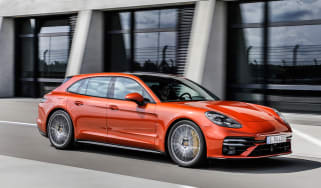
Every model in the Panamera line-up comes with an eight-speed automatic transmission, while Porsche Active Suspension Management, or PASM, air-suspension is standard on all cars. The only body shape offered for the third-generation Panamera is the low-slung five-door hatch – Porsche has yet to reveal a Sport Turismo estate variant of the current car.
As with any Porsche, it’s easy to get carried away with the options list and see the price rocket if you select too many. Among the kit on offer is the excellent Active Ride Control system (£7,000), but other extras such as a Burmester sound system (£4,500), Sport Design Package (£4,300) or 21-inch wheels (£4,000) don’t add enough to make the additional expense worthwhile.
Engines, performance & drive
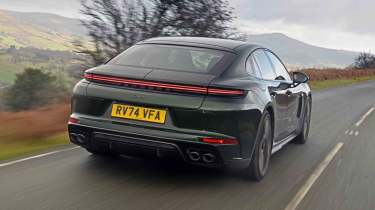
As much as any other car on the market, the Panamera has a huge spread of abilities, from comfort and refinement at one end of the spectrum, to engaging handling at the other.
The two engines on offer in the range are potent V6 and V8 powerplants, with E-Hybrid assistance for the versions carrying that badge.
The standard car is enjoyable to drive, with the 2.9-litre twin-turbo V6 delivering 348bhp and 500Nm of torque for a 0-62mph time of 5.3 seconds, or five seconds exactly for the Panamera 4 and its four-wheel drive traction.
For many short journeys, the E-Hybrid models are capable of driving on electric power alone. On these occasions, the car is smooth, silent and has enough performance to keep up with the daily commute. The integration between electric motor and petrol engine is among the most seamless around. Aside from the menacing burble when the V8-powered Turbo models burst into life, there are no jolts or delays in power to reveal that the system is switching from one power source to the other. In this regard, it’s much more impressive than its predecessor.
However, the transition between motor regeneration and mechanical braking isn’t smooth; the change in deceleration doesn’t match the amount of pressure the driver is applying through the pedal.
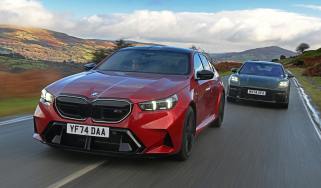
Compared with rivals such as the BMW M5, the Porsche’s drive modes are refreshingly simple. The ride height and suspension firmness can be adjusted, and so can the powertrain response. Regardless of driving mode, the steering stays the same – and that’s because Porsche got things so right in the first place that there’s no need to tinker.
Beside its rivals, the wheel’s weight and response feel so natural and predictable, even with four-wheel steering fitted, that it has a profound effect on driver enjoyment and confidence when exploiting its performance. And there’s a huge amount to exploit, too. When equipped with the optional active suspension, the Panamera’s ability to control its weight through turns – the hybrid versions in particular – is staggering.
It allows enough movement for the driver to feel the tyres load up, but not to a point where the chassis starts to unravel on a challenging road. That weight blunts the overall feeling of sharpness, which means for the most part you feel encouraged to take a step back and enjoy the flow of that chassis. While the feel at the top of the brake pedal’s travel could be better, when you’re really leaning on the brakes, they offer phenomenal stopping power.
Once away from a twisty B-road, you only need to switch the suspension into its most forgiving setting to deliver superb comfort. Cruising at the UK motorway limit is effortless; the air-suspension system hunkers down to improve aerodynamic efficiency, and stability is brilliant.
The only minor negative comes from the fat tyres on higher-spec cars, which generate plenty of road noise. This is more noticeable in the E-Hybrid versions, given that a top speed of 87mph in EV mode means drivers will have no issue completing some motorway trips in the near silence this brings.
The Panamera GTS uses an unassisted twin-turbo V8 that packs 493bhp (or 500PS in metric horsepower) and 660Nm of torque, and is good for 0-62mph in 3.8 seconds, accompanied by a typically engaging soundtrack. It also comes with an enhanced chassis and Normal, Sport and Sport Plus driving modes, while the brakes and suspension have been beefed up to deliver a more focused drive. For driving enthusiasts, it’s the version of the Panamera to choose.
We never felt that the previous Panamera Turbo E-Hybrid lacked performance, but there’s an uplift here in the form of an extra dose of electrical assistance, raising power from 134bhp and 400Nm to 187bhp and 450Nm. Combined with a 4.0-litre twin-turbo V8 which produces 512bhp and 770Nm on its own, the Turbo E-Hybrid now makes 671bhp and 930Nm.
While these figures are a little down on a BMW M5, the Porsche still outsprints the BMW from 0-62mph, taking just 3.2 seconds. It’s also worth noting that this isn’t even the peak of the range; the Turbo S E-Hybrid offers up 771bhp and a staggering 0-62mph time of just 2.9 seconds. In all its applications, the V8 sounds fantastic, with a thunderous growl right the way through the rev range.
| Model | Power | 0-62mph | Top speed |
| Panamera | 348bhp | 5.3 seconds | 169mph |
| Panamera 4 E-Hybrid | 463bhp | 4.1 seconds | 174mph |
| Panamera GTS | 493bhp | 3.8 seconds | 188mph |
| Panamera Turbo S E-Hybrid | 771bhp | 2.9 seconds | 202mph |
MPG, emissions & running costs
Just because there’s potential for driving in zero-emissions mode doesn’t make the Panamera Turbo E-Hybrid a friend of Greenpeace. As with any plug-in hybrid, regular recharges to make the most of that battery energy are an absolute must – and ideally that energy needs to come from a cheap home electricity tariff to make it financially worthwhile.
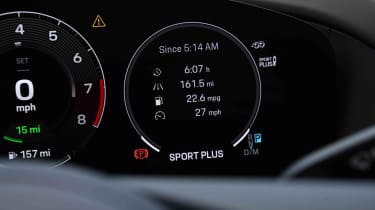
With a light right foot and regular charges, then the official 235.4mpg figure would be achievable, but stretch the Panamera’s legs on the sort of long-distance trips it feels built for, and the figure will soon start to drop. On these sorts of drives, we achieved somewhere closer to the mid-30s to the gallon, which is still a respectable return considering the huge performance on offer. A Panamera GTS, which does without the hybrid tech, returned roughly 10mpg less in our hands, but it also costs £18,000 less to buy in the first place – you’d need a lot of mileage in electric mode to make the fuel savings financially worthwhile.
Officially, the Turbo E-Hybrid will cover up to 49 miles between charges, and while we haven’t achieved that ourselves, we could imagine that on a warm day, and with more low-speed driving, this figure could be reached. Charging the battery fully from empty takes two hours and 42 minutes through its 11kW on-board charger. Thanks to its huge 80-litre fuel tank, the Panamera is still capable of long distances between refills after the battery is used up.
The lower-powered Panamera 4 E-Hybrid and 4S E-Hybrid are better, with official all-electric ranges of up to 57 miles, and economy figures of 282 and 256mpg respectively. Low emissions of 23-24g/km and more affordable list prices boost company car costs.
Elsewhere, the standard Panamera returns claimed fuel economy of 29.1mpg, with the Panamera 4 returning 27.7mpg. The poorest performer is the Panamera GTS, which has a claimed combined figure of 23.5mpg. Emissions are equally steep, ranging from 219 to 274g/km.
A higher-rate income tax payer will face annual deductions of £5,090 in the 2025/26 tax year, while upcoming revisions to the emissions-testing standard will adjust the Turbo E-Hybrid’s real-world CO2 figure higher.
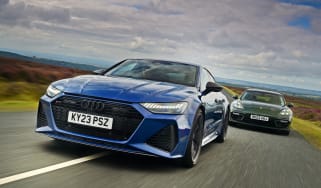
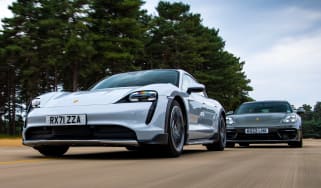
As for other running costs, it’s no surprise to discover that the high-end, high-performance Panamera slots into the top insurance group 50 throughout its range. Residual values are another talking point, with the Turbo E-Hybrid being the best performer in the range; it’s predicted to hold on to 52.4 per cent of its original value after three years. This figure is also much stronger than what can be expected from direct rivals such as the BMW M5, the pure-petrol Audi RS 7 and Porsche’s own all-electric Taycan.
| Model | MPG | CO2 | Insurance group |
| Panamera | 29.1mpg | 219g/km | 50 |
| Panamera 4 E-Hybrid | 282.5mpg | 23g/km | 50 |
| Panamera GTS | 23.5mpg | 274g/km | 50 |
| Panamera Turbo S E-Hybrid | 201.8mpg | 31g/km | 50 |
Design, interior & technology
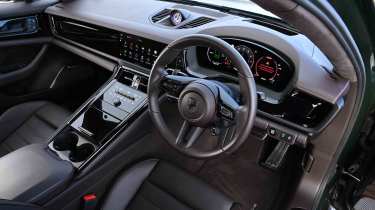
Opulent yet sporty surroundings make every journey in the Panamera feel like an event, regardless of whether you’re sitting in the front or the back.
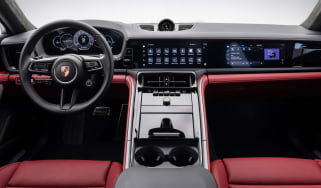
For this generation of Panamera, Porsche significantly pared down the interior, particularly around the fussy centre console. The previous button-heavy design has been stripped back so that only the volume and climate controls remain as physical switches, with the remaining functions moving onto the infotainment screen.
Even the gear selector has moved from its old position to a location more reminiscent of that in the Taycan; the old, large lever has been replaced with a small toggle switch just beside the steering wheel. The wheel itself is a perfect size and is fantastic to hold, while the high sides to the centre console make you feel like you’re sitting inside a Porsche 911 – albeit an even more luxurious one.
The fit and finish is flawless. Most surfaces are covered in leather, and those that aren’t still feel suitably expensive to the touch. There’s a little too much gloss black in areas where it might be susceptible to scratches, but otherwise the Panamera’s cabin feels worthy of that lofty price tag.
The latest Panamera ditches the analogue rev counter of the old car and replaces it with a fully digital instrument panel. Although it doesn’t really change how clearly the information is presented to the driver, it doesn’t quite look as evocative.
Sat-nav, stereo and infotainment
The Porsche Connect infotainment set-up isn’t burdened with having to control the climate functions, which makes it easier to appreciate the neat menu layouts and the system’s crisp graphics. Loading times aren’t quite as quick as they are with the system found in a BMW 5 Series, for example, but nor is the screen as large, which some users might prefer. The main menu functions are logically presented, and a side bar makes it easy to select the main ones. An optional passenger display (£1,300) allows a co-driver to programme navigation instructions more easily, meaning the driver can keep their eyes on the road.
Boot space, comfort & practicality
The first surprise with the Panamera comes even before you’ve stepped inside. Cars equipped with the Active Ride Control system will jump up a couple of inches as you open the door, making access that little bit easier. The speed at which it springs up is surprising the first time, and if you don’t like the system, it can be disabled.
Once inside, the driver is treated to a great seating position that has a huge range of adjustment for the seat and the wheel. Storage is generous, with covered cubbies in the tall centre console providing plenty of space for trinkets.
As standard, the Panamera comes in a four-seat configuration, but a three-seat bench is optional (Porsche calls this 4+1, to emphasise the temporary nature of the extra space). Regardless of the configuration, the Panamera feels incredibly luxurious in the back; lashings of leather and wonderfully supportive seats make it a much plusher place to travel than in the rear of the more spartan-feeling BMW M5, for example. The BMW is more spacious, and ultra-luxurious alternatives like the Bentley Flying Spur even more so, but the Panamera isn’t short of either kneeroom or headroom.
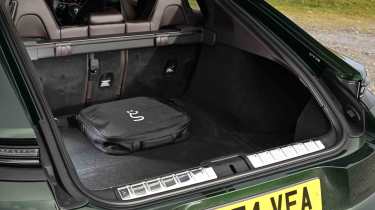
At 421 litres, the Panamera’s boot capacity isn’t very generous for a car as large as this, but the hatchback opening makes for a spacious load bay with the rear seats folded. This frees up 1,255 litres of storage in total and adds useful length.
| Dimensions | |
| Length | 5,054mm |
| Width | 1,937mm |
| Height | 1,421mm |
| Number of seats | Four (five optional) |
| Boot space | 421-1,255 litres |
Safety & reliability
Porsche has ranked highly in our annual Driver Power customer satisfaction surveys in recent years. While 2024 saw the brand drop from the top spot it secured in 2023, a fourth-place finish overall (out of 32 brands in total) was still a great result.
All Panameras come with a three-year warranty. The battery pack in E-Hybrid models is covered separately for a period of eight years – that’s two years longer than the comparable warranty on PHEV versions of the BMW 5 Series.
Porsche recommends an annual inspection for peace of mind, but it isn’t mandatory in order to maintain the Panamera’s warranty. Otherwise, servicing of fluids, filters and other consumables is only required every other year, or at intervals of 20,000 miles depending on your annual mileage.
| Key standard safety features | Euro NCAP safety ratings |
|
|
Porsche Panamera alternatives
The Panamera sits in something of a unique position in the new-car market. The entry-level models challenge higher-spec, sporty versions of the BMW 5 Series and Mercedes E-Class, while the E-Hybrid models will appeal to upper management business users.
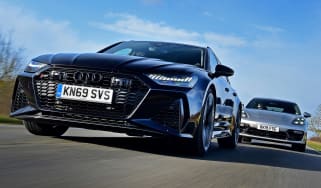
The sporty GTS and Turbo models are on another level, with the former rivalling the BMW M5 and Mercedes-AMG models such as the E 63, Mercedes-AMG GT 4-door and even the Mercedes-AMG S 63. You could even consider the Bentley Flying Spur as an alternative.
Frequently Asked Questions
Porsche offers a fairly standard three-year warranty on the Panamera, while there’s unlimited mileage on that cover and roadside assistance available for the same period.