Porsche Macan Electric review
Hi-tech, good to drive, and with a high-end interior, the Macan Electric feels like a proper Porsche

Our opinion on the Porsche Macan Electric
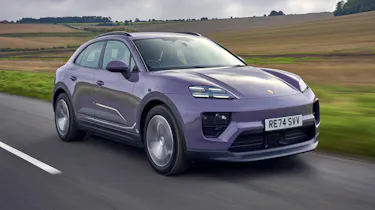
The Porsche Macan Electric feels like a Porsche in all the right ways: cutting-edge technology, a carefully crafted cabin and sharp yet approachable driving dynamics. The cheaper rear-wheel-drive model has the best range of all and loses little to the four-wheel-drive versions dynamically, plus it has the best ride. But with all versions, be careful with the options list; you can make this a six-figure SUV without too much effort.
About the Porsche Macan Electric
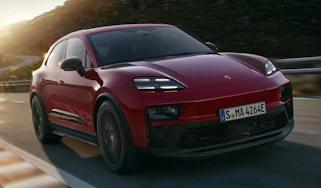
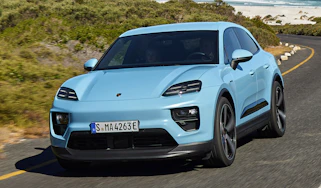
Building on the success of the original petrol (and briefly diesel) Macan, the Porsche Macan Electric draws on the experience gained from the electric Taycan to give buyers the sporty yet practical SUV they've come to know and love, but updated for the modern zero-emissions era.
Challenging the likes of the Audi Q6 e-tron, BMW iX3 and Mercedes EQE SUV, the Macan Electric comes with a choice of single and dual-motor powertrains – both mated to a hefty 100kWh (96kWh usable) battery for up to 399 miles of range in single-motor, rear-wheel drive form.
The less expensive versions of the Macan Electric range will take the lion’s share of sales, starting with a rear-wheel-drive model with conventional coil-sprung suspension, but sharper-handling GTS and bonkers high-performance Turbo models (the latter without an actual turbo, of course) are also available for those looking for a bit more entertainment.
Used - available now

2026 Porsche
Macan
15,000 milesAutomaticPetrol2.9L
Cash £56,490
2018 Porsche
Macan
46,965 milesAutomaticPetrol2.0L
Cash £22,197
2021 Porsche
Macan
44,000 milesAutomaticPetrol2.9L
Cash £39,989
2018 Porsche
Macan
51,574 milesAutomaticDiesel3.0L
Cash £22,432We’ve driven various versions of the Macan Electric, including the Porsche Macan Electric GTS, which we’ve reviewed separately.
Performance & driving experience
Pros |
|
Cons |
|
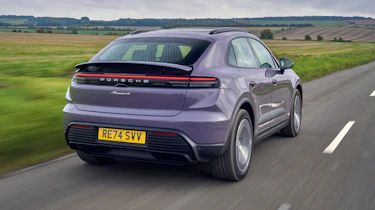
If the Macan Electric struggles in any one area, it’s ride comfort – specifically at lower speeds and around town. There are precious few ways to circumnavigate an electric SUV’s essential raised ride height and hefty kerb weight, other than to fit slightly stiffer suspension. This firm setup is something that can cause the Macan Electric to fidget over rough surfaces and clunk through deeper potholes.
The cars we tried had adaptive air suspension (optional on the entry-level, 4, and 4S trims; std on GTS and above), but the smaller 20-inch wheels offered a noticeable improvement – especially in an urban environment. Both versions (4 and Turbo) felt more pliant and tied down on the motorway or over faster, more undulating roads.
Performance, 0-60mph acceleration and top speed
Even the entry-level car has 335bhp (355bhp on overboost with Launch Control) and can do 0-62mph in 5.7 seconds. Acceleration is strong but progressive, making it easy to modulate and feed in power out of the bends. The Macan 4 delivers 382bhp (402bhp LC) and hits 62mph from rest in 5.2 seconds; it doesn’t feel as urgent or snappy as a Tesla Model Y Performance, but the softer throttle enables a more comfortable day-to-day driving experience. If this isn’t enough, the 4S has 442bhp (509bhp LC) and does 0-62mph in 4.1 seconds.
Then we get to the seriously quick versions, starting with the 509bhp GTS (563bhp LC) that’ll do 0-62mph in 3.8 seconds and romp on to 155mph. Meanwhile, the 576bhp (630bhp LC) Macan Turbo Electric will do 0-62mph in just 3.3 seconds and top out at 162mph.
In terms of straight-line speed, we suspect only a handful of owners will feel the need to step up from the base Macan or Macan 4 Electric to the flagship Turbo.
| Model | Power | 0-62mph | Top speed |
| Macan Electric | 335bhp (355bhp with LC) | 5.7 seconds | 137mph |
| Macan 4 Electric | 382bhp (402bhp with LC) | 5.2 seconds | 137mph |
| Macan Turbo Electric | 584bhp (630bhp with LC) | 3.3 seconds | 162mph |
Town driving, visibility and parking
Although it wears a respected sporting badge, the Macan Electric is as easy to drive as most other EVs when navigating the city streets. Rear-wheel steering does make manoeuvring around tight bends just that bit easier, but we found this system to be a bit too quick in its operation during testing, so much so that it felt slightly unnatural. There’s also a trade-off for the Macan’s sporting credentials, and that is a rather firm ride at lower speeds.
Porsche’s Park Assist and a reversing camera are standard across the line-up, making parking a little less stressful. Of course, the dealer will be only too happy to sell you an upgraded 2D surround view camera and an automated parking system available for nearly £900 as an individual option, or as part of the £5,000 Luxury Package on rear-wheel drive and 4 models. There's also a 3D surround-view camera system for an even pricier £2,300, which is bundled with a keyless-entry digital key.
Country road driving and handling
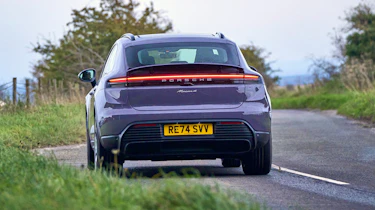
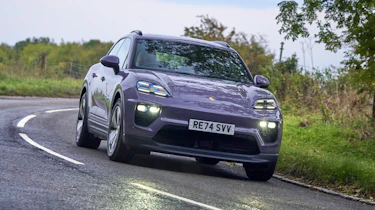
As with just about every other Porsche in existence, blasting the Macan Electric down a twisty B-road is a real source of joy. What’s particularly pleasing about this EV is the control weights. While the steering doesn’t have the granularity of an old hydraulic rack, it’s precise and consistent, and the grip on offer means the car will turn on a dime. The brakes are smooth; there are no adjustable brake energy regen settings, but the transition between recuperation and the conventional discs and pads is absolutely seamless. And despite weighing considerably more than its predecessor, the Macan Electric's centre of gravity is 140mm lower, so it remains remarkably agile.
The Macan GTS adds torque vectoring and adaptive air suspension for even better control through fast, sweeping bends, and feels just as alert as any other high-performance electric SUV. The GTS uses the more powerful rear motor from the Turbo version, and it's meant to give the car a more rear-driven dynamic than the 4 and 4S models, but we felt it still handled neutrally when booting the throttle out of a corner. We also noted that with the suspension's 10mm reduction in ride height and larger 21-inch wheels, the ride never really settles down, even when you go from the car's firmest sport plus driving mode back to its normal settings.
We really like the brakes on the GTS, which blend regen and the car's mechanical brakes just as imperceptibly as the regular Macan, but has uprated 400mm front discs with six-piston calipers and 350mm rear disc set-up to provide phenomenal stopping power.
Motorway driving and long-distance comfort
There’s little question of the Macan’s ability to reach motorway cruising speeds, but we found the most effective way to boost refinement is to opt for the smaller 20-inch wheels. The suspension tweaks and larger 21-inch wheels of the Macan GTS make it feel firmer than a BMW iX3, and its heavier steering requires more effort to move it off centre. One way to help is to specify the Drive Assist package for around £900, which, when switched on with adaptive cruise, helps keep the car centred in your lane by making small steering corrections. It can even switch lanes for you if it deems there is space to do so in the lane you're indicating to go into.
You can also opt for laminated glass for better noise insulation, at around £800 (£1,200 if you want the windows tinted), but oddly, laminated glass isn't compatible with the optional rear windscreen wiper.
Range, charging & running costs
Pros |
|
Cons |
|
Electric range, battery life and charge time
Porsche claims up to 398 miles on a charge using the WLTP test procedure for the single-motor version. Driving a dual-motor Macan 4 Electric on a fast and demanding test route showed an overall efficiency of around 2.9m/kWh, which translates to a real-world range of around 275 miles. However, we reckon a gentler right foot would easily see that figure surpass the magic 300-mile mark, and get closer to its official figure of 379 miles.
The quicker 4S version has a similar range of 376 miles, while the range-topping Turbo drops this to 366 miles to a charge. The GTS gets the least number of miles to a charge, at 362 miles. In a week of testing the latter, we found the estimated range to be more like 320 miles at a steady cruise, dropping to as low as 280 miles when driven enthusiastically.
However, the good news is that if you do drain that battery quicker than you might like, the Porsche’s 800-volt architecture allows for an ultra rapid charging peak of 270kW, which should mean that a 10-80 per cent top-up can be completed in just 21 minutes.
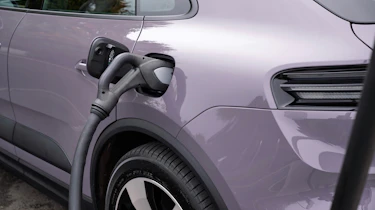
The Macan Electric gets two 11kW AC charge ports (one on either side) to make home or on-street charging more convenient. The big battery means a full charge via a conventional 7kW home wallbox is likely to take the best part of 13 hours.
All Macan Electric models get an eight-year or 100,000-mile warranty for the battery pack, guaranteeing it will maintain above 70 per cent capacity for that period, otherwise it’ll be replaced.
| Model | Battery size | Range | Insurance group |
| Macan Electric | 96kWh | 398 miles | 44E |
| Macan 4 Electric | 96kWh | 379 miles | 46E |
| Macan Turbo Electric | 96kWh | 366 miles | 50E |
Insurance groups
Insurance costs for the Macan Electric are on par with rivals like the Audi Q6 e-tron, starting in group 44 for the entry-level Macan Electric, before rising to group 50 for the quickest Turbo version. If you need a quick electric SUV that’s slightly more affordable to insure, you’ll have to look at a Volvo EX40, because its quickest Twin Motor Performance version is in group 40.
Tax
Electric cars no longer qualify for zero Vehicle Excise Duty (VED) road tax due to changes that were implemented in April 2025. Year one costs a modest £10, but it climbs from year two onwards due to every version costing more than the £50,000 luxury car tax limit for EVs. On top of the standard annual rate of £200, you’ll also need to pay an additional £440 per annum from years two to six.
There’s a bit of relief for company car drivers, though, because you’ll enjoy a Benefit-in-Kind (BiK) company car tax rate of four per cent for the ‘26 to ’27 tax year, five per cent from ‘27 to ‘28, and seven per cent from ‘28 to ‘29.
EVs would also be subject to an eVED pay-per-mile fee if that comes into force from April 2028 onwards.
Depreciation
According to our depreciation data, the Porsche Macan Electric is likely to hold on to its value better than its closest rivals. After three years or 36,000 miles, the Macan Electric is likely to hold on to between 54 and 57 per cent of its original value. That’s better than the Audi Q6 e-tron range (43 to 48 per cent) and much better than the Volvo EX40, which is likely to retain only 37 to 40 per cent of its original value over the same period.
Interior, design & technology
Pros |
|
Cons |
|
As with the rest of the car, there are plenty of options to choose from in order to make your Macan Electric’s cabin as distinctive as you see fit. The Macan’s interior is black as standard, though, as with every Porsche, everything is highly customisable. Leather starts from around £1,300, while ‘Extended’ leather is more than double that, but brings softer materials throughout, including the lower parts of the doors and dash.
Elsewhere, every car comes with eight-way electrically adjustable heated front seats, two-zone climate control, twin screens with Apple CarPlay and Android Auto, LED lights, and those aforementioned 20-inch wheels. Upgrade to the GTS or Turbo, and beyond the extra power, you get adjustable air suspension, 21-inch wheels, adaptive LED headlights, 18-way electrically adjustable front seats, a heated GT steering wheel, and an upgraded BOSE sound system.
Interior and dashboard design
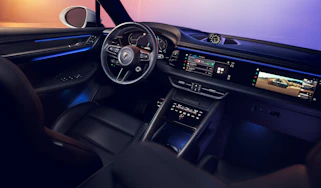
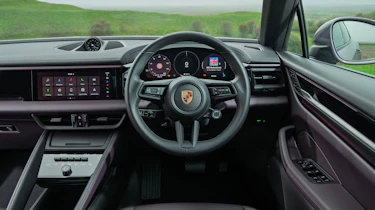
The idea of making a Porsche feel like a Porsche extends to more than just the driving experience. You must feel unequivocally cocooned in the cabin, surrounded by intuitive, tactile buttons and switches, and responsive, crystal-clear screens.
Thankfully, the Macan Electric ticks almost all of these boxes. There is plenty of adjustment in the seat and steering wheel, and the 12.6-inch driver's display and 10.9-inch touchscreen are both typically easy to read. Some of the climate functions are touch-operated, but things like the temperature and fan speed use physical switches. The cooled wireless charging pad is among the fastest and most effective we’ve used.
Materials and build quality
Quality, on the whole, is very good and befitting the car’s near-£70k base price. There are some cheaper plastics if you go searching in the lower reaches of the cabin, but you’ll rarely notice any evidence of cost-cutting.
Beware, however, because – like on all Porsches since the dawn of time - the options list is long. Even our Macan 4 Electric test car came with more than £25,000 of options, so it’s difficult for us to truly assess what a base-spec car might look like. We suspect the Extended Leather package (between £3,000 and £3,500, depending on your colour choice, plus at least £950 for the 14-way comfort seats) could cover a multitude of sins. The question is, how often do you touch the door bins or the lower dash? This may or may not matter to you, but be careful if you’re working to a budget.
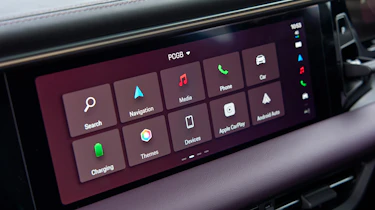
Infotainment, sat-nav and stereo
The Android Automotive-based infotainment is quick to respond, and you can even option a passenger-side display if you wish. We wouldn’t bother – it seems a frivolity, and a cost (over £1,200) that could be better spent elsewhere. After all, it’s hardly a stretch for your nearest and dearest to use the central screen instead.
Speaking of which, that main infotainment system is typical Porsche. The fonts are familiar, and the functionality is on point. Most of the menus are fairly logically laid out, and the processor behind it all seems pretty slick.
Personally, we’d avoid the augmented-reality head-up display (nearly £1,800 extra). Porsche claims it can, in effect, project up to 10 metres in front of the car – equivalent to an 87-inch screen directly in front of your eyes – but at times, it’s a little distracting.
Wireless phone charging and sat-nav come as standard, or you could connect your smartphone to the car through Apple CarPlay or Android Auto. The standard audio system is a 150-watt, 10-speaker set-up, but you can upgrade that to a 710-watt, 14-speaker BOSE sound system for around £1,000 or as part of the £5,000 Luxury pack on rear-wheel drive and 4 models (GTS and Turbo models get the BOSE sound system as standard). Of course, you could also really push the boat out and spend nearly £4,000 on the 1,470-watt, 21-speaker Burmester sound system instead. Its subwoofer takes up some boot space, but audiophiles might think that’s a sacrifice worth making.
“While the interior looks smart and the overall quality is excellent, the plastic phone cover section does feel a bit cheap. The shiny climate control screen also likes to reflect sunlight, which isn’t ideal on a bright summer day.” - Alex Ingram, special contributor.
Boot space & practicality
Pros |
|
Cons |
|
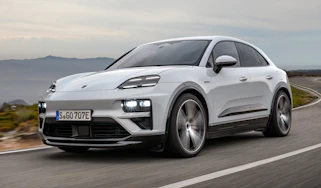
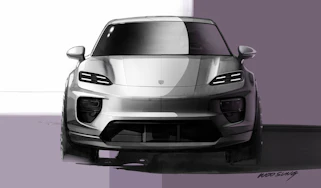
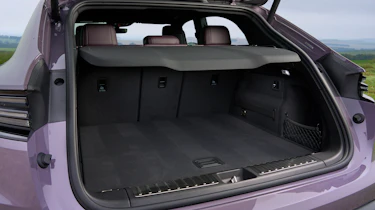
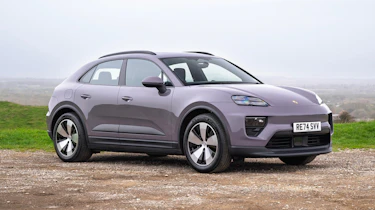
Depending on the angle you view it from, the Porsche Macan Electric can look more like a jacked-up hatchback than a full-blown SUV. The sloping roof helps with aerodynamics – Porsche claims the lower drag coefficient versus the old Macan is equivalent to 85km (53 miles) of range – and while it doesn’t impede proceedings in the cabin, it’ll limit how much you can put in the boot versus, say, a BMW iX3.
You may also want to have a rear wiper fitted for around £300. Not having such a thing might be fine in California where rain is infrequent, but it’s a bit mean to charge for something like that in a country like ours with such variable weather conditions.
Dimensions and size
The latest Porsche Macan Electric is very close in length, width, and height to its sibling, the Audi Q6 e-tron, but it takes up about the same space in the car park as a BMW iX3 and Tesla Model Y. The only downside is its sloping tailgate limits boot space with the seats down.
| Dimensions comparison | |||
| Model | Porsche Macan Electric | Tesla Model Y | BMW iX3 |
| Length | 4,782mm | 4,790mm | 4,782mm |
| Width | 1,938mm (2,152mm inc mirrors) | 1,982mm (2,129mm inc mirrors) | 1,895mm (2,093mm inc mirrors) |
| Height | 1,624mm | 1,624mm | 1,635mm |
| Wheelbase | 2,893mm | 2,890mm | 2,897mm |
| Boot space | 540-1,348 litres (480-1,288 litres GTS and Turbo), plus 84 litres under the bonnet | 890-2,138 litres (both to roof), plus 88 litres under the bonnet | 520-1,750 litres |
Seats & passenger space
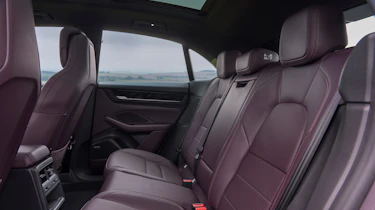
Despite adding 86mm to the wheelbase, Porsche hasn’t transformed the first electric Macan into a Range Rover rival. Space in the back is just about sufficient for taller adults, though specifying a panoramic roof eats into headroom. The hard-backed Sports Seats (standard on the Turbo) limit legroom, too.
Parents with children who need child seats will find two Isofix mounting points on the outer positions of the rear bench, with the option to add a third on the front passenger seat for £150.
Boot space
The 540-litre boot space (480 litres for the GTS and Turbo models due to the audio system's subwoofer taking up space) is a good size and is in the same league as the Audi Q6 e-tron (526 litres). The Tesla Model Y’s official 890-litre capacity may look practically van-like compared to the Porsche, but it’s important to note that Tesla measures up to the roofline, whereas other brands normally measure to the window line.
The Macan Electric’s seats fold 40:20:40 to boost versatility when you need to carry longer items, and there's 84-litre space under the bonnet for the charging cables, too.
Towing
Towing preparation comes as standard on the Porsche Macan Electric, but you’ll have to pay extra for the tow bar itself. Have one fitted, and the Macan is rated to tow up to 2,000kg. This certainly isn’t bad, but the Audi Q6 e-tron manages 2,400kg. The Tesla Model Y, meanwhile, can only tow up to 1,600kg.
There’s good news for campers, too, because the Macan Electric was named as the best car in the 1,800-2,000kg category in the 2025 Towcar of the Year awards, thanks to its long electric driving range and strong powertrain, which has no trouble pulling a caravan around.
“Being able to lower the Macan Electric’s suspension to improve access and make loading heavier items easier is a useful touch, but what we’d really like to see is some underfloor storage in the boot to help keep valuables hidden.” - Alex Ingram, special contributor
Reliability & safety
Pros |
|
Cons |
|
Safety experts Euro NCAP have awarded the latest Porsche Macan Electric the maximum five-star score (tested in 2024). Despite being based on the same underpinnings, the Audi Q6 e-tron performed slightly better than the Macan Electric in the adult, child, and safety assistance categories.
All cars come with things like automatic emergency braking, plus traffic sign recognition and lane-keeping assist. Thankfully, we didn’t find these systems too intrusive, even when driving quickly on winding roads or on longer motorway stretches; it’s always a positive if you don’t find yourself reaching for the off switch five minutes into the drive.
With the Macan Electric being a recent arrival, it’s difficult to accurately assess any potential reliability woes. That said, Porsche customers are a satisfied bunch – the brand has historically finished in the top ten of our annual Driver Power owner satisfaction survey.
| Euro NCAP safety ratings | |
| Euro NCAP safety rating | 5 stars (2024) |
| Adult occupant protection | 90% |
| Child occupant protection | 90% |
| Vulnerable road user protection | 83% |
| Safety assist | 78% |
Buying, prices and deals
Best buy: Porsche Macan Electric (base model)
Prices start from just under £70,000 for the single-motor, rear-wheel drive. The four-wheel drive Macan 4 starts at a little over £73,000, while the quicker Macan 4S is around £78,500. Next up is the GTS for £91,000, while the range-topping Macan Turbo comes in at around £99,500.
While the higher-spec cars (especially the Turbo) offer immense power, the entry-level Macan Electric is still more than fast enough for most who will be in the market for Porsche’s small SUV. As well as being the least expensive variant (provided you go easy on the options), the standard car also offers the highest WLTP combined battery range, up to 399 miles.
Remember, this isn’t a budget car in any guise; the standard Macan Electric is still adorned with a healthy dose of standard kit, including electronically adjustable comfort seats, LED headlights, front and rear parking sensors with a reversing camera, and dual-zone climate control.
If your budget is slightly more constrained, you can buy a used Porsche Macan Electric via the Auto Express Buy a Car service instead.
Porsche Macan Electric alternatives
The Porsche Macan Electric shares its Premium Platform Electric (plus plenty of other components) with the Audi Q6 e-tron, and this car is better suited to use as a family car due to its more capacious cabin.
Alternatively, the latest BMW iX3 is one of the longest-range electric cars on the market, claiming up to 493 miles on a single charge. The stalwart Tesla Model Y may have been around a while, but it’s still one of the most efficient EVs around, and remains a very practical family car.
If you’re not as bothered about the sporting factor and would prefer a focus on comfort, the Mercedes EQE SUV and Genesis Electrified GV70 are two plushier options for similar money.
Key updates of the Porsche Macan Electric review
9 October 2026: General update and added UK driving impressions of the GTS version.
14 January 2026: Updated to reflect the increased expensive car supplement threshold and mention the proposed pay-per-mile tax for EVs from 2028.
Deals on the Porsche Macan Electric alternatives
Porsche Macan Electric pictures
Frequently Asked Questions
Porsche’s standard three-year/unlimited-mileage warranty applies to the Macan Electric just as it does to the rest of the brand’s line-up. However, the Macan’s battery pack is also covered by its own eight-year/100,000-mile plan, which covers a battery replacement if it drops below 70 per cent capacity during this period.
More reviews
Car group tests
In-depth reviews
Which Is Best