Porsche Mission S supercar reveals brand’s future look and plan to challenge to Ferrari
Officially it’s a design study, but Porsche is working flat out to bring this petrol-burning, Ferrari-chasing supercar to life

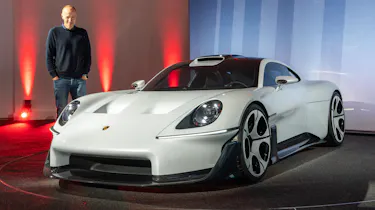
This is the Mission S, a supercar concept showing Porsche’s intent for a new halo model. And, like its Carrera GT and 918 Spyder forebears, the high-performance Porsche Mission S will burn petrol: this is a supercar to thrill Porsche’s core fans, not satisfy environmental regulators or electric advocates.
It’s supposedly a concept, but Porsche is hell-bent on bringing it to life as part of its drive upmarket and back to healthy profitability. “We are developing a super-sports car platform, and we intend to use it as the basis for a new mid-engined car, a car that will sit clearly above the 911,” said Michael Leiters, Porsche’s CEO, at a concept car sneak preview attended by Auto Express.
“The Mission S is an idea of what such a car might look like, a vision of how Porsche can continue to evolve while remaining unmistakably Porsche. It reflects some of the ideas, proportions and design principles that will influence our future products and help shape the next chapter of our brand,” he continued.
A design for all Porsches
The concept car embodies Porsche’s future direction under Dr Leiters. He returned to Porsche having served as Ferrari’s technology boss and McLaren Automotive CEO – and he brought the British supercar maker’s chief design officer, Tobias Sühlmann, with him.
Sühlmann and his team began in February, starting from scratch to conceive a new design language for Porsche. “Michael and I are both car passionate and we were discussing could there be a car above a 911, and what could that be? What are its elements and shapes and what size would it be? Relatively compact is important and clearly it’s a mid-engined concept.”
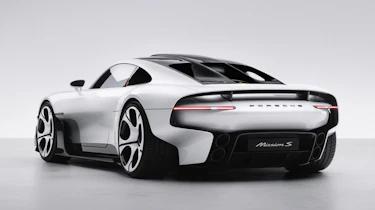
Think of the Mission S as Sühlmann’s manifesto for all future Porsches. And that means a classical, curvy look, a clear link back to the iconic 911. “I don’t like hard lines on a Porsche, I like soft shapes. With very precise, architectural graphics that give an amazing contrast, that [create] tension,” he told Auto Express.
The Mission S clearly lives up to Sühlmann’s philosophy. He’s deconstructed the company’s design into key elements: the torpedo-shaped fenders that rise up above the bonnet to help drivers place a car on the road, the ‘fly line’ which – in profile – curves from the roof’s highest point down to the rear deck, creating the 911’s teardrop shape. “Every child can draw that one line, and everybody will know what kind of car it is,” says the design boss.
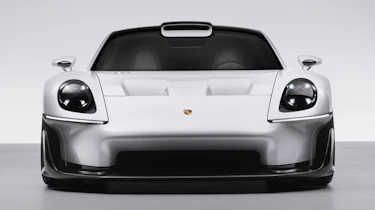
Both are present on the curvy, low-slung Mission S – along with those “architectural graphics”. So the headlamps start off 911-round at the top, broadening into a more triangular base, and are separate to the indicators. Sühlmann hints it’s time to draw a line under the widely copied Porsche rear light bar, with the concept’s rear lights being very slim but also packed with graphical detail. For alloy wheel design inspiration, Porsche looked back to the 928’s teledial rims from 1978.
“I also like openness on these kind of cars, so you see the technical details. Look through the diffuser and you see the gearbox or the rear tyres,” said the designer. It’s a very clean look, unsullied by aggressive scoops, and with a retractable rear wing as per its V10 and plug-in hybrid V8 predecessors.
Sühlmann’s team followed the Bauhaus approach, with the form following function. “Where does the engine sit, and what could the package be? This is what we defined to come up with the size of that car.” The wider hips are also functional, to cover a rear track capable of handling big power – but from what kind of engine?
Mission S chassis and engine
“With Mission S we will listen to the customer,” answered Dr Leiters. “We have the flexibility in that platform to do pure ICE, hybrid and also plug-in hybrid. There won't be a BEV on that platform: there is no demand.”
Porsche’s Sportwagenschmiede 35 strategy – which roughly translates to “sports car foundry” – will use four vehicle architectures. MMB, the modular mid-engined platform, will underpin the production Mission S and the future 911.
But Porsche’s definition of a platform is flexible: engineers talk of a toolbox of components – from engines, gearboxes and hybrid technologies down to axle designs, steering wheels and seats – which they integrate to create each new model. That’s why the upcoming electric 718 Boxster replacement nominally shares the MMB platform too.
The toolbox contains four-cylinder, V6, V8 and ‘boxer’ six engines. From the low height of the Mission S’s rear deck, the classic 911 engine, with horizontally opposed cylinders reducing its height, looks best-placed to fit that space. “There are a variety of solutions we can incorporate,” R&D boss Michael Steiner told us. “In principle it could be a very pure, lightweight [combustion] sports car or combine performance hybridisation to take advantage of chassis systems.”
The 911 Turbo S has electric turbochargers to eliminate lag and active anti-roll, powered by the 400-volt T-hybrid system. A motor in the transmission adds more power and torque into the driveline too. Porsche’s last hypercar, the 918 Spyder, was a plug-in hybrid but executives vow there also remains room for uncomplicated sports cars – with naturally aspirated engines and even manual transmissions – in the portfolio.
Performance will be heightened by rigorous engineering to keep weight down. “We’ll use materials that are best for the characteristics [we’re targeting]: that’s not pure aluminium or pure carbon-fibre but what fits best,” said Steiner.
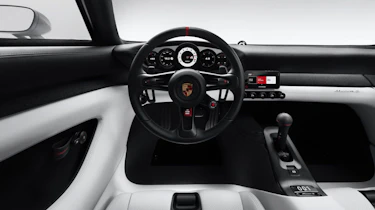
The cockpit blends cutting-edge tech with old-school clarity. Like the clean exterior design, the dashboard loops around the occupants and flows into the doors. And the dials seek to prioritise exactly the correct amount of driver detail: in track mode, peripheral information is stripped away, “and the rev counter comes to you,” says Sühlmann.
Porsche won’t be drawn on when the production Mission S will blast into existence. It’s juggling multiple new model introductions – next year’s electric Boxster, an SUV to replace the discontinued Macan in 2028 and potentially a halo SUV above the Cayenne. But with the sports car maker slashing development times to 30-months and determined to take its brand – and price points – upmarket, expect the supercar to arrive and take on Ferrari before the end of the decade.
Did you know you can sell your car through Auto Express? We’ll help you get a great price and find a great deal on a new car, too.