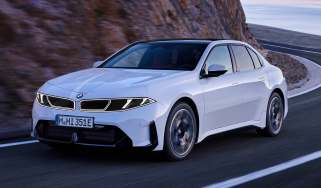
New Peugeot E-408 review: updates fail to hide its age
The Peugeot E-408 has been updated for 2026, but the changes only offer limited appeal


Verdict
With competitive range figures, the Peugeot E-408 holds its own in the hotly contested family EV market, while providing some additional French flair with its coupe-like styling. As before, the interior ergonomics will be make or break for some customers, and only having one battery and electric motor configuration restricts the audience, but with generally decent cabin quality, space and refinement, the Peugeot feels like a considered choice. However, given the rapid advances in electric car technology and the limitations of the Peugeot’s aged platform, we’ll see if that’s the case in years to come.
The Peugeot 408 has always been a difficult car to pigeonhole due to its jacked-up ride height, sloping, coupe-like roofline, four doors and estate-sized boot - although with pure-electric, hybrid and plug-in hybrid powertrains, Peugeot would argue that there’s something for everyone.
Looking to hone its rather niche offering, Peugeot has given the 408 a mid-life refresh, just months after doing the same for the 308 hatchback and 308 SW estate, which share the same underpinnings.
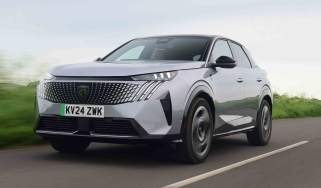
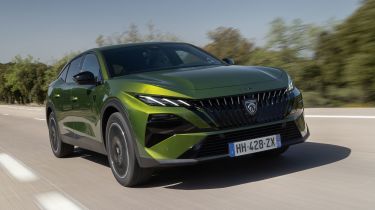
As part of the update, the 408 has gained a new front end. The old car’s distinctive fang-like daytime running lights have been replaced by a sleeker ‘three-claw’ design connected by LED strips running into a freshly sculpted grille, which hides the front radar sensor within the badge.
Used - available now


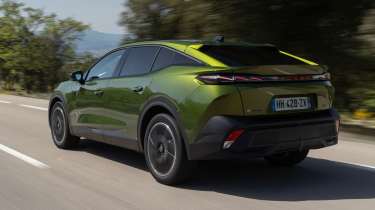
The rear is a little more distinct, and instead of the brand’s shield you find on the 308, new Peugeot lettering has been added to the bootlid and forms part of the rear lights. The 408 is the first car from Peugeot with this feature and, along with the new three-claw tail-lights, rakish rear window and new 20-inch geometric-style alloy wheels, it makes the 408 really stand out on the road.
Unlike the new Vauxhall Astra, with which the Peugeot shares its EMP2 platform, there’ll be no base petrol engine for the 408. The Peugeot’s line-up will be fully electrified from launch, including a mild-hybrid, plug-in hybrid and the all-electric E-408 we’re driving here.
Although the updated E-408 looks different on the outside, underneath it retains the 58.2kWh battery that was introduced in 2025. However, thanks to aerodynamic tweaks, the EV can muster 283 miles on a charge, three miles more than before and four miles more than the E-308. It also puts it into the same ballpark as the Kia EV4 Air (273 miles) and the Skoda Elroq SE L (265 miles), although both of those can offer almost 100 miles more in their larger-battery variants.
Our drive took place on a mild day in the south of France on smooth surfaces, and included town, countryside and motorway roads. The predicted real-world range we saw was pretty good as a result, at 261 miles.
At higher speeds the efficiency did drop slightly, but not as significantly as in the previous model. Like the E-308, of the three E-408 trim levels (Allure, GT and GT Premium), only the GT Premium gets a heat pump as standard to help with year-round efficiency. That’s disappointing, especially for UK buyers, although both the Kia and Skoda also reserve a heat pump for top-spec models.
Despite sitting on what is now a fairly old electric platform (the newer E-3008 uses parent firm Stellantis’ STLA Medium architecture), the E-408's charging is relatively competitive. There’s only a 120kW peak, but Peugeot says the E-408 will take 31 minutes to go from 20 to 80 per cent – around the same as rivals from Kia and Skoda. With this 2026 model, Peugeot has added a pre-conditioning function, so it’s possible to get the battery up to an optimal temperature for recharging in advance. On the mid-range GT trim and above, the integrated sat-nav will automatically trigger pre-conditioning when approaching a charging station set as a destination.
The E-408 is more powerful than the E-308 or indeed the Astra Electric, both of which get a 154bhp electric motor powering the front wheels. Also front-wheel drive, the E-408 has a single motor producing 207bhp and 340Nm of torque for a 7.6-second 0-62mph time - around the same as you get from the entry-level, small-battery versions of the rival Kia EV4 and Skoda Elroq.
While it doesn’t pin your head to the headrest like some EVs, the E-408’s instant shove makes overtakes a breeze. And in contrast to the 408 PHEV, where the throttle can feel hypersensitive if you run in electric-only mode, the calibration on the E-408 is far better, whichever driving mode you choose.
We also liked the natural-feeling brake regeneration system in the E-408, although it’s unchanged from before. It offers four levels that can easily be adjusted on the move via paddles behind the wheels, but there’s still no one-pedal driving mode.
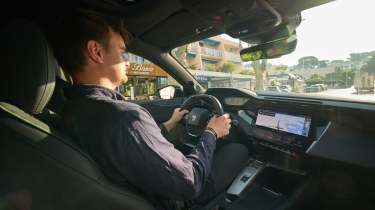
What isn’t enjoyable about the E-408’s driving experience is the steering. Peugeot has continued with its highly divisive i-Cockpit set-up, which essentially forces you to have the tiny wheel placed low-down between your legs so you can clearly see the driver’s display. The actual calibration of the steering weight doesn’t help things either: it’s sluggish to self-centre after a corner and there’s precious little feedback from the front wheels, meaning it can be difficult to get into a flow in a series of bends. A kerbweight of over 1,800kg is out of sorts with a steering wheel that appears sized for a go-kart too. It’s a shame because the E-408 seems to offer an engaging drive in other aspects. The body control is composed and on initial turn-in at least, the front end responds positively.
Clawing back points is the well sorted suspension. During our drive it managed to soak up some pretty sizable speed bumps and the odd sunken drain cover where the lower-riding E-308 hatchback may have had more trouble. On the motorway the E-408 also settles into a groove and that slightly stiff steering has the side-effect of not having to be adjusted too often. The EV is much quieter than the hybrid and plug-in hybrid models as well, where the coarse petrol engines often disrupt the quiet.
The interior of the E-408 is essentially the same as before, although there are updated graphics on the 10-inch driver’s display and the GT Premium gets a holographic instrument panel that shows driving aids, energy flow or selected media. It’s a bit odd in practice, though, and if you customise the background screen for maps, it obscures a fair chunk of it.
All versions of the E-408 get the same 10.25-inch central touchscreen and as part of the aforementioned i-Cockpit set up, it’s angled slightly towards the driver. The infotainment is more glossy than what Vauxhall offers in the Astra, despite the underlying menu layout being similar. As a result, we continue to find the fonts too small and the loading times a bit sluggish. The integrated sat-nav is atrocious to use, because the view is too narrow and we found the system regularly flummoxed by junctions and roundabouts.
What is bespoke to the Peugeot and remains a real highlight are the customisable ‘i-Toggles’ below the screen which act as shortcuts to frequently used functions such as climate, phone and general media. They’re large enough to use easily while driving and respond to touch well – although the physical row underneath for the heating controls works even better.
At £37,595, the top-spec GT Premium is pretty expensive and you can buy large-battery versions of the Kia EV3 and EV4 for around the same money. They won’t be as well equipped, however, because staying true to the self-proclaimed ‘upper mainstream’ positioning of the Peugeot brand, the GT Premium gets a foot-operated powered bootlid, an uprated sound system from Focal, Alcantara upholstery, heated and massaging front seats and a 360-degree exterior camera.
The mid-range GT at £35,095 comes with some nice features including a powered bootlid, leather upholstery and sound-insulated windows, but considering that all models will feel the same to drive, we’d opt for the Allure, which looks pretty much the same on the outside (you only get 19-inch wheels instead of 20-inch rims) and still has the same i-Cockpit interior.
Did you know you can sell your car through Auto Express? We’ll help you get a great price and find a great deal on a new car, too.
| Model: | Peugeot E-408 GT |
| Price: | £35,095 |
| Powertrain: | 1x e-motor, 58.2kWh battery |
| Power/torque: | 207bhp/340Nm |
| Transmission: | Single-speed automatic, front-wheel drive |
| 0-62mph: | 7.9 seconds |
| Top speed: | 99mph |
| Charging: | 120kW (20-80% in 31 minutes) |
| Range: | 280 miles |
| Size (L/W/H): | 4,687/1,848/1,487mm |
| On sale: | Now |