Peugeot 208 review
The Peugeot 208 has eye-catching looks and a well finished interior, but rivals are more practical

Our opinion on the Peugeot 208
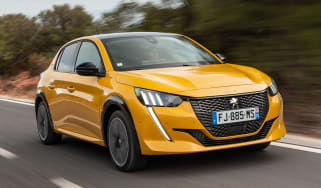
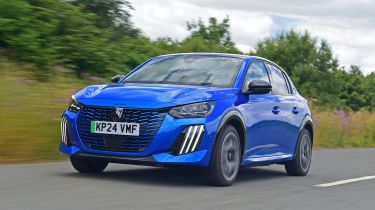
Sharp looks inside and out help the Peugeot 208 stand out against its supermini rivals, and the interior is definitely a cut above most cars in its class. There's plenty of choice, with four trim levels and a spread of petrol, mild-hybrid or all-electric power. However, the 208 is a little compromised in the rear for passenger space, and it doesn’t have the biggest boot in the class. It’s also been quite an expensive supermini choice since this latest version launched, although recent price cuts mean many versions now undercut key rivals, such as the Honda Jazz or VW Polo.
About the Peugeot 208
Peugeot has some terrific small cars in its back catalogue, most notably the Peugeot 205, a huge success across Europe in the ‘80s and ‘90s. The company went off the boil a bit thereafter, and although Peugeot has produced respectable numbers of subsequent cars, nothing has hit the spot in quite the same way. Part of the problem has been a lack of design flair, which the brand has worked hard to address in recent years, especially with cars like the latest 208.
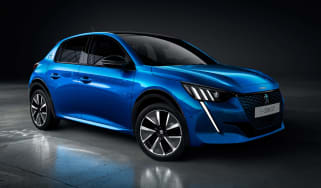
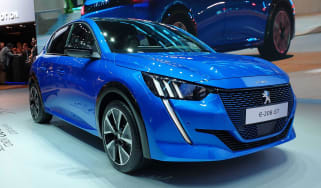
Not only does the 208 look the part, but it has a wide mix of engines. There’s still a traditional petrol engine option, but it is following the trend for electrification across the whole car industry by offering a couple of mild-hybrid engine options with increased fuel efficiency. For those wishing to forgo fossil fuels entirely, there’s also the fully electric E-208. You can read our dedicated in-depth Peugeot E-208 review here…
Used - available now


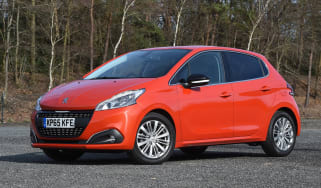
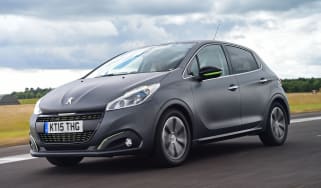
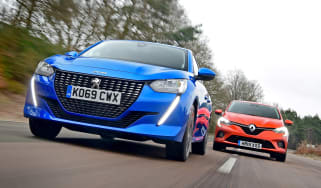
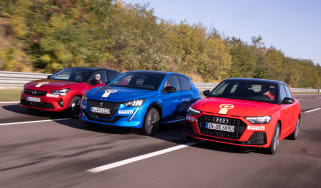
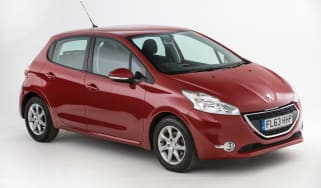
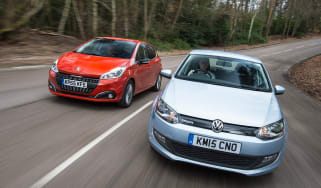
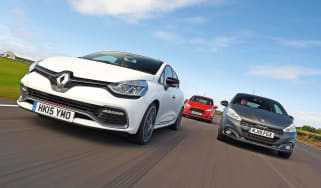
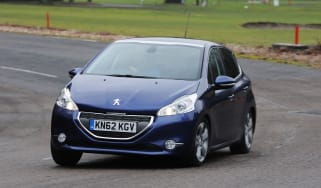
We’ve pitted pre-facelift petrol versions of both the Peugeot 208 and Renault Clio together in a twin test, and driven various versions of the 208 over the years.
Peugeot 208 prices and latest deals
Recent revisions to the price now mean that the entry-level 208 Style comes in at around £20,500, while our preferred Allure trim starts at £22,500. The cheapest hybrid, the Allure Hybrid 110, costs around £24,500. The sportier-looking GT starts at a little under £25,000, while the range-topping GT Premium starts at a little over £26,000.
If you’re tempted by a Peugeot 208 of your very own, our Buy a Car service is here to help. You can configure your ideal Peugeot 208 and receive top offers from our dealer network, browse the very latest Peugeot 208 leasing deals or look at plenty of top used Peugeot 208 models. Need to sell your current car? Look no further than our Sell my Car service.
Performance & driving experience
Pros |
|
Cons |
|
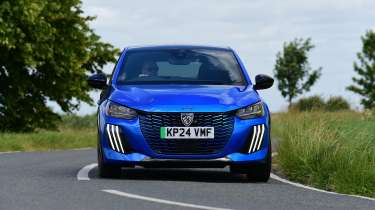
The 208 and Corsa also use the same CMP platform and 1.2-litre three-pot PureTech engine. It has very little low-down turbo lag, and there’s real fizz to the way it spins up to the red line. The six-speed manual feels quite vague and rubbery, though, and it's the only gearbox you can have with a petrol 208. If you need an automatic version, you’ll need to go with the mild hybrid.
One thing worth noting is that the driving modes (Normal, Sport, and Eco) have a far more dramatic impact on the driving experience of electric E-208 models, and you can read about that in our dedicated in-depth Peugeot E-208 review…
Performance, 0-60mph acceleration and top speed
Predictably, acceleration in the 1.2-litre 99bhp petrol is best described as leisurely, with an official 0-62mph sprint time of 10.1 seconds, and a maximum speed of 117mph.
Some electrical assistance in the 99bhp mild-hybrid 1.2 model helps it to get off the line more swiftly, completing the 0-62mph sprint in 9.8 seconds, and on to a top speed of 118mph. The swiftest 208 is the 134bhp mild-hybrid, which covers the 0-62mph dash in 8.1 seconds and has a higher top speed of 127mph.
| Model | Power | 0-62mph | Top speed |
| 208 Style 1.2L PureTech 100 | 99bhp | 10.1 seconds | 117mph |
| 208 GT Hybrid 110 e-DSC6 | 99bhp | 9.8 seconds | 118mph |
| 208 GT Premium Hybrid 145 e-DSC6 | 134bhp | 8.1 seconds | 127mph |
Town driving, visibility and parking
The 208’s light steering means tight manoeuvres won’t require much physical effort, but the steering wheel’s tiny size and unusual shape can feel a bit strange at times. There were points where we lost track of the front wheels’ position during testing, and this can be especially problematic when attempting to parallel park.
Visibility from the driving position is a particular bugbear around town in the 208. The rear windscreen is small, and that makes reverse parking difficult. You get standard-fit rear parking sensors, but you’ll need to spring for an Allure to get sensors at the front, and a GT for a colour reversing camera. The view over the shoulder also needs improving.
The 208’s ride can get a bit jarring over potholes at lower speeds, but on the whole, it remains compliant enough to keep occupants happy.
Country road driving and handling
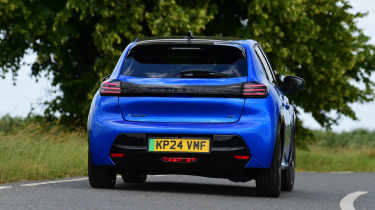
While the latest 208 is a step on from what went before, it still doesn’t have the agility and sharpness of some of the better handling superminis, such as the SEAT Ibiza. Its steering feel is a little too light for our taste, and it weighs up inconsistently at higher speeds for us to fully feel confident with it.
There’s a decent amount of grip, though, and it behaves in a predictable manner – even if you lift off the accelerator mid-corner in an attempt to unsettle it. Overall, it's a safe car suited to urban and sensible B-road driving. We’d never describe it as being especially fun to drive, though.
Motorway driving and long-distance comfort
A slight lack of excitement is the cost you’ll pay for the Peugeot 208’s decent composure on longer motorway trips. The mild-hybrids offer enough shove to keep up with traffic and overtake without undue stress, and the ride quality is calm at high speeds, making this one of the better superminis for long journeys.
MPG & running costs
Pros |
|
Cons |
|
With an official WLTP combined fuel economy of up to 58.2mpg and 127g/km of CO2 emissions, the petrol 208 isn’t too far behind its mild-hybrid siblings. The 99bhp mild-hybrid has a headline figure of 65.9mpg, while the more powerful 134bhp model drops ever so slightly to 60mpg on the dot.
Unsurprisingly, the mild-hybrids do have a slight edge over the petrol in terms of emissions, producing up to 116 and 117g/km, respectively. The key downside of these models is that they cost around £1,500 more to purchase, and it’ll take a little while to recoup this additional expense through fuel savings.
| Model | MPG | CO2 | Insurance group |
| 208 Style 1.2L PureTech 100 | 58.2mpg | 114g/km | 22 |
| 208 GT Hybrid 110 e-DSC6 | 65.9mpg | 105g/km | 23 |
| 208 GT Premium Hybrid 145 e-DSC6 | 62.8mpg | 105g/km | 23 |
Electric range, battery life and charge time
If you think an electric car fits into your lifestyle, it’s certainly worth considering the E-208, and you can find out more about the range and charging times in our dedicated in-depth Peugeot E-208 review…
Insurance groups
The petrol-powered car in entry-level Style trim sits in group 22 (out of 50), as does the range-topping GT Premium models. The mild-hybrids range between groups 22 and 23. In comparison, the Renault Clio starts in group 10 for the 90 TCe petrol, rising to group 15 for the E-Tech hybrid models.
Tax
Every variant of the Peugeot 208 faces the standard rate of VED road tax, but it sneaks in well below the £40,000 luxury car tax surcharge threshold. There’s a small Benefit-in-Kind (BiK) company car tax advantage with the mild-hybrid version, but the all-electric E-208 has the lowest taxation rate.
Depreciation
The petrol and hybrid-powered versions of the Peugeot 208 are expected to retain between 46 and 51 per cent of their initial value after 36,000 miles or 36 months, according to our market data. That’s quite a lot better than the closely related Vauxhall Corsa, which is expected to retain 39 to 48 per cent over the same period, but is far behind the Honda Jazz, which is predicted to retain between 50 and 50 per cent of its original value.
To get an accurate valuation of a specific model, check out our free car valuation tool...
Interior, design & technology
Pros |
|
Cons |
|
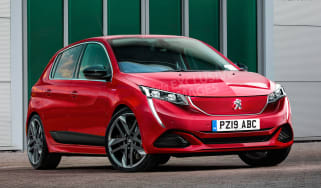
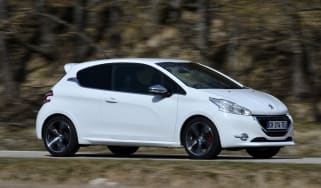
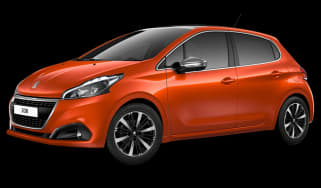
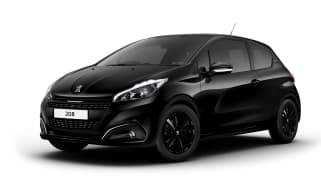
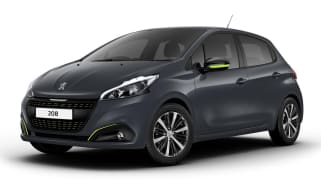
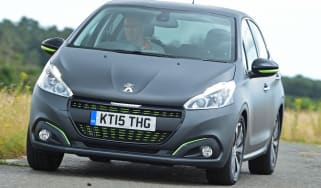
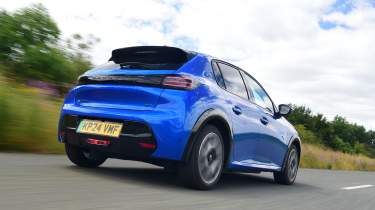
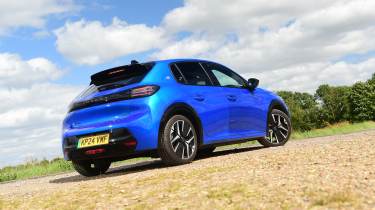
The Peugeot 208 has an eye-catching design, and the quality of the interior is equally impressive.
The cheapest Style (only available in petrol form) includes 16-inch steel wheels, LED headlights, automatic lights and wipers, climate control, a 10-inch central touchscreen with Apple CarPlay and Android Auto smartphone connectivity, Bluetooth, and a DAB radio, plus rear parking sensors.
We’d recommend upgrading to mid-range Allure trim, because it adds:
- 16-inch alloy wheels
- Front parking sensors
- An auto-dimming rearview mirror
- Privacy glass
- A 10-inch digital instrument cluster
It’s worthwhile adding the £300 Parking Pack to the Allure trim in order to get blind spot monitoring and both front and rear cameras to help with parking.
Moving up to GT spec brings in 17-inch alloy wheels, automatic high beam assistance, eight-colour ambient lighting, plus a 180-degree colour reversing camera. You can add heated front seats to the GT trim, along with Alcantara seat trim and an electric driver’s seat for £500.
That latter option is standard on the range-topping GT Premium, along with adaptive cruise control and wireless smartphone charging.
Interior and dashboard design
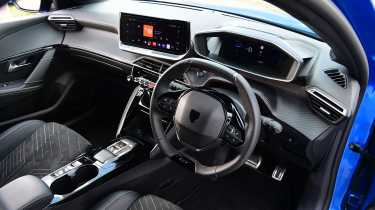
The latest 208 uses a revised version of Peugeot’s i-Cockpit set-up, but we still think it won’t suit everyone. Rather than looking through the steering wheel, the 208 has a much smaller wheel that you must look over to see vital information. We recommend you try it for yourself to ensure you can find a comfortable driving position and still see all the info on the dash.
This digital display is similar (in theory) to the Virtual Cockpit that’s available with the Volkswagen Polo. Switching between screens in the 208 isn’t as easy as in the Polo, and some people may find the layout takes a bit of getting used to.
Materials and build quality
Aside from some hard plastics on the doors and glovebox lid, plus the piano black plastic that highlights every fingerprint and light scratch, the dashboard has plenty of soft-touch materials, and it feels well put together. There are also many nice design details, like contrast stitching and configurable ambient lighting on certain trims.
Infotainment, sat-nav and stereo
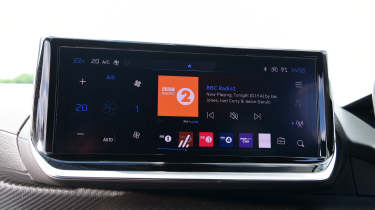
All models receive Bluetooth, a DAB radio, and wireless Apple CarPlay and Android Auto smartphone connectivity, and a six-speaker sound system. At the centre of the dash resides an HD screen that looks snazzy but can be fiddly to use. During testing, we found Peugeot’s software far more complex to navigate compared to rivals like the SEAT Ibiza and Volkswagen Polo.
Boot space & practicality
Pros |
|
Cons |
|
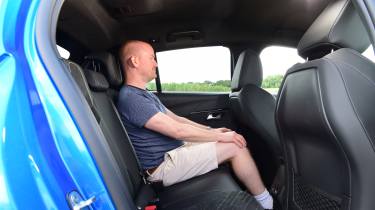
The Peugeot 208 is offered exclusively as a five-door hatchback, unlike some rivals like the MINI Cooper, which still offers the choice of three. Space inside the 208 is adequate, but those who are six feet in height or taller may feel a little snug in the back.
Dimensions and size
The latest 208 is 4,055mm long, 1,765mm wide and 1,430mm tall. These are reasonably compact dimensions, although the 208 offers more boot space than its Vauxhall Corsa sibling.
| Dimensions comparison | |||
| Model | Peugeot 208 | Vauxhall Corsa | Volkswagen Polo |
| Length | 4,055mm | 4,060mm | 4,074mm |
| Width | 1,765mm | 1,765mm | 1,751mm |
| Height | 1,430mm | 1,435mm | 1,451mm |
| Wheelbase | 2,540mm | 2,538mm | 2,552mm |
| Boot space | 352-1,163 litres | 309-1,118 litres | 351-1,125 litres |
Seats & passenger space
Although it’s one of the smaller cars in the modern supermini class, the Peugeot 208 does provide a reasonable amount of space in the front, even for taller passengers. There’s just enough room to stretch out comfortably, and useful storage cubbies help to keep any space-obstructing clutter at bay.
The 208 isn’t as well packaged as the Renault Clio, feeling cramped in the rear because there isn’t as much legroom as in its rival. Accessing the rear isn’t as easy as it could be, with a small opening being particularly awkward for anyone putting a child into their car seat. The rear seats fold in a 60:40 configuration if required, and every model comes with two Isofix mounting points provided on the outer positions.
Boot space
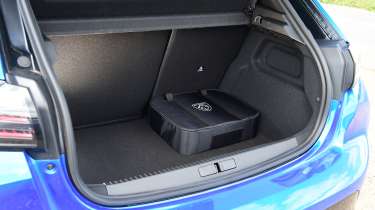
Boot space in petrol and mild-hybrid versions of the 208 is respectable at 352 litres, which is one litre more than a Volkswagen Polo, and just under 30 litres shy of the 380 litres provided in the more generous Skoda Fabia. Like the Fabia, the 208 has a significant load lip to heave hefty items over to load up the boot. Unlike the Fabia, you can’t add a variable-height boot floor to the 208.
If you need to carry longer items, folding the rear seats down expands the combustion 208's luggage capacity up to 1,163 litres. That’s not bad, but if you need greater hauling capabilities, consider the Honda Jazz, which offers 1,205 litres of capacity and seats that fold flat into the floor.
“Remarkably, you can get a tow bar for £750 on petrol and hybrid versions of the 208, but we suspect it’ll be of more use with a bike carrier than a caravan because the 1,200kg braked towing limit, while the same as a Skoda Fabia, isn’t all that impressive.” – Max Adams, online reviews editor
Reliability & safety
Pros |
|
Cons |
|
The Peugeot 208 has significantly improved upon its past Driver Power customer satisfaction survey result, finishing in 15th out of 50 models in our 2026 survey of the best cars to own . That's one place higher than its sibling, the Vauxhall Corsa, and much higher than the Renault Clio (24th) and Volkswagen Polo (43rd). Owners like the 208's styling and driving experience. They weren't so keen on the cost of running and buying the car, although the latter should improve in subsequent surveys thanks to recent price cuts. Visibility was also rated poorly, highlighting our advice to specify the optional parking with its front and rear camera system, and blind spot assistance to alert you to any vehicles that appear alongside you.
Even more reassuringly, the Peugeot brand placed sixth out of 31 brands in our 2025 best manufacturer rankings.
In terms of safety, the current 208’s four-star Euro NCAP safety rating from 2019 has expired due to NCAP’s testing criteria becoming much more stringent. The 208’s initial score criticised poor whiplash protection for rear seat occupants, and a standard autonomous emergency braking (AEB) system that couldn’t recognise pedestrians and cyclists at night. That’s still the case with Style and Allure trim cars, but GT trim cars and above get a more advanced system that does recognise cyclists and works at night.
All 208s get six airbags, lane-keeping assist to help keep you in your lane on the motorway, and a speed limit recognition system to (hopefully) keep you from breaking the speed limit. It is a shame that you must pay extra for adaptive cruise control on Allure and GT trims (it’s a system that maintains a safe distance from the car in front of you), because this is standard on hybrid versions of the cheaper MG3.
Buying and owning
Best buy: Peugeot 208 1.2 PureTech Allure
Although the mild-hybrid models offer a bit more power and efficiency, the petrol 208 still offers low fuel costs, and an affordable starting price. Forking out a little bit more for the Allure trim will add some worthwhile features over the entry-level Style trim. We’d still recommend adding the reasonably priced £300 Parking Pack, though.
Peugeot 208 alternatives
The latest Renault Clio is another stylish French supermini like the 208, and the Clio also has a choice of petrol or hybrid power. The closely related Vauxhall Corsa is arguably less fashionable than the 208, but comes with more affordable pricing.
There’s also a range of excellent rivals that include the Skoda Fabia, Volkswagen Polo, and MINI Cooper. The Fabia is more practical than the 208, while the Polo remains a fine all-rounder – if a little dull. The MINI Cooper is a much more desirable choice, and its stronger residual values attest to this.
Peugeot 208 pictures
Key updates of the Peugeot 208 review
11 June 2026: Mention of the price cuts across the 208 range and this model's results in the 2026 Driver Power customer satisfaction survey.
7 May 2026: General update with latest resale valuation data.
Frequently Asked Questions
You get a three-year or 60,000-mile warranty with a Peugeot 208, which isn’t as generous as the five-year, unlimited-mileage policy of the Hyundai i20, or the 10-year/100,000-mile warranty of the Toyota Yaris.
Deals on the 208 and alternatives