Nissan Qashqai’s 20th birthday celebrated with an iPod, CDs and a stickerbomb livery
Nissan is celebrating two decades of the groundbreaking crossover, but questions remain over where it goes next

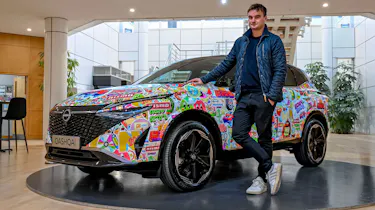
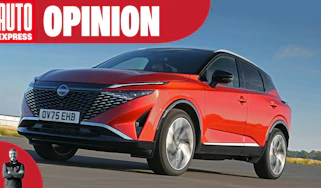
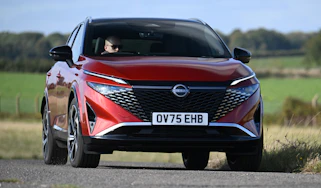
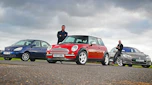
One of the most important, game-changing and popular cars in recent history is celebrating its 20th anniversary. Some two decades on from the Nissan Qashqai’s debut in 2006, the brand revealed a unique livery for its current e-Power model that draws on the ‘creativity, optimism and cultural energy’ of the 2000s, according to the brand.
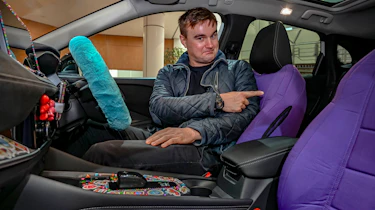
Taking inspiration from the time, Nissan has customised the Qashqai with a suite of unique touches. The in-your-face stickerbomb livery on the outside is matched inside with plenty of accessories that evoke so-called Y2K style, with purple seat covers, a fluffy steering wheel cover, CDs of the era and on the dash, an iPod Video – chock full of 2006 tunes. Unfortunately for those wishing to relive their youth, none of these elements is available to Qashqai customers.
However, Nissan welcomed Auto Express to its technical centre in Cranfield, Bedfordshire, not just to check out the funky celebratory statement car, but to also take a look back at how the Qashqai was developed, as well as give us an idea what the the future has in store for the smash-hit crossover.
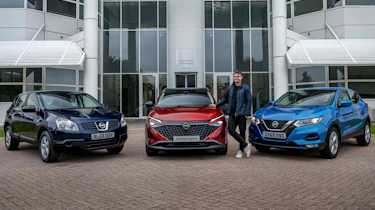
Since the Qashqai arrived, Nissan has sold more than 4.1 million units, with three generations in that time. It was a success from the off – 100,000 sales were planned for its first full year, but Nissan achieved 164,000, with a 10-month waiting list for certain versions.
As well as being a huge hit for the Japanese company, the Qashqai also transformed the wider car industry, with Nissan claiming there are now 50 direct competitors generating over four million total sales between them in the segment. Having been built in Sunderland throughout its life – where it supports 6,000 jobs – the car has also contributed an average of £2.8bn to the UK economy annually. The Qashqai’s groundbreaking success has even resulted in it becoming a study case for the Harvard Business School in the US.
Asked if he felt a sense of pride or resentment for kickstarting the hugely important family SUV segment, Pierre Loing, who was in charge of Strategy and Planning for Nissan Europe in 2006 and is now Senior Director at Nissan Americas, said: “I’m more flattered than anything. Competition is good, it lifts our game.”
During our time at Cranfield we had the chance to drive all three generations of Qashqai back to back. Hopping into the first generation felt like going back to a childhood home. The ergonomic layout is excellent with buttons and dials for almost every function, although its positioning as a family-friendly offering is reflected by its hard and scratchy, yet durable, plastics.
Taking the highly popular first Qashqai and building on it for the replacement was a challenge, with Loing acknowledging “the biggest difficulty is to replicate success”. It’s easy to see why the second-gen Qashqai was just as popular, with interior quality taking a visible step up and the driving experience becoming more refined.
While the Qashqai has evolved over the years with new powertrain technology – perhaps the most notable change is the current car’s e-Power hybrid system – something that connects them all is the raised seating position, combined with well mannered driving dynamics. Those traits really helped shape the family crossover sector, giving customers a more commanding presence on the road, without the efficiency compromise or complexity of a 4x4.
The birth of the Nissan Qashqai
The Qashqai was born out of a difficult period for Nissan. Loing recalled the lead up to the first model. “Nissan’s line-up was a copy and paste of the big boys,” he said, referring to a range that included the Micra, Almera, Primera and X-Trail. Instead of trying to compete with the likes of Volkswagen and Ford in these mass-market areas, Nissan decided it needed to reach new customers.
Loing added that, given the firm’s multi-billion pound debt in the early 2000s, “Carlos Ghosn, the [then] Nissan chairman, was coming every month, and they were not pleasant meetings. The resources of the company were mainly directed to the US because the company needed to recover. So we had not so much [money for a replacement for the Almera]”. That replacement was the B32A concept, a fresh design ready to replace the underwhelming hatch, but it was canned on Friday 13 December, 2002.
Loing said despite that decision, “our targets didn’t change and [they were told] if it doesn’t work, we’re gonna fold you into Renault”, with Nissan having formed an alliance with the French firm back in 1999.
Instead of an MPV-style hatch, Nissan took the bold decision to develop a new sector of vehicle that combined the best attributes of multiple categories.
Matt Weaver, who had recently taken over the reins as Nissan global design chief, was tasked with creating the Qashqai concept in 2004 from the firm’s then-new London design studio. “The night before the Geneva Motor Show we had to sort the ride height because it was too low. Bringing the car up you could see the staff understand what this car was about and I think that’s when Qashqai was probably born.”
He added that the term “not SUV ‘down’, but car ‘up’” from a colleague in Japan helped him understand the Qashqai brief.
What does the future hold for the Qashqai?
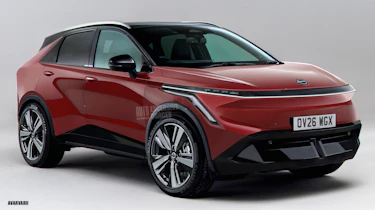
The current Qashqai remains by far the most popular Nissan in the UK, where it’s been the fourth best-selling car overall in 2026 to date. However, while there’s a pure-petrol and a hybrid, there’s still no futureproof fully electric version.
Reports earlier this year suggested development of a fully electric Qashqai had been shelved, in response to waning customer interest in electric cars, but also in alignment with Nissan’s cost-cutting strategy ‘Re:Nissan’. That roadmap is promoting closer ties with partners such as Mitsubishi, Honda and Renault, while in 2027 the market plan for Europe will culminate in the all-electric third generation Juke.
Confirming the current Qashqai will live on with hybrid power, Nissan’s divisional vice president, Europe and Africa, Jordi Vila, told Auto Express in September: “Planning is always dynamic, but we will continue to leverage all electrified technologies for as long as the market demands it.”
Back at Nissan’s technical centre in Cranfield, David Moss, Nissan’s Senior Vice President for R&D, maintained that the fuel type for the Qashqai of the future is flexible. “We will continue to develop. We’ll keep our options open and we’ll make the changes we need to suit the market,” he stated.
In regards to the latest e-Power system, Moss said that while the current set-up is a “sweet spot”, he suggested further improvements can still be delivered. “Could you make a longer range? We’ll see!”
Nissan says the original Qashqai asked a specific question: ‘What if drivers no longer had to compromise between a hatchback and an SUV?’. Now, while pretty much every segment-crossing niche possible has been filled – apart from a convertible minivan, Loing joked to us – there are plenty of compromises customers have to make in terms of powertrain, price and technology that Nissan, and perhaps the Qashqai, can once again solve in the future.
Did you know you can sell your car through Auto Express? We’ll help you get a great price and find a great deal on a new car, too.