BMW i3 vs Mercedes C-Class Electric vs Hyundai Ioniq 6: big test for the 3 Series EV
The new electric BMW 3 Series takes on Mercedes’ latest C-Class and the updated Hyundai Ioniq 6 in a premium EV showdown

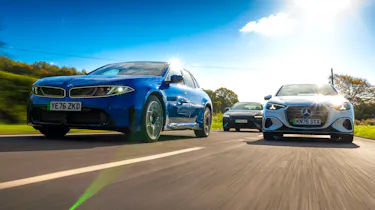
It’s a sign of the times that BMW launched its cutting-edge Neue Klasse electric-car platform with the iX3 SUV. In the past, it would’ve been an executive saloon that pioneered the new tech, but only now, 12 months later, has the 3 Series version arrived.
However, if the iX3 is anything to go by, the new BMW i3 looks set to be a very strong contender in the compact executive saloon sector. To find out exactly how good it is, we’re lining the i3 up on UK roads against two rivals that should provide it with a stern test. The Mercedes C 400 Electric mirrors BMW’s philosophy by using a bespoke electric platform while retaining a name that’s familiar to motorists.
The Mercedes promises to deliver strong performance and efficiency, but the C 400 Electric comes at a price point that reflects the German manufacturer’s strategy to become a more exclusive brand.
At the other end of the spectrum, the Hyundai Ioniq 6 was a tough rival for the outgoing BMW i4 EV, and a series of updates have sharpened the looks and revised the line-up, while prices are competitive. Is it enough to prevent the BMW i3 taking glory?
Used - available now


Did you know you can sell your car through Auto Express? We’ll help you get a great price and find a great deal on a new car, too.
BMW i3
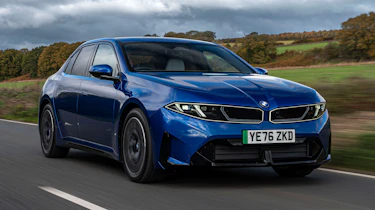
| Model: | BMW i3 50 xDrive M Sport First Edition |
| Price: | £58,535 |
| Powertrain: | 113.4kWh battery, 2x e-motors, 463bhp |
| 0-62mph: | 4.7 seconds |
| Test efficiency: | 3.9 miles/kWh |
| Official range: | 563 miles |
| Annual VED: | £640 |
While the BMW i3 and new petrol 3 Series look alike, they use bespoke platforms, with the electric model featuring the same Neue Klasse architecture as the firm’s iX3 SUV.
There are 87kWh and 113.4kWh battery options available, and all models come with a two-motor, four-wheel-drive set-up as standard. Base, M Sport and M Sport Pro models are on offer, and prices start at £47,925. Here we’re testing the First Edition variant, which costs £58,535.
Testers' notes
- I’m not keen on the two-spoke steering wheel. It looks as if there are four spokes in total, but it’s only the two vertical ones that hold the rim to the boss; there are gaps next to the controls on either side. Twice I caught a flash of a silver spoke while steering that made me briefly think I didn’t have any lock on at all.
- Want to become a smoother driver? There’s an app for that. The BMW Drive Challenge logs your steering, acceleration and braking inputs in real time, and an icon within the Panoramic Vision display tots up smooth inputs of all three, showing a green block when you meet the requirements. Earn 50 points, and you ‘level up’, with an image of the forthcoming electric M3 shown with colour and bodykit upgrades. If you’re not smooth, then the bar doesn’t fill, and judgmental ‘jerky’ and ‘harsh’ one-word responses appear.
Mercedes C-Class Electric
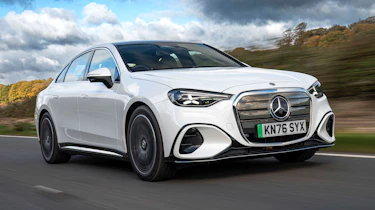
| Model: | Mercedes C 400 4MATIC AMG Line Premium Plus |
| Price: | £69,125 |
| Powertrain: | 94kWh battery, 2x e-motors, 482bhp |
| 0-62mph: | 4.0 seconds |
| Test efficiency: | 3.3 miles/kWh |
| Official range: | 433 miles |
| Annual VED: | £640 |
In a similar vein to BMW, the electric Mercedes C-Class shares its looks, but not a lot else with the combustion-engined version. There’s just one powertrain available at the moment, which is badged C 400 and features a 94kWh battery and twin motors for 4MATIC four-wheel drive.
The £57,995 Sport model kicks off the line-up, but the bulk of sales are likely to be taken by AMG Line versions, with Premium and Premium Plus trim levels bumping the kit count, and price tag, even higher.
Testers' notes
- Energy recovery is managed via steering wheel paddles, with three fixed levels of recovery or an Auto setting. The latter is mostly intuitive, but if you don’t set the adaptive cruise control to adjust your speed to the current limit, the car may overspeed when freewheeling downhill; in this instance the fixed level two mode gives better control.
- Some people might find the C-Class’s LED interior lighting to be overkill. An illuminated strip runs around the perimeter of the cabin at sill height, while the door pulls and air vents are bathed in the same glow. Crank up the brightness, and you’ll get all sorts of reflections in the windows, even during the day, but you can also dim the lights or turn them off completely. The colour palette offered is comprehensive, while Mercedes allows you to sync the lights with the on-board systems, even pulsing and changing colours to music.
Hyundai Ioniq 6
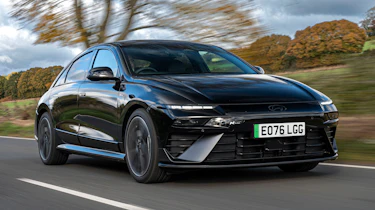
| Model: | Hyundai Ioniq 6 N Line Evo AWD |
| Price: | £46,960 |
| Powertrain: | 84kWh battery, 2x e-motors, 321bhp |
| 0-62mph: | 5.1 seconds |
| Test efficiency: | 3.8 miles/kWh |
| Official range: | 354 miles |
| Annual VED: | £200 |
Updates to the Ioniq 6 have sharpened the exterior to boost its aerodynamics, while bigger batteries help the Korean EV to deliver a longer range than before.
There’s a revised trim line-up on offer, too, with the entry-level Premium model joined by N Line and N Line Evo specs, and the latter two come with the option of rear or four-wheel drive. Prices are competitive when compared with the BMW and Mercedes being tested here, starting at £36,990 and rising to £46,960.
Testers' notes
- The new N Line trim has looks inspired by the hot 6 N. The front has a splitter and blade-style trim in the grille, the side skirts are chunkier and there’s more matt grey plastic at the rear. There are no performance enhancements beyond the 20-inch rims and low-profile tyres adding a firm edge and sporty feel to the ride.
- Hyundai is persevering with digital side mirrors on the Ioniq 6, but they’re only a £1,250 option on the top-spec N Line Evo (note they’re not offered on the high-performance Ioniq 6 N). They’re designed to boost aerodynamics and contribute to the car’s 0.21Cd drag factor, but it’s a system that we’d happily avoid at the expense of a shorter range. In our experience, the system isn’t the most intuitive because the cameras are mounted where the door mirrors would be, and your eye is naturally drawn to them instead of the displays next to them.
Head-to-head
On the road
If you value comfort above all else, then the Mercedes with air suspension is the winner – it’s fast, quiet and refined at all speeds.
The BMW is decent, but a sportier set-up means the newcomer is unsettled at lower speeds. It more than makes up for it with a sharp drive and agile handling, though. The Hyundai’s suspension is on the firm side and feels less sophisticated than its rivals here, but isn’t harsh.
Tech highlights
BMW has ported the iX3’s interface across to the i3, so you get the same Panoramic Vision display across the bottom of the windscreen, and a large, high-resolution touchscreen.
Mercedes’ Hyperscreen is enormous, but is highly configurable and easy to get along with. The Hyundai feels a little spartan in comparison, but is actually very well equipped for the money.
Price and running
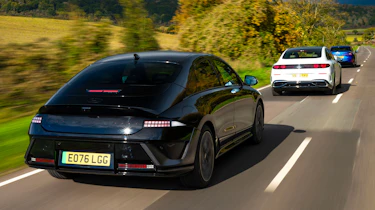
All three cars are well equipped, and the i3 looks good value for money next to the Mercedes, but the Hyundai is cheaper still.
A big 113.4kWh battery and the best efficiency meant the i3 was the range champion in this test, with more than 420 miles on offer. The Mercedes was pegged back by motorway use, so should be better at lower speeds. The Hyundai has the smallest battery here.
Practicality
The space in all three cars is geared towards those up front, with back-seat occupants having limited legroom, while there’s less headroom in the Mercedes and Hyundai than in the BMW.
Access to the boot is restricted, too. The Ioniq 6 has a narrow opening and the smallest capacity, while the i3 has the best access, but not as much room as the Merc. The C-Class also has a big frunk.
Safety
Neither the BMW nor Mercedes has had their Euro NCAP results published yet, but there is lots of equipment fitted on both to help keep you safe. The BMW’s systems are less intrusive overall, though.
Hyundai’s five-star rating was awarded in 2022, when it achieved best-in-class results, but the tests have moved on since then, so its score won’t be comparable with its rivals’ once they are published.
Ownership
Hyundai’s five-year warranty is two years longer than those offered by its premium rivals here, although all three manufacturers’ coverhas an unlimited mileage limit.
Maintenance charges for the Mercedes are very steep, especially when you consider that BMW’s Service Inclusive package is almost half the cost and lasts for five years instead of the three that its German rival covers.
Verdict
First place: BMW i3
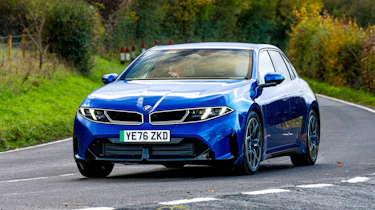
We had a feeling that the i3 would be good, simply because it uses the same running gear as the iX3 SUV, and we weren’t wrong.
It’s not as comfy or as fast as the C-Class, but it’s not far behind, while it more than makes up for it with a well judged handling balance that mirrors that of BMW’s combustion models. Throw in user-friendly tech and competitive pricing, and it’s our first-choice electric compact executive car.
Second place: Mercedes C-Class Electric
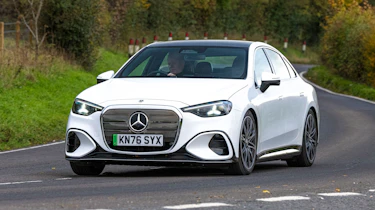
If you want the plushest, most comfortable electric compact exec around, the C-Class is the only choice. It delivers S-Class levels of refinement in a compact package, while the high-grade materials and user-friendly Hyperscreen layout boost the car’s premium credentials.
However, you need the optional air suspension for the ultimate in luxury, and that bumps up an already steep asking price. It will
be interesting to see how lower-spec versions fare.
Third place: Hyundai Ioniq 6
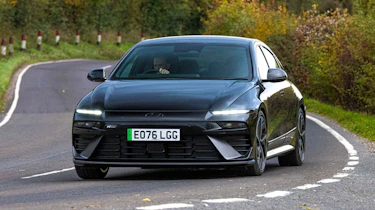
Third place is no disgrace for the Ioniq 6 in this test. The 2026 updates have boosted its looks, and if you want to stand out from the crowd, it’s a great-value way of doing so, with lots of kit, decent efficiency and a long driving range all in its favour.
However, the Hyundai feels like it’s a generation behind the other two cars in terms of tech and driving involvement. There’s a sporty edge to its character, but it’s not as engaging as the BMW, while the firm ride mars overall comfort.
Prices and specs
| Model tested | i3 50 xDrive M Sport First Ed. | C 400 4MATIC AMG Line Prem. Plus | Ioniq 6 N Line Evo AWD |
| Price from/as tested | £47,925/£58,535 | £57,995/£69,125 | £33,240/£46,960 |
| POWERTRAIN AND PERFORMANCE | |||
| Powertrain/power/torque | 2x e-motors/463bhp/645Nm | 2x e-motors/482bhp/800Nm | 2x e-motors/321bhp/605Nm |
| Transmission | Single-speed/4WD | Two-speed/4WD | Single-speed/4WD |
| 0-62mph/top speed | 4.7 seconds/124mph | 4.0 seconds/130mph | 5.1 seconds/115mph |
| Battery capacity/usable/official range | 113.4/108.6kWh/563 miles | 94/94kWh/433 miles | 84/84kWh/354 miles |
| Test efficiency/range | 3.9 mi/kWh/424 miles | 3.3 mi/kWh/310 miles | 3.8 mi/kWh/319 miles |
| Max DC charging | 400kW (10-80% in 21 mins) | 330kW (10-80% in 22 mins) | 350kW (10-80% in 18 mins) |
| DIMENSIONS | |||
| Length/wheelbase | 4,760/2,897mm | 4,894/2,962mm | 4,935/2,950mm |
| Width/height | 1,865/1,480mm | 1,892/1,505mm | 1,880/1,495mm |
| Front door opening width/height/sill height | 680/925mm/420mm | 695/950/435mm | 725/870/415mm |
| Rear door opening width/height | 810/925mm | 860/810mm | 860-945mm |
| Rear kneeroom | 510-760mm | 580-825mm | 675-900mm |
| Rear headroom/elbow room | 880/1,450mm | 890/1,445mm | 910/1,530mm |
| Boot opening width/height | 1,000/490mm | 1,015/475mm | 1,090/450mm |
| Boot space (front/seats up) | 31/420 litres | 101/470 litres | 14.5/401 litres |
| Boot length/width/lip height | 1,020/1,060/670mm | 1,020/950/750mm | 1,090/1,040/740mm |
| Kerbweight/payload/towing weight | 2,205/505/1,800kg | 2,460/505/1,800kg | 2,030/490/1,500kg |
| Turning circle | 12.2 metres | 12.1 metres (11.2m w/rear-steer) | 11.8 metres |
| COSTS/OWNERSHIP | |||
| Residual value (after 3yrs/36,000 miles) | N/A | £32,627/47.20% | N/A |
| Depreciation | N/A | £36,498 | N/A |
| Insurance group/quote/VED | 40/£866/£640 | TBC/N/A/£640 | 41/£787/£200 |
| Three-year service cost | £650 | £1,200 | £398 |
| Annual tax liability std/higher rate | £463/£925 | £547/£1,095 | £374/£747 |
| Fuel cost (10k miles) | £674 | £797 | £692 |
| Basic warranty (miles)/recovery | 3yrs (unlimited)/3yrs | 3yrs (unlimited)/3yrs | 5yrs (unlimited)/1yr |
| Driver Power manufacturer position | 5th | 1st | 13th |
| NCAP Adult/child/ped./assist/stars | Not yet tested | Not yet tested | 97/87/66/90/5 (2022) |
| EQUIPMENT | |||
| Metallic paint/wheel size | £875/19 inches | £750-£1,000/20 inches | £795-£1,295/20 inches |
| Parking sensors/camera | Front & rear/rear | 360/360 | Front & rear/rear |
| Spare wheel/Isofix points | Repair kit/two | Repair kit/two | Repair kit/two |
| Keyless entry & go/powered tailgate | Yes/yes | Yes/yes | Yes/yes |
| Seat upholstery/leather | Fabric/£275 | Artificial leather/£2,000 | Artificial suede & leather/no |
| Heated seats/steering wheel | Front/yes | Front & rear/yes | Front & rear/yes |
| Screen size/digital dashboard | 17.9 inches/N/A | 39.1 inches/N/A | 12.3 inches/12.3 inches |
| Climate control/panoramic sunroof | Three-zone/£1,275 | Two-zone/yes | Two-zone/no |
| USBs/wireless charging | Four/yes | Four/two | Four/yes |
| Wireless Apple CarPlay/Android Auto | Yes/yes | Yes/yes | Yes/yes |
| Blind-spot warning/head-up display | Yes/yes | Yes/yes | Yes/yes |
| Adaptive cruise/steering assist | Yes/yes | Yes/yes | Yes/yes |
What would we choose?
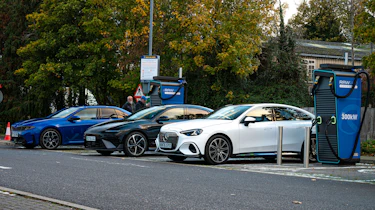
BMW i3
Panoramic glass is the priciest option offered, while a tow hitch is £1,000 and 20-inch wheels cost up to £1,200. The £275 leather upgrade comes in black, white, dark brown or dark green hues. Park assist with remote control is £775.
Mercedes C-Class Electric
The £2,500 Refinement package adds air suspension and rear-wheel steering, while brown Nappa leather is a £2,000 upgrade. Metallic white, red or grey are the £1,000 paint options, and a tow bar is £1,000.
Hyundai Ioniq 6
There aren’t as many options on the Ioniq 6 because so much is standard already. Digital side mirrors are £1,250, but we find them distracting, while matt paints are £1,295. We like Ultimate Red, which is the no-cost colour.
Don't miss the best of Auto Express on Google! Make us a preferred source. Click here...