New “tipping point” in UK EV demand: breakthrough or flash in the pan?
Enquiries for Renault EVs have risen by 42 per cent since 28 February, says the French brand’s UK boss

Consumer interest in electric cars has spiked. Manufacturers, retailers and the raw sales data all provide convincing evidence of EVs in the ascendancy but are UK car buyers acting out of love or being coerced by mounting external pressures?
Renault has reported a 42 per cent increase in enquiries for its line-up of EVs since the start of the Iran war. Speaking exclusively to Auto Express, Renault’s UK boss, Adam Wood, described the outbreak of hostilities as a “catalyst for EV demand”. Since the US and Israel began their strikes on Iran at the end of February, inflated fuel prices and concerns around energy security appear to have fuelled consumer interest in electric cars which, until recently, has fallen far behind expectations.
Renault says online enquiries from customers regarding its line-up of electric cars has risen by 42 per cent over pre-war levels, with EVs making up virtually half (49 per cent) of the brand’s total UK registrations in April.
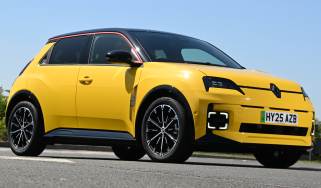
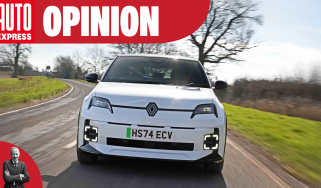
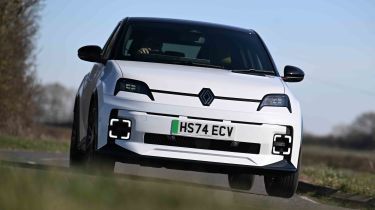
Much of this is driven by the success of the Renault 5. The retro supermini was the best-selling electric car last month both overall and in terms of sales purely to retail customers. It beat the Ford Puma Gen-E and Vauxhall Frontera Electric into second and third place.
Enquiry and sales data support growing EV trend
The proliferation of demand for EVs isn’t confined to Renault dealerships; analysis from Auto Express’ parent company, Carwow, found that UK enquiries for all new electric cars rose by 23 per cent in March.
This is supported by the fact that electric cars accounted for over a quarter (26 per cent) of new car registrations in April – a jump of 59 per cent month-on-month. With more than two million EVs now on UK roads, the Society of Motor Manufacturers and Traders expects that in 2027, as many as one in three (32 per cent) of all new cars sold will be fully electric.
“[The war] is fundamentally accelerating an underlying growing trend in demand for electric vehicles,” Wood explained. “We're at the tipping point as EVs go from the alternative choice to [the] mainstream.”
Yet while the number of consumers choosing an electric car is heading in the right direction, demand still lags behind what is required by the Government’s tough ZEV Mandate rules. So far this year, EVs account for just over one in five (23 per cent) of new cars sold, which is significantly behind the 33 per cent required, meaning many manufacturers will be forced to trade compliance credits with others or borrow from future years in order to skip fines.
True love or a forced marriage?
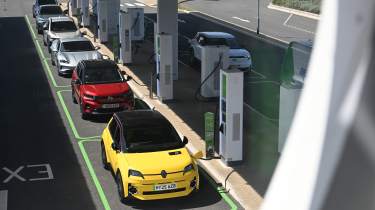
Philip Nothard, insight director at Cox Automotive, isn’t convinced that recent figures indicate a long-term shift in customer sentiment toward EVs: “April’s strong headline growth isn't necessarily indicative of a step‑change in demand,” he said. “While the market is recovering from policy‑driven disruption, year‑to‑date performance highlights a persistent mismatch between real‑world consumer uptake and the pace assumed by the ZEV Mandate.”
Aside from inflated fuel prices, perhaps the biggest recent driver of EV uptake has been the Government’s Electric Car Grant. Rolled out in August 2025, over 100,000 consumers have now benefited from up to £3,750 off the price of an EV. However, the persistently high cost of public charging and the introduction of the eVED pay-per-mile tax on EVs in 2028 could prove to be major barriers to more widespread electric car adoption.
EV headwinds could grow
For example, HMRC announced that it would challenge a recent court ruling that affirmed that chargepoints dispensing less than 1,000kWh of electricity per month to customers should only attract the domestic VAT rate of five per cent, as opposed to the 20 per cent typically demanded at public chargers.
“There's no doubt that the government's got a difficult balancing act,” Wood conceded. “Ultimately, we're seeing that incentives are having a positive impact on EV demand. I think anything which undermines that confidence or puts doubt into consumers' minds, it’s not necessarily what we need.”
Others were more vocal in their criticism of Government policy; Matt Adams, head of electrical transport systems at BEAMA (the British Electrotechnical and Allied Manufacturers' Association), said the introduction of eVED “risks undermining” the country’s progress when it comes to the EV transition.
“Introducing eVED in 2028 is simply too soon,” Adams said. “It comes before the 2030 deadline on the sale of new petrol-only and diesel-only cars. To keep up momentum around EV demand, we need to delay eVED until 2030. This will give manufacturers the confidence they need to keep building the charging infrastructure to keep cars moving.”
When it comes into effect in April 2028, the eVED system will charge electric car drivers three pence per mile travelled – the equivalent of £12.66 for a return trip from London to Manchester. This will be checked during a vehicle’s annual MOT exam and is designed to plug the financial gap created by lower revenue from fuel duty as fewer and fewer drivers fill up at petrol stations.
It all amounts to a complicated picture facing the electric car industry and its customers. High petrol and diesel prices, the Electric Car Grant, increasing choice and improved technology are among the factors fuelling demand but public charging costs and the looming eVED tax system could stunt EV growth if not handled well by the Government.
Get even more from Auto Express, follow our channels...
• Google
• Reddit
• Whatsapp