MINI Cooper Electric review
The MINI Cooper Electric maintains a premium feel while also being fun to drive

Our opinion on the MINI Cooper Electric
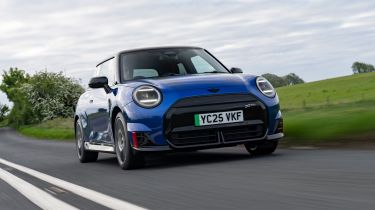
The MINI Cooper Electric is not cheap, but it does have that air of sophisticated fun that’s made the reborn brand such a success over the past two decades. Compact dimensions and a modest battery mean that this is not a car that will win prizes for practicality or even EV range – but it oozes quality and has just enough dynamic spark to feel like a MINI.
About the MINI Cooper Electric
MINI tries hard to maintain the links between its modern three-door Cooper and the original car from the sixties – probably harder than it ought to. But the latest reinvention is certainly a neat one.
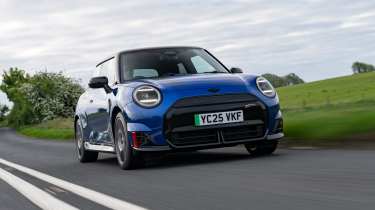
The overall effect of the styling revamp is quite angle dependent; from the front corner the car looks short and squat, as a MINI should. But the side profile reveals how much front overhang has had to be introduced, presumably in the name of crash protection and the myriad sensors, and how lengthy the wheelbase has become to accommodate the battery pack.
We’ve tested various versions of the Cooper Electric since it came out, including the MINI Cooper Paul Smith special edition. We’ve also included the MINI Cooper Electric in a twin test against the Peugeot E-208.
This review focuses on the electric model, so be sure to check out our dedicated MINI Cooper review if you’re looking for the combustion variant instead. If you prefer to drop your top, we also have an in-depth review of the MINI Cooper Convertible.
Performance & driving experience
Pros |
|
Cons |
|
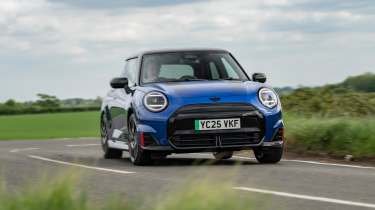
The question is, can the driving experience of this latest MINI Cooper Electric get even remotely close to the agility and fun offered by so many petrol-powered MINIs over the past couple of decades? The answer is yes, albeit with a few caveats.
Used - available now

2026 Mini
Cooper
17,095 milesAutomaticPetrol1.5L
Cash £18,564
2026 Mini
Cooper
14,620 milesAutomaticPetrol2.0L
Cash £20,490
2026 Mini
Cooper
22,385 milesAutomaticPetrol2.0L
Cash £20,118
2026 Mini
Cooper
4,913 milesAutomaticPetrol1.5L
Cash £22,790There are three powertrain outputs for the all-electric MINI Cooper, which essentially mirrors the way the petrol vehicles are arranged.
| Model | Power | 0-62mph | Top speed |
| Cooper E Classic 41kWh | 181bhp | 7.3 seconds | 99mph |
| Cooper SE Classic 54kWh | 215bhp | 6.7 seconds | 106mph |
| Cooper John Cooper Works 54kWh | 254bhp | 5.9 seconds | 124mph |
Electric motors, 0-60mph acceleration and top speed
The entry-level Cooper E has a single front-mounted motor producing 181bhp and 290Nm of torque, for a 0-62mph time of 7.3 seconds.
The Cooper SE sits in the middle of the range, which is still front-wheel drive, but bumps its single motor’s output up to 215bhp and 330Nm. This trims the 0-62mph sprint down to 6.7 seconds.
Once again, the John Cooper Works sticks with the single front-mounted motor, but here it produces a zestier 254bhp and 340Nm. This is still pretty modest by hot electric car standards, but it’s very in-keeping with the MINI’s intended ‘go-kart’ character.
While the John Cooper Works is the hottest of the bunch, the Cooper E and SE also have enough instant punch to overcome the car’s weight – nearly 1,700kg. This makes the regular Coopers feel nippy, if not hot-hatch quick. If you happen to be running in silent mode, without any of the sound effects activated, you’ll be pleased with the refinement, too.
Town driving, visibility and parking
MINI has nailed the Cooper’s controls, with the pedals providing plenty of feedback without feeling too heavy. This allows for easy, linear control when navigating stop-start traffic. However, while the steering is sharp to use, it’s a bit on the heavy side at slower speeds. This is also a firmly-sprung car, so although the damping prevents any crashiness, you’ll still literally feel every bump, no matter how small.
Country road driving and handling
Crucially, a three-door MINI has to handle if it’s to deliver the ‘go-kart feeling’ that’s so frequently quoted by the car’s engineers. It’s this — perhaps slightly cynical — essence of ‘the classic MINI’ that’s hardest to achieve in a car carrying more than double the weight of the original icon.
And yet the MINI Cooper Electric has enough agility about it to satisfy most customers. Approach a corner quickly, and the front end tucks in nicely; there’s excellent lateral grip and minimal body roll, so if you’ve enjoyed hugging the inside of a corner in your petrol-powered MINI over the years, you can do the same here. You’re never unaware of the mass involved – the laws of physics simply can’t be ignored – but equally, it’s hard to think of many EVs that are as happy to change direction as this.
We’ve tried the car on both dry and thoroughly shiny, drenched roads, and were pleased by how effectively the Cooper puts down its power. In the wet conditions, stamping on the throttle did induce a bit of understeer as the front wheels started spinning, but in the vast majority of scenarios, this is a vehicle that’s comfortable with its weight and performance – and that is not an easy balance to execute.
Motorway driving and long-distance comfort
Just like when it’s in town, the MINI once again feels very firm at motorway speeds. There’s a constant patter on even smooth surfaces, and we also noticed some porpoising along soaked motorways, a trait that could quickly become wearisome on longer journeys.
MINIs have never been the most soothing of creations, of course, but if you’re looking for an area where it’s clear that engineers have had to compromise to accommodate the weight of a large battery, it’s right here. Opting for the smallest possible wheels will help to mitigate this problem, if only slightly.
“Around town, the suspension sits on the wrong side of firm, which is a surprise given the MINI has typically excellent urban-friendly traits elsewhere.” - Alastair Crooks, senior news reporter.
Range, charging & running costs
Pros |
|
Cons |
|
The MINI Cooper Electric’s claimed battery ranges are fairly underwhelming by the latest standards, but they should still suffice for most typical supermini requirements. Despite its increased power output, the John Cooper Works can still cover up to 230 miles on the WLTP combined cycle. However, this is just that bit less than its French foe, the Alpine A290, as that manages 235 miles.
The Cooper SE shares the same 54.2kWh (49.2kWh usable) battery pack as the JCW, but here it officially manages up to 242 miles on a single charge. Once again, the French take the win here, though, as the Renault 5 is capable of up to 252 miles.
A smaller 40.7kWh (36.6kWh usable) battery is fitted to the Cooper E, and this slashes the predicted range down to 182 miles. That being said, this variant does at least manage to get close to its promised figure in the real world, as our own testing returned an average of 4.5 miles/kWh, which equates to 165 miles.
Every version of the MINI Cooper Electric gets a standard heat pump, which is always a welcome sight, because it’ll help deliver more predictable range when the weather turns cold.
The maximum charging speed is a decidedly average 75kW for the Cooper E and 95kW for the Cooper SE and JCW, but the modest battery size ensures that a meaningful refill for all variants from 10 to 80 per cent should still take around half an hour at a suitable rapid chargepoint.
Utilise a typical 7.4kW home wallbox charger, and it’ll take around six hours to fully recharge a Cooper E, and eight hours to do the same with the Cooper SE and JCW.
| Model | Battery size | Range | Insurance group |
| Cooper E Classic 41kWh | 40.7kWh (36.6kWh usable) | 186 miles | 20 |
| Cooper SE Classic 54kWh | 54.2kWh (49.2kWh usable) | 247 miles | 26 |
| Cooper John Cooper Works 54kWh | 54.2kWh (49.2kWh usable) | 230 miles | 26 |
Insurance groups
Following the arrival of the Paul Smith Edition, the MINI Cooper Electric now starts in insurance group 18 (out of 50) whereas it previously started in group 21. The line-up then climbs to group 26. The combustion-powered Cooper, meanwhile, sits between groups 20 and 27.
The Paul Smith Edition’s lower insurance group brings the Cooper Electric more in line with the Renault 5, which falls into groups 18 to 22.
Tax
The usual electric car tax savings apply with the MINI Cooper Electric, and its pricing structure means that even the John Cooper Works steers well clear of the £50,000 electric luxury car tax bracket.
Company car drivers also get the added benefit of the very lowest applicable Benefit-in-Kind (BiK) tax rates.
Our Car Tax Checker tool lets you check your tax status and renewal date in seconds. Check your VED car tax now...
Depreciation
Our market data indicates that after three years or 36,000 miles, the Cooper Electric will retain between 47 and 52 per cent of its value. This is actually a far stronger outcome than the petrol Cooper faces, because that only retains 34 to 38 per cent after the same period.
This means the standard electric Coopers fare similarly to the Renault 5, as this rival retains 44 to 46 per cent.
To get an accurate valuation on a specific model check out our free car valuation tool...
Interior, design & technology
Pros |
|
Cons |
|
There's little mistaking the MINI Cooper Electric for anything else on the road, except perhaps the petrol-powered MINI Cooper. As the smallest model in the current line-up, this model is the closest homage to the original Mini.
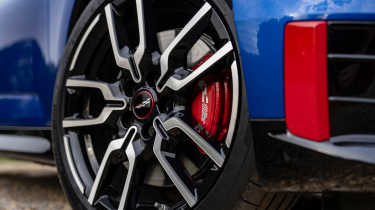
MINI’s long-standing relationship with the Paul Smith fashion brand has also been put to use in the Cooper Electric. The Paul Smith Edition comes with its own selection of three paint colours: Inspired White, Midnight Black or Statement Grey, as well as other cosmetic enhancements such as a colourful Signature Stripe, several roof colour options and unique 18-inch alloy wheels,
Interior and dashboard design
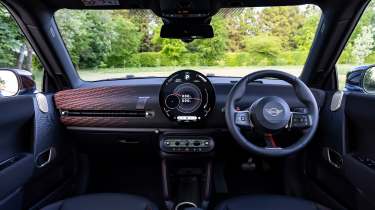
The Cooper Electric follows the usual MINI design of having a fairly simple dashboard layout that’s dominated by a round central screen. While the layout can take a little while to get used to if you’re new to driving a MINI, it’s pretty easy to get along with. That being said, SE models and above come with a head-up display to make life even easier.
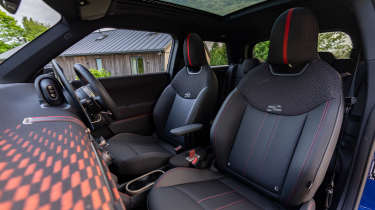
Those who opt for the Paul Smith Edition get further unique touches on the inside. These include two-tone blue leather seats — which our senior news reporter, Alastair Crooks, found particularly pleasant to both look at and sit in — as well as unique floor mats and a striped dashboard.
Materials and build quality
The good news is that the Cooper Electric feels every bit as premium as we’ve come to expect from modern MINIs. Admittedly, the base Classic trim, with its woven dashboard texture, is a little dark and dull to look at but it still does a good job of feeling nicely engineered. The more expensive trim levels brighten up this finish, while still retaining the quality feel.
There are soft-touch materials in many key areas, and even where there aren’t, the plastics and switches are high-grade and feel posh to the touch. This is absolutely a premium small car, just as the original modern MINI was – and feels how a premium vehicle should.
Infotainment, sat-nav and stereo
MINI’s infotainment system is a straight carry-over from the Countryman, and in general that’s a good thing. The circular OLED display in the centre of the dash measures more than nine inches in diameter; it’s crisp and clear, and judging by the speed with which it throws around graphics and zooms in and out of the map during navigation, it has a suitably grunty processor at its heart.
The interface itself can be a little fussy, and we’re less impressed that you have to prod the screen once before getting access to the temperature controls. The voice command system, complete with its personal assistant ‘Spike’, can help perform functions like this, but it takes an age compared with twiddling a physical knob left or right.
Most functions are easy enough to use once you get used to the sheer number of graphics, icons, and on-screen buttons. It also helps that the system quickly responds to your inputs.
“We’ve found MINI’s current OLED round touchscreen a point of contention, as it’s both a uniquely interesting screen design but a faff to use, with Apple CarPlay not being integrated very well and hard to use. Android Auto uses much more of the screen” - Alastair Crooks, senior news reporter.
Boot space & practicality
Pros |
|
Cons |
|
The MINI Cooper is the traditional three-door hatchback in the brand’s line-up, so it’s inevitably less practical than the larger MINI Aceman and MINI Countryman.
Certain details about the driving position remain familiar to anyone who’s driven the previous three-door hatch, such as the steeply raked windscreen that sits far forward of the driver, a low header rail, and thick A-pillars that can obstruct your view at roundabouts or when exiting junctions. The seats are wider for comfort, though, and the armrest is now mounted on the seat.
Dimensions and size
In keeping with its name, this MINI is shorter than both the Renault 5 and Peugeot E-208, and is just as wide as the latter. Mind you, it’s still more than 20cm longer overall than the Fiat 500e, so if your overriding priority is a tiny EV then the Italian car may be a better option.
| Dimensions comparison | |||
| Model | MINI Cooper Electric | Renault 5 | Peugeot E-208 |
| Length | 3,858mm | 3,922mm | 4,055mm |
| Width | 1,756mm | 1,774mm | 1,765mm |
| Height | 1,460mm | 1,498mm | 1,430mm |
| Wheelbase | 2,495mm | 2,540mm | 2,540mm |
| Boot space | 210 litres | 277 litres | 309 litres |
Seats & passenger space
The MINI Cooper Electric’s cabin is probably a bit closer to being a genuine four seater than you might expect; you can fit four adults in there. There’s quite a bit of pitch in the rear seats, admittedly, so your knees are higher and your backside lower than you’d like, but this in turn means that there’s enough headroom for six-footers.
Getting in and out is not a graceful activity, mind you – and we can see why MINI has made front passenger-seat Isofix points standard across the range, since it’d be a pain to extract a child from back seat berths.
Boot space
Luggage capacity has been a running joke for generations of MINI customers, and the latest Cooper isn’t going to rip up the rule book in that regard. The load bay measures 210 litres with the rear seats in place, which falls short of several electric superminis, including the Renault 5, Vauxhall Corsa Electric and Peugeot E-208.
Fold down the rear seats, and the MINI’s space expands to 800 litres; it’s a special type of car that can’t manage 1,000 litres in a two-seat layout, but this is one such vehicle. It’s odd, in fact, that MINI has decided to engineer a movable boot floor, since the gain is so marginal. A carry hook or two would have been a better addition.
Reliability & safety
Pros |
|
Cons |
|
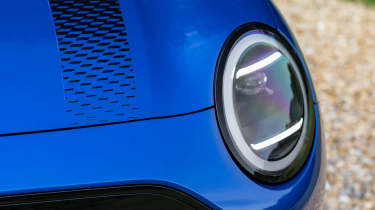
The MINI Cooper Electric underwent its own round of Euro NCAP safety testing in 2025, achieving the same five-star rating as its petrol-powered twin. Interestingly, the two cars differed in their individual category scores, with the EV performing better for both adult and child occupant safety — 89 and 87 per cent compared to 82 and 82 per cent.
This five-star rating is thanks in part to MINI including features such as automatic emergency braking, traffic-sign recognition, and lane-keeping assist as standard. Other optional features include MINI’s Park Assistant Plus, smartphone-based keyless entry, and a remote 360-degree monitoring system accessible through MINI’s app.
The current generation of MINI Cooper didn’t appear in the 2026 Driver Power owner satisfaction survey. However, the MINI brand wound up in an uninspiring 22nd place of 30 brands in the best manufacturer rankings. This was a very long way behind Renault’s sixth-place finish.
| Euro NCAP safety ratings | |
| Euro NCAP safety rating | 5 stars (2025) |
| Adult occupant protection | 89% |
| Child occupant protection | 87% |
| Vulnerable road user protection | 77% |
| Safety assist | 79% |
Buying, prices and deals
- Best buy: MINI Cooper SE Classic
In its most basic E Classic spec, the Cooper Electric will set you back at least £27,000. However, in order to benefit from the bigger battery without handing over too much extra cash, we’d opt for the SE model from £30,000. While this car foregoes some of the posher kit, it still comes with the more essential features such as a heat pump.
There are three powertrain setups to choose from, along with a multitude of trim levels (or ‘Styles’ as MINI calls them). The MINI Cooper Electric starts from roughly £2,000 more than the combustion model, and at the top of the line-up you’ll find the hottest and priciest John Cooper Works Electric. This comes in just the one configuration, and costs at least £34,900.
You can save on the list price by building your new MINI Cooper Electric with the Auto Express Buy A Car service. We also have a selection of Cooper Electric leasing deals to choose from.
MINI Cooper Electric alternatives
The retro electric supermini is continuing to gather pace, and the Renault 5 and Fiat Grande Panda are two front runners. Both of these cars offer plenty of charm, but we’d argue that the MINI is a more premium proposition.
Another continental rival is the Peugeot E-208, but this does give the Cooper a run for its money in the upmarket stakes. If you want to save those precious pennies, though, the Citroen e-C3 forgoes the fanciness in favour of a very competitive price.
MINI Cooper Electric pictures
Key updates of the MINI Cooper Electric review
18 August 2026: Details about Paul Smith Edition.
20 May 2026: Latest driving impressions and line-up details.
Frequently Asked Questions
While the three-year duration of the MINI’s manufacturer’s warranty is nothing special, the unlimited mileage part is at least a step on from some cars in this class. It can’t match the seven-year warranty offered by MG, though.
The battery pack has a separate eight-year or 100,000-mile warranty, which guarantees that its capacity won’t drop below 70 per cent state of charge during the warranty period. If it does, the pack will be replaced.
Deals on the Cooper and alternatives
More reviews
Which Is Best